
For years, a buyer almost anywhere in the US could open a single app or website and see nearly every home for sale nearby. That near-complete picture exists because competing brokerages agreed to share their listings through their local multiple listing service (MLS). Most buyers never think about it. They just expect it.
T3 Sixty’s 2026 Swanepoel Trends Report, released in November 2025, argues that this expectation is under pressure. The report points to three forces: brokerages growing through consolidation, technology that makes it easier to market a home outside the MLS, and a growing appetite among brokerages, including the largest ones, for inventory nobody else has. If all three keep pulling the same way, the report warns, that shared marketplace could fracture.
Below we go through the report’s argument and where it applies, then share what we think it means for anyone who markets listings.
Key takeaways
- T3 Sixty sees three forces behind the trend: consolidation, tools for marketing homes off the MLS, and brokerages’ push for exclusive inventory.
- The bigger a brokerage’s share of listings, the more an exclusive strategy is worth to it, and the more reason competitors have to hold back their own listings.
- Off-MLS sales tend to be more common when demand is high and inventory is tight, in some urban and luxury markets, and where private investors are active.
- In many markets even large brokerages hold too few listings for this to pay off. Where the largest firms hold 30% or more, the report says an exclusive strategy can change how the local market competes.
- Our view: when a listing is split across more channels, its photos have to do more of the selling, and AI virtual staging is the quickest way to make empty rooms look finished.
How an Exclusive Listing Strategy Takes Hold

The report’s starting point is that exclusive inventory gets more valuable as a brokerage gets bigger. A firm with a small slice of a market’s listings gains little by keeping them in-house. A firm that holds a large share can give its agents more homes to show and information rivals don’t have, which is a real edge when a buyer is choosing whom to work with.
That edge turns into a recruiting pitch. Agents at smaller shops who keep hearing about homes they can’t access start to wonder whether they belong at the bigger firm. Buyers wonder the same thing. According to T3 Sixty, this is how an exclusive strategy helps a brokerage attract agents and keep them longer.
The Reverse Network Effect
The MLS works because every new listing makes it a little more useful to everyone. The report describes the same logic running backward. Once one brokerage holds enough listings to offer something unique, its competitors have a reason to hold theirs back too. Every firm that does so leaves the shared pool thinner. The MLS doesn’t disappear, but it becomes a much weaker source for anyone who wants to see the whole market.
Where Off-MLS Sales Already Happen
Timing matters. Per the report, keeping listings off the MLS tends to spread when buyer demand is high and inventory is tight. In that kind of market, buyers and their agents are willing to hunt for homes beyond the ones everybody can already see online.
Location matters too. The report points to competitive urban markets such as Manhattan, San Francisco and Washington, DC, and to luxury markets like Palo Alto and Los Altos in Silicon Valley, Boca Grande in Florida and the Hamptons on Long Island. In places like these, a brokerage with deep inventory really can show buyers homes they won’t find anywhere else.
The third factor is who is buying. Markets with a lot of private investors see more off-MLS sales, because those deals involve a small pool of professional buyers with clear criteria. When an agent already knows what those buyers want, a public listing is often not the first step.
Why Exclusive Listings Don’t Pay Off Everywhere

None of this happens on its own. An exclusive strategy only works if a brokerage controls enough inventory to make its private pool worth joining, and in many MLS markets no single firm does.
California Regional MLS (CRMLS) shows why. It is the second-largest MLS in the country, with nearly 100,000 subscribers. Of its 2024 listings, 46% came from brokerages with fewer than 100 agents. Its three brokerages with more than 3,000 agents apiece supplied just 11% between them. With numbers like that, even a very large firm has too few homes to build a private marketplace that buyers would pick over the MLS. The report does add that shares vary a lot between local markets inside the CRMLS footprint.
The picture changes where the largest brokerages hold 30% or more of the listings. There, the report says, a firm has real market power and a chance to use exclusives to change how the whole local market competes. San Francisco is the example it gives: in 2024, Compass represented sellers on 34% of the homes sold in the county. At that level, keeping listings in-house stops being a niche tactic and becomes something every competitor has to answer.
So the trend is real, but uneven. For most agents, the useful thing to watch is how much of their local inventory sits with one or two dominant firms, and how fast that share is growing.
Our Take: Fewer Eyes per Listing, More Weight on the Photos

Some of this is already visible. In January 2026, Compass closed its purchase of Anywhere Real Estate, the company behind Coldwell Banker, Century 21, Corcoran and Sotheby’s International Realty. Compass encourages sellers to launch in three phases: Private Exclusive first, then Coming Soon, and only then the MLS. NAR’s “delayed marketing” option, added in March 2025, lets a seller keep a listing off public websites for a period set by the local MLS, as long as it stays visible to agents inside the MLS. And in March 2026, Zillow announced Zillow Preview, a pre-market stage where participating brokerages can show homes publicly before they go active.
Put that together and a single house can now have several launches: a private network, a pre-market or coming-soon window, and finally the MLS and every site it feeds. Each stage reaches a different and usually smaller audience. A buyer who scrolls past the home in one channel may not stop for it in the next.
We think that raises the stakes on presentation. When a listing gets fewer chances to be seen, each one has to count, and in every channel the first thing a buyer judges is the photos. In NAR’s 2025 Home Buyers and Sellers Generational Trends report, 83% of buyers who used the internet in their search rated photos “very useful,” ahead of every other website feature, including detailed property information (79%) and floor plans (57%).
Empty rooms are where a lot of listings lose that moment. A vacant living room photographs as a box with a window. Buyers can’t tell whether a sectional fits or where the dining table goes, and it’s hard to fall for a room you can’t read. That’s why agents stage. In NAR’s 2025 Profile of Home Staging, 83% of buyers’ agents said staging made it easier for buyers to picture the property as their future home, and the rooms staged most often were the living room (91%), the primary bedroom (83%) and the dining room (69%).
Why AI Virtual Staging Fits a Split Market
Physical staging costs real money and takes days to schedule. It also only helps the photos if the furniture is in place before the shoot. A large brokerage can build that into its launch process. A solo agent with a vacant condo usually can’t, and that gap matters more when big firms control more of the inventory.
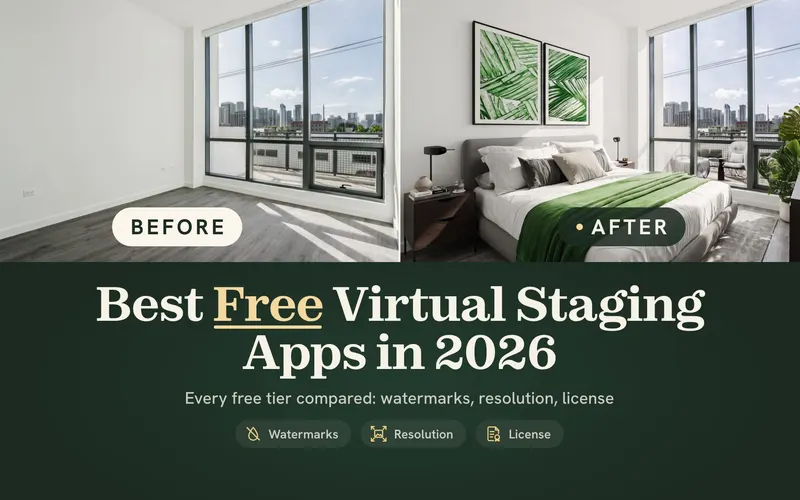
AI virtual staging closes most of it. (We cover how it developed and where it still falls short in our look at the pros and cons of AI virtual staging.) With TINTY, you upload a photo of an empty room, pick the room type and a style, and get furnished previews in about 30 seconds. It handles living rooms, bedrooms, dining rooms, living–dining spaces, studios, home offices, kids’ rooms, nurseries and terraces. Styles include Contemporary, Transitional, Scandinavian, Modern, Japandi / Organic and Minimalist, and you can add an accent color such as sand, green or navy, so a downtown studio and a suburban family room don’t come out looking like the same catalog page. You keep the preview you like and render the finished photo. The day the photographer delivers, the empty bedrooms and living areas in the listing can already look furnished.
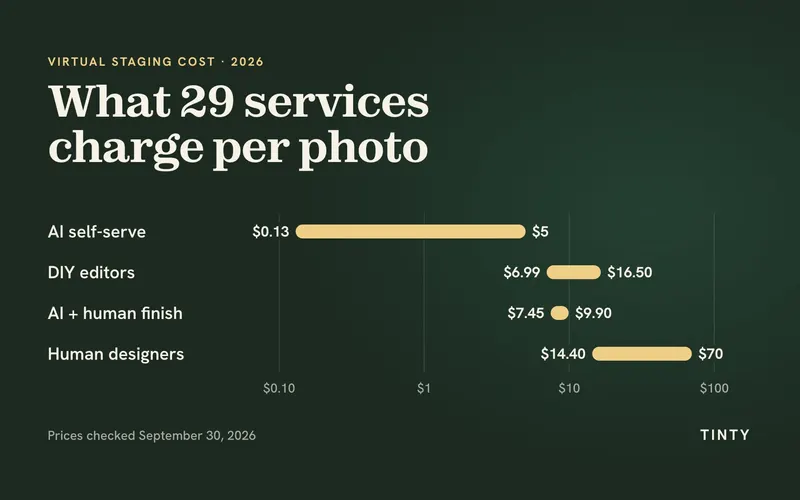
Previews are free and don’t require a credit card. A free account includes 20 previews a month and 3 finished photos with a TINTY watermark to try it. Paid plans start at $9 a month, and a $29 one-time listing pack gives you 10 finished photos for a single property, valid for 12 months.
Whatever tool you use, disclose it. Check your MLS rules. In California, AB 723 has required since January 1, 2026 that a digitally altered listing image carry a clear statement on or next to it, along with access to the original, unaltered photo. TINTY can add a “Virtually staged” label to the finished image when you download it, which covers the on-image part. In California you still need to post or link the original.
Where This Is Heading
Here is our bet. As listings move through more channels, agents will need finished-looking photos faster and for every stage of a launch. In our view, manual virtual staging, where a designer places every sofa and lamp in each photo by hand, is too slow and too costly to do for every vacant room of an ordinary listing. We think furnishing empty rooms for listing photos will soon be done almost entirely by AI, and hand-built virtual staging will become a niche service. Physical staging will keep a place in some homes that buyers walk through in person, but the photo work is moving to software.
If you have a vacant listing going live soon, run one empty room through TINTY first. The previews are free, so it costs you a couple of minutes.
The first two sections summarize the outlook in T3 Sixty’s 2026 Swanepoel Trends Report, released in November 2025. The last section adds later developments and our own view as the team behind TINTY.
Sources
- Trends 2026: The uncertain future of real estate’s open marketplace (excerpt from T3 Sixty’s 2026 Swanepoel Trends Report), Real Estate News
- 2026 Swanepoel Trends Report Maps Disruptive Shift, T3 Sixty
Show 10 more sourcesShow fewer sources
- Nation’s second-largest MLS expands access to AI property intelligence platform, Inman
- The Hamptons, Britannica
- Compass completes its acquisition of Anywhere Real Estate, Real Estate News
- Anywhere Real Estate, Wikipedia
- Compass drops lawsuit after Zillow embraces pre-marketing, Real Estate News
- Multiple Listing Options for Sellers, National Association of REALTORS®
- Zillow launches Zillow Preview to bring pre-market home listings into the open, Zillow
- 2025 Home Buyers and Sellers Generational Trends Report (Exhibit 3-6), National Association of REALTORS®
- Profile of Home Staging (2025), National Association of REALTORS®
- AB-723 Real estate: digitally altered images: disclosure, California Legislative Information