
How do you sell a stale listing? Find where buyers drop off, then fix what they see before you touch the price. That means a new lead photo, staged empty rooms, easier showings and a relaunch inside your multiple listing service (MLS) rules. If the data still points to price, make one meaningful cut. A string of small cuts can backfire.
Market figures checked October 2, 2026.
We make TINTY, an AI virtual staging app, so weigh our staging advice with that in mind. This guide is for US listing agents. Every figure names its source, and the full list is under Sources. We label our own math and opinions.
The timing matters. In September 2026, 20.8% of listings on Realtor.com took a price cut, the highest September share since 2018. Below is how to sell a stale listing without leading with another reduction.
Key takeaways
- Stale is local: a listing is stale when it sits clearly longer than similar homes nearby. Published cut-offs run from 30 days to six months.
- Diagnose first: few views, views without showings and showings without offers each need a different fix.
- Refresh before you reduce: to revive a stale listing, fix photos, staging and access first, then relaunch.
- Cut once: the evidence leans toward one meaningful reduction over several small ones.
- Label staged photos: mark every virtually staged image and keep the original.
On this page: What is a stale listing? · Why listings go stale · Diagnose first · Fix the presentation · Access and exposure · Relaunch · Price reduction script · 30-day plan · If it still doesn’t sell · FAQ · Our research
What is a stale listing?
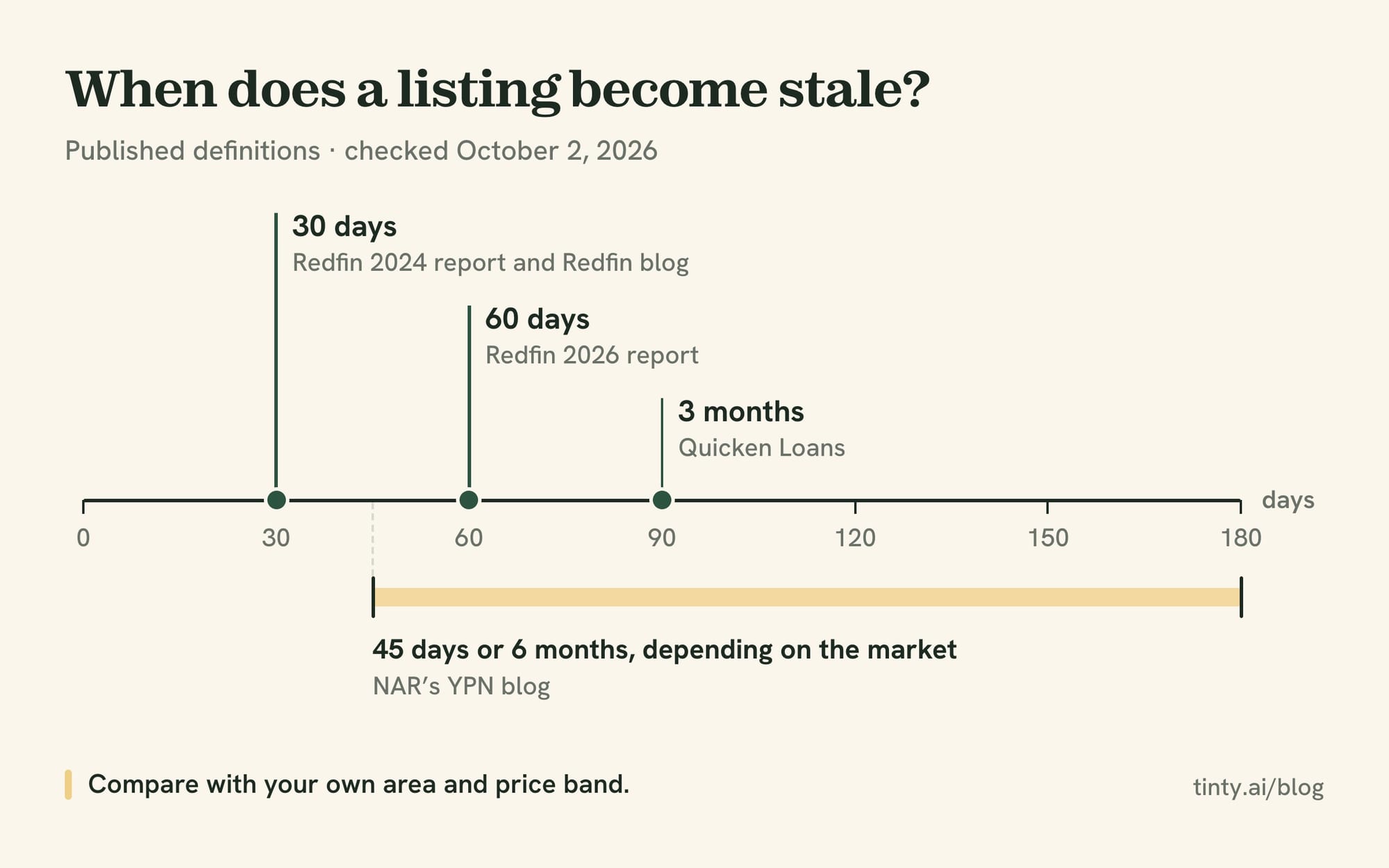
A stale listing is a home that has been for sale clearly longer than similar homes nearby and has stopped drawing new showings or offers. The stale listing meaning is simple. The number of days isn’t: there’s no official cut-off, and published ones run from 30 days to six months.
What is considered a stale listing depends on who you ask. Published definitions don’t agree:
- 30 days or more: Redfin’s data team in a 2024 stale-inventory report, and a 2025 Redfin blog post.
- 60 days or more: Redfin’s data team in its February 2026 stale-inventory report.
- Three months or longer: the Quicken Loans guide for agents.
- 45 days or six months: the Young Professionals Network (YPN) blog of the National Association of Realtors (NAR) in 2023, depending on the market.
So when does a listing become stale? Our test (an opinion): compare the home with its own area and price band, not with a national number.
The YPN article suggests three local checks. Are homes in this neighborhood selling slower or faster than the city average? How many nearby listings dropped their price? How many expired and came back quickly?
How common stale listings are in 2026
More than half of listings were stale by Redfin’s count early this year. In February 2026, 52.2% of listings had sat 60 days or more without a contract, the highest February share since 2019. Redfin valued those stale home listings at $347 billion.
The fall numbers point the same way:
- Price cuts, Realtor.com: 20.8% of active listings had a cut in September, per its September 2026 housing report.
- Price cuts, Redfin: 21.1% of sellers cut their price in the four weeks to September 20, according to the Redfin price-drop report.
- Time on market: a median 61 days for listings on Realtor.com in September. NAR’s August sales release shows 31 days, but that counts homes that sold.
- Demand: pending sales on Realtor.com fell 4.1% from a year earlier, and mortgage rates reached 7.03% on September 24.
Watch out: these numbers measure different things. Realtor.com counts listings cut during the month, and Redfin counts sellers who cut in a four-week window. Name the publisher whenever you quote a figure to a seller.
Why listings go stale, and what waiting costs
Overpricing comes first in Redfin’s list of common causes, but price is rarely the only problem. In our view, a listing stalls for one or more of six reasons:
- Price: set above what comparable sales support.
- Presentation: dark photos, empty rooms or a weak first image.
- Access: showing rules that make buyers’ agents skip the home.
- Marketing: one launch push, then silence.
- Condition: small defects that every visitor names.
- Market: higher rates and more homes to choose from.
On price, a Redfin analysis from March 2026 estimates the damage. Overpricing by 10% or more can add more than a month to a home’s time on market.
What waiting costs: the monthly carry and the signal
Waiting costs the seller twice. First comes the monthly carry: mortgage, taxes, insurance, utilities and any association dues. Add it up now, because you’ll need the number in the price talk.
The second cost is the signal. Economist Curtis Taylor’s 1999 paper on time on the market set out the theory. Buyers judge a home’s quality by how long it has been for sale. Redfin’s September report tells buyers to consider offering below asking on homes that have sat for more than a month.
Example: Redfin’s March analysis estimates that a home listed at $600,000 and cut to $500,000 sells for $475,000 to $490,000. That’s 2% to 5% less than an identical home listed at $500,000 from the start, a gap Redfin blames on price-cut stigma. It’s an economists’ estimate from a piece promoting Redfin’s pre-listing marketing, not a study.
Repeated cuts deepen the problem. A 2023 study of recurrent price reductions found that they lower the likelihood of a sale. The abstract doesn’t name the market it covers.
Diagnose first: find where the listing loses buyers
Different symptoms need different fixes, so diagnose before you spend. A listing with no online views has a different problem from one with ten showings and no offer.
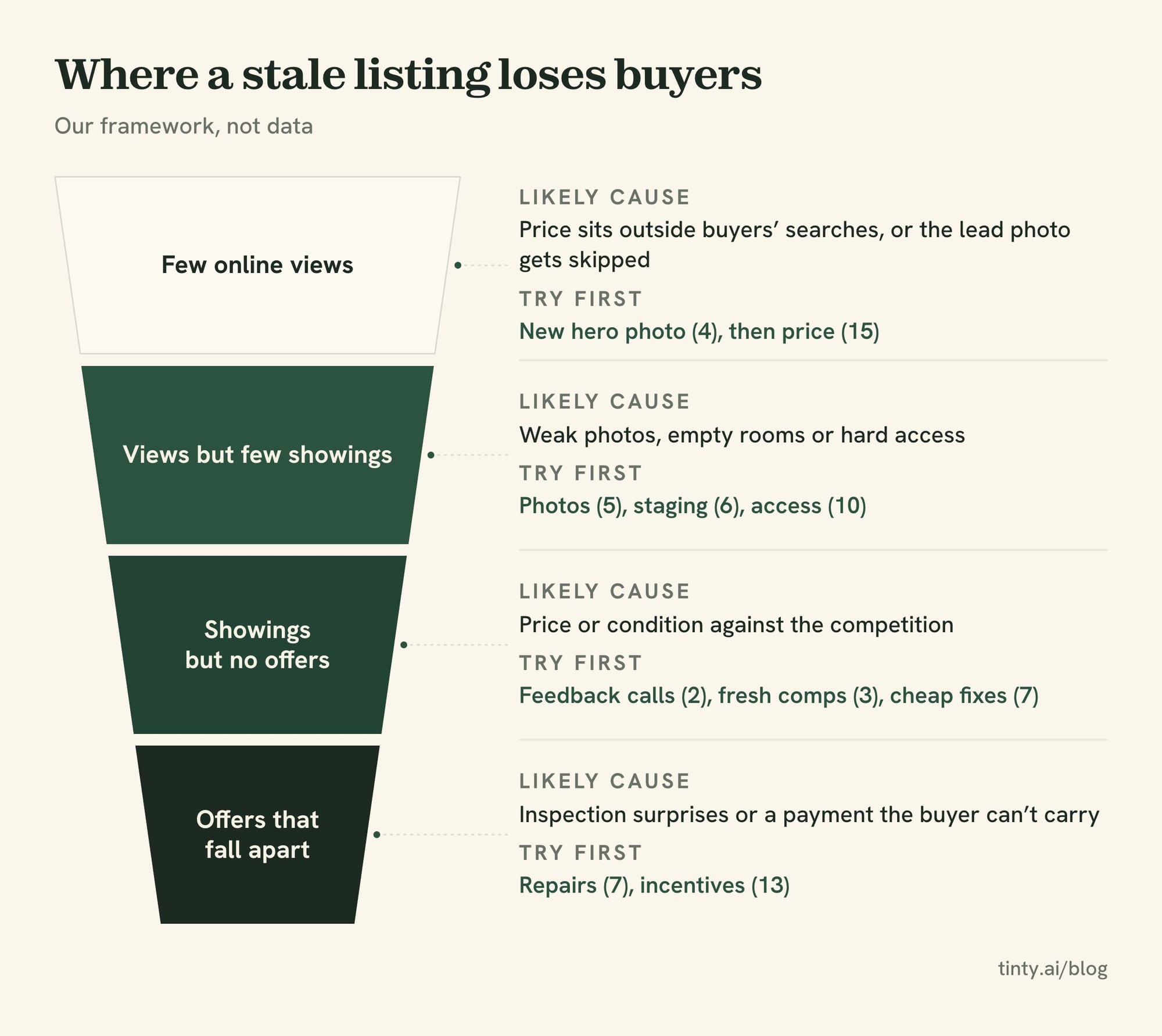
Start with the table, then ways 1 to 3, or skip to the 30-day relaunch plan for the full order. The numbers in parentheses are the ways below.
Where a stale listing loses buyers, and what to try first (our framework, not data)
| Symptom | Likely cause | Try first |
|---|---|---|
| Few online views | Price sits outside buyers’ searches, or the lead photo gets skipped | New hero photo (4), then price (15) |
| Views but few showings | Weak photos, empty rooms or hard access | Photos (5), staging (6), access (10) |
| Showings but no offers | Price or condition against the competition | Feedback calls (2), fresh comps (3), cheap fixes (7) |
| Offers that fall apart | Inspection surprises or a payment the buyer can’t carry | Repairs (7), incentives (13) |
1. Read the funnel before you change anything
Start with numbers you already have: online views, saves, showing requests and offers, week by week since launch. Your MLS, the portals and your showing service report them. The step where the count collapses tells you what to fix.
Coach Darryl Davis calls the next step an exposure audit in his HousingWire column on stalled listings. You log every open house, broker tour, ad, social post, email and mailer. Then you compare time on market and price changes on similar active and sold homes.
His point: a listing that feels stalled may be normal against today’s benchmarks. Check before you alarm the seller.
Example: in a 2025 r/realtors thread about 60 days without showings, an agent described great photos and a $40,000 price cut two weeks earlier. The listing still had zero showing requests. One post isn’t data, but it shows a cut alone doesn’t always restart interest.
2. Call every agent who showed the home
YPN calls feedback free data, and in our view a phone call gets more of it than a form. Ask three questions:
- How did the home compare with the others your buyer saw that day?
- What did the buyer mention first after the showing?
- At what price would your buyer have written an offer?
Share the good and the bad with the seller. With few showings to draw on, YPN suggests asking three to five trusted agents, your broker and a mentor to walk the home.
3. Re-run the CMA and walk the competition
A fresh comparative market analysis (CMA) shows whether the market moved since launch. Add to the new one: homes listed since yours went live, nearby reductions and new construction.
Builders are competing hard. In September 2026, 38% of them cut prices and 66% used sales incentives, per the National Association of Home Builders (NAHB) builder survey.
Then walk the two or three closest competing listings with the seller. In our view, seeing the alternatives in person does more than any chart.
How to revive a stale listing: fix the presentation
Presentation is the lever you can pull this week without the seller taking a dollar off the price. Start with photos, because buyers’ agents rank them first.
In NAR’s 2025 Profile of Home Staging, 73% of buyers’ agents rated photos highly important to clients. Physical staging got 57%.
4. Swap the hero photo
The lead photo is what buyers see in search results, so change it first. We think a buyer who has scrolled past the same image for weeks has stopped seeing it.
Swaps to try:
- Best interior: the brightest living room shot instead of the front of the house.
- Fresh exterior: YPN’s example is a home listed in August that needs a new exterior shot by October, because the season changed.
- Twilight shot: a Texas agent in NAR’s March 2026 relisting tips often swaps the first image between daytime and twilight photos.
- Staged room: a furnished version of an empty living room, with a label.
We found no independent data on what a new first photo does to views. Treat it as a cheap test.
5. Re-shoot or re-edit, then reorder the gallery
Re-shoot if the originals are dark or the home looks different now. Re-edit if the photos are sound but flat, since brightness and color fixes are cheap.
Then reorder the gallery so the rooms buyers care about come first. NAR’s survey names them: the living room leads at 37%, then the primary bedroom at 34% and the kitchen at 23%.
Took the listing over from another agent? You need a license from the photos’ owner before you reuse the earlier shots. NAR’s page on who owns your property photos explains the agreements.
6. Stage the empty rooms, physically or virtually
In our view, empty rooms are the hardest to sell from a photo, so stage them before the relaunch. Knight’s 2002 paper on list-price changes found vacant homes among those most likely to have list-price changes.
NAR’s 2025 staging survey gives the agents’ side:
- Picturing the home: 83% of buyers’ agents said staging made it easier for buyers.
- Time on market: 49% of sellers’ agents said staging reduced it.
- Offers: 29% of agents said staging raised the dollar value offered by 1% to 10%.
- Cost: a median $1,500 with a staging service.
These are agent opinions, from 1,266 Realtors, not sales data.
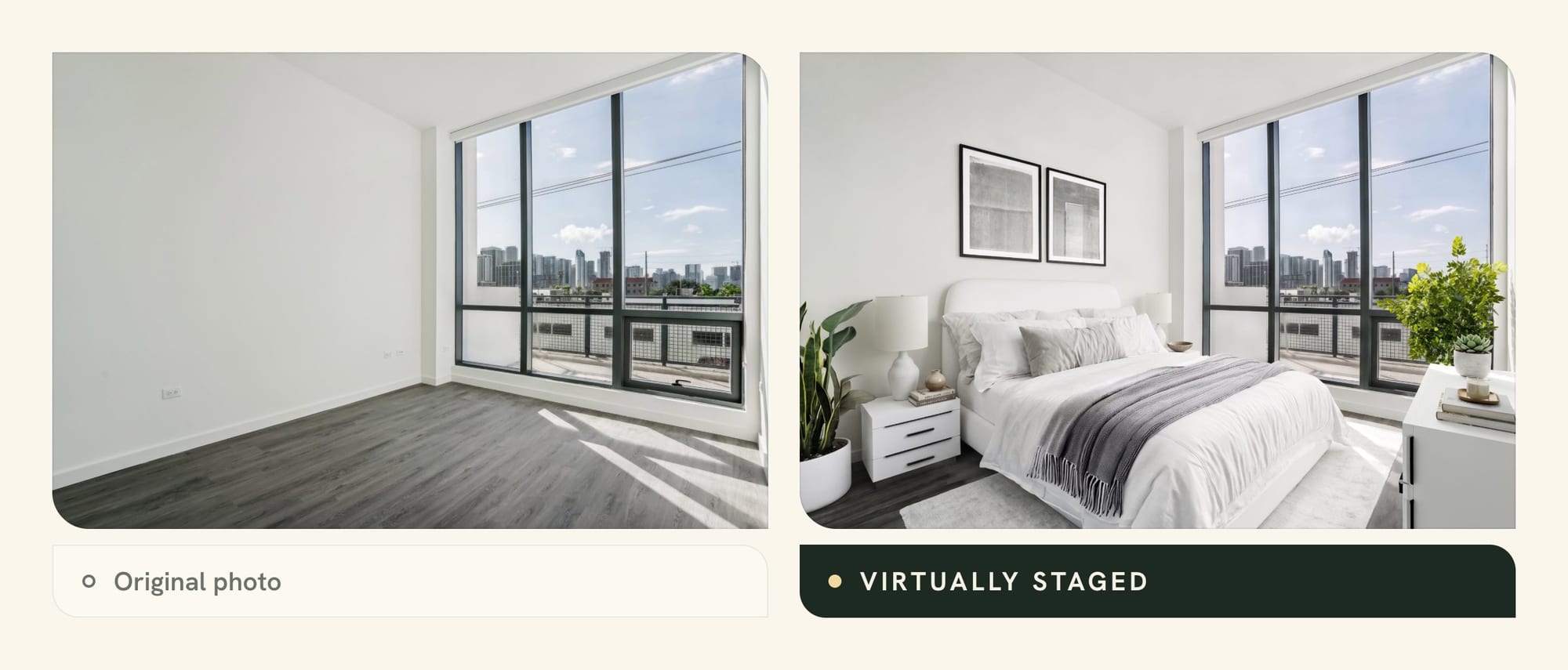
Virtual staging adds furniture to a photo of an empty room. Our primer covers what virtual staging is.
No independent study measures what it does to days on market. In NAR’s survey, sellers’ agents were cooler on it: 34% called virtual staging less important to clients and 24% equally important. By contrast, 43% rated physical staging as more important.
Rule: label every virtually staged photo and keep the original. California’s AB 723 has required a statement on or next to each altered image, plus a link to the original, since January 1, 2026. MLS rules differ: CRMLS in California wants the label in the photo’s text field, and Arizona’s ARMLS requires its own watermark.
Our guide to virtual staging laws and MLS label rules has the details. Vacant listing? See our guide to selling a vacant house.
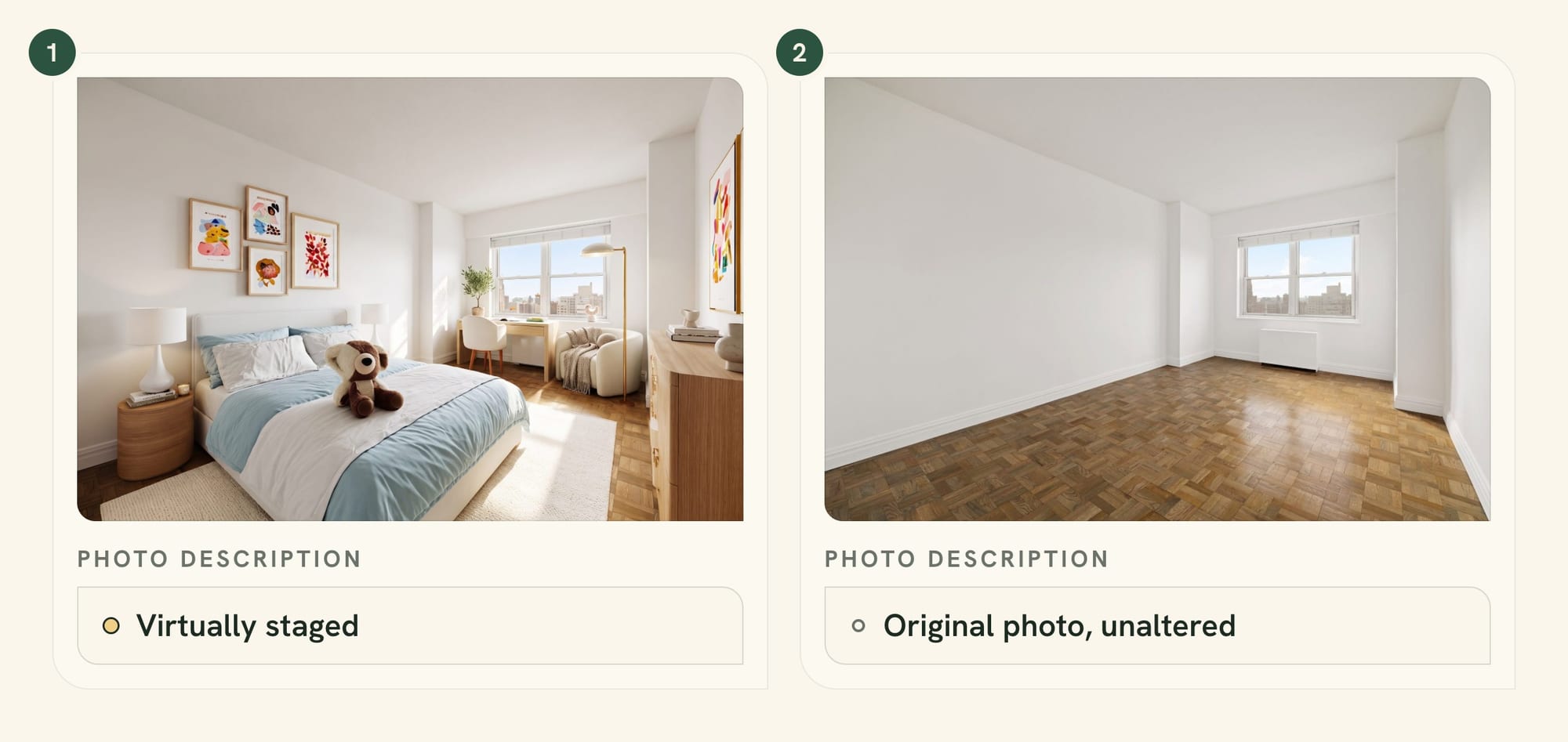
Where TINTY fits in a photo refresh, and where it doesn’t
TINTY stages empty rooms, so it covers part of this step. What it does and what it doesn’t:
- Free previews: test layouts at no cost and show the seller a furnished room before anyone pays.
- Clean photos: from $9 a month for 4 finished photos, or a one-time pack of 10 for $29. Our virtual staging cost guide compares 29 services.
- Limits: no kitchens, bathrooms or exteriors, no twilight edits, no decluttering or furniture removal.
Free finished photos carry a watermark. Our terms allow watermarked images for review and sharing, and the watermark has to stay on. We read that as: not for the MLS. We compare the alternatives in our guide to the best free virtual staging apps.
No time to stage the photos yourself? TINTY Studio does it for you. Email the empty-room photos to hello@tinty.ai with the style you want and what each room is for (a floor plan helps). Our team stages them with TINTY’s AI tools and finishes every photo by hand.
The finished photos arrive on a private link within 2 to 24 hours, at $10 a photo, from 3 photos. There’s no prepayment: you pay only if you’re happy with the result.
Example: staging three photos with TINTY Studio costs $30, and a 2% cut on Realtor.com’s $419,250 median list price is $8,385 (our math). Staging doesn’t replace a price cut the data calls for.
We’d do this before the next price cut: refresh the hero photo and stage the empty rooms with TINTY, starting with free previews.
7. Fix the cheap objections buyers keep naming
If three agents mention the same flaw, fix it before you discuss price. NAR’s survey lists what agents tell sellers most often: declutter (91%), clean the whole home (88%) and improve curb appeal (77%).
These jobs happen in the house, not in a photo editor. Re-shoot the affected rooms once they’re done.
Did an offer die at inspection? NAR’s March 2026 relisting tips suggest a pre-listing inspection, so the seller can make repairs before the next buyer finds the problems. Check your state’s disclosure rules first.
8. Add a floor plan and a short video
A floor plan answers the layout question that photos can’t. YPN recommends adding floor plans and video tours to a stalled listing.
Buyers’ agents back the video part. In NAR’s survey, 48% rated videos highly important to clients, and 43% said the same of virtual tours. We think a short phone walkthrough is enough to start.
9. Rewrite the remarks around what buyers liked
Start from the feedback you collected in way 2. YPN’s advice is to play up the features that drew positive comments.
A sponsored Realtor.com piece on Real Estate News adds practical steps. Open with a one-sentence hook. Call out recent upgrades and anything the seller offers buyers. Then trim the length.
AI can draft it. Among agents who use AI, 75% use it for listing descriptions, per NAR’s 2026 tech survey article. Check every claim against the home before it goes live.
How to market a stale listing: access and exposure
A refreshed listing needs new eyes. Once the presentation is fixed, widen who can get into the home and who hears about it.
10. Make the home easier to show
We think every extra step between a buyer’s agent and the front door costs you showings. We found no data tying showing rules to days on market.
The ShowingTime help center describes two of its appointment types. With Auto Confirm, or “Go and Show”, requests are documented and confirmed at once. It’s typical for vacant homes on a lockbox. With Appointment Required, a listing contact must be notified first.
Our suggestion: move a vacant listing to Go and Show. For an occupied home, ask the seller for wider time windows and shorter notice.
11. Work the phones and hold a broker open
Buyers’ agents can’t sell a change they haven’t heard about, so tell them yourself. Start with everyone who toured the home, then call colleagues with buyers in this price band.
Add a broker open or office tour, so agents see the refreshed rooms in person. Log each call and event. It feeds the audit you’ll show the seller in way 15.
12. Get other agents to post video (a Reddit tactic)
What do agents on Reddit say works? In the most discussed stale listing Reddit thread we found, the answer was to borrow other agents’ audiences.
In that r/realtors thread from October 2025, an agent described a listing that was priced right, staged and photographed, yet got little traction. The fix was a broker’s open with a twist. The agent hired one videographer, then invited other agents to film their own short videos for free, each with a prepared script.
The agent reported about ten extra videos on other agents’ social accounts and a few showings that week. It’s one agent’s self-report.
13. Offer an incentive before a cut
An incentive can move a buyer’s monthly payment more than the same money taken off the price. Sellers gave concessions in 44.7% of home sales in the three months to August 31. The figure comes from deals Redfin’s own agents reported, in the Redfin concessions report.
Our math on a $400,000 loan at 7.0% (30-year fixed, principal and interest only):
- No incentive: $2,661 a month.
- 2-1 rate buydown: the seller pays about $9,300 up front to cut the rate to 5.0% in year one and 6.0% in year two. That’s $2,147, then $2,398 a month.
- Same $9,300 as a price cut: about $50 a month less, with 20% down.
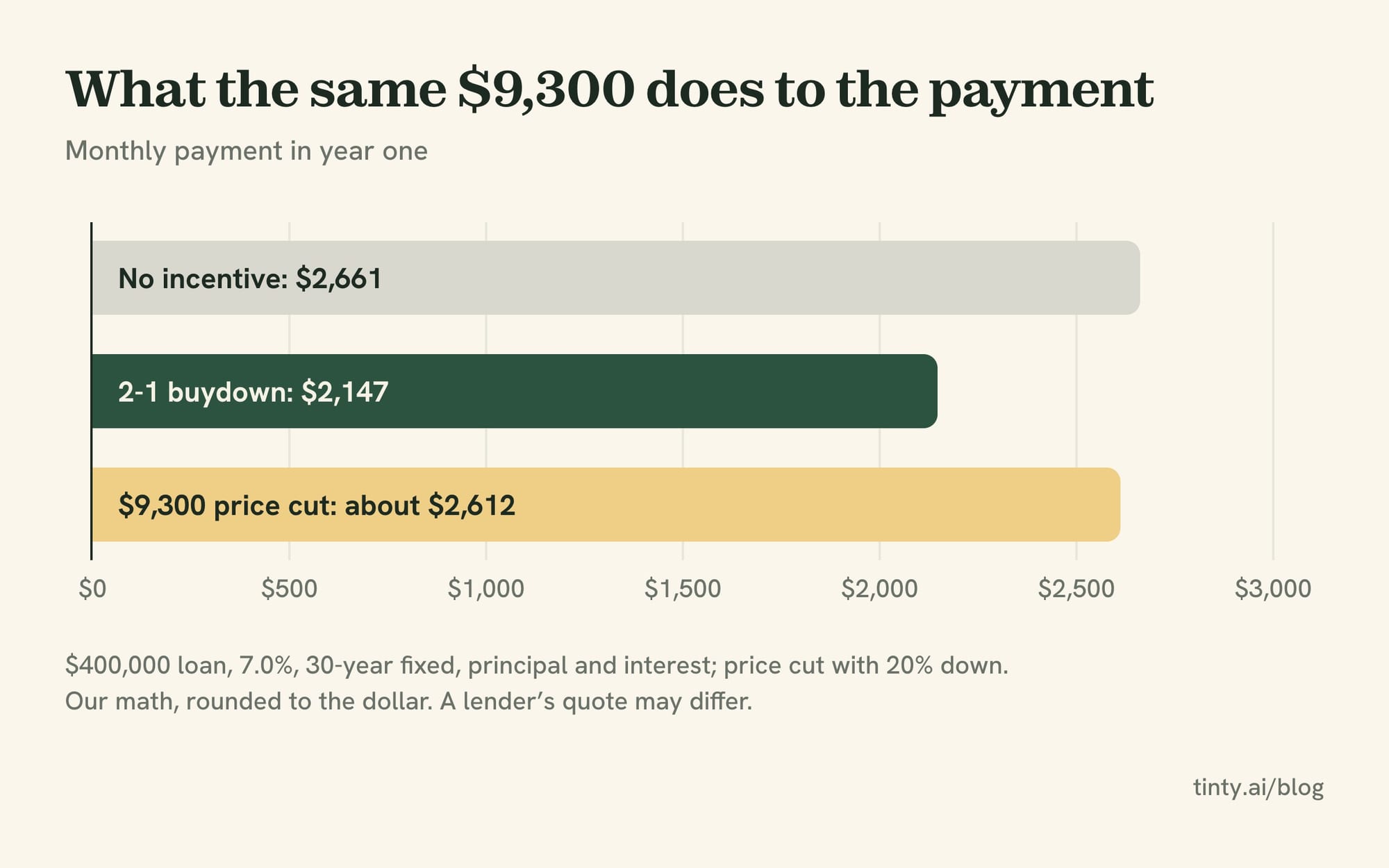
So the buydown saves the buyer about $514 a month in year one. The price cut saves $50, but it lasts, and it lowers the down payment and taxes too. If the buyer can’t qualify, ask a lender about a permanent buydown instead.
Watch out: a 2-1 buydown ends after two years and doesn’t help a buyer qualify. Under Fannie Mae’s buydown rule, lenders qualify the borrower at the full note rate. Loan programs also cap seller contributions, so run both options with a lender first.
How to refresh a stale listing and relaunch it
Relaunch only after something real has changed, and do it all on one day. A new photo here and a new sentence there won’t read as news. A refresh doesn’t reset the days-on-market count, so your own outreach has to carry it.
To refresh a real estate listing in one push:
- Finish the photo, staging and repair work first.
- Update photos, remarks and showing instructions together.
- Tell agents what changed, in one line: new photos, staged rooms, easier showings.
- Announce it to your list and on social the same day.
14. Relaunch as refreshed, inside your MLS’s rules
Check your MLS’s rules before you cancel and relist, because the days-on-market reset differs by MLS. Some sellers will ask for it anyway.
CRMLS, for example, resets its cumulative count after more than 30 days off the MLS, per a notice from a CRMLS member association. Other MLSs wait longer, and REcolorado doesn’t allow a reset at all.
Rule: REcolorado’s Days in MLS policy page says: “Expiring a listing to reset Days in MLS is against MLS Policy.” NAR’s Code of Ethics also requires Realtors to give a true picture in marketing. Our reading: don’t call a relist new in a way that misleads.
The safer route is a real change. Give buyers something new to see when the listing comes back.
The price reduction script: one cut, after the refresh
If the refresh didn’t restart showings, the price has to move. Show the seller your work first, then ask once.
15. Make one meaningful cut, not several small ones
The evidence leans toward fewer, larger cuts. No study we found tests one 5% cut against five 1% cuts on US homes, so treat this as a lean, not proof.
What the sources show:
- Zillow, October 2025 data: the typical single cut stayed near $10,000, yet cumulative cuts reached $25,000, per Zillow’s report on record discounts. Sellers were cutting more than once.
- Redfin, February 2026: on homes that sold after a cut, the final list price was 7.3% below the original on average, or $40,915. That total can include several cuts: the Redfin price-cut report compares first and final list prices.
- Research: the 2023 study above found that repeated cuts lower the odds of a sale.
- A Texas broker: Nimesh Patel said a $500,000 house with no activity needs to go to $475,000, not $490,000, in HousingWire’s September 29 analysis.
A 2022 coaching rule of thumb published by ArchAgent reads the showings. Many showings and no offers means the price missed by at least 5%. Few showings means at least 10%.
Already cut once or twice? Stop trimming. Refresh first, then make the next cut the last: big enough to land under the next round number buyers search by. The same ArchAgent page warns that a seller loses confidence after one or two reductions.
Tip: land the new price just under a round number. Buyers search with a maximum, so a price just over it drops out (common practice, not data). A 2014 study of listing price strategy did find that “just below” pricing worked best for sellers.
How to ask a seller to reduce the price
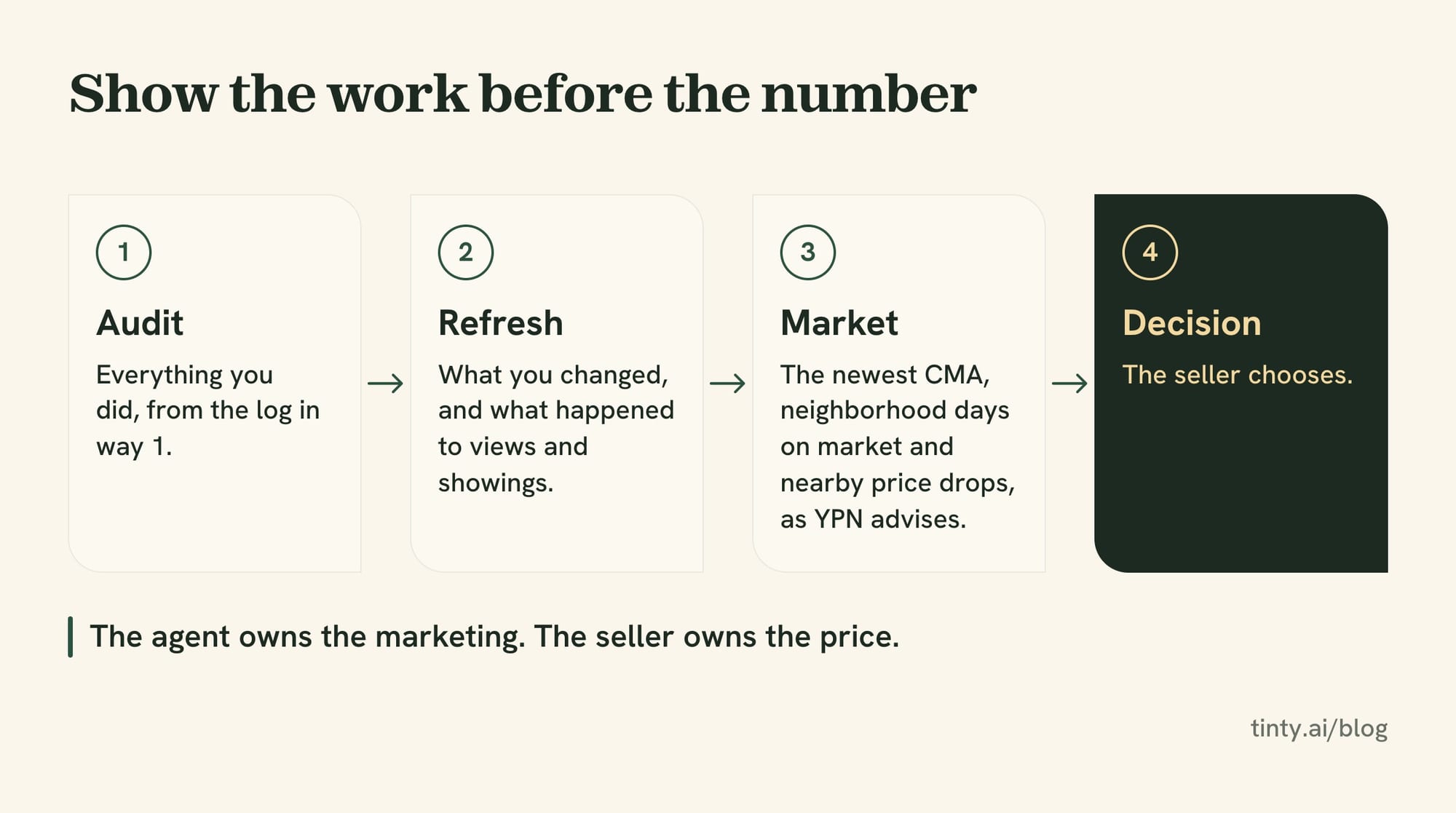
Present your work first and the price last. In his HousingWire column, Davis tells agents to show the marketing audit on its own before any price talk. He splits the job cleanly. The agent owns marketing, exposure and negotiation, and the seller owns the price.
Our order for the price reduction conversation with a seller:
- Audit: everything you did, from the log in way 1.
- Refresh: what you changed, and what happened to views and showings.
- Market: the newest CMA, neighborhood days on market and nearby price drops, as YPN advises.
- Decision: the seller chooses.
A price reduction script in our own words, built on Davis’s split. Fill the brackets with your numbers:
“Here’s everything we’ve done since launch, and what changed after the new photos went live on [date]. Views [rose or stayed flat], and we had [number] showings. [Number] nearby homes lowered their price this month. Buyers are comparing us with those homes. The marketing is my job, and the price is your call. What would you like to do?”
The closing question comes from coach Tom Ferry’s pricing strategy guide. If the seller asks what you’d do, have one number ready and the reason: under [round number], below [competing listing].
What to say when the seller says no
Expect pushback, and answer it with data, not pressure. Five common objections, with our suggested replies:
- “Let’s wait for spring.” “We can. Here’s the monthly carry, and what the listing history will show by then.”
- “We priced high to leave room to negotiate.” “Buyers who never tour can’t negotiate.”
- “Just do more marketing.” “Here’s the audit. Tell me what’s missing and I’ll add it this week.”
- “Let’s try a small cut.” “Small cuts add up. In October 2025, Zillow saw $10,000 cuts turn into $25,000.”
- “We’ve already cut twice.” “Both cuts were small, and the listing looked the same after each. This time the photos change first. If we cut again, we cut once.”
The easiest version of this talk starts at the listing appointment. Our set-up script for that day:
“Let’s agree on a review date now. If we haven’t had [number] showings by [date], we’ll sit down with the data and decide together what to change.”
Price honestly from the start, too. For Realtors, NAR’s Code bars misleading an owner about market value to win a listing.
A 30-day stale listing relaunch plan
Here’s how to sell a stale listing in practice: run the 15 ways as a four-week sequence, with the price decision last. We’d start on your agreed review date, or when the listing passes the local median days on market. If the listing agreement ends inside the plan, ask for an extension first.
The four weeks, at your seller’s pace:
- Week 1, diagnose: pull the funnel numbers, call every showing agent, refresh the CMA and walk the competition (ways 1 to 3).
- Week 2, prepare: fix the cheap objections first. Then re-shoot or re-edit, and stage and label the empty rooms. Pick the hero photo, add a floor plan and rewrite the remarks (ways 4 to 9). Don’t publish yet.
- Week 3, relaunch: publish everything on one day and open up showings. Call agents, hold the broker open, post video and announce any incentive (ways 10 to 14).
- Week 4, decide: compare views, showings and feedback with week 1. If nothing moved, hold the price talk (way 15).
Send the seller a short weekly report through all four weeks. Use the same lines each time: views, saves, showings, feedback, new competition and what you changed. Ferry’s guide recommends regular updates like this. By week 4, the data won’t surprise anyone.
If the listing still doesn’t sell
A refresh and one right-sized cut won’t sell every home, and the seller still has options. None is free:
- Cut again: go deeper, knowing that repeated cuts carry a cost.
- Withdraw and wait: come back in a more active season, inside your MLS’s relisting rules.
- Rent it: an option for a seller who doesn’t need the equity now.
- Let it expire: the seller may then choose another agent.
Pulling a listing is still an option many sellers use. Redfin’s delistings report counted 5.8% of listings delisted in April, tied for the highest share since March 2020. By September, Realtor.com’s monthly trends page put the figure near 5.6%, in line with a year earlier.
Stale listing FAQ
What is a stale listing in real estate?
In real estate, a stale listing is a home that has been for sale clearly longer than similar homes nearby. It has stopped drawing new showings or offers. There’s no official stale listing definition. Redfin’s 2026 research counts 60 days or more, its blog says 30 days, and Quicken Loans says three months.
How many days on the market before a listing is considered stale?
It depends on your market. Published cut-offs run from 30 days to six months. A better test is local. If similar homes in the same area and price band go under contract faster, the listing is stale.
Show 6 more questionsShow fewer questions
Why do listings go stale?
Overpricing is the cause Redfin’s guide lists first. Weak photos, empty rooms, hard showing access, thin marketing and visible defects also stall listings. The 2026 market adds pressure: mortgage rates passed 7% in September.
Can a stale listing still sell for its asking price?
Sometimes, but expect pressure. Redfin estimates that a home sold after a big price cut goes for 2% to 5% less than one priced right from the start. In our view, a refreshed listing at a realistic price can sell near asking. Buyers will still test it with a lower offer.
Should you take a stale listing off the market and relist it?
Only with real changes, and only inside your MLS’s rules. Some MLSs reset the cumulative count after a set time off the market, and some never do. A relist without new photos, staging or a new price changes little, and it must not mislead buyers.
Can virtual staging revive a stale listing?
It can help empty rooms photograph better and, in our view, give buyers a reason to look again. No independent study measures what virtual staging does to days on market. In NAR’s 2025 survey, 83% of buyers’ agents said staging in general helps buyers picture a home. Label every staged photo and keep the original.
How do you ask a seller to lower the price?
Show your work first. Present the marketing audit, then what the photo and staging refresh changed, then fresh comps and nearby price cuts. Close by handing the decision back: marketing is your job, and price is the seller’s call. Ask for one meaningful reduction instead of several small ones.
Is a stale listing a good deal for buyers?
It can be. Redfin advises buyers to consider offering below asking on homes that have sat for more than a month. Check why the home sat first: price is fixable, but condition problems may not be.
How we researched this
On October 2, 2026, we checked every market figure here against its source page. That covers the September 2026 reports from Realtor.com, Redfin, HousingWire and NAHB, plus the reset rules of four MLSs. For the four academic studies, we read the abstracts, not the full papers.
We found no independent data on three things: the effect of a new lead photo, of rewritten remarks, or of showing rules. The scripts, the diagnosis table and the buydown math are our own.
Sources
Checked October 2, 2026, unless noted.
Market data
- Realtor.com September 2026 Housing Report (press release, September 30, 2026)
- Realtor.com, September 2026 Monthly Housing Trends (research page, September 30, 2026; also the source for the 5.6% delisting share)
Show 43 more sourcesShow fewer sources
- Redfin, stale inventory, February 2026 (March 30, 2026)
- Redfin, stale inventory, May 2024 (June 12, 2024)
- Redfin, price-drop rate, September 2026 (September 30, 2026)
- Redfin, size of price cuts, February 2026 (April 9, 2026; updated May 6, 2026)
- Redfin, delistings and relistings, April 2026 (June 3, 2026)
- Redfin, seller concessions, August 2026 (September 18, 2026)
- Redfin, overpricing and price-cut stigma estimate (March 13, 2026)
- Zillow, cumulative price cuts (November 24, 2025)
- NAR, existing-home sales, August 2026 (September 10, 2026)
- HousingWire, market analysis with the Nimesh Patel quote (Jonathan Delozier, September 29, 2026)
- NAHB/Wells Fargo Housing Market Index, September 2026 (September 16, 2026)
Definitions and agent advice
- Redfin blog, stale listing guide (Pablo Alvarez, August 27, 2025)
- Quicken Loans (Kevin Payne; page shows “Updated: Oct. 28, 2022”; metadata modified August 20, 2026)
- NAR’s YPN Lounge, “Strategies to Revive a Stale Listing” (Jennifer Weinberg, August 2, 2023). Not linked: the page carried injected spam text when we checked. Address:
ypn.realtor/the-lounge/revive-a-stale-listing-strategies/ - NAR, “From Delisting to Relisting: 7 Tips to Freshen Up the Home’s Marketing” (Melissa Dittmann Tracey, March 23, 2026)
- HousingWire, Darryl Davis column on stalled listings (July 7, 2026)
- Real Estate News, Realtor.com sponsored content (October 14, 2024)
- Tom Ferry, pricing strategy guide (July 3, 2022; modified June 20, 2025)
- ArchAgent, price reduction tips (August 22, 2022)
- NAR, 2025 Profile of Home Staging release (May 6, 2025)
- NAR, “The Tech Real Estate Agents Rely on Most in 2026” (September 22, 2026)
- NAR, “Who Owns Your Property Photos?” (November 9, 2016)
- NAR Code of Ethics and Standards of Practice, effective January 1, 2026
- ShowingTime help center, appointment types
- Fannie Mae Selling Guide, B2-1.4-04, Temporary Interest Rate Buydowns (page dated August 7, 2024)
MLS rules and law
- CRMLS reset change, via Glendale Association of REALTORS (November 17, 2025)
- CRMLS reset change, via Pacific Southwest Association of REALTORS (November 18, 2025)
- REcolorado, Days in MLS (modified December 8, 2025)
- ARMLS, days on market reset, one of the MLSs that “wait longer” (45 days; modified July 7, 2026)
- Canopy MLS, CDOM reset, also 45 days (January 22, 2026)
- California Business and Professions Code §10140.8 (AB 723)
- CRMLS, digitally altered image guidance (label in the photo description field)
- ARMLS, digitally altered media (“Digitally Altered” watermark plus the original)
Studies (abstracts read)
- Curtis R. Taylor, “Time-on-the-Market as a Sign of Quality”, Review of Economic Studies 66(3), 1999
- John R. Knight, “Listing Price, Time on Market, and Ultimate Selling Price”, Real Estate Economics 30(2), 2002
- Eli Beracha and Michael J. Seiler, “The Effect of Listing Price Strategy on Transaction Selling Prices”, Journal of Real Estate Finance and Economics 49(2), 2014
- Lawrence Kryzanowski and Yanting Wu, “Signaling effects of recurrent list-price reductions on the likelihood of house sales”, Journal of Financial Research 46(1), 2023
- r/realtors, “I tried something different for a stale listing and it actually worked!” (October 6, 2025)
- r/realtors, “Home on market 60 days no showings” (July 2, 2025)
TINTY and our own guides
- TINTY (ours): tinty.ai · pricing · terms (terms updated September 25, 2026)
- What virtual staging is
- What virtual staging costs
- Best free virtual staging apps