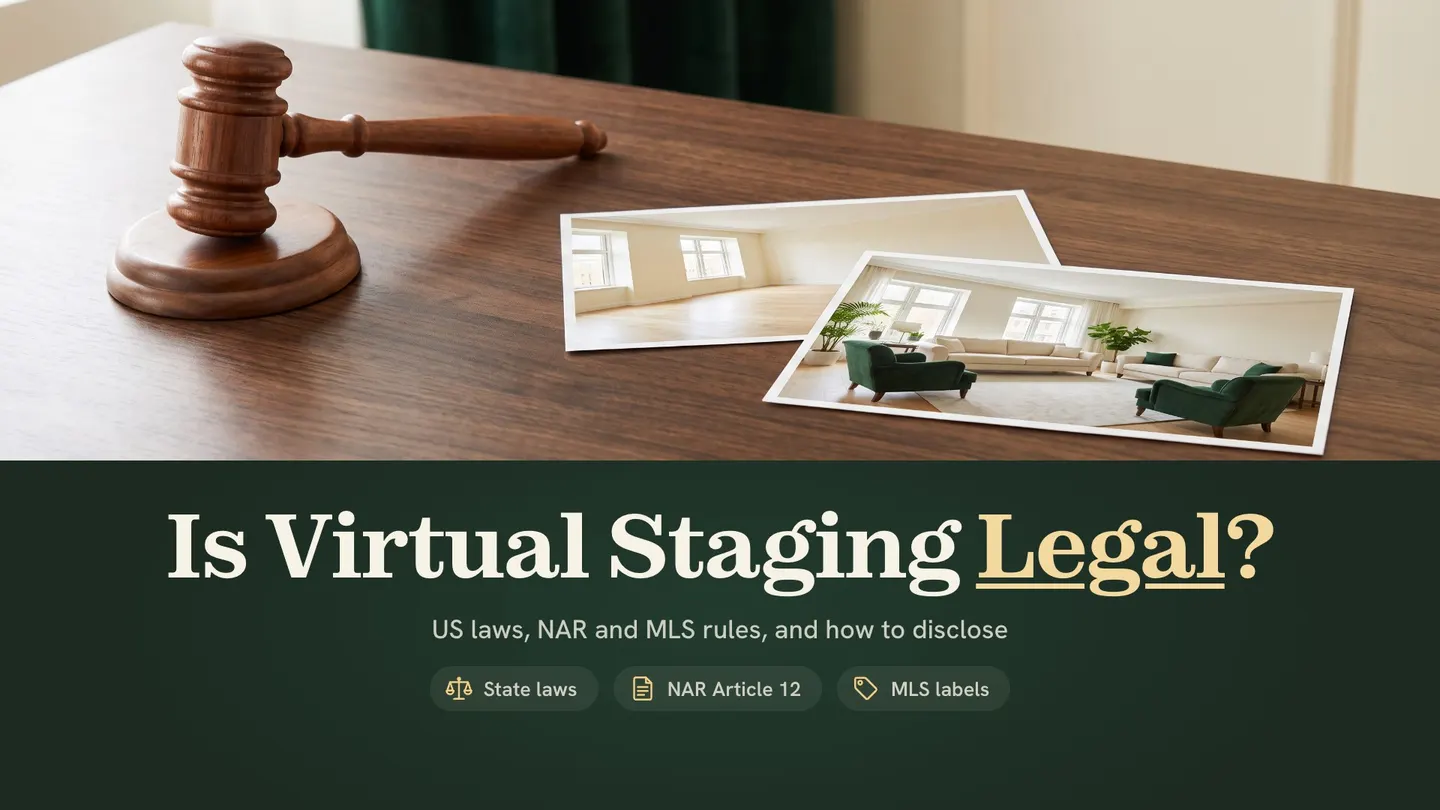
Is virtual staging legal? Yes, as far as we know: no US state bans it, but using it to mislead buyers gets agents in trouble. California has required disclosure by law since January 1, 2026, and Wisconsin’s law starts January 1, 2027. Most MLSs we read require a label, and NAR’s Code of Ethics requires Realtors to present a “true picture.”
Laws and MLS rules checked October 1, 2026.
This article is general information, not legal advice. For a specific listing, ask your broker, your MLS or a real estate attorney. We make TINTY, an AI virtual staging app, so we have a stake in this question. We used primary sources wherever we could and flag what we couldn’t confirm.
New to the topic? Start with what virtual staging is and how it works.
Key takeaways
- California agents: label each altered photo on or next to it, and say the originals are at a link, URL or QR code. Your MLS adds rules. AB 723 details
- Agents in other states: we found no staging law in force outside California (Wisconsin’s starts in 2027). Follow your MLS’s label rule and stage furniture only. Compliance checklist
- Listing photographers: deliver the original with every staged file. Skip burned-in labels unless asked, and don’t edit the house itself. Photographer notes
- Everyone: a label doesn’t rescue a misleading photo. Hiding a cracked wall can break nearly every layer of rules.
On this page: How the rules stack up · Allowed vs banned edits · False advertising · NAR rules · Laws by state · MLS rules · Portals · Lawsuits · Copyright · Rentals · Checklist · TINTY · FAQ · Method
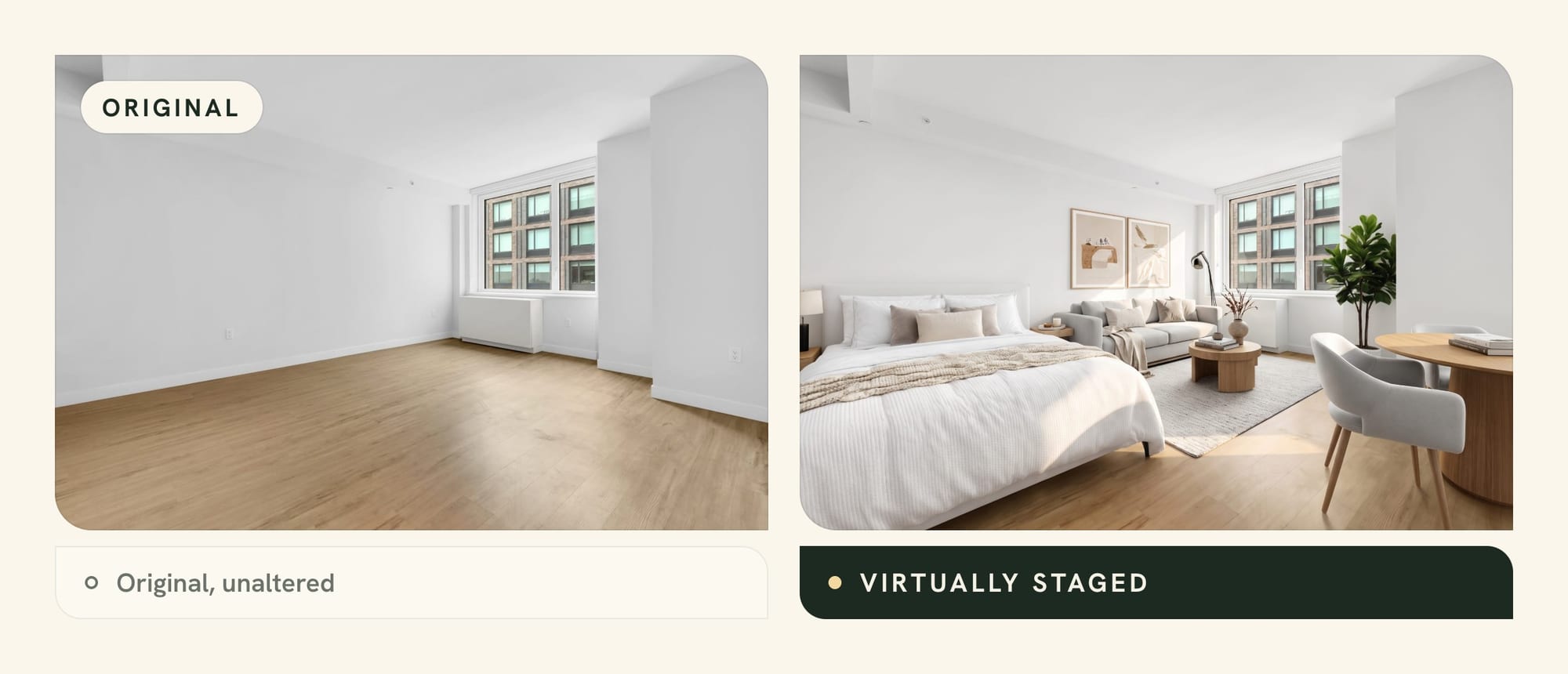
Is virtual staging legal? How the rules stack up
There’s no single federal virtual staging law. The virtual staging laws and rules that apply come in layers, and you have to meet all of them at once.
From broadest to narrowest:
- Consumer-protection law. The FTC Act and state false-advertising laws ban deceptive ads of any kind. A misleading photo is a deceptive ad, staged or not.
- State real estate license law. The license laws we read in California, Texas, Florida and New York let regulators discipline agents for misleading ads.
- Staging-specific state laws. California has one in force for sales. Wisconsin’s starts January 1, 2027, the same day California adds rentals.
- NAR’s Code of Ethics. It binds Realtors, meaning NAR members. It doesn’t bind every licensee.
- MLS rules. Each MLS writes its own, including where the label goes and which edits are banned. Most published fines for staging mistakes are MLS fines.
- Portal terms. Zillow, Realtor.com and others ask for accurate photos. They mostly show whatever your MLS sends them.
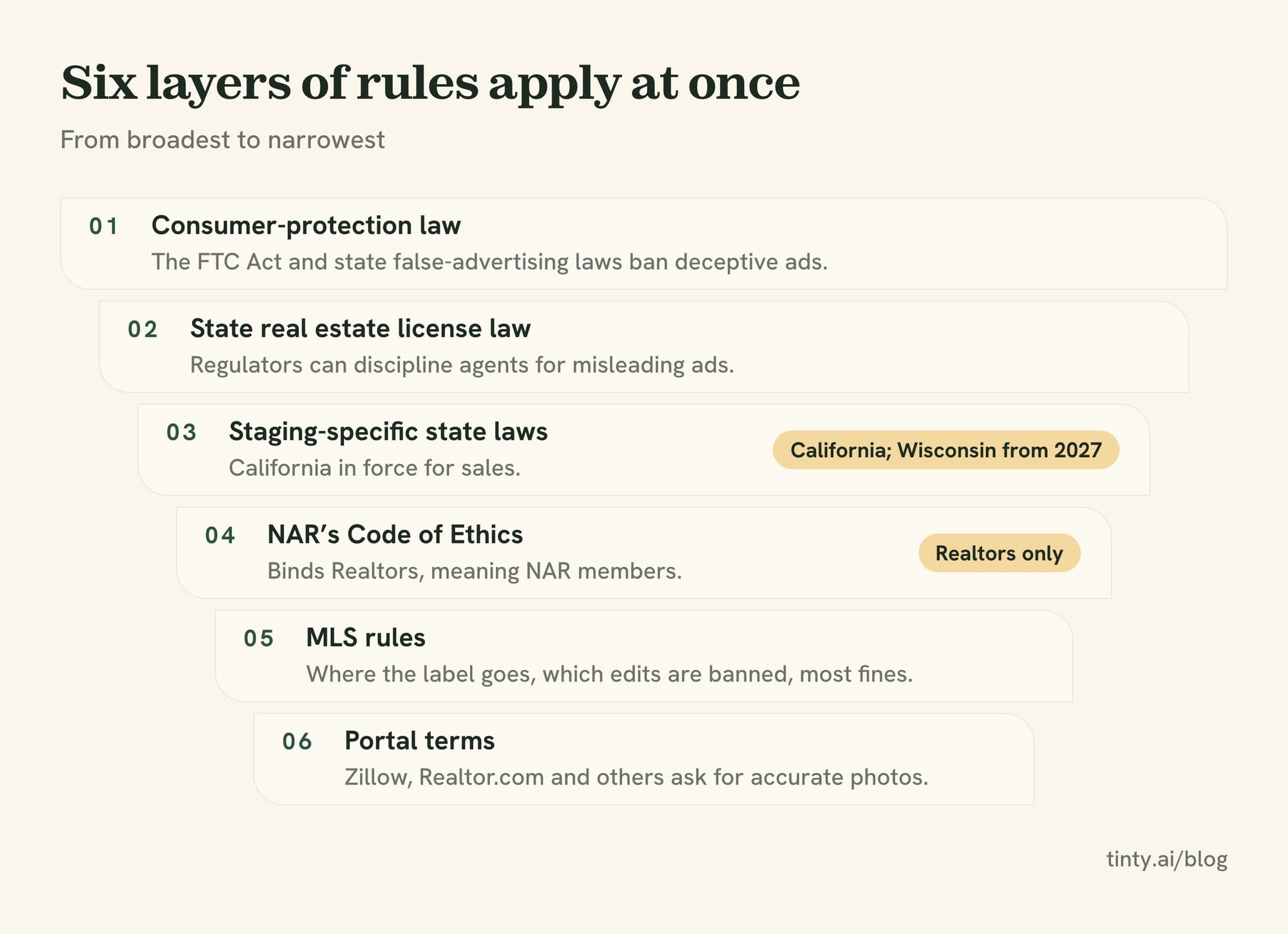
So is virtual staging legal? Yes, with conditions. Furniture in an empty room is fine. Hiding a cracked wall can break nearly every layer on this list.
What makes virtual staging legal or illegal
The line runs between presentation and misrepresentation. Showing how an empty room could be used is presentation. Changing what the buyer would get is misrepresentation.
NAR senior counsel Chloe Hecht drew that line, as quoted in a 2023 NAR article. She said using AI to remove a structural crack violates Articles 2 and 12. Still, “removing a hose and bucket accidentally caught in a picture is different.”
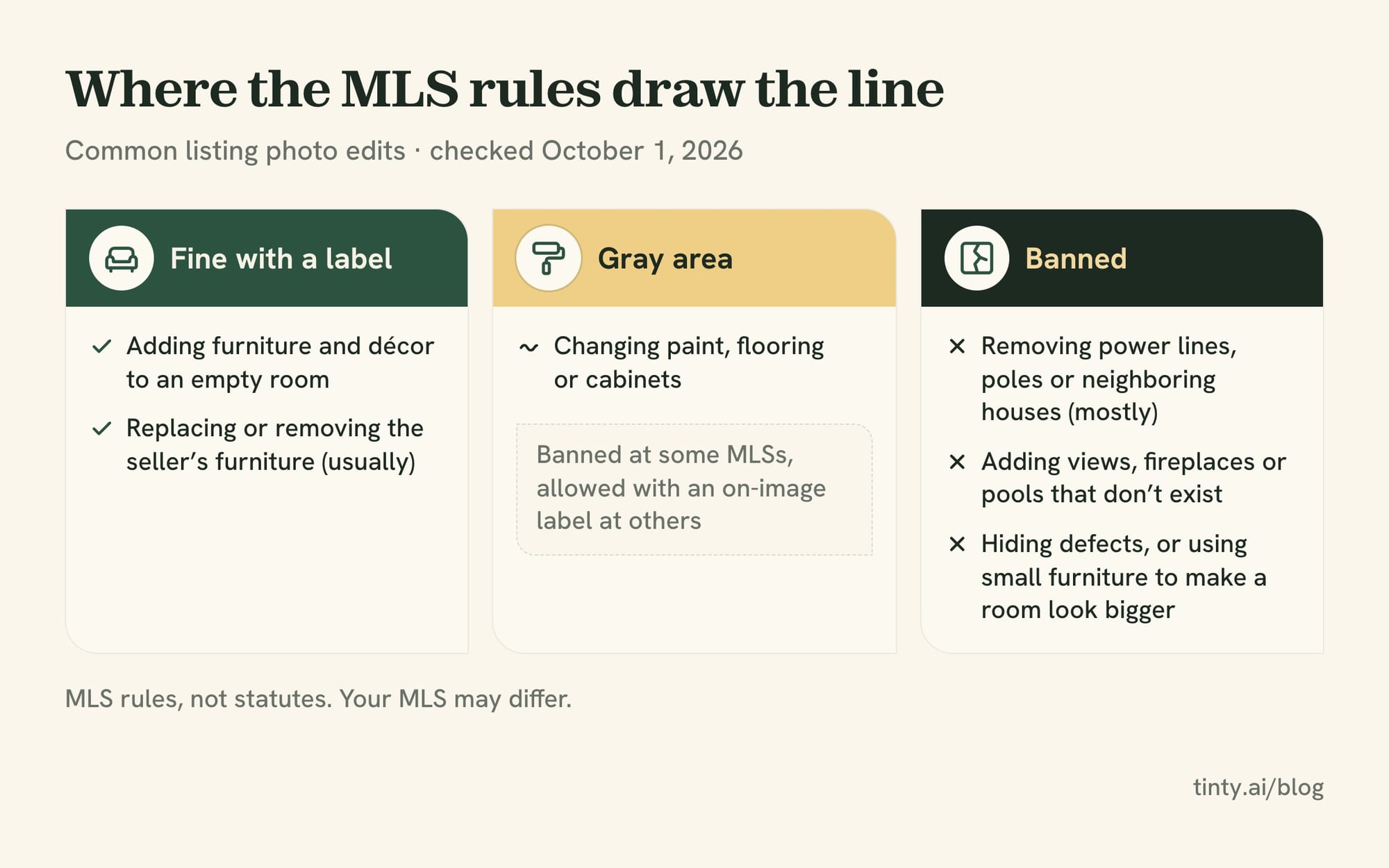
Here’s how common edits fare under the MLS rules we read. These bans are MLS rules, not statutes. State laws mostly require disclosure, though hiding defects can also break misrepresentation law. Your MLS may differ.
Common listing photo edits under the MLS rules we read (checked October 1, 2026)
| Edit | Usually allowed? | What the rules say |
|---|---|---|
| Adding furniture and décor to an empty room | Yes, with a label | Every MLS we read allows it |
| Replacing or removing the seller’s furniture | Usually, with a label | Bright permits replacing furniture; CRMLS counts virtual clearing as an altered image |
| Changing paint, flooring or cabinets | Gray area | Banned at CRMLS (unless the seller makes the change by closing) and Stellar; Canopy, ARMLS and HAR allow some with an on-image label |
| Adding views, fireplaces or pools that don’t exist | No | Canopy bans all three; CRMLS, Bright, MRED and Stellar ban fake views |
| Hiding defects, or using small furniture to make a room look bigger | No | Stellar bans both by name |
Power lines are mostly off-limits too. CRMLS, Bright, Stellar and Canopy ban removing power lines, poles or neighboring houses, while ARMLS allows it with its watermark and the original.
Light edits are a separate case. California’s law doesn’t count “lighting, sharpening, white balance, color correction, angle, straightening, cropping, exposure” as alterations. The catch: those edits can’t change how the property is represented.
Sky swaps and twilight shots are murkier, and MLSs differ.
Rule: a label doesn’t rescue a misleading photo. The FTC’s deception policy statement says “pro forma statements or disclaimers may not cure otherwise deceptive messages or practices.” CRMLS agrees: AI landscaping stays banned “even if the photo is watermarked and labeled as digitally enhanced.”
Is virtual staging false advertising or misleading?
Is virtual staging misleading? Not by itself. A staged photo becomes false advertising when it misleads buyers about something that matters to them.
Start with federal law. Section 5 of the FTC Act bans “unfair or deceptive acts or practices in or affecting commerce.” The FTC’s 1983 Policy Statement on Deception explains the test. An ad deceives if it’s “likely to mislead the consumer acting reasonably in the circumstances, to the consumer’s detriment.”
The misleading part also has to be material, meaning it could change a buyer’s decision. Pictures count too: the FTC, quoting an appeals court, weighs “the impression made by the advertisements as a whole.”
Watch out: an honest showing may not fix the misleading photo that brought the buyer in. The FTC says the law can be broken “even if the truth is subsequently made known to the purchaser.”
We found no FTC guidance on virtual staging. Our reading: labeled virtual furniture that hides nothing probably isn’t a material misrepresentation. A hidden water stain is exactly what the test targets.
State license law is where agents face discipline. A few examples:
- California can suspend or revoke a license for “making any substantial misrepresentation” (B&P §10176).
- Texas can discipline an agent whose ad “misleads or is likely to deceive the public” or “tends to create a misleading impression” (Occ. Code §1101.652).
- Florida can fine up to $5,000 per count for advertising that’s “fraudulent, false, deceptive, or misleading in form or content” (§475.25).
- New York requires “an honest and accurate depiction of the property being sold or leased” (19 NYCRR §175.25©(9)).
New York’s Department of State also warned in a November 2025 trend alert that AI tools “may produce misleading or exaggerated representation of properties.”
Is virtual staging ethical?
Yes, when buyers know what they’re looking at. Jennifer Lindsley of the Wisconsin REALTORS® Association said virtual staging is fine “so long as buyers know it’s virtual.”
NAR quoted that line in a February 2026 article on “housefishing.” The term spread in early 2026 for listing photos that make a home look better than it is.
Our ethical test: would a buyer who visits feel misled? If the room is empty but the walls, floors and views match, probably not. If they find peeling paint that was edited out, yes.
NAR rules on virtual staging: Article 12, Standard of Practice 12-10
NAR’s Code of Ethics never mentions virtual staging, AI or photographs. A text search of the 2026 Code finds none of those words. So when agents talk about NAR virtual staging rules, they mean three general duties:
- Article 12 says Realtors “shall be honest and truthful in their real estate communications.” They must also “present a true picture in their advertising, marketing, and other representations.”
- Standard of Practice 12-10 extends that duty to “Internet content, images” and more. Since its 2018 amendment, it bans “otherwise misleading consumers, including use of misleading images.”
- Article 2 tells Realtors to avoid “exaggeration, misrepresentation, or concealment of pertinent facts.” Editing out a defect is concealment.
When agents ask about Standard of Practice 12-10 and photos, the “misleading images” clause is the one they mean. Clause 4 also bars using other people’s content without attribution or permission.
Watch out: some vendor blogs claim Standard of Practice 12-5 requires a “virtually staged” label. It doesn’t: that standard is about showing your firm’s name in ads. NAR doesn’t require a watermark either. Your MLS and state law decide how you label.
What an ethics complaint can cost a Realtor
Sanctions run up to a $15,000 fine, membership suspension or expulsion, and loss of MLS rights (Part 2, Section 14). Anyone can file an ethics complaint against a Realtor, usually within 180 days (Part 4, Section 20).
But boards can’t award money to the person who complained, and they can’t touch a license (Appendix X). A buyer who wants money goes to court, and license action is the state’s job.
Example: NAR’s Article 12 cases include no edited-photo case. The closest, #12-2, found “gross exaggeration” when an agent’s website called a neglected house a “modern 3-bedroom home, well maintained.” Swap the copy for an edited photo and the logic carries over (our reading).
Virtual staging laws by state
As of October 1, 2026, two states have laws written for altered listing photos: California and Wisconsin. New York and New Jersey have pending bills.
We found no other state with a staging-specific law, though our search wasn’t exhaustive.
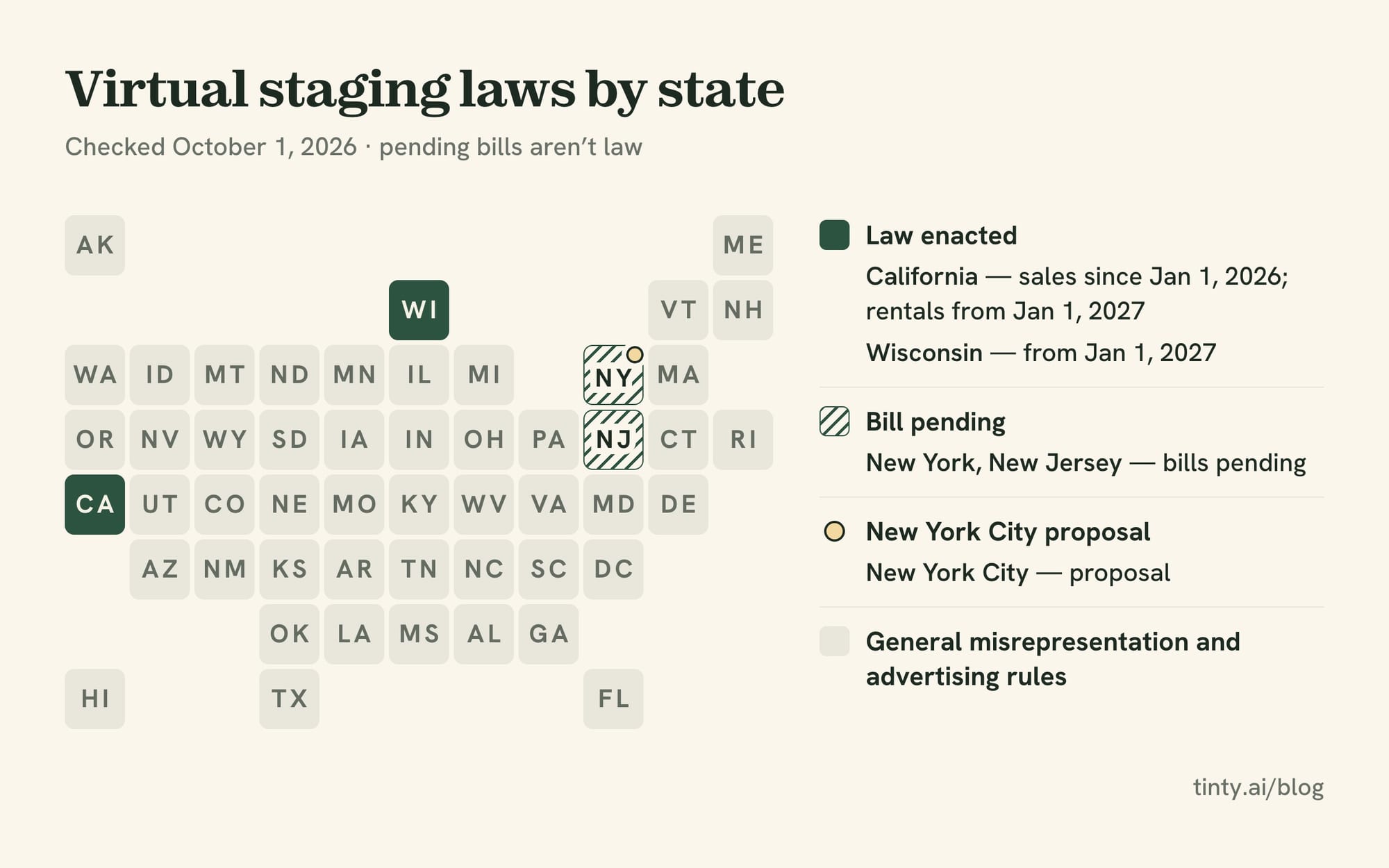
Enacted:
- California, AB 723 (sales). In force since January 1, 2026, as Business and Professions Code §10140.8.
- California, AB 2025 (rentals). Signed September 27, 2026, as Chapter 572. It takes effect January 1, 2027.
- Wisconsin, 2025 Act 69. Enacted December 9, 2025. It takes effect January 1, 2027, per HousingWire and the Wisconsin REALTORS® Association.
Pending, not law:
- New York, S9584. In the Senate Judiciary Committee since April 28, 2026 (bill page).
- New York, A11635. In the Assembly Housing Committee since July 29, 2026 (bill page).
- New Jersey, A4728. In the Assembly Appropriations Committee since May 14, 2026, per the FastDemocracy tracker. The state’s own site didn’t load for us, so we couldn’t confirm there.
- New York City. In July 2026, Mayor Zohran Mamdani proposed disclosure for AI-altered rental photos, Fortune reported. We found no adopted rule.
No specific law found: Texas’s 2025 AI law, TRAIGA, is a general AI statute, not a listing-photo rule. The license law’s ban on misleading ads still applies.
In every other state, we found no statute that spells out a label, but general misrepresentation and advertising rules apply. Your MLS rule probably requires one.
California: AB 723, and rentals from 2027
AB 723 covers sale ads by a broker, a salesperson “or person acting on their behalf.” It names “furniture” and covers edits made with “artificial intelligence,” so AI staging is clearly covered.
The definition likely covers edits by photographers and stagers working for the agent. The label duty falls on whoever puts the image in an ad (our reading).
Each altered image needs three things:
- A label: a “reasonably conspicuous” statement “on or adjacent to the image.”
- A link: the statement must also say the unaltered images can be seen at a link, URL or QR code.
- A public page: that link must lead to a public page that “clearly identifies” the original. On a website you control, post the originals or link to them.
The law doesn’t require a watermark, and CRMLS accepts a label in the photo description. San Diego MLS wants the label “Digitally Altered,” the original’s public URL in the photo description and no text burned into the photo. On flyers and social posts, put the label under each photo and the link or QR code in the same piece (our reading).
AB 723 sets no fine of its own. Under the general Real Estate Law, the DRE can issue a citation of up to $2,500 (§10080.9) or suspend or revoke a license (§10177). A willful violation is also a misdemeanor (§10185).
Watch out: the “$250 fine” you’ll see online is a CRMLS fine, not state law. We’re not aware of any DRE citation or prosecution under AB 723 so far.
The DRE’s March 2026 advisory warns AI users directly. Skipping a review of AI images “may result in violations even if the alteration was unintentional.”
AB 2025 extends the rule to rental ads, landlords included, from January 1, 2027.
Wisconsin Act 69
Act 69 adds a disclosure duty for licensees (Wis. Stat. 452.136(1m)). You must disclose in your ads when technology, including AI, added, removed or changed parts of the property. The duty applies when the change creates a false or misleading impression.
That trigger is narrower than California’s. The law doesn’t say outright that plain furniture staging counts. The cautious reading, which the WRA shares, is to label all staging.
One caveat: Wisconsin’s legislature site wouldn’t load for us, so we saw the official wording only in search results. We also didn’t confirm penalty amounts.
New York and New Jersey: what’s pending
New York’s S9584 would require staged images to “disclose that furnishings or finishes were digitally added.” Violations would become grounds for license discipline. A11635 would also cover leases, sellers, owners and property managers.
New Jersey’s A4728 would allow staging and decluttering with disclosure, per a law firm’s summary. It would bar photos edited in a way that “fundamentally alters the image.” The summary may not reflect the bill’s May 2026 amendments.
None of these is law yet. We’ll check them again when New York’s 2027 session opens in January. This guide covers the US only. We’ll cover Canada, the UK and Australia separately.
MLS rules: where the label goes and what it costs
No national MLS rule covers virtual staging, as far as we can tell. Each MLS writes its own, and they disagree on where the label goes. Five examples:
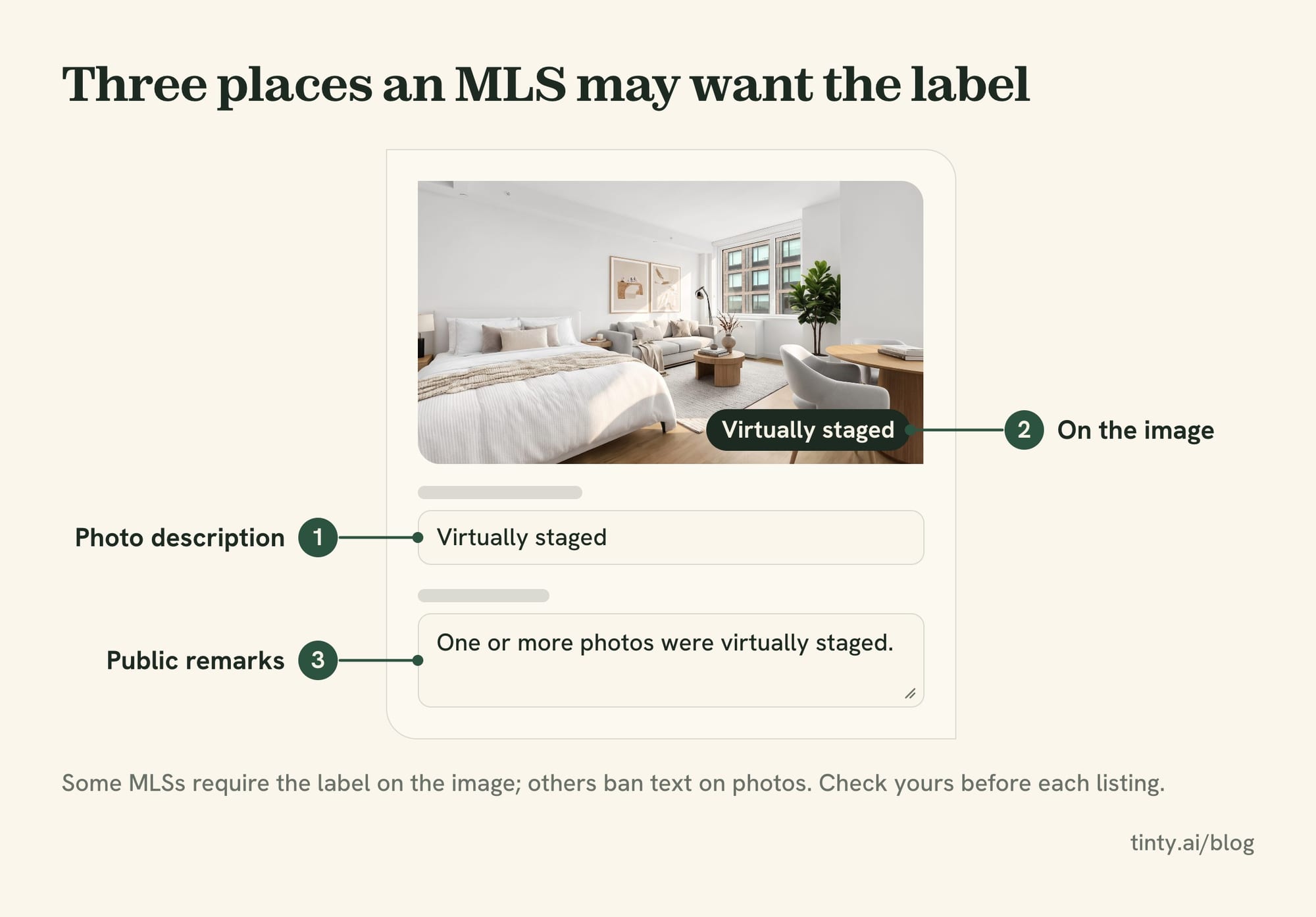
- CRMLS (California). Put “Virtually Staged” or similar in the photo’s text field, and show the original immediately before or after it (FAQ, updated July 24, 2026).
- ARMLS (Arizona). Since May 28, 2026, every altered photo needs the MLS system’s “Digitally Altered” watermark, paired with the original. The old “Virtually Staged” watermark “is no longer ARMLS-approved” (ARMLS).
- Canopy MLS (Charlotte). The disclosure must sit “directly ON the image.” A label only in captions or remarks “is NOT acceptable” (Canopy).
- Stellar MLS (Florida). Type “Virtually staged” in the photo description and check the box. Open the public remarks with “One or more photo(s) was virtually staged” (rules dated September 15, 2025).
- HAR (Houston). Furniture staging gets a note in the Photo Description. Altering the house itself needs an on-image banner: “Image does not represent actual property as is” (HAR rules).
Bright MLS bans text or graphics added to listing photos.
Tip: check your own MLS before each listing. Both “always watermark” and “never watermark” are wrong. San Diego MLS and Stellar forbid a label on the photo, while Canopy and ARMLS require one.
Labels often get skipped. Coraly, a company that scans listing photos, checked about 40,000 primary listing photos from early 2026. Nearly 11% were altered, and “more than 90%” of those had no visible disclosure, Real Estate News reported.
MLS fines for staging mistakes
Published penalties at four of these MLSs:
- CRMLS: “a warning at first and then, if not corrected in a timely manner, a $250 fine” (CRMLS FAQ).
- ARMLS: fines of $200 start in December 2026 (ARMLS media page).
- Stellar MLS: fines start at $100 and reach $1,000 plus a hearing (Stellar rules).
- HAR: charges start at $250 (HAR MLS rules).
Zillow, Realtor.com and Redfin rules
Portals mostly leave staging rules to the MLS. Your photos reach them through the MLS feed, so your MLS label is what travels. We couldn’t confirm that every portal displays photo-description labels, so check your live listing.
Zillow says its content standards “require that listing photos accurately represent the home.” In a July 2026 post, it said it “supports clear disclosure when AI is used to materially alter a listing image.”
Realtor.com and Redfin have no staging rule we could find. Realtor.com’s terms ask users “to provide true, accurate and complete information.” They ban content “which is misleading to others, including consumers.”
Virtual staging lawsuits: can you get sued?
Yes, in theory. Any misleading listing can lead to a claim.
But as of October 1, 2026, we couldn’t find a single public US court case, license case or MLS fine over virtual staging itself. Vendor blogs that cite one don’t name a source.
The closest case: C$6,000 in penalties in British Columbia
The closest documented case is Canadian. A British Columbia agent’s listing used virtually staged bedroom photos that also hid peeling and cracked paint. A buyer offered C$490,000 without seeing the house, then backed out after his first visit.
The agent added a “virtually staged” note to the listing only after the deal. BC’s regulator imposed C$6,000 in penalties in 2024 and confirmed them on review (Evans (Re), 2024 BCSRE 59). Buyers would have thought the home “was in a better state of repair than it in fact was,” the decision said.
Three details matter for US agents:
- A site-wide “deemed reliable, but not guaranteed” disclaimer didn’t help.
- The regulator didn’t need to prove the buyer relied on the photos, though it found he likely did.
- The real problem was staging plus hidden defects, with no label.
What a US lawsuit would look like
A buyer would bring the usual claims: misrepresentation, fraud or consumer protection. Fraud needs a false statement, made knowingly or recklessly, that the buyer relied on and that caused harm (Cornell’s Wex). Sales talk, or “puffing,” usually can’t support fraud.
Our reasoning: a nicer-looking empty room is close to puffing. A photo that removes a defect is a false statement of fact about the home’s condition.
An “as is” clause may not save a seller who hid a defect. The Texas Supreme Court said so in a 1995 commercial sale case (Prudential). An “as is” deal doesn’t bind a buyer who agreed “because of a fraudulent representation or concealment of information by the seller.” Rules vary by state.
Watch out: a claim can name the seller, the listing agent and the broker. Don’t count on blaming the software. California’s DRE says responsibility for AI output “rests with the licensee and their responsible broker, not the technology provider.”
What happens if you don’t disclose virtual staging?
Consequences come in steps (published amounts only):
- MLS. A warning, photo removal, then fines: $250 at CRMLS after a warning, $200 at ARMLS from December 2026, and $100 and up at Stellar.
- Realtor ethics complaint. A fine of up to $15,000, suspension or expulsion, and loss of MLS access.
- State regulator. In California, a citation of up to $2,500, or license suspension or revocation. Florida can fine up to $5,000 per count.
- Criminal charges in California. Only for willful violations, and we know of none under AB 723.
- A buyer’s lawsuit. It’s most likely when the photos hid a defect and the buyer relied on them.
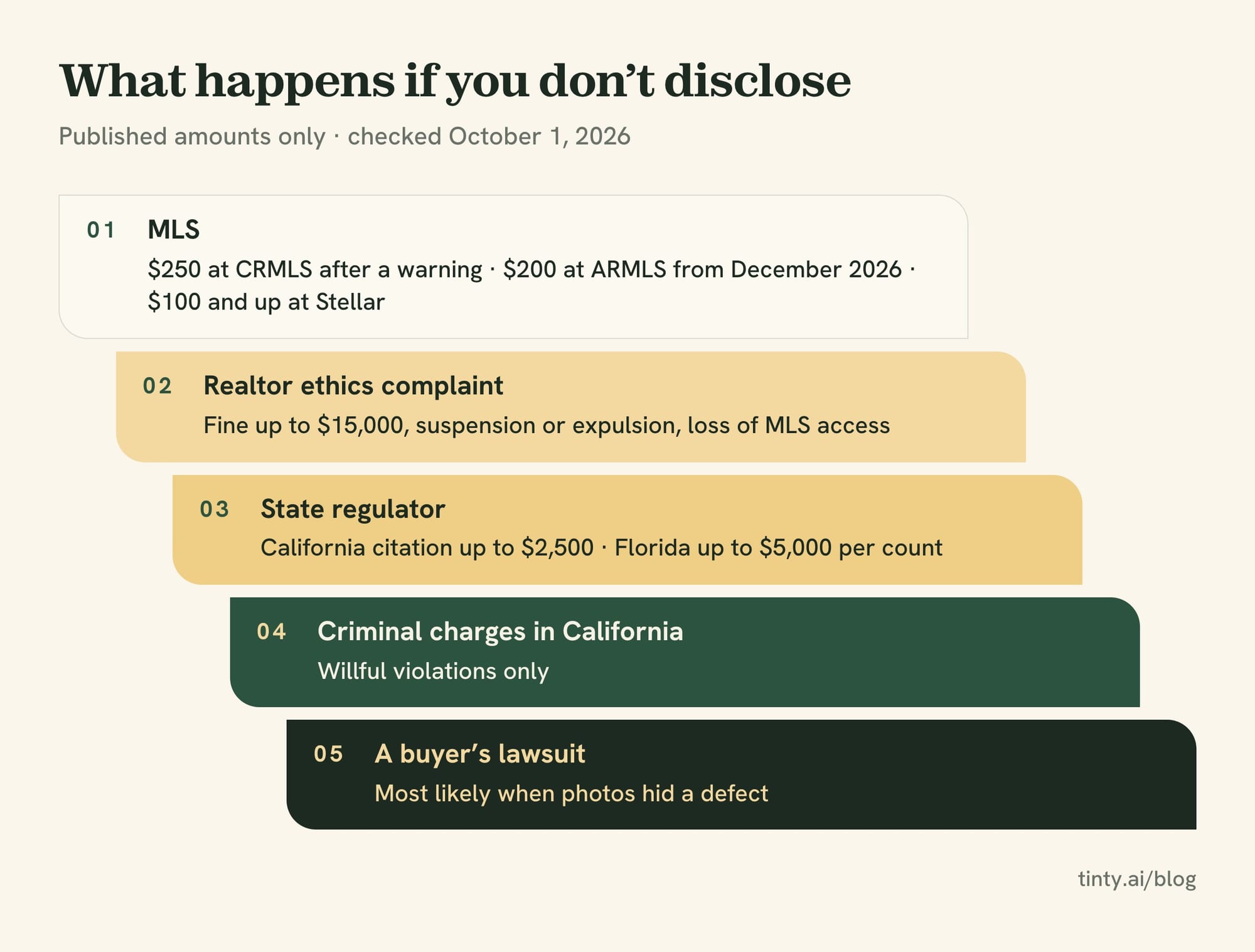
In our view, outside California undisclosed furniture alone is mostly an MLS and ethics problem. In California, it also breaks AB 723. Undisclosed edits to the home itself can reach every step.
Can a buyer back out if a home doesn’t match virtually staged photos?
Sometimes. Before closing, the contract decides, and an inspection contingency is the main exit. With one, the CFPB says you can cancel “without penalty if you are not satisfied with the results of the inspection.” A buyer who walks away without one can put the earnest money at risk.
Furniture alone rarely gives a buyer a claim, because it usually isn’t part of the sale. A state Senate committee analysis says the California Association of REALTORS® makes this point in its staging guidance. Things change if the contract includes the furnishings, as in the BC case.
They also change when the photos hid defects. After closing, those buyers may sue for misrepresentation or fraud.
Virtual staging copyright: who owns the staged photo?
Usually the photographer owns the photo, and staging it doesn’t change that. NAR’s legal team says the creator owns the copyright unless there’s a written work-for-hire deal or the rights were assigned.
The owner controls “derivative works,” and we’d treat a staged photo as one. So your license has to allow edits.
Short answers:
- Photos taken by another photographer. Get written rights that cover editing and MLS use. When you upload, you “represent and warrant” that you hold those rights, per CRMLS. CRMLS adds that photographer license forms “rarely provide the necessary license language.”
- The previous agent’s photos. You need a license from whoever owns them. Stellar fines unlicensed reuse automatically, and Bright requires the owner’s express consent. Staging over their photo doesn’t fix that.
- After the listing expires. Check the license, since some cover active listings only. NAR’s Standard of Practice 12-4 bars advertising property “without authority.” Case #12-19 says to take listings off your site once that authority ends.
- AI-made images. The U.S. Copyright Office says AI output is protected only where “a human author has determined sufficient expressive elements.” Our reading: the photo underneath stays protected, but AI-added furniture alone likely isn’t.
Rental listings and fair housing
California’s AB 2025 brings the AB 723 rule to rental ads on January 1, 2027. It applies to “a person,” so landlords and property managers must also label altered or fully AI-generated images. For altered photos, the ad must include the original or link to it. New York’s A11635, New Jersey’s A4728 and the New York City proposal would cover rentals too, but none is law yet.
Fair housing is the other risk, and it’s about what you add. Federal rules ban ads that signal a home isn’t open to a protected group (24 CFR §100.75). That covers “photographs” and “illustrations” as well as words.
So keep staged rooms neutral and leave people out. Stellar bans “people or persons” in listing photos outright.
A virtual staging compliance checklist
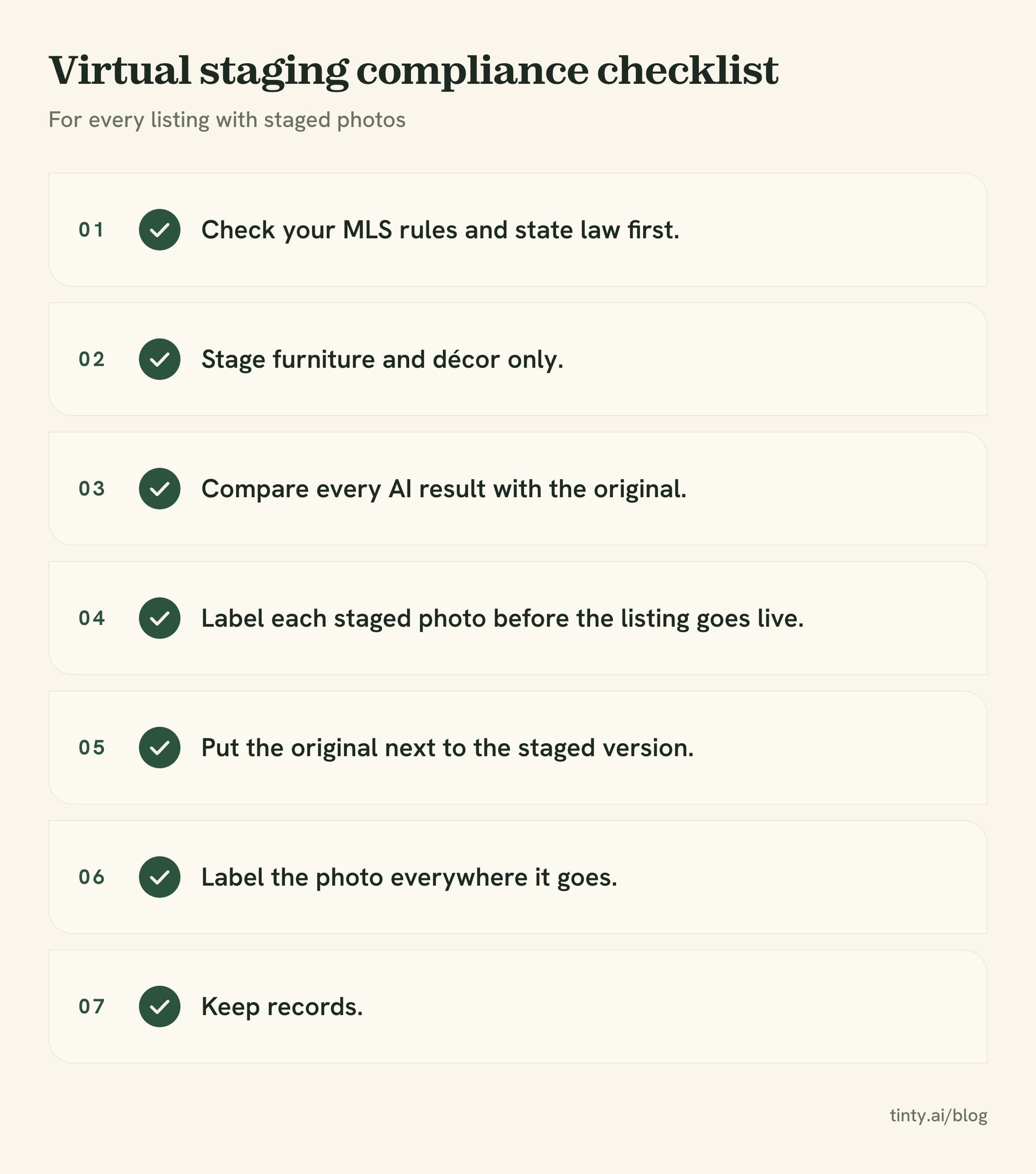
For every listing with staged photos:
- Check your MLS rules and state law first. Search your MLS rules for “staged,” “altered” and “enhanced.” ARMLS and CRMLS both tightened theirs in 2026. Ask your broker if anything’s unclear.
- Stage furniture and décor only. Leave walls, floors, fixtures, views and defects as they are.
- Compare every AI result with the original. Look for added features, changed windows and furniture at the wrong scale.
- Label each staged photo before the listing goes live. Put the label where your MLS wants it. That might be the photo description, the image itself or the public remarks.
- Put the original next to the staged version. In California ads, link to it as well.
- Label the photo everywhere it goes. Flyers, social posts and your website should carry it too. In California, the law covers them.
- Keep records. Save the originals, your photo license and notes on each edit. California’s DRE suggests keeping “records showing how AI outputs were reviewed and verified for accuracy and compliance with law.”
If your MLS is silent on labels, use the caption and the remarks, not text on the image, which many MLSs ban.
If you’re the listing photographer
MLS rules bind agents, but your files decide how easy compliance is.
- Deliver pairs. Send each staged file with its original, named to match (kitchen-original.jpg, kitchen-staged.jpg).
- Keep files clean. Skip burned-in labels, logos and watermarks unless asked. CRMLS says photographers needn’t add a watermark, and ARMLS bans other companies’ marks. Canopy wants an on-image label, so ask.
- Stage, don’t renovate. Flag any change to walls, floors, views or exteriors in your delivery note. Many MLSs ban such edits, and HAR requires an on-image banner for them.
- Put staging in your license. Cover edits, MLS upload and use after the listing ends.
- California: if you host the property website, AB 723’s original-photo rule likely applies to you too (our reading).
How TINTY handles disclosure
TINTY stages furniture in interior rooms. What the app and our terms do:
- Furniture, not renovation. TINTY doesn’t remove furniture, renovate, declutter, swap skies or edit exteriors. AI can still drift, so check each image against the original.
- Our terms ask you to disclose. TINTY’s terms name AB 723 and MLS rules and say: “You are responsible for following the rules that apply to your listings.”
- No hiding defects. The terms also ban using staged images “to hide or misrepresent the condition of a property.”
- Originals stay visible. We keep the original next to the staged photo on project links. We don’t claim a project link meets AB 723 on its own.
- The label is optional, and where it goes is your call. A project setting, “Add ‘Virtually staged’ to photos,” puts the label on finished photos, on screen and in downloads. Use it only where your MLS allows text on photos. Otherwise label the photo where your MLS asks, such as the photo description.
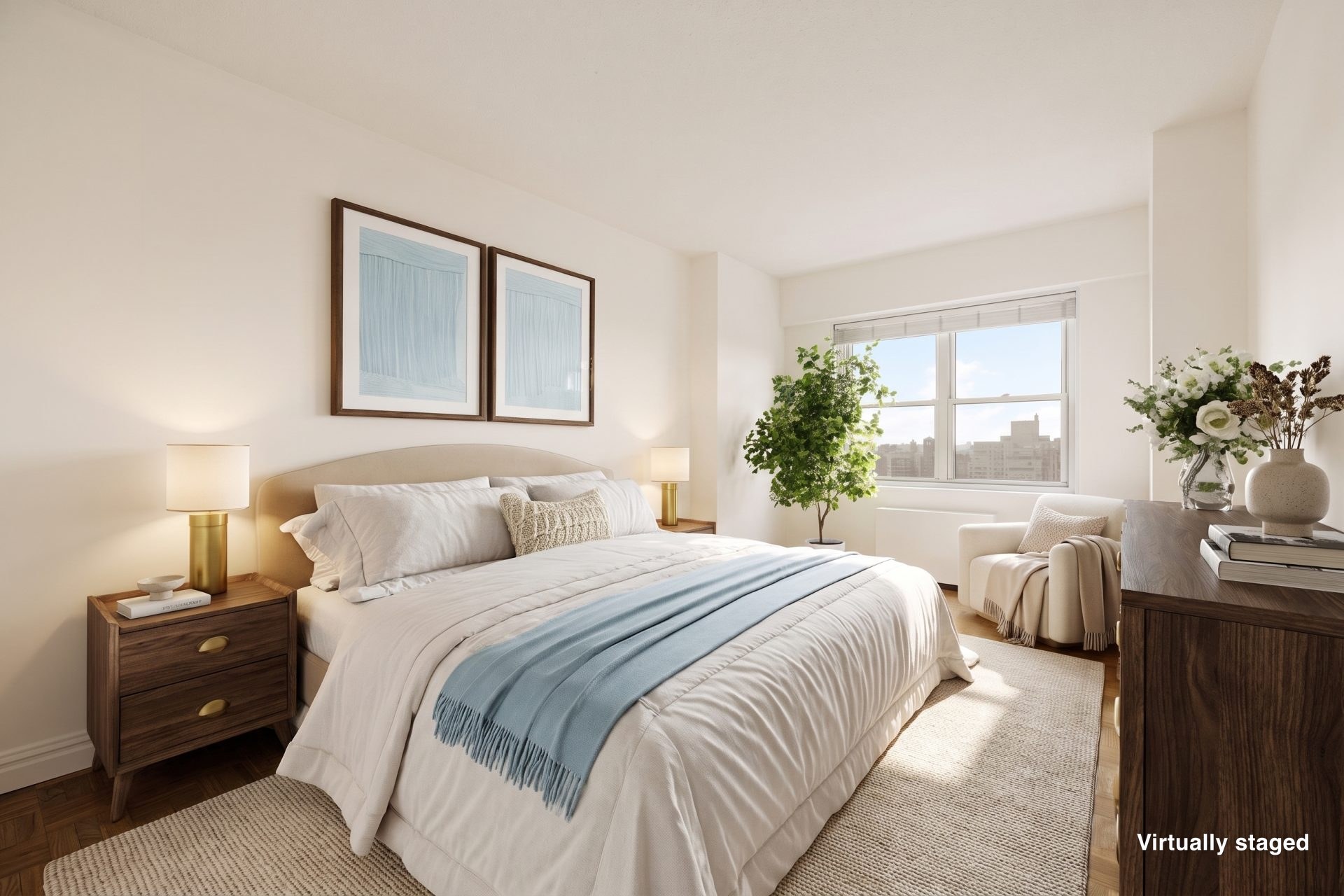
Watch out: previews and free finished photos carry a TINTY watermark, and it must stay. Our terms let you use them for review and sharing. They aren’t MLS-ready: a vendor watermark isn’t a disclosure label, and many MLSs we read ban them.
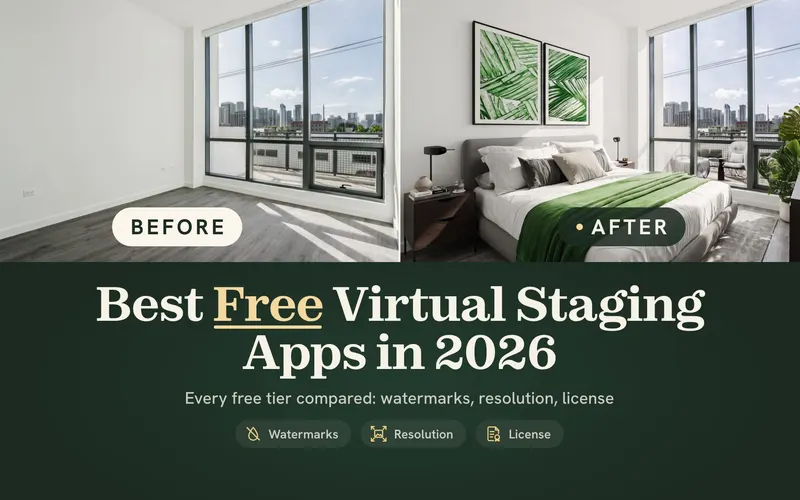
Our guide to the best free virtual staging apps compares watermarks, and what virtual staging costs covers paid plans.
No time to stage photos yourself? Email them to hello@tinty.ai with the style you want and what each room is for. TINTY Studio stages them with our AI tools, finishes each by hand and returns them within 2 to 24 hours. You pay nothing up front and only if you’re happy, but disclosure stays your job.
Try TINTY’s free previews on your own photo.
Is virtual staging legal? FAQ
Is virtual staging legal in all 50 states?
As far as we know, yes: as of October 1, 2026, no US state bans it. California requires disclosure, Wisconsin will from 2027, and most MLSs require a label. Staging is legal, but misleading buyers with it isn’t.
What are NAR’s rules on virtual staging?
None by name. NAR’s Code of Ethics doesn’t mention virtual staging, watermarks or AI. Article 12 requires a “true picture,” and Standard of Practice 12-10 bans “misleading images.” How and where you label comes from your MLS and state law, and some MLSs require an on-image label while others ban one.
Show 6 more questionsShow fewer questions
Which states have virtual staging laws?
Two, as of October 1, 2026. California’s AB 723 has covered sale ads since January 1, 2026, and AB 2025 adds rentals on January 1, 2027. Wisconsin’s Act 69 also starts January 1, 2027. New York and New Jersey have pending bills, and New York City has a proposal.
Can you get sued for virtual staging?
You can be sued over any misleading listing, staged or not. We found no public US lawsuit over virtual staging itself as of October 2026. The risk rises sharply when staging hides defects. In a 2024 Canadian case, a regulator imposed C$6,000 in penalties after edited photos hid peeling paint.
Can I virtually stage photos taken by another photographer?
Only if your license allows edits. The photographer usually owns the copyright, and a staged photo builds on their work. Get written rights that cover editing and MLS use before you upload. MLSs make you warrant that you hold those rights, and some, like Stellar, fine unlicensed use.
Can I use virtually staged photos after the listing expires?
Only if your photo license covers it, and some cover active listings only. NAR’s Code also bars advertising a property without authority. A new agent can’t use the previous agent’s virtually staged photos without a license from the owner, as Stellar’s and Bright’s rules spell out.
Can tenants sue over virtually staged rental ads?
We found no case where a tenant sued over a staged rental ad. A tenant could bring the same misrepresentation or consumer-protection claims a buyer could. From January 1, 2027, California will require anyone advertising a rental to label altered images. Pending bills in New York and New Jersey would add similar rules.
Is AI virtual staging safe for privacy?
It depends on the tool, so read its privacy policy for training use, retention and processors. TINTY’s privacy policy says, “We don’t use your photos or the images generated from them to train AI models.” Photos staged without an account are deleted once they’re more than 72 hours old. Don’t upload photos showing identifiable people.
How we researched this
On October 1, 2026, we checked each rule against its primary source, including the public rules or guidance of 12 MLSs. Three sources wouldn’t load for us: Wisconsin’s and New Jersey’s legislature sites and Zillow’s July post. Those entries rest on search-indexed text, a bill tracker and news reports, and we flag them.
Rules change often, so confirm with your MLS. This is general information, not legal advice.
Sources
Federal law and regulators
Show 59 more sourcesShow fewer sources
State laws, bills and regulators
- California B&P §10140.8 (AB 723)
- California AB 723 (Chapter 497, Statutes of 2025)
- California AB 2025 (Chapter 572, Statutes of 2026) · history
- California B&P §10176
- California B&P §10177
- California B&P §10185
- California B&P §10080.9
- California DRE Licensee Advisory, “Artificial Intelligence in California Real Estate” (March 17, 2026)
- California Senate Judiciary Committee, AB 723 analysis (July 2025)
- 2025 Wisconsin Act 69 · Wis. Stat. 452.136 (official site unreachable for us; text seen via search index)
- HousingWire on Wisconsin Act 69 (January 13, 2026)
- Wisconsin REALTORS® Association, Jennifer Lindsley (November 24, 2025)
- New York S9584
- New York A11635
- New York Department of State trend alert (November 13, 2025), citing 19 NYCRR §175.25©(9)
- Observer on New York A11635 (August 24, 2026)
- New Jersey A4728, FastDemocracy tracker · official page (unreachable for us)
- O’Toole Scrivo on NJ A4728 (June 22, 2026)
- Fortune on the New York City proposal (July 22, 2026)
- Texas Occupations Code §1101.652
- Florida Statutes §475.25
- Law Commentary, state laws overview (September 10, 2026)
NAR
- Code of Ethics and Standards of Practice, effective January 1, 2026
- Case Interpretations Related to Article 12
- Part 2, Section 14, Nature of Discipline
- Part 4, Section 20, Initiating an Ethics Hearing
- Part 4, Appendix X, Before You File an Ethics Complaint
- “AI Use in Real Estate Comes With Copyright Concerns” (May 10, 2023, quoting senior counsel Chloe Hecht)
- “Are You ‘Catfishing’ Buyers With Picture-Perfect Real Estate Photos?” (February 13, 2026)
- “How to Manage and Protect Listing Content”
- “Who Owns Your Property Photos?”
- Listing photo sample agreements
MLS rules (checked October 1, 2026)
- CRMLS, Digitally Altered Image Guidance & FAQs (updated July 24, 2026)
- CRMLS Rules & Policies, effective July 10, 2026
- CRMLS Photographs and Media FAQs (March 2021)
- San Diego MLS rule changes, effective January 2026 · Coraly
- ARMLS, Digitally Altered Media · Rules (May 28, 2026)
- Canopy MLS, Digital, Virtually Staged, and AI-enhanced Images (February 27, 2026)
- Stellar MLS Rules and Regulations (September 15, 2025)
- HAR MLS Rules (June 8, 2026)
- Bright MLS Policy on Images and Documents (February 28, 2024)
- MRED Rules and Regulations (revised May 14, 2026)
- Georgia MLS photo policy (September 9, 2020)
- NorthstarMLS proposed guidelines (July 10, 2026)
- REcolorado MLS Policy (revised November 2025) · photo FAQ
- NWMLS public photo guidance (April 18, 2023)
Portals
- Zillow, “Zillow’s take on AI-generated listing photos” (July 2026; blocked for our fetchers, quotes confirmed via the search index, Real Estate News below and Fortune above)
- Real Estate News on Zillow’s July post (September 8, 2026)
- Realtor.com Terms of Use
Cases and legal background
- Evans (Re), 2024 BCSRE 59 (BC Financial Services Authority, reconsideration)
- Evans (Re), 2024 BCSRE 61 (notice of administrative penalty)
- Prudential Ins. Co. of America v. Jefferson Associates, 896 S.W.2d 156 (Tex. 1995)
- Cornell Wex, fraudulent misrepresentation · puffing
- U.S. Copyright Office, Copyrightability report (January 29, 2025)
News
TINTY
- TINTY Terms (last updated September 25, 2026): tinty.ai/terms
- TINTY Privacy Policy (last updated September 25, 2026): tinty.ai/privacy