How do you sell a vacant house? Selling a vacant house means covering six jobs the owner used to do by living there. Tell the insurer before day 30 and keep the utilities on. Hold the heat at 55°F or drain the plumbing, lock up, and have someone check the house every week. Then photograph it warm and lit, and label any virtually staged photos.
We make TINTY, an AI virtual staging app, so we have a stake in the photo section. Everything else comes from insurer, regulator and trade sources, and we flag what we couldn’t confirm. This is general information, not insurance, legal or tax advice. Here’s how to sell a vacant house without a frozen pipe, a denied claim or a break-in.
Key takeaways
- Insurance: many policies limit coverage after 30 or 60 consecutive days of vacancy. Have the seller call the insurer at move-out, or today if they’ve left.
- Heat: hold the thermostat at 55°F or higher, or have a plumber drain the system.
- Checks and security: name one person, by email, to visit every week, and never advertise that the house is vacant.
- Utilities: keep power, gas and water accounts open until closing. Inspectors and some appraisers need them.
- Photos: shoot with the heat and lights on, and label every virtually staged photo.
On this page: What changes · Checklist · Who checks · Insurance · How long · Utilities · Winterizing · Security · Showings · Photos · Out of state · Tips · FAQ · Research
Selling a vacant house: what changes when nobody lives there
When the seller moves out, three things change at once. The insurance clock starts, the monthly bills go on, and nobody is home to spot a leak. Selling a vacant home carries those risks in any season. Freeze season raises the stakes.
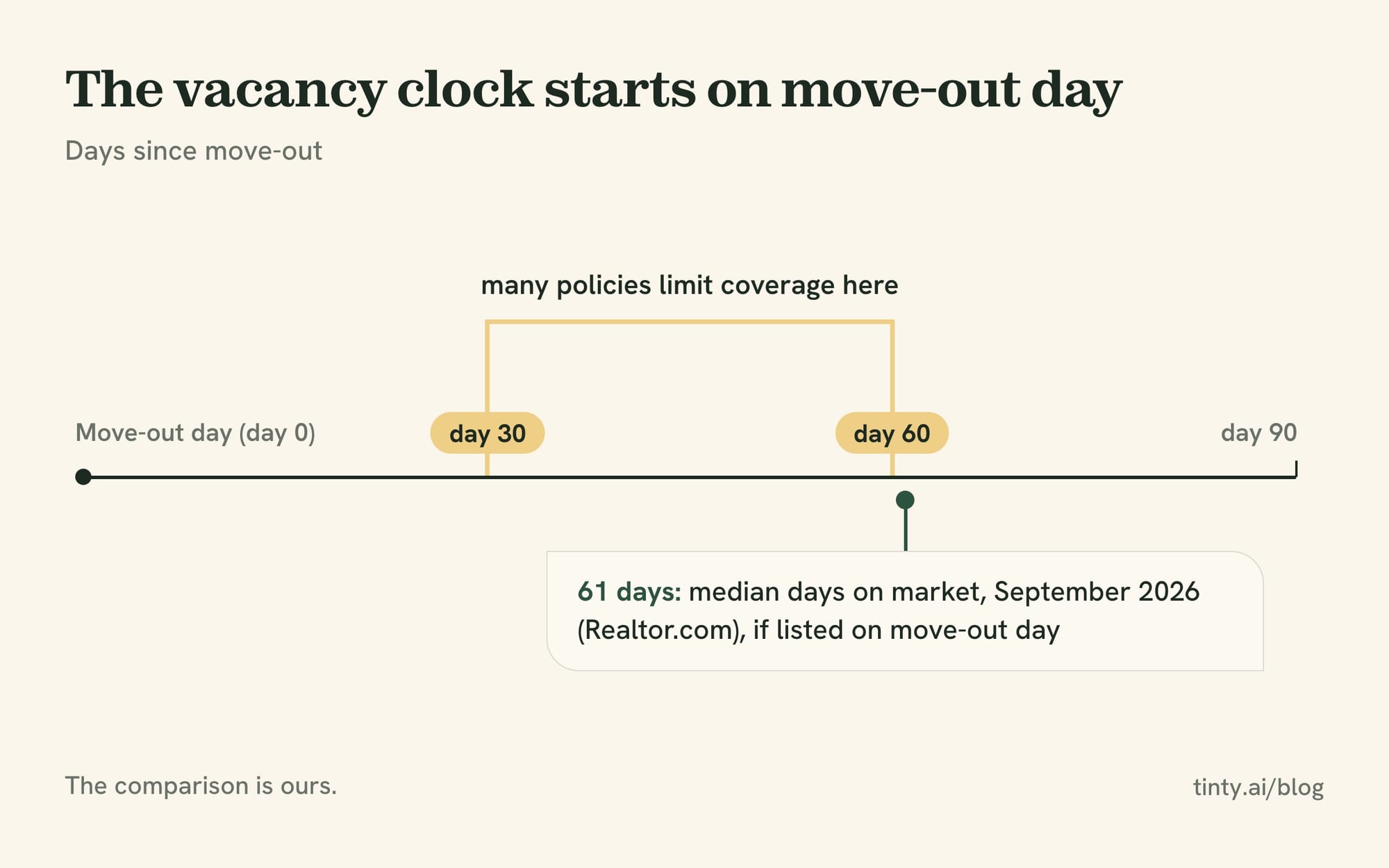
This fall the wait is long. In Realtor.com’s September 2026 housing report, homes had spent a median of 61 days on the market. Many insurers limit coverage after 30 or 60 days of vacancy. So a typical vacant listing can outlast its standard coverage (our inference, not a published figure).
Buyers may also pay less. A 2019 Redfin study of 2018 sales found vacant homes sold for $11,306 less than comparable occupied homes and took six days longer. The data is old, shows correlation only, and counted staged homes as vacant.
Example: the Insurance Information Institute (Triple-I) describes an inherited house that sat on the market through winter. After more than 60 days without a visit, a pipe burst in a hard freeze. Repairs were estimated at over $60,000, and the vacancy clause excluded the claim.
What an empty house costs each month: a worked example
An empty house costs about $100 a day to hold in our example. Selling a vacant property means paying for a home nobody uses, so show the seller this math with their own numbers.
Our inputs for one month:
- Mortgage: $2,085 in principal and interest. That’s 80% of September’s $419,250 median list price, borrowed for 30 years at 6.34%, last October’s average rate.
- Property tax: $369, from ATTOM’s average 2025 tax bill of $4,427.
- Insurance: $208, from NerdWallet’s average homeowners premium of about $2,490 a year.
- Utilities: $250 (our assumption).
- Upkeep: $150 for lawn, snow and cleaning (our assumption).
That adds up to $3,062 a month. Over 61 days it’s about $6,100, before any extra premium for a vacant policy. The rate is Freddie Mac’s 30-year average from a year ago, as if the seller had bought last fall. With no mortgage, such as a paid-off or inherited house, the same month costs $977.
The vacant-house checklist at a glance
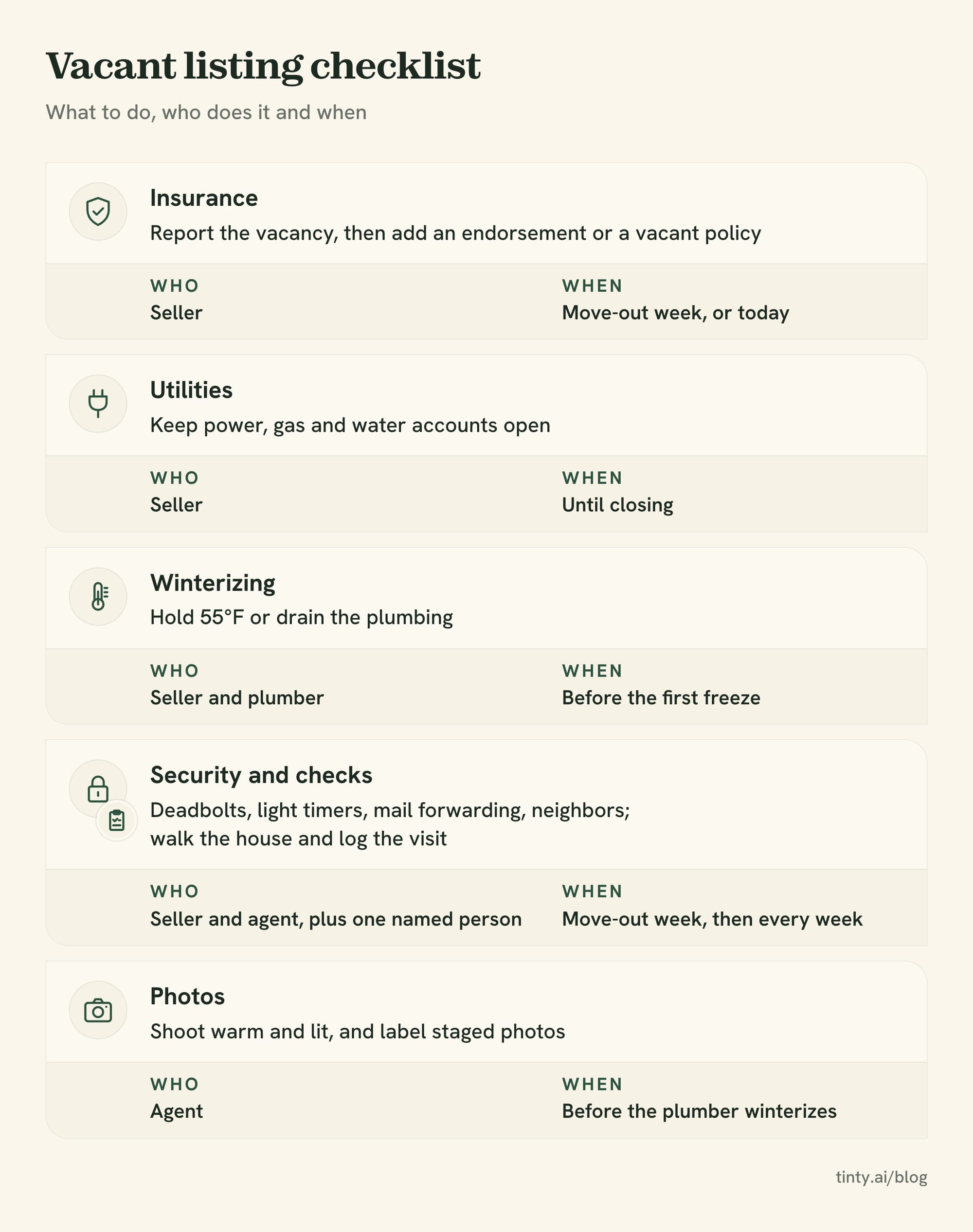
Six jobs cover the risks in this guide. The table shows who owns each job and when it’s due.
Vacant listing checklist: what to do, who does it and when
| Job | What to do | Who | When |
|---|---|---|---|
| Insurance | Report the vacancy, then add an endorsement or a vacant policy | Seller | Move-out week, or today |
| Utilities | Keep power, gas and water accounts open | Seller | Until closing |
| Winterizing | Hold 55°F or drain the plumbing | Seller and plumber | Before the first freeze |
| Security and checks | Deadbolts, light timers, mail forwarding, neighbors; walk the house and log the visit | Seller and agent, plus one named person | Move-out week, then every week |
| Photos | Shoot warm and lit, and label staged photos | Agent | Before the plumber winterizes |
Who checks the house: seller, agent or a paid service
Put one name on the weekly check, in writing, before the listing goes live. Triple-I’s checklist says to have a neighbor, family member or property manager check the home every week. It doesn’t name the agent.
The seller owns the house and the risk, so the seller picks the checker and confirms it by email. The usual choices:
- The seller or a relative: works when they live close enough to come by weekly.
- A neighbor: good for a quick look. The National Association of Realtors (NAR) suggests meeting the neighbors when a sale may take a while, in its safety tips for Realtors.
- A property manager or home-watch service: a paid visit with a report, for sellers who’ve left the state.
- The listing agent: only if your broker allows it and the listing paperwork says so.
What should the agent take on? One brokerage’s page, from Garrett Realty Partners, keeps the list short: give access, document the condition with photos, and pass messages between seller and vendor.
Watch out: the same page says not to hire vendors on the seller’s behalf. It’s one brokerage’s opinion on a partly AI-assisted page. Check your broker’s rules and your errors and omissions (E&O) policy before you take on the weekly check.
Each visit should leave a dated note. We’d log the thermostat reading, any water under sinks or on ceilings, locked doors and windows, and working lights. Send the note to the seller the same day.
Vacant home insurance: the 30-to-60-day clause
Vacant home insurance matters because a standard policy can stop paying for key losses once the house sits empty. Triple-I’s vacancy insurance explainer says most policies limit or exclude coverage after typically 30 to 60 consecutive days. NerdWallet’s vacancy coverage guide says 30 or 60.
After that point, NerdWallet lists four losses that may not be paid: broken glass, vandalism, burst pipes or other water damage, and theft.
A sample HO-3 homeowners policy form hosted by Triple-I shows how the wording can work. It drops vandalism and glass coverage once the dwelling has been vacant more than 60 consecutive days. It covers freeze damage only if you took reasonable care to keep the heat on, or shut off the water and drained the system.
Watch out: heat matters even with the right policy. Triple-I says failing to heat the home in winter could void coverage even under a vacant home policy.
The sample form is an old edition (form HO 00 03 10 00, copyright 1999). Real policies differ by insurer and state, so read the seller’s own vacancy wording.
Ask about liability too. Triple-I warns that liability coverage could be denied if someone is hurt at a showing in a home classed as vacant. The Texas Department of Insurance guide says insurers usually keep liability coverage going.
Vacant vs unoccupied: which one your listing is
A house with the furniture gone is usually vacant, which is the stricter category. NerdWallet describes a vacant home as completely empty or close to it. An unoccupied home still has enough furniture that someone could move back in at any time.
Your policy may define the two words differently, or not at all. The sample HO-3 form uses “vacant” in two clauses and never defines it.
Tip: physical staging puts furniture back in the rooms. We found no source saying a staged house stops being vacant, so have the seller ask the insurer in writing.
What vacant home insurance costs and how to buy it
Expect to pay more than a standard premium, but nobody publishes a solid figure. Triple-I and NerdWallet give no number. ValuePenguin’s coverage page says around 50% more, or about $500 a year, and shows no method.
Those two figures don’t match. On NerdWallet’s average premium of about $2,490 a year, 50% is $1,245. So the page implies $42 to $104 more a month. Treat that as an illustration and get a quote.
Start with the seller’s current insurer, because an endorsement on the existing policy may be enough. Separate vacant policies are often sold in 3-, 6- and 12-month terms. NerdWallet adds that you may be able to buy a longer term, cancel it and get a prorated refund.
Five questions to ask the insurer
Have the seller ask these questions the week they move out, and get the answers by email:
- When does the clock start? After how many consecutive days does the policy treat the house as vacant?
- What stops being covered? Ask about vandalism, glass, theft, water damage and liability by name.
- What does freeze coverage require? Heat on, water off and drained, or both?
- How often must someone check the house? And does the insurer want a log?
- Endorsement or new policy? What does each cost, and is there a refund at closing?
Keep the policy in force until the sale closes (our advice).
How long can a house be vacant?
We found no general legal limit on how long a house can sit vacant. The practical limit is the insurance policy, and that’s usually 30 or 60 consecutive days before coverage narrows. State Farm’s wording is “a month or more.”
Watch out: the clock runs from move-out day, not list day. The sample HO-3 form counts the consecutive days “immediately before the loss.” If the seller left in September and you list in November, day 30 or 60 may already have passed.
State regulators describe the same clock in different ways:
- Wisconsin: the insurance commissioner’s homeowners FAQ says an insurer can cancel the policy once the home has been vacant more than 60 days. Some coverages may be suspended even without a cancellation.
- Texas: the state guide says a company may refuse to renew when a house is vacant for 60 days or more.
- New York: a 2009 regulator letter says not living in a home isn’t, on its own, grounds to cancel a policy mid-term.
So a house can stay vacant as long as it’s insured, heated or drained, and checked. Some cities also register vacant buildings. We didn’t research local codes or homeowners association rules, so check both.
Utilities: what stays on until closing
Keep the power, gas and water accounts open in the seller’s name until closing. Heat, lights, inspections and some appraisals all depend on them.
What to do with each service:
- Electricity: leave it on. It runs the furnace controls, the lights for showings and any leak sensor or camera.
- Gas or heating fuel: leave it on, so the thermostat can hold 55°F.
- Water: keep the account open. Whether the main valve stays open is a winterizing choice.
- Internet: keep it if a Wi-Fi thermostat, leak sensor or camera depends on it (our advice).
- Mail: forward it. A USPS Hold Mail request lasts 30 days at most, so a hold won’t cover a listing period.
Rule: on a Federal Housing Administration (FHA) loan, the appraiser must ask to have the utilities turned on in a vacant property. If that isn’t feasible, the appraisal is completed subject to reobservation, per HUD Handbook 4000.1 (section II.D.3.f).
In plain terms, utilities that are off can mean a second appraiser visit. We confirmed that rule for FHA loans only.
Winterizing a vacant house for sale
Winterizing comes down to one choice: heat on, or water off and drained. Those are the two methods the sample HO-3 form names for freeze coverage.
Skipping the job is expensive. State Farm’s frozen-pipe claims data shows more than 20,000 claims from 2024 through June 2025, with over $628 million paid. The average payment topped $30,000. Those figures cover all homes, not vacant ones only.
Who does the work? In our view, a licensed plumber the seller hires and pays. Travelers’ water system guide says a licensed plumber can help if you don’t understand how the system is set up.
Heat on or fully winterized: three options
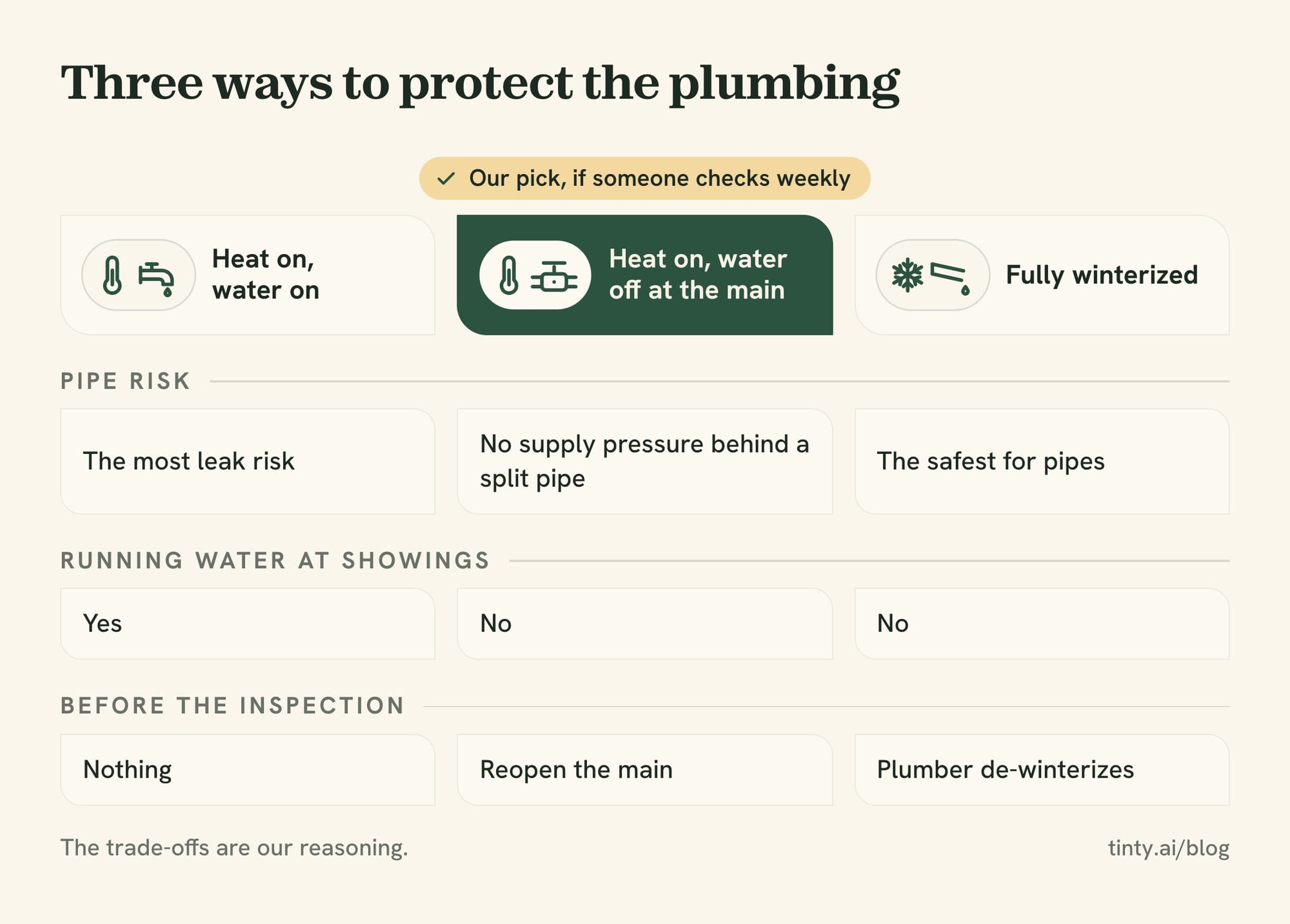
A listed house has three options, not two. Here’s how they compare when buyers are walking through:
- Heat on, water on: the house shows like a lived-in home, with working taps and toilets. It carries the most leak risk, so it needs weekly checks and a leak sensor.
- Heat on, water off at the main: the middle path. A split pipe has no supply pressure behind it. The plumber or the named checker reopens the valve for an inspection.
- Fully winterized: water off and lines drained by a plumber. It’s the safest for pipes, but there’s no running water at showings.
These trade-offs are our reasoning, not a sourced comparison. Our pick for a listed house in a cold state is the middle path, if someone checks weekly. Go fully winterized when nobody can.
Can the heat go off once the lines are drained? The sample HO-3 form accepts either method. Triple-I still warns that an unheated home could void coverage, so ask the insurer first.
Watch out: some houses can’t have the water shut off. A Cincinnati brokerage’s winterizing page says homes with steam heat or fire sprinklers may need the supply left on. With sprinklers, the sample HO-3 form requires both water and heat for freeze coverage.
Vacant home winterization checklist
Hand this checklist to the seller and the plumber. The steps come from the Red Cross frozen pipes page, This Old House’s winterizing guide, Triple-I and the brokerage page above.
- Service the furnace and clean the gutters before the house sits empty.
- Drain the outdoor lines: store the hoses, close the inside valves and open the outside hose bibs.
- Add a leak sensor and a thermostat that sends alerts to the seller’s phone.
- Set the thermostat to 55°F or higher, the same day and night.
- Open the cabinet doors under sinks.
- Shut off the water at the main.
- Drain the lines by opening faucets and flushing toilets.
- Ask the plumber about blowing out the lines and adding non-toxic antifreeze to toilet tanks.
Steps 1 to 3 apply to every vacant house. Steps 4 and 5 are for heat on. Step 6 adds the middle path, and steps 7 and 8 finish a full winterizing.
Antifreeze isn’t a DIY step. The Red Cross calls it dangerous to people, pets, wildlife and landscaping, so leave it to the plumber.
We couldn’t verify a retail price for this work. HUD caps what it repays loan servicers for winterizing a vacant home with a defaulted FHA loan at $100 to $250, depending on the heating system. Those caps come from HUD’s 2016 fee letter and were unchanged in its 2024 handbook. A retail plumber will likely charge more, and our estimate is a few hundred dollars.
Empty house winter thermostat setting: 55°F minimum
Set the thermostat to at least 55°F. The Red Cross, Triple-I, State Farm, Travelers and the Insurance Institute for Business & Home Safety (IBHS) all give that number. We found no authoritative source that asks for more.
Hold it day and night, as the Red Cross advises. Pipes can freeze once the temperature drops below 32°F, whether they’re plastic or copper, per State Farm’s winter prep notes.
That’s a floor for a vacant house in winter, not a comfort setting. Warm the house before buyers arrive.
De-winterizing for the inspection: who orders and who pays
A fully winterized house has to be de-winterized before the home inspection, and the seller’s plumber should do it. Under the InterNACHI Standards of Practice, an inspector isn’t required to operate a system that’s shut down or to open shut-off valves.
Settle three things in writing before the inspection is booked. Who orders the plumber? Who pays for the de-winterize, and for a re-winterize if the deal stalls? How much notice does the plumber need?
Don’t do it yourself. Adam Garrett of Garrett Realty Partners writes that it isn’t wise for an agent to accept the liability of winterizing or de-winterizing a house. We agree. Your part is the note in the agent remarks: “winterized” or “heat on, water off at main.”
Vacant home security: make the house look lived in
Security starts with not advertising that the house is empty. NAR’s safety tips tell agents never to describe a listing as vacant, because that may invite criminals. We read that as the public remarks, not the agent-only ones.
Insurers and NAR recommend these measures:
- Locks: deadbolts on every exterior door, and keys handled through your office’s lockbox procedure.
- Lights: timers on a few interior lamps, and motion-sensor lights outside.
- Alarm and sensors: an alarm system, plus leak sensors and a doorbell camera that send phone alerts.
- Driveway: ask someone to park there now and then.
- Yard and walks: mow, and clear snow and ice, so the house doesn’t look abandoned and nobody slips at a showing.
- Neighbors: introduce yourself and leave your number.
Most of these come from State Farm’s vacant house tips, NerdWallet and Triple-I. Camera and recording rules vary by state, and we didn’t research them, so ask your broker.
Watch for hijacked listings too. The FTC’s rental scam warning says scammers copy a real listing’s photos and description and swap in their own contact details. A for-sale house with nobody in it suits that scam (our reading). Tell the neighbors the house is for sale, not for rent.
Squatter laws: what changed since 2024
More than a dozen states have passed anti-squatter laws since 2024, many with a faster removal process. These laws target trespassers with no lease, not tenants who stay past one.
Three examples:
- Florida (HB 621): an owner can ask law enforcement to remove a squatter immediately if three conditions are met, per the governor’s signing announcement. The law took effect July 1, 2024, Newsweek reported.
- Texas (SB 1333): in effect since September 1, 2025, per the Texas bill history. The owner or agent can file a sworn complaint with the sheriff or constable, per a Lubbock Apartment Association summary.
- Kansas (HB 2378): approved April 6, 2026, per the Kansas session law. The owner or the owner’s agent submits a notarized affidavit to law enforcement.
The National Apartment Association counted 13 states with new or added laws in 2025, as of June 3. This isn’t legal advice. If someone moves in, call the seller, your broker and a local attorney.
How to make the house feel warm for showings
Warm the house before the buyer arrives, light every room, and reset everything when you leave. A house held at 55°F feels cold, and empty rooms show every cobweb.
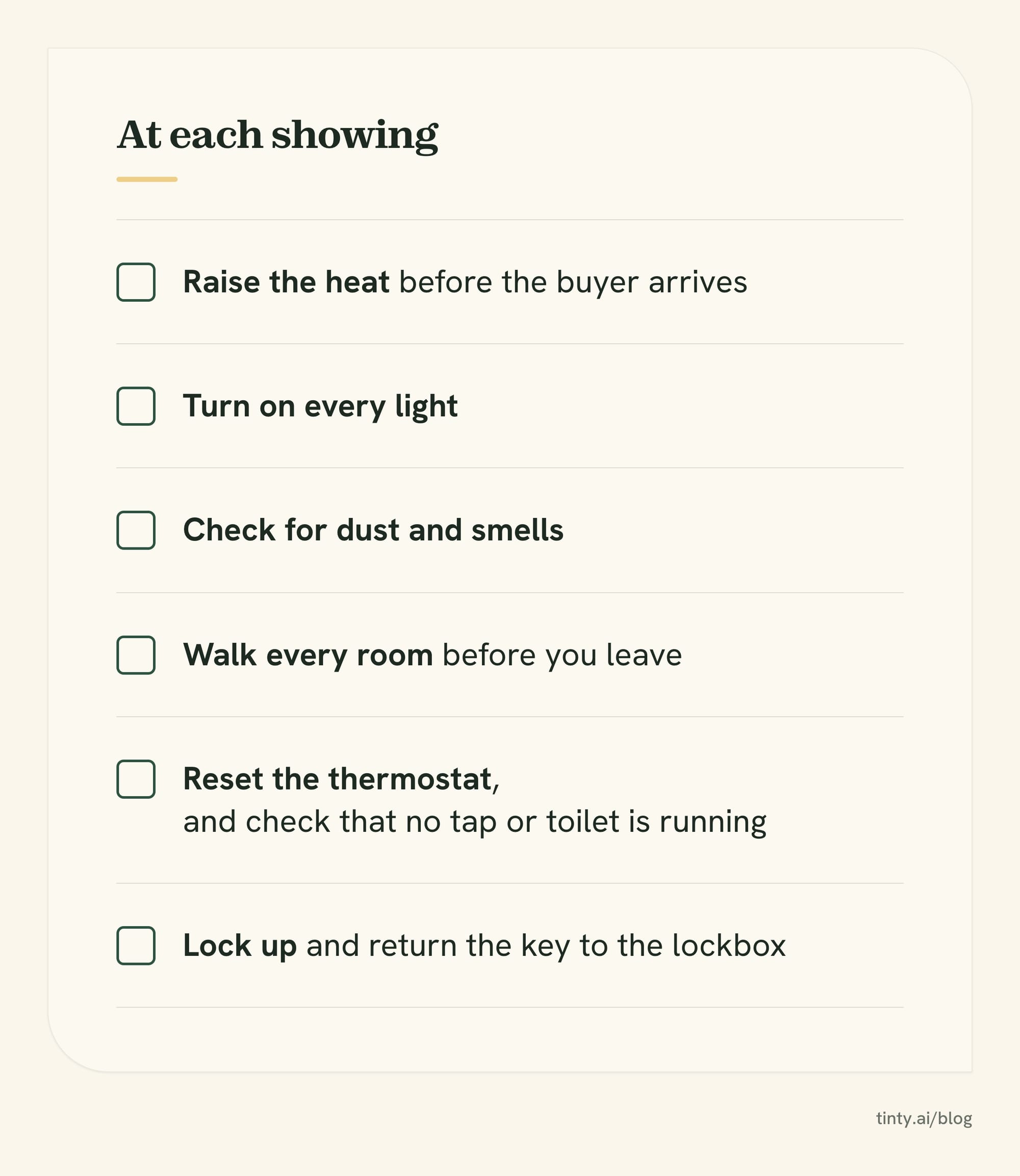
Run these six steps at each showing:
- Raise the heat before the buyer arrives. One brokerage says many sellers hold a listed home at 60 to 65°F.
- Turn on every light. NAR advises showing before dark and lighting rooms as you go.
- Check for dust and smells. HomeLight’s seller tips article suggests a cleaning every three weeks.
- Walk every room before you leave. NAR’s open-house tip says not to assume everyone has left.
- Reset the thermostat, and check that no tap or toilet is running.
- Lock up and return the key to the lockbox.
You won’t be at every showing. Put steps 5 and 6 in the showing instructions and on a card by the thermostat. The 60 to 65°F range is one brokerage’s practice from a 2016 post, not a standard.
Listing photos: shoot before you winterize
Shoot the photos while the house is warm, lit and free of winterizing notices. Then decide which rooms to stage. We think empty rooms photograph smaller and colder than they are, but we have no study for it.
In NAR’s 2025 Profile of Home Staging, 83% of buyers’ agents said staging helped buyers picture a property as their future home. In the survey’s press release, 73% called photos highly important to their clients. The survey covers staging in general, not vacant homes or virtual staging.
A photo-day order for a vacant listing (our advice):
- Shoot first. Book the photographer before the plumber, so no notices or taped-off fixtures show.
- Warm and light it. Turn the heat up, switch on every light and open the blinds.
- Clear leftovers. Remove the odd chair, the boxes and the cleaning gear.
- Pick the rooms to stage. Buyers’ agents rank the living room (37%), primary bedroom (34%) and kitchen (23%) highest.
Stage, virtually stage or leave it empty? Physical staging helps the photos and the showings, at a $1,500 median for a staging service in NAR’s survey. Virtual staging helps the photos only, so buyers still walk into empty rooms. Leaving it empty costs nothing, but take out what the seller left behind.
Staging company founder Justin Riordan told HomeLight that full staging is best, completely vacant is second best, and halfway done is worst.
Virtual staging with TINTY: prices and limits
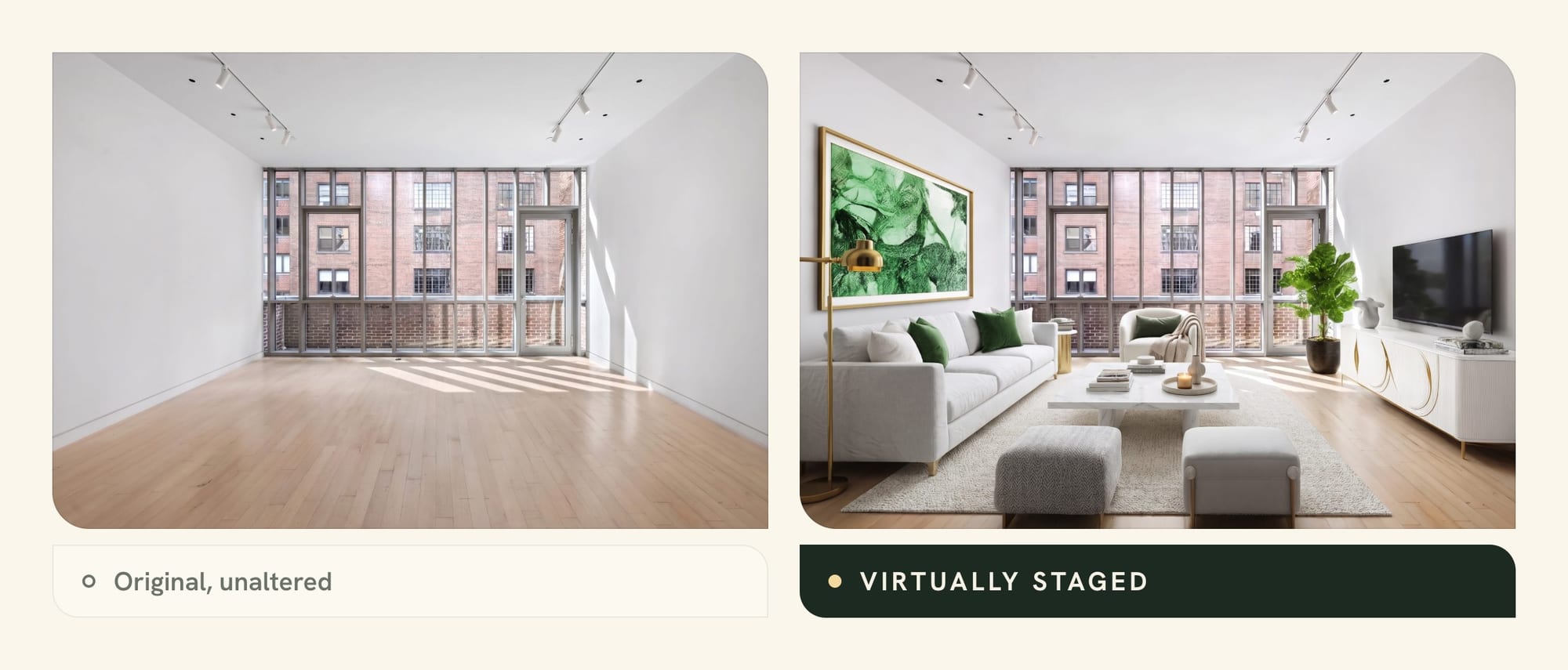
Virtual staging adds furniture to a photo of an empty room. Our guide explains what virtual staging is. We make TINTY, so weigh this part with that in mind.
Free previews are watermarked, take about 30 seconds and need no card. Clean photos start at $9 a month for 4 photos, or $29 for a pack of 10.
What TINTY doesn’t do:
- Room types: the app has no kitchens, bathrooms or exteriors.
- Decluttering: it doesn’t remove the seller’s furniture or boxes.
- Free images: the watermark must stay, so they’re for the seller’s approval, not the multiple listing service (MLS).
No time to stage photos yourself? Email them to TINTY Studio at hello@tinty.ai with the style and what each room is for (a floor plan helps). Our team stages them with TINTY’s AI tools, finishes every photo by hand and sends a private link within 2 to 24 hours. It’s $10 a photo from 3 photos, with no account or prepayment: you pay only if you’re happy.
For other vendors, see our breakdown of virtual staging cost and the best free virtual staging apps. Virtual staging fixes the photos. It doesn’t fix a cold showing, an insurance gap or the price.
Try a free TINTY preview on your own empty-room photo.
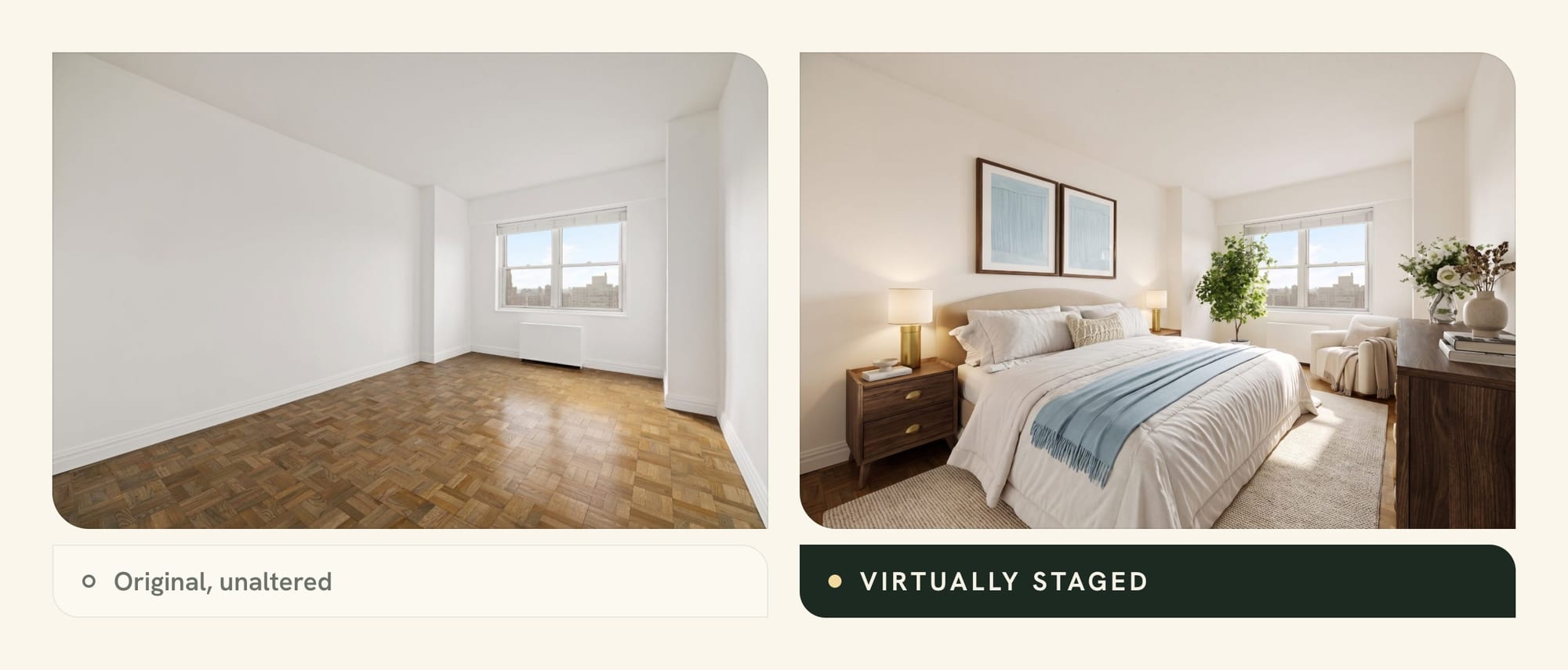
Label every staged photo and keep the original
Every virtually staged photo needs a label, and the original empty-room photo should stay in the gallery. Most of the rules we read share that pattern.
Rule: California’s AB 723 disclosure law has applied since January 1, 2026. You must disclose that a listing image was altered and give access to the unaltered version. Wisconsin’s Act 69 takes effect January 1, 2027.
In other states, Article 12 of NAR’s Code of Ethics asks Realtors for a true picture in their advertising. Your MLS decides where the label goes, and the rules conflict. California Regional MLS wants it in the photo’s text field. Canopy MLS wants it on the image itself.
Stage furniture only. Never edit out damage or add features the house doesn’t have. For state laws and MLS rules, see is virtual staging legal.
Selling a vacant house from out of state
When the seller lives far away, write down who does what before the listing goes live. Selling a house out of state is mostly a logistics and paperwork problem.
In HomeLight’s out-of-state selling guide, Phoenix agent Geoffrey Adams says a good agent serves as the seller’s eyes and boots on the ground. That doesn’t make the agent the plumber or the house-sitter.
Sort out four things in the first week:
- Duties in writing: who checks the house, who meets vendors and who gets the reports.
- Vendors: the seller hires and pays the plumber, the cleaner and the lawn or snow service.
- Signing: ask the title company about a mail-away closing or remote online notarization (RON).
- Power of attorney: HomeLight advises working with an attorney, because every state has its own rules.
Most states now allow RON. Whether your closing can use it depends on the state, the title company, the lender and the county recorder. Connecticut bars it for local real estate closings, according to notarization vendor Proof.
Photo approval works by email. If you stage virtually, send the seller the previews, get a yes, then order the final files.
Tips for selling a vacant house faster
The best tip is to cut the days the house sits, because each one costs about $100 in our example. If you’re asking how to sell a vacant house in a slow market, start with the calendar.
Four moves, in the order we’d take them:
- Price for today’s market. Realtor.com counted price cuts on 20.8% of active listings in September.
- Keep it show-ready. Clean on a schedule, and fix small problems the week they appear.
- Compare the spend on photos. Carrying the house costs about $3,000 a month. A staging service runs a $1,500 median. Virtual staging on TINTY starts at $9 a month for 4 photos, and it changes the photos only.
- Set a review date. At day 30, review the price, the photos and the insurance clock together, before it turns into a stale listing.
Selling a vacant house: FAQ
How long can a house be vacant before insurance stops covering it?
Usually 30 or 60 consecutive days, but the policy sets the number. The count runs from move-out day, not list day. After that, many insurers limit or exclude losses such as vandalism, broken glass, theft and water damage. Have the seller ask the insurer in writing, then add an endorsement or buy a vacant home policy.
Do I need vacant home insurance when selling a house?
You need it if the house will sit empty past the policy’s vacancy limit. With a 61-day median on the market this fall, many listings will. The seller should call the insurer the week of move-out. An endorsement on the current policy may be enough.
Show 6 more questionsShow fewer questions
What temperature should a vacant house be in winter?
At least 55°F, day and night. The Red Cross, Triple-I, State Farm, Travelers and IBHS all give that floor, and we found no authoritative source that requires more. Raise the heat before showings. One brokerage says many listed homes are kept at 60 to 65°F.
Should utilities stay on when selling a vacant house?
Yes. Keep the electric, gas and water accounts open until closing. The furnace needs power and fuel, showings need lights, and inspectors don’t have to operate systems that are shut down. On an FHA loan, utilities that are off can mean a second appraiser visit.
Can you show and sell a winterized house?
Yes, but plan for it. Tell showing agents the water is off, and note the status in the agent remarks. Before the home inspection, the seller’s plumber has to de-winterize the house. Agree in writing who orders that, who pays and how much notice the plumber needs.
How much does it cost to winterize a vacant house?
We couldn’t verify a retail price, so our estimate is a few hundred dollars. Get a local plumber’s quote. The only primary figures we found are HUD’s caps for vacant homes with defaulted FHA loans. They run $100 to $250 to winterize and $50 to re-winterize.
Do vacant houses sell for less?
They did in the one large study we found. Redfin’s 2019 study of 2018 sales put the gap at $11,306, or 3.6%, plus six extra days on the market. The data is old and shows correlation only. The gap also varied by metro: in San Jose it was 0.9%.
Can you sell a house while out of state?
Yes. A local listing agent handles access and showings, and the seller hires and pays the vendors. Ask the title company early about a mail-away closing or remote online notarization, because the rules depend on the state, the lender and the county. Put the agent’s duties in writing.
How we researched this
On October 2, 2026, we re-read most of the sources cited here. They include insurers, three state insurance regulators, the Red Cross, NAR, HUD documents, state laws and market reports. The disclosure sources were checked a day earlier for our virtual staging law article.
We couldn’t verify retail winterizing prices. The only retail figure here is our own rough estimate. We ran no tests for this article. It’s general information, not insurance, legal or tax advice.
Sources
Insurance
- Triple-I Blog, “When No One’s Home: Understanding Role of Vacancy Insurance” (Loretta L. Worters, June 3, 2025)
- Sample HO-3 form (ISO HO 00 03 10 00, copyright 1999), hosted by Triple-I
Show 43 more sourcesShow fewer sources
- NerdWallet, “Unoccupied and Vacant Home Insurance: What to Know” (Sarah Schlichter, updated April 17, 2026)
- NerdWallet, average cost of homeowners insurance (updated May 6, 2026)
- State Farm, “Ways to Help Protect Your Vacant House After Moving”
- Wisconsin Office of the Commissioner of Insurance, PI-232 homeowner’s insurance FAQ (updated March 3, 2023)
- New York Department of Financial Services, Supplement No. 1 to Insurance Circular Letter No. 23 (2008), April 7, 2009
- Texas Department of Insurance, home insurance guide
- ValuePenguin, “How to Get Unoccupied & Vacant Home Insurance” (Matt Timmons, updated June 11, 2026)
Winterizing, utilities and inspections
- American Red Cross, “Frozen Pipes”
- Travelers, winterize your home water system
- IBHS news release (January 10, 2023)
- State Farm newsroom, frozen pipe claims (January 20, 2026)
- State Farm newsroom, “Winter Prep 101” (December 20, 2024)
- This Old House, “How To Winterize Your Vacant Home” (Nina Malkin, updated May 28, 2026)
- Platinum Service Realty (Cincinnati), “The Winterization Checklist for Vacant Homes” (published December 30, 2016, per page metadata)
- Garrett Realty Partners, Adam Garrett, on agents and winterizing (September 26, 2025; partly AI-assisted page)
- HUD Mortgagee Letter 2016-02 (February 5, 2016)
- HUD Handbook 4000.1, section II.D.3.f, “Utilities - Mechanical Components”, and Appendix 7.0 (edition issued May 20, 2024)
- InterNACHI Home Inspection Standards of Practice (revised October 2022)
- USPS Hold Mail
Security and squatter laws
- NAR, “56 Safety Tips for REALTORS®”
- FTC, “Rental Listing Scams”
- Florida Governor’s Office, HB 621 signing announcement (March 27, 2024)
- Newsweek on the Florida and Georgia squatter laws (July 1, 2024)
- Texas Legislature Online, SB 1333 bill history
- Lubbock Apartment Association on Texas SB 1333 (October 24, 2025)
- Kansas 2026 Session Laws, chapter 56, HB 2378
- National Apartment Association, “Anti-Squatter Legislation Continues Momentum” (June 3, 2025)
Market data and costs
- Realtor.com September 2026 Housing Report, press release (September 30, 2026)
- Redfin, “Should I Wait to Move Out Until After I Sell My Home?” (May 17, 2019, updated October 7, 2020; 2018 sales)
- Freddie Mac, “Mortgage Rates Average 7.28%” (October 1, 2026; it gives 6.34% as the average a year earlier)
- ATTOM, 2025 property tax report (April 9, 2026)
- NAR, 2025 Profile of Home Staging, report page
- NAR press release on the 2025 Profile of Home Staging (May 6, 2025)
Showings and out-of-state sales
- HomeLight, “Is it easier to sell a vacant home” (April 2, 2025; modified October 1, 2026)
- HomeLight, “How to Sell a House From Out of State” (April 15, 2026)
- Proof, “Is Remote Online Notarization Legal and Available in All States?” (Phil Motto, updated July 8, 2026)
Disclosure rules (checked October 1, 2026, for our virtual staging law article)
- California Business and Professions Code §10140.8 (AB 723)
- 2025 Wisconsin Act 69, official text
- NAR Code of Ethics and Standards of Practice, effective January 1, 2026
- CRMLS, Digitally Altered Image Guidance & FAQs (updated July 24, 2026)
- Canopy MLS, Digital, Virtually Staged, and AI-enhanced Images (February 27, 2026)
TINTY
- TINTY (ours): tinty.ai · pricing · terms (last updated September 25, 2026)
- Our related guides: What is virtual staging · Virtual staging cost · Best free virtual staging apps