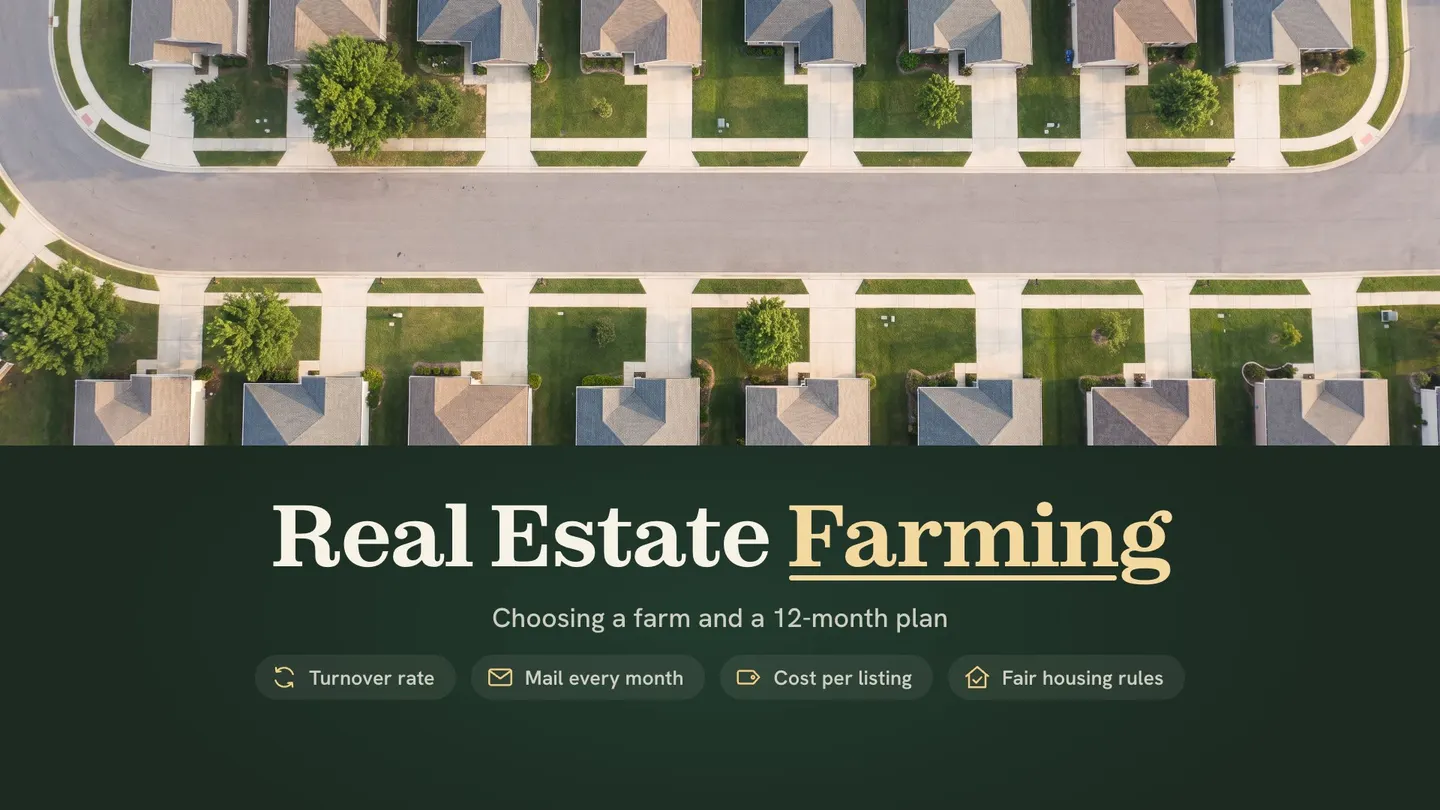
What is farming in real estate? It means marketing to the same neighborhood every month for a year or more, so owners know your name before they decide to sell. A farm is often a few hundred homes. Agents reach them with postcards, door knocking, events and local posts, and listings grow slowly from that recognition.
We make TINTY, an AI virtual staging app, which appears in one section below. Every postcard line and script here is an example we wrote, and the rules section is general information, not legal advice.
Key takeaways
- One area, many touches: farming means marketing to the same few hundred homes for a year, not one big mailing.
- Pick by numbers: divide homes sold in the last 12 months by homes in the area. Guides put the bar between 5% and 12%.
- Be the agent they call: in a 2025 National Association of Realtors (NAR) survey, 80% of sellers contacted only one agent.
- Follow the rules: choose a farm by homes and sales, never by who lives there, and respect Do Not Call, text and mailbox rules.
On this page: What farming is · Choosing a farm · 12-month plan · Just listed cards · Budget · Results · Rules · FAQ
What is farming in real estate? Geographic farming explained
Geographic farming is the main kind: you pick one area and market to every home in it, month after month. When an owner there decides to sell, yours is the name they already know.
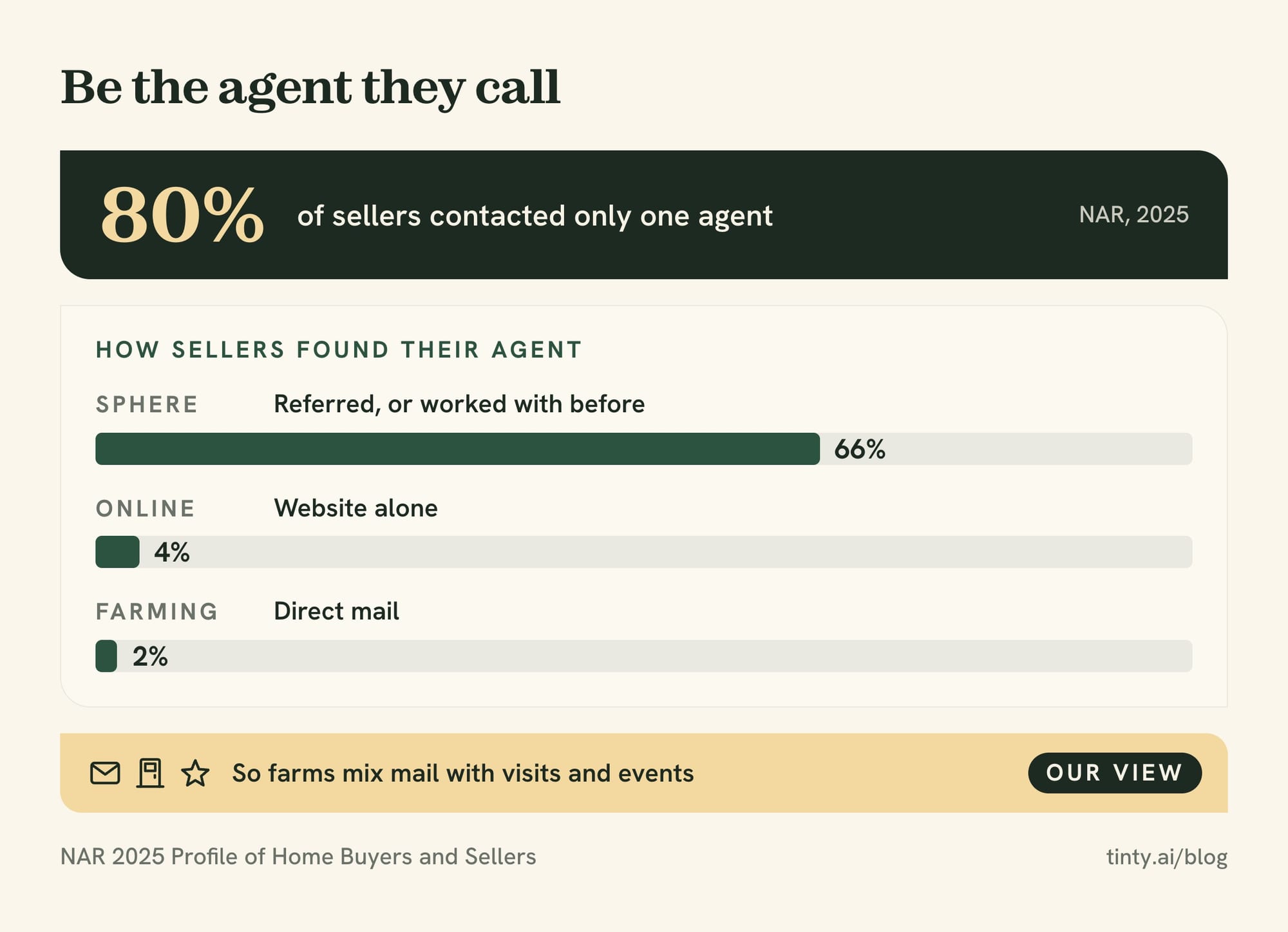
That matters because most sellers don’t shop around. In NAR’s 2025 Profile of Home Buyers and Sellers, 80% of sellers contacted only one agent before choosing. Seller figures come from people who bought from July 2024 to June 2025 and also sold.
How sellers found their agents, per the same survey:
- Sphere: friends, family and past clients. 66% of sellers used an agent they were referred to or had worked with before.
- Online: strangers who find you on the web. Only 4% of sellers found their agent through a website alone.
- Farming: owners in one area who see your name every month. Only 2% of sellers found their agent through direct mail, so farms mix mail with visits and events (our view).
Farming is one form of real estate prospecting, and it works best next to your sphere, not instead of it (our view). Our guide on how to get listings covers the other channels.
Some guides also describe “demographic farming,” which targets a type of client instead of a place. If you try it, read the fair housing rules below first.
How to choose a farm area
Choose a farm by its numbers first: how often homes sell, how big it is and who already works it. Then check that it fits your price range, budget and time.
Check the turnover rate
The turnover rate shows how often homes in an area change hands. Pull the numbers from your multiple listing service (MLS) and county property records, then work it out in three steps:
- Count the homes in the area.
- Find how many sold in the last 12 months.
- Divide sales by homes and multiply by 100.
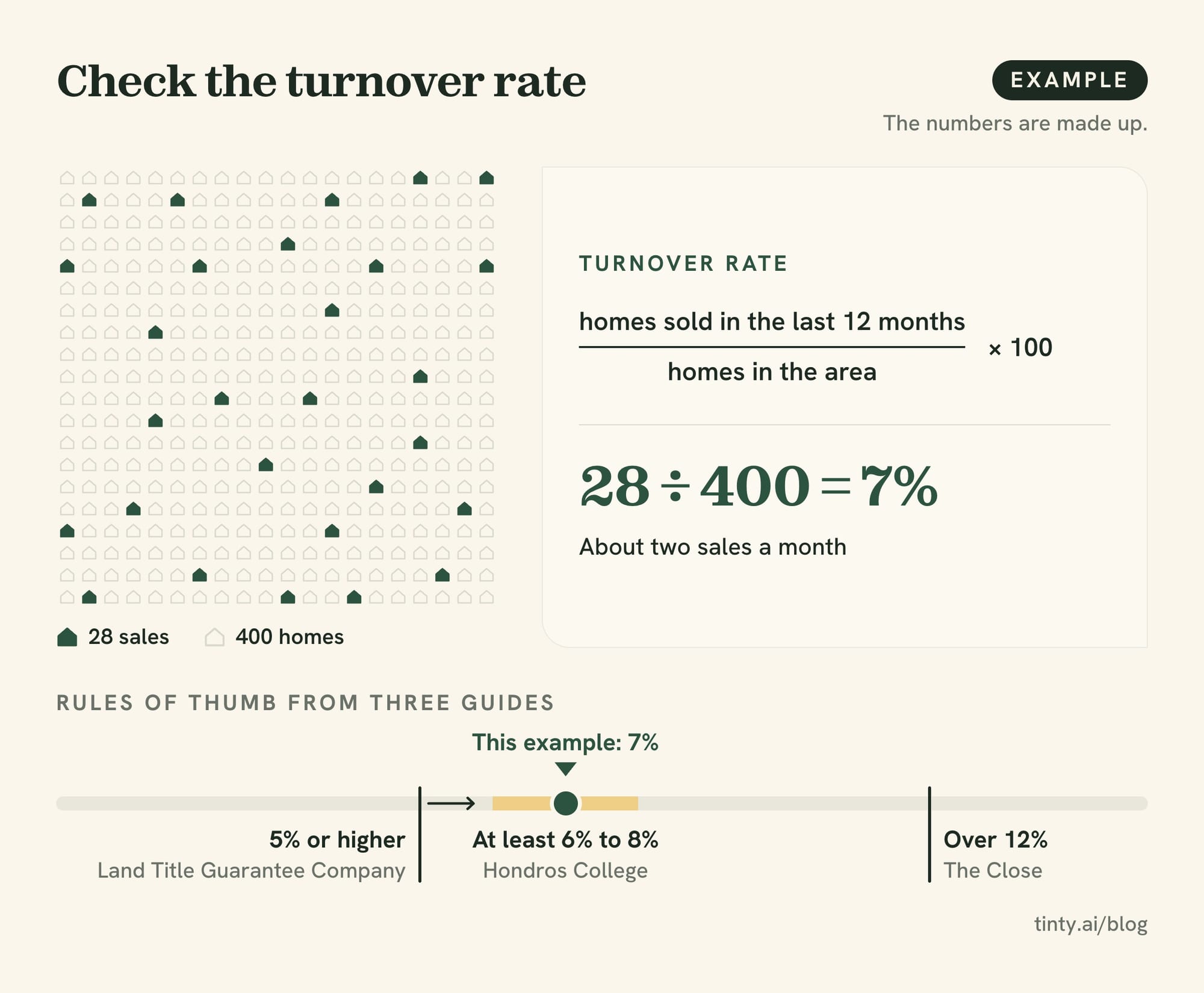
Example: a subdivision has 400 homes, and 28 sold in the last 12 months. 28 ÷ 400 = 0.07, so the turnover rate is 7%. That’s about two sales a month. The numbers are made up.
There’s no official benchmark. Land Title Guarantee Company’s farming guide suggests 5% or higher, and Hondros College’s guide says to aim for at least 6% to 8%. The Close’s writer calls anything over 12% pretty good. Treat these as rules of thumb, not law.
Size, competition and fit
After turnover, check five more things (our checklist):
- Size: start small enough to reach every month. The Close suggests 100 to 250 homes, and Market Leader 500 or fewer.
- Competition: look up who listed homes there last year. If one agent holds most listings, expect a long climb or pick another area.
- Fit: choose a price range and home type you can price well, ideally near where you live or work.
- Budget: multiply homes by mailings per year by cost per piece before you commit.
- Access: make sure you can walk it. Gated communities and some buildings limit door knocking.
Choose by homes and sales, never by who lives there.
A 12-month real estate farming plan
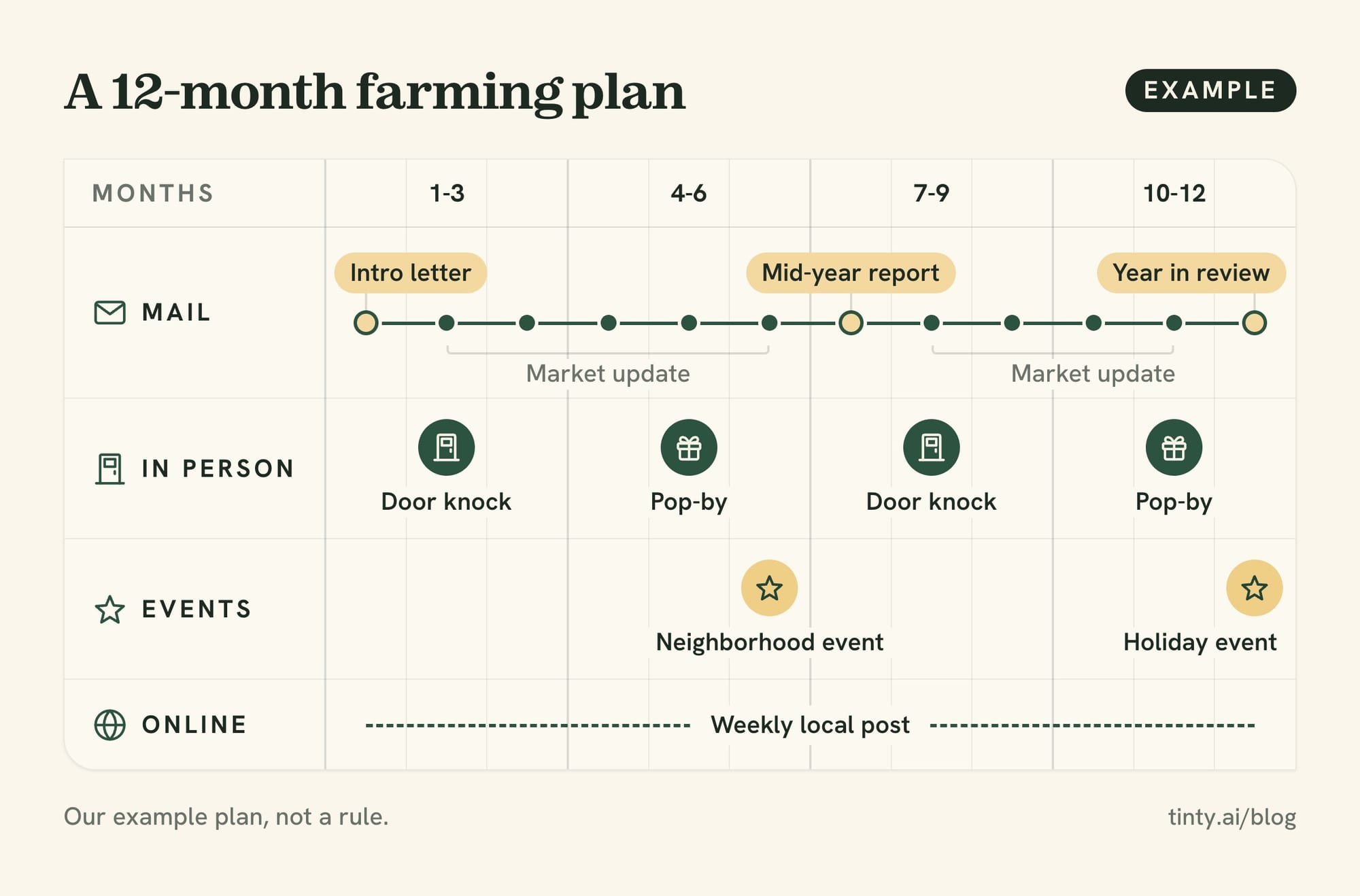
A farm runs on rhythm: mail every month, a visit every quarter, two events and a light online layer.
A sample farming year. Our example plan, not a rule.
| Months | Mail every month | In person | Online and events |
|---|---|---|---|
| 1-3 | Intro letter, then market updates | Door knock with a market report | Start a farm page; post weekly |
| 4-6 | Market updates; just listed and just sold cards | Spring pop-by | One neighborhood event |
| 7-9 | Mid-year report; listing cards | Second door-knock round | Invite the farm to an open house |
| 10-12 | Year-in-review report | Holiday pop-by | Holiday event; review results |
Monthly mail: market updates and listing cards
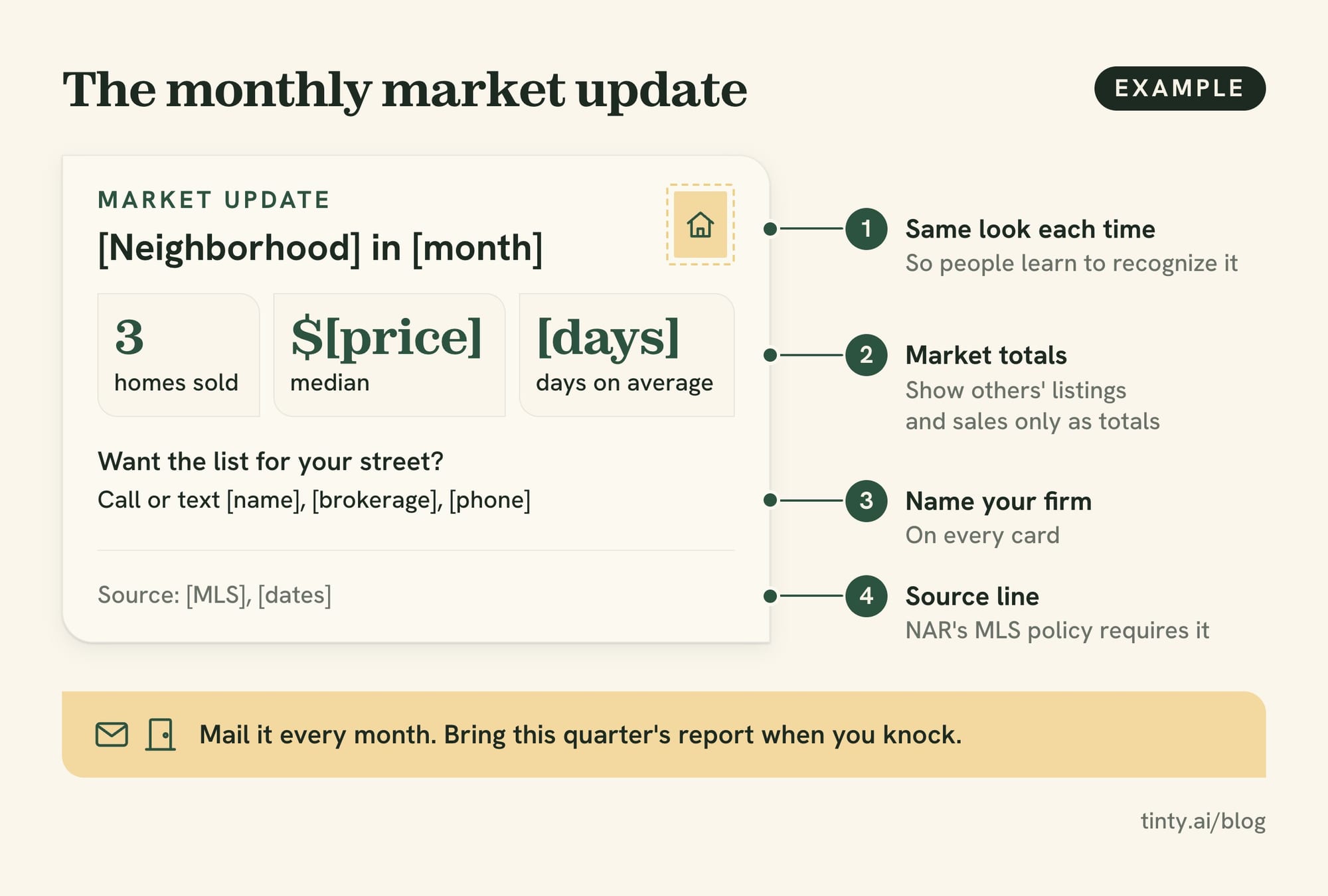
Send something every month, with the same look each time so people learn to recognize it. A market update is the backbone: homes sold, median price and days on market in the farm. Add a just listed or just sold card within a few days of each of your own listings or sales there.
Example postcard (market update): “[Neighborhood] in [month]: 3 homes sold, at a median of $[price], in [days] days on average. Want the list for your street? Call or text [name], [brokerage], [phone]. Source: [MLS], [dates].”
Pull the numbers from your MLS monthly. NAR’s MLS policy requires the source line.
Watch out: NAR’s Code of Ethics lets only Realtors who took part in a sale claim they “sold” it (Standard of Practice 12-7). Standard of Practice 12-4 bars advertising property without authority, so show others’ listings and sales only as market totals.
Quarterly visits: door knocking and pop-bys
Door knocking puts a face to the name on the postcard. Bring something useful, such as this quarter’s market report, and keep each stop to a minute or two. Two door-knock rounds and two pop-bys give you four visits a year (our plan).
Example door-knock opener: “Hi, I’m [name] with [brokerage]. I send the monthly market update for [neighborhood]. Here’s this quarter’s report. Any questions about your street?”
If an owner pushes back, see our objection handling scripts.
For small seasonal gifts, see our pop-by ideas for realtors. Some owners in your farm may have an expired listing or be selling on their own (FSBO). Our expired listings guide and FSBO scripts cover those conversations.
Events and a simple online layer
Events give neighbors a reason to meet you, such as a shred day, a park cleanup or a holiday photo booth (our ideas). When you hold an open house in the farm, invite the neighbors first, as in our open house ideas.
Keep the online part small:
- Posts: one local post a week, such as a market note or a new cafe, with your brokerage named.
- Email: send it only to owners who asked for your updates, and include an opt-out.
- Ads: Facebook and Instagram housing ads run under special targeting limits (see the rules).
Just listed cards for empty homes in your farm
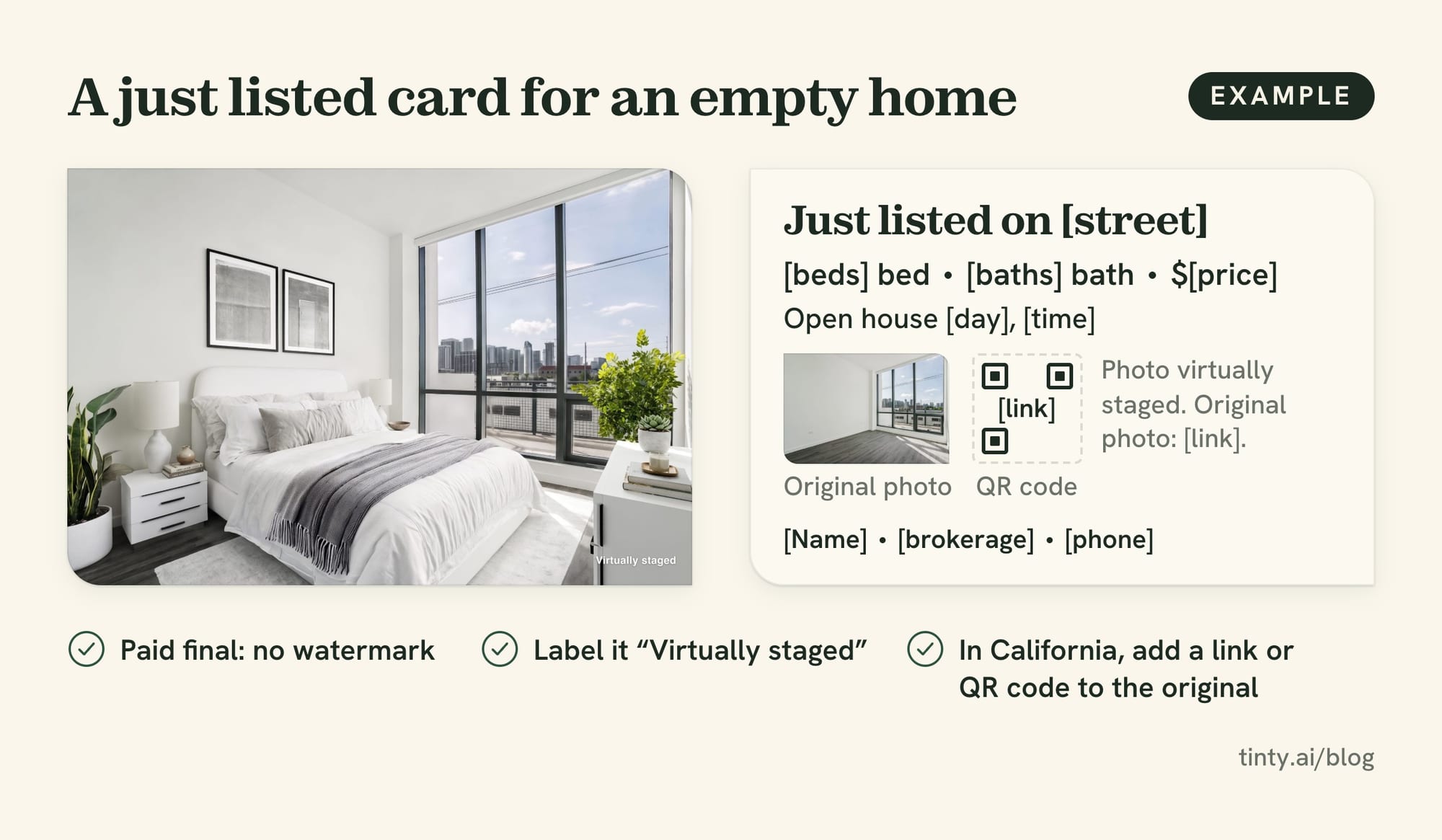
When you list an empty home in your farm, its just listed card shows every neighbor how you market a home, and bare rooms make it weak. A virtually staged room shows how the space works (our view).
How to stage the photo for the card:
- Pick the photo: an empty living room, studio or bedroom from your listing.
- Make previews: upload it to stage the room free with TINTY on a phone or laptop, no card needed. Previews take about 30 seconds and carry a light TINTY watermark.
- Render the final: a paid final has no watermark, and the 2K file suits print up to letter size.
- Label it: add the “Virtually staged” label when you download. In California, also add a link or QR code to the original.
Our guide on whether virtual staging is legal covers MLS disclosure rules.
Example postcard (just listed): “Just listed on [street]: [beds] bed, [baths] bath, $[price]. Open house [day], [time]. Photo virtually staged. Original photo: [link]. [Name], [brokerage], [phone].”
TINTY stages empty living spaces only, in 9 room types. It doesn’t stage kitchens, bathrooms, building exteriors or yards.
What farming costs: postage and a sample budget
Postage is the steady cost. USPS Every Door Direct Mail (EDDM) mails every address on a carrier route without a mailing list. Here are the EDDM Retail rules from USPS, checked on October 13, 2026:
- Price: $0.26 a piece for flat-size marketing mail up to 3.3 ounces.
- Volume: at least 200 and up to 5,000 pieces per day per ZIP Code, so a farm under 200 homes mails whole routes or uses addressed mail.
- Address: “Postal Customer,” delivered to every address on the routes you pick.
- Size: longer than 10-1/2 inches, taller than 6-1/8 inches or thicker than 1/4 inch (Domestic Mail Manual 143). A standard 4-by-6 postcard doesn’t qualify.
Example: 400 homes times 12 mailings is 4,800 pieces. At $0.26 each, postage comes to $1,248 a year, before printing.
Printing, gifts and events add more. The Close’s sample budget for a 250-home farm comes to about $11,000 in startup costs, including a $3,500 neighborhood website. You can start leaner with mail and visits only (our view).
Draw your farm’s edges along carrier routes, so one EDDM order covers it. In the EDDM map tool, skip the age, income and household size filters (our tips).
How to measure farming results
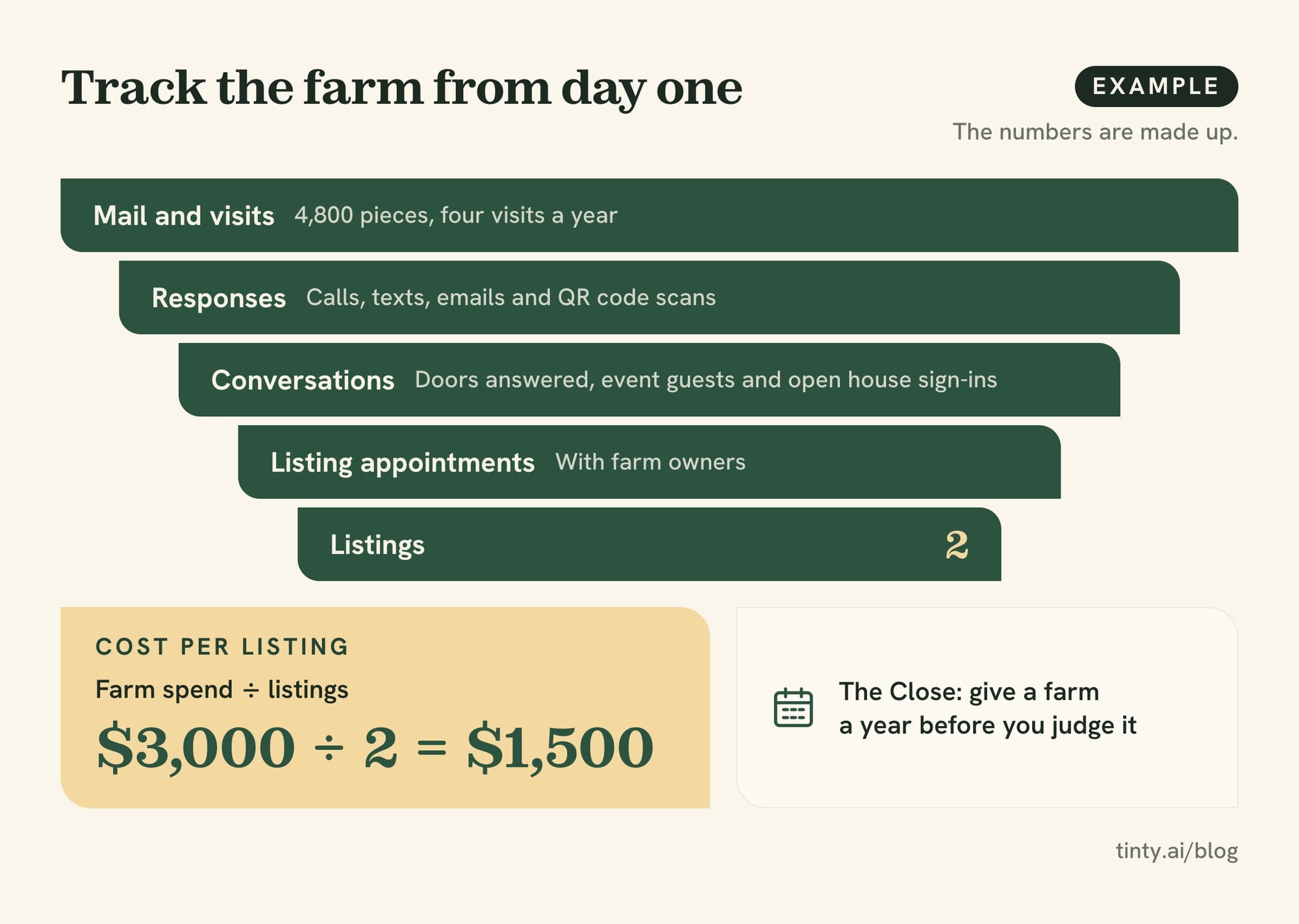
Judge a farm by listings and cost per listing, not by postcards sent. To see if farming for real estate leads pays off, record where each lead came from. Track these from day one in your customer relationship management (CRM) tool or a spreadsheet:
- Responses: calls, texts, emails and QR code scans that mention the farm.
- Conversations: doors answered, event guests and open house sign-ins from the farm.
- Appointments: listing appointments with farm owners.
- Listings: each listing and closing, plus referrals from farm owners.
- Cost per listing: total farm spend divided by listings from the farm.
Example: you spend $3,000 in a year and take two listings from the farm. Your cost per listing is $1,500. The numbers are made up.
Give it time. The Close suggests a farm needs a year before you judge it, and Tom Ferry’s guide says traction usually takes a few months. When an appointment comes, our free listing presentation templates help you prepare.
Farming rules: fair housing, calls, texts, doors and mail
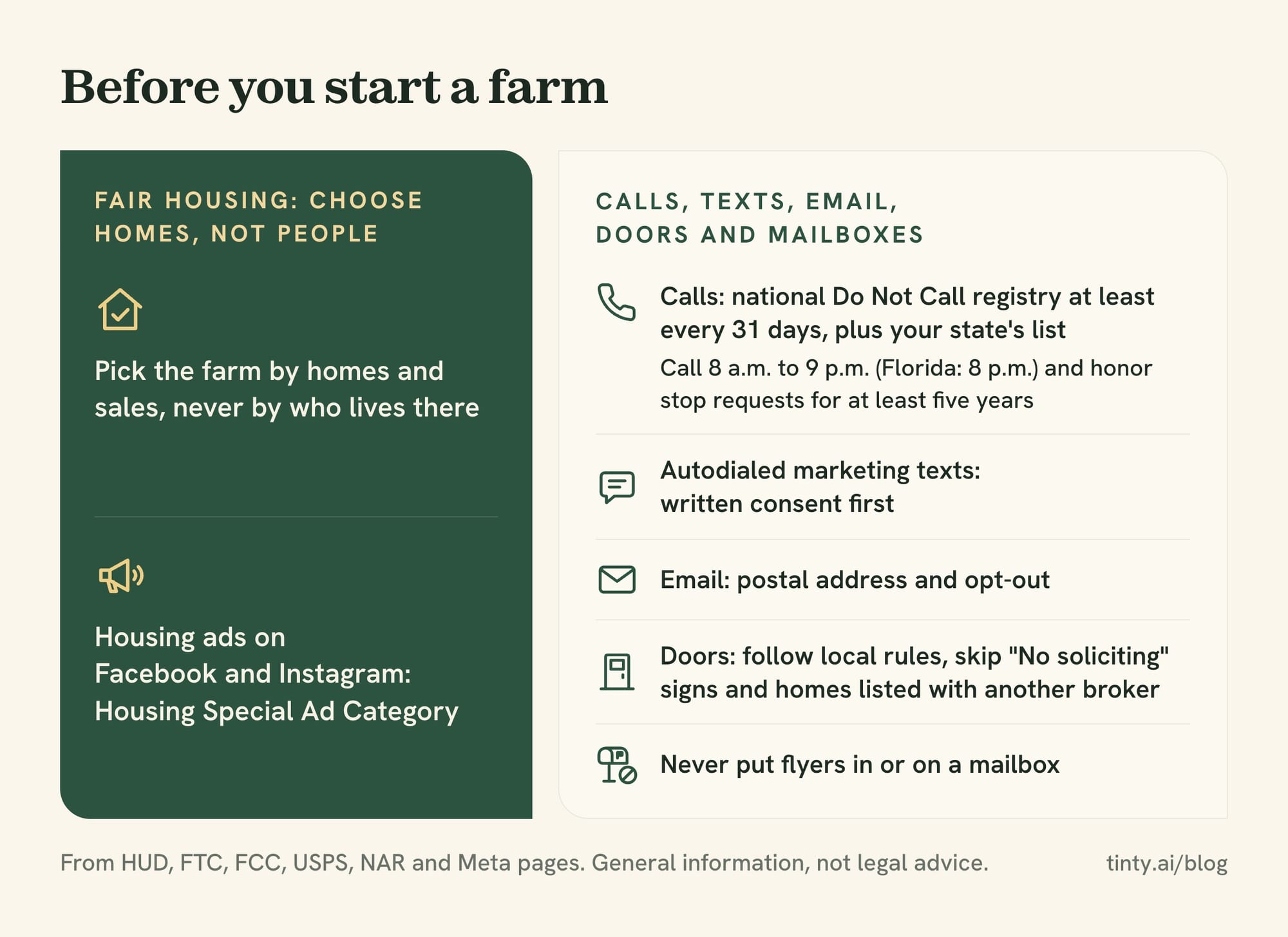
Farming is legal, but each channel has rules. This is general information, not legal advice, and your state or broker may add more.
Fair housing: choose homes, not people
The Fair Housing Act bars discrimination in selling housing because of race, color, religion, sex, disability, familial status or national origin (42 U.S. Code 3604). The Department of Housing and Urban Development (HUD) enforces the Act and writes its rules. Pick and market a farm by homes and sales, never by who lives there.
Rule: HUD rules ban choosing ad media or locations that keep housing information from people because of a protected trait (24 CFR 100.75). HUD rules also bar uninvited listing pitches suggesting that the race or other protected traits of a neighborhood’s residents are changing (24 CFR 100.85).
HUD withdrew its 2024 guidance on digital housing ads, effective September 17, 2025. Its Federal Register notice says conduct that breaks the Act still faces enforcement.
On Facebook and Instagram, ads for listings and other housing services must use Meta’s Housing Special Ad Category. It limits targeting by age, gender and ZIP code, and city audiences get an expanded radius.
Calls, texts, email, doors and mailboxes
Our summary of the rules, channel by channel:
- Calls: scrub numbers against the national registry at least every 31 days, per the Federal Trade Commission (FTC), and your state’s list. Call 8 a.m. to 9 p.m. (Florida: 8 p.m.) and honor stop requests for at least five years.
- Texts: Do Not Call rules cover marketing texts to cell phones (47 CFR 64.1200). Under the Telephone Consumer Protection Act (TCPA), autodialed marketing texts and prerecorded or AI-voice sales calls need written consent, per the Federal Communications Commission (FCC).
- Email: CAN-SPAM requires your postal address and an opt-out you honor within 10 business days, per the FTC’s CAN-SPAM guide.
- Doors: check your city’s door-to-door rules, skip “No soliciting” signs and leave when asked.
- Listed homes: NAR’s Standard of Practice 16-2 allows a general mailing to the whole farm. Leave homes listed with another broker out of calls, knocks and targeted letters (Standard of Practice 16-4).
- Mailboxes: never put flyers in or on a mailbox. Postal rules reserve it for mail with postage (USPS Domestic Mail Manual 508).
- Your brokerage: name your firm on every card, post and ad, per NAR’s Standard of Practice 12-5 and your state’s rules.
Real estate farming FAQ
What does farm mean in real estate?
A farm is the area an agent markets to again and again, often one neighborhood of a few hundred homes. Land Title Guarantee Company’s guide also spells FARM out as Focus Area Research Marketing.
How many homes should be in a real estate farm?
As many as you can reach every month on your budget. The Close suggests 100 to 250 homes, and Market Leader 500 or fewer. At the EDDM retail price of $0.26, one mailing to 400 homes costs $104 in postage.
Show 3 more questionsShow fewer questions
How long does real estate farming take to work?
Expect months, not weeks. The Close suggests giving a farm a year before you judge it. Track listing appointments and cost per listing from the start, so you know whether it’s working.
Do real estate farming postcards work?
Postcards build name recognition, but they rarely bring the call alone. In NAR’s 2025 survey, 2% of sellers found their agent through direct mail. Pair postcards with door knocking, events and your sphere.
Can a new agent farm a neighborhood?
Yes. Land Title Guarantee Company’s guide suggests new agents start with the neighborhood they live in, because they already know it. Keep it small, such as monthly EDDM postcards and two door-knock rounds a year.
How we researched this
On October 13, 2026, we read the top search results for “what is farming in real estate” and “real estate farming.”
We read six guides closely: Market Leader, Tom Ferry, Land Title Guarantee Company, The Close, Hondros College and IDX Central. None of them covers fair housing, Do Not Call or mailbox rules. Rules come from the federal code, HUD, FTC, FCC, USPS, Meta and NAR pages, read the same day.
Budgets are our arithmetic or the cited guide’s estimate, and we haven’t tested response rates. If something here is wrong, email hello@tinty.ai and we’ll fix it.
Sources
All pages read October 13, 2026. Dates in parentheses are publication or update dates.
NAR data and ethics:
- NAR 2025 Profile of Home Buyers and Sellers, full report (PDF) (November 2025; Exhibits 7-2 and 7-3; the copy posted by the Long Island Board of REALTORS, since NAR offers the full report free to members only)
- NAR 2026 Code of Ethics and Standards of Practice (Standards of Practice 12-4, 12-5, 12-7, 16-2 and 16-4)
Show 23 more sourcesShow fewer sources
- NAR Handbook on Multiple Listing Policy, 2025 edition (PDF) (Policy Statement 7.80, source line on ads that use MLS data)
Guides on choosing a farm:
- Land Title Guarantee Company: Real Estate Farming (updated April 18, 2024)
- Hondros College: 11+ Real Estate Farming Ideas (August 27, 2025, updated October 31, 2025)
- The Close: Real Estate Farming (April 22, 2025, updated June 29, 2026)
- Market Leader: Best Real Estate Farming Tips (November 10, 2025, updated January 6, 2026)
- Tom Ferry: Geographic Farming (April 2026, updated June 12, 2026)
- IDX Central: How to Master Real Estate Farming (March 12, 2021; read, not cited for a figure)
Mail:
- USPS: Every Door Direct Mail (EDDM Retail price and rules)
- USPS Notice 123, Price List (effective October 4, 2026; EDDM Retail flats $0.260)
- USPS Domestic Mail Manual 143, EDDM-Retail flats (size and weight)
- USPS Domestic Mail Manual 508, Recipient Services (section 3.1.3)
Fair housing and ads:
- Cornell LII: 42 U.S. Code 3604
- eCFR: 24 CFR 100.75, discriminatory advertisements (paragraph ©(3))
- eCFR: 24 CFR 100.85, blockbusting (paragraph ©(1))
- Federal Register: HUD withdrawal of fair housing guidance documents (April 6, 2026; effective September 17, 2025)
- Meta: How to choose a Special Ad Category
Calls, texts and email:
- FTC: Q&A for Telemarketers and Sellers About DNC Provisions in the TSR (edited September 2026)
- Florida Statutes, section 501.616: telephone solicitation hours (subsection (6)(a); text read on FindLaw, current as of January 1, 2025)
- eCFR: 47 CFR 64.1200, delivery restrictions (paragraphs ©, (d) and (e): calling hours, do-not-call requests, texts to wireless numbers)
- FCC: Stop Unwanted Robocalls and Texts (updated February 27, 2026)
- FTC: CAN-SPAM Act, A Compliance Guide for Business (edited January 2024)
TINTY and related guides: