
How do you get listings in real estate? Mostly through people who already know you. In a 2025 National Association of Realtors (NAR) report, 38% of sellers hired an agent who was, or was referred by, a friend, neighbor or relative. Another 28% hired an agent they had used before. So start with your sphere and past clients, then add open houses, circle prospecting and farming.
We make TINTY, an AI virtual staging app, so two of these 15 strategies cover photos and staging. This guide shows how to get real estate listings as a US agent, especially in your first years. Every script is an example we wrote, and times and costs are our estimates unless we name a source. The rules section is general information, not legal advice.
Key takeaways
- Referrals first: 66% of sellers hired a past agent or one linked to friends, neighbors or relatives, and 81% contacted only one agent. Be the agent people think of first.
- Borrow a reason: a new listing, a recent sale or an open house nearby gives you a natural reason to meet owners.
- Start slow channels early: farming, social media and reviews take months, so begin them in your first weeks and keep them small.
- Win the appointment: sellers most want marketing help, so bring a concrete plan with photos, staging and a description.
- Follow the rules: scrub cold calls and texts against Do Not Call lists, get written consent for marketing texts and honor email opt-outs.
On this page: Where sellers find agents · Sphere and past clients · Face to face · Expireds and FSBOs · Local presence · Partners · Listing appointment · Rules · 90-day plan · FAQ
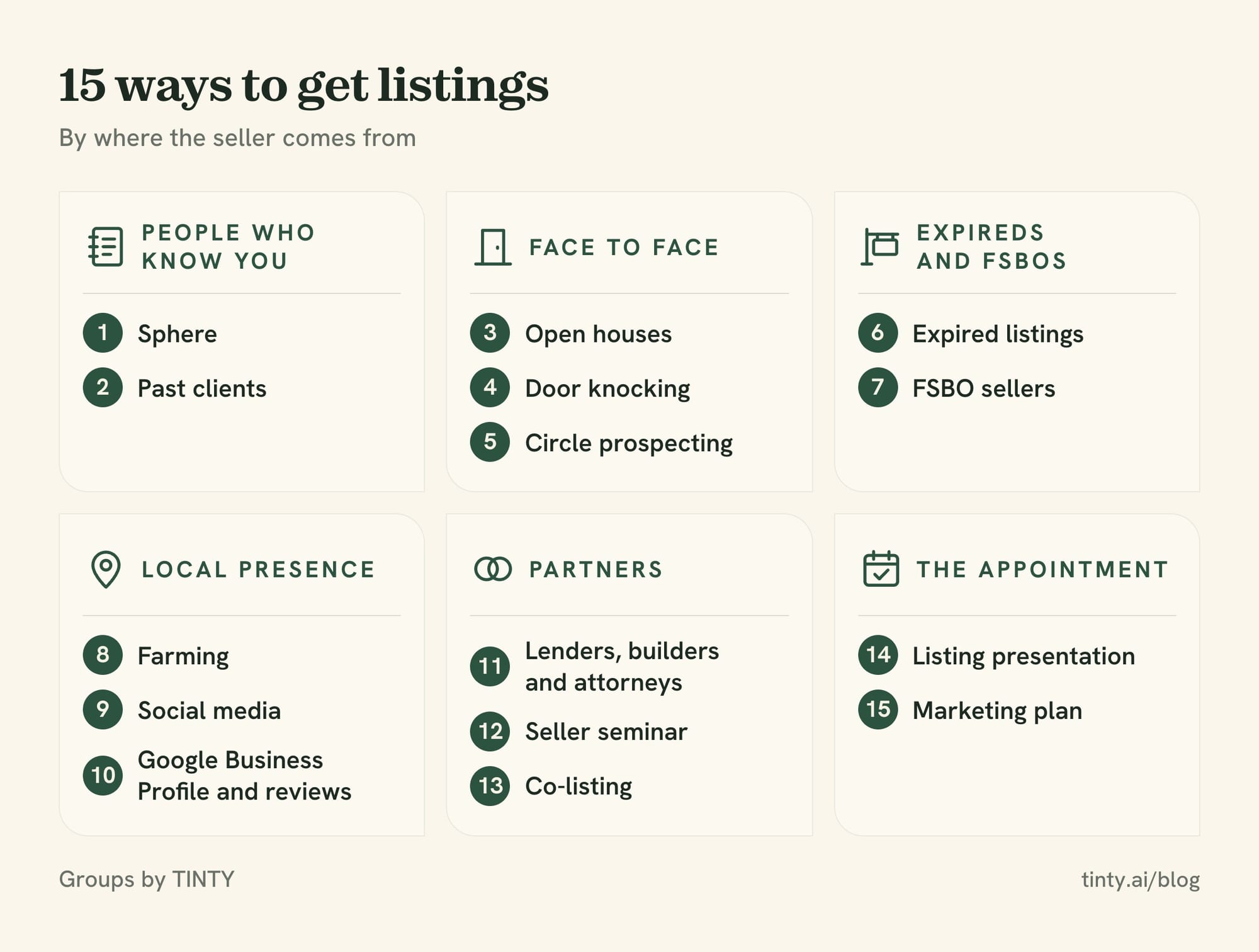
How to get listings in real estate: where sellers find agents
Referrals and repeat clients bring in most listings. NAR asked recent sellers how they found the agent who sold their home. Two answers cover two thirds of sellers, and every cold channel sits in single digits.
How sellers found their agent. Source: NAR, 2025 Home Buyers and Sellers Generational Trends, sales from July 2023 to June 2024.
| How the seller found the agent | Share of sellers |
|---|---|
| Referred by, or is, a friend, neighbor or relative | 38% |
| Used the agent before to buy or sell | 28% |
| A website, with no specific referral | 4% |
| Referred by another agent | 4% |
| Personal contact by the agent, such as a call or email | 4% |
| Met the agent at an open house | 3% |
The same report found that 81% of sellers contacted only one agent before they chose. The agent a seller thinks of first usually gets the listing (our reading).
NAR’s 2026 Member Profile says the typical Realtor earned 28% of their 2025 business from repeat clients and 22% from past-client referrals. Members with two years or less of experience earned a median of $8,000 in 2025.
What this means if you’re newer (our reading):
- Start warm: your sphere is the only referral base you have on day one.
- Borrow reasons: other agents’ listings and open houses give you a reason to meet strangers.
- Plan for slow channels: mail, farming and social media pay off over months, not weeks.
Start with people who already know you
Wondering how to get more real estate listings? Start with the list you already have. Friends, family, past clients and former buyers know you, and they know people who will move.
1. Tell your sphere you’re in business
Your sphere of influence is everyone who knows you by name. One announcement isn’t enough. Make sure each person knows what you do and how they can help.
Who belongs on the list (our checklist):
- Close circle: family, friends and neighbors.
- Work: former coworkers, past customers and your own dentist or accountant.
- Groups: clubs, sports teams, school parents, volunteer groups and faith communities.
- Online: people you actually talk to on social media, not every follower.
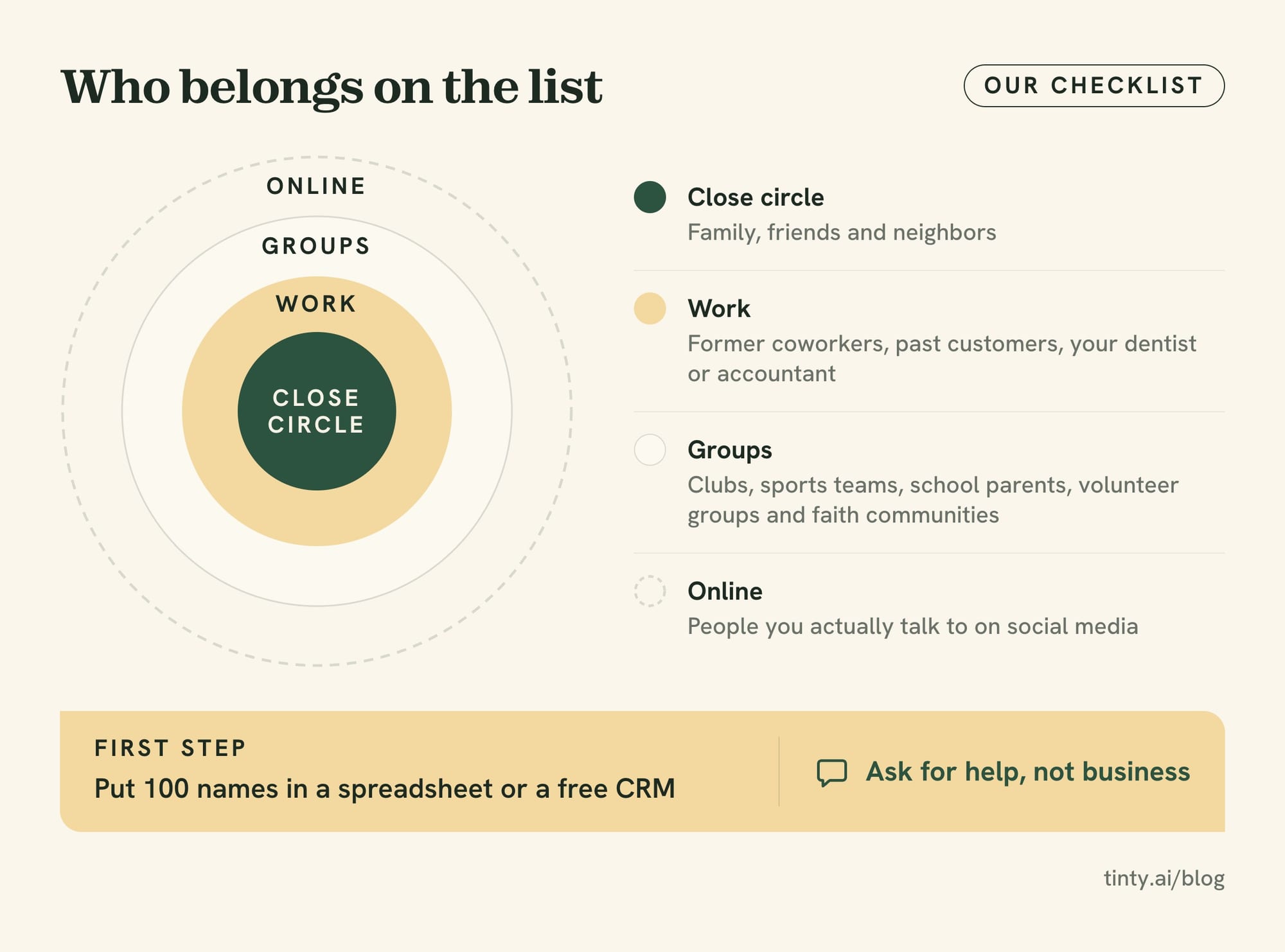
First step: put 100 names in a spreadsheet or a free customer relationship management (CRM) tool. Contact the people you’d talk to anyway, one by one, and ask for help, not business.
Example script (sphere): “Hi Sam, quick favor. I’m now licensed with [brokerage]. If you hear anyone mention selling or buying this year, would you think of me? I’ll take good care of them.”
Time and money: about an hour a day for the first two weeks, then a few touches a week. It costs nothing but time.
2. Stay in touch with past clients, buyers included
Past clients are the second big source: 28% of sellers hired an agent they had used before. Your past buyers count too, because buyers become sellers. The typical seller had lived in the home for 11 years, a record in NAR’s 2025 Profile of Home Buyers and Sellers. So plan to stay in touch for the long run.
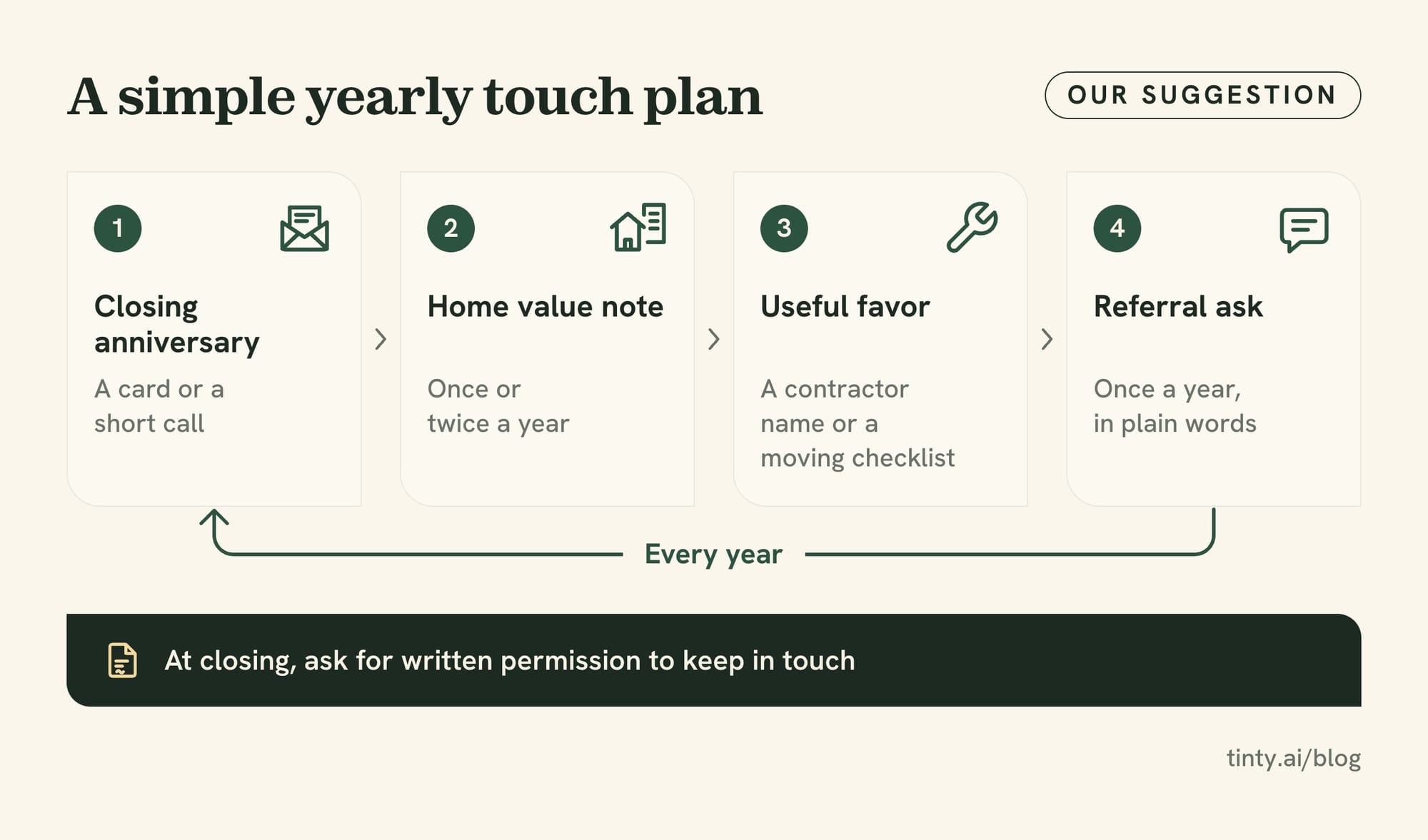
A simple yearly touch plan (our suggestion):
- Closing anniversary: a card or a short call.
- Home value note: a market update for their street once or twice a year.
- Useful favor: a contractor name, a moving checklist or a reminder about a local deadline.
- Referral ask: once a year, in plain words.
First step: list every past client and buyer with their closing date. If you have none yet, start with renters you’ve helped and the buyers you show homes to now.
At closing, ask clients for written permission to keep in touch by phone and text. Under Federal Trade Commission (FTC) rules, a past client on the Do Not Call Registry can get calls for 18 months after the last transaction, not forever.
Example script (past client): “Hi Maria, it’s been two years since you got the keys. I pulled what homes on your street sold for this year. Want me to send it? And if a friend is thinking of moving, I’d be glad to help.”
Time and money: about 15 minutes a day once the list is set up, plus cards and postage.
Meet sellers face to face
When your sphere is small, borrow a reason to meet people. Another agent’s listing, a sale down the street or an open house gives you one.
3. Host open houses for other agents’ listings
Open houses rarely produce a listing: only 3% of sellers met their agent at one, per NAR. But you meet buyers, and neighbors who come to look may sell later.
Tip: one r/realtors commenter advises arriving an hour or two early to invite the neighbors in person. Ask every visitor to sign in, and offer nearby owners a free home value report.
First step: ask your broker which agents need open house coverage. Get the listing agent’s okay, and follow your brokerage’s policy on seller permission.
Example script (neighbor invite): “Hi, I’m [name] with [brokerage]. I’m hosting the open house at [address] on Sunday from 1 to 3. Since you live nearby, I wanted to invite you first. Curious what it’s listed for?”
Time and money: about three hours per open house, plus an hour of door knocking before it. Budget for signs, printed sign-in sheets and snacks.
4. Knock on doors with something useful
Door knocking works best with a reason and a handout, so pick a street near a new listing or sale.
Leave something useful at each door: a sheet of what nearby homes sold for in the last six months, or an open house invite. Add your card with your brokerage name on it (our suggestion).
First step: choose 50 homes and check your city’s rules. Some towns require a solicitation permit, and a “No soliciting” sign means skip that door.
Example script (door): “Hi, I’m [name], a local agent with [brokerage]. A home two streets over just listed, and I’m dropping off what nearby homes sold for. Have you ever wondered what yours might be worth?”
Time and money: about two hours for 40 to 60 doors, and printing costs cents a page.
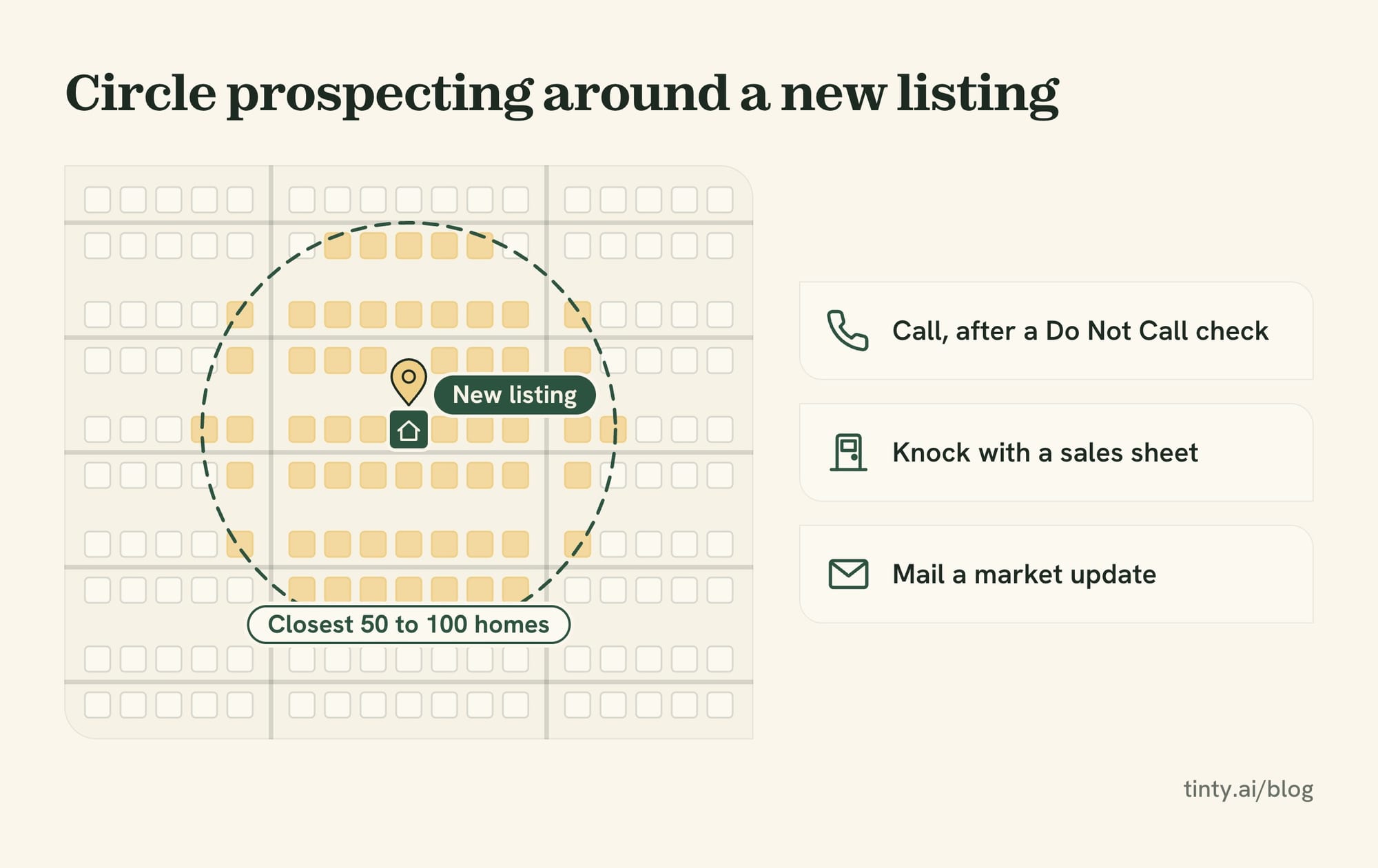
5. Circle prospect around new listings and sales
Circle prospecting means contacting the owners around a fresh listing or sale, by phone, door or mail. The nearby news gives you a timely reason to reach out. In NAR’s data, 4% of sellers found their agent through a call, email or other direct contact, so treat it as one channel among several.
First step: pull the 50 to 100 homes closest to the listing (our suggestion). Then scrub every phone number against the national and state do-not-call lists.
Time and money: about an hour a day of calls. Phone data costs money. Do Not Call Registry data for the first five area codes is free. Since October 1, 2026, each extra area code costs $85 a year, per the FTC’s fee notice.
Watch out: NAR’s Code lets only the listing or cooperating broker claim to have “sold” a home (Standard of Practice 12-7). If the sale isn’t yours, say “a home nearby just sold,” not “I just sold.”
Circle prospecting script for real estate agents (example)
This circle prospecting script is an example to adapt, not a promise of results. Keep it short and let the owner talk.
Example script (circle prospecting): “Hi, is this [owner name]? This is [name] with [brokerage]. A home on [street] just came on the market, and I’m letting neighbors know before Saturday’s open house. Have you thought about moving in the next year or two?”
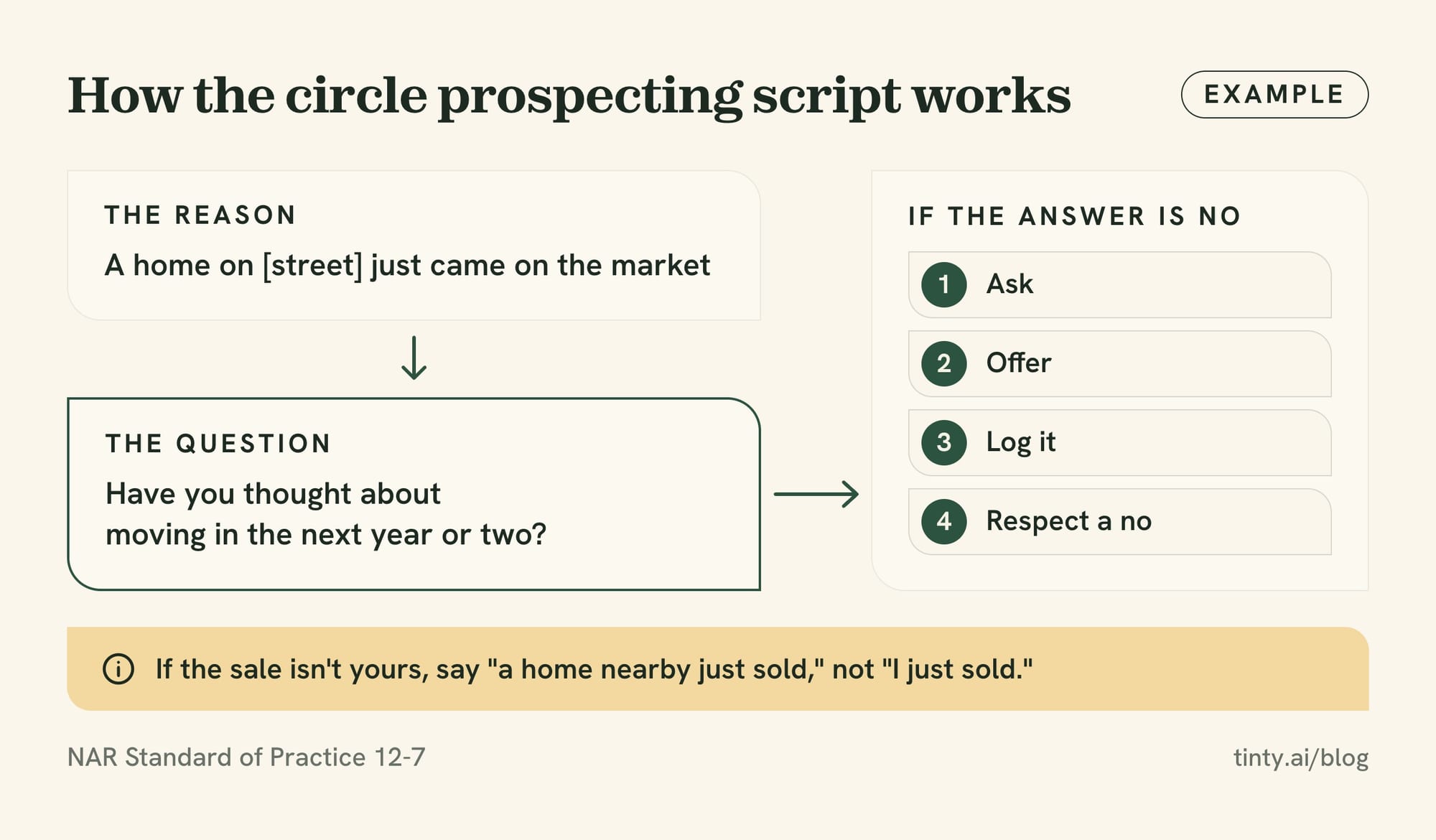
If the answer is no, use these four steps (our suggestion):
- Ask: “If you did move someday, where would you go?”
- Offer: “Want me to send you the sale price when it closes?” Get a clear yes before you text.
- Log it: note the answer and a follow-up date in your CRM.
- Respect a no: if they ask you not to call again, put them on your own do-not-call list.
Expired listings and FSBO sellers
Owners of expired listings and for-sale-by-owner (FSBO) homes already want to sell. Keep your approach short, specific and polite.
6. Call expired listings with a relaunch plan
An expired listing is one whose listing agreement ended without a sale. Lead with what you would do differently: photos, staging, price and access. Our guide on how to sell a stale listing lists 15 fixes you can build the plan from.
First step: each morning, pull yesterday’s expired listings from your multiple listing service (MLS). Confirm the home hasn’t been relisted, then scrub the owner’s number against do-not-call lists.
Watch out: NAR’s Code bars soliciting a listing that’s still exclusively listed with another broker (Standard of Practice 16-4). A “withdrawn” status may not mean the agreement has ended, so check before you call (our reading).
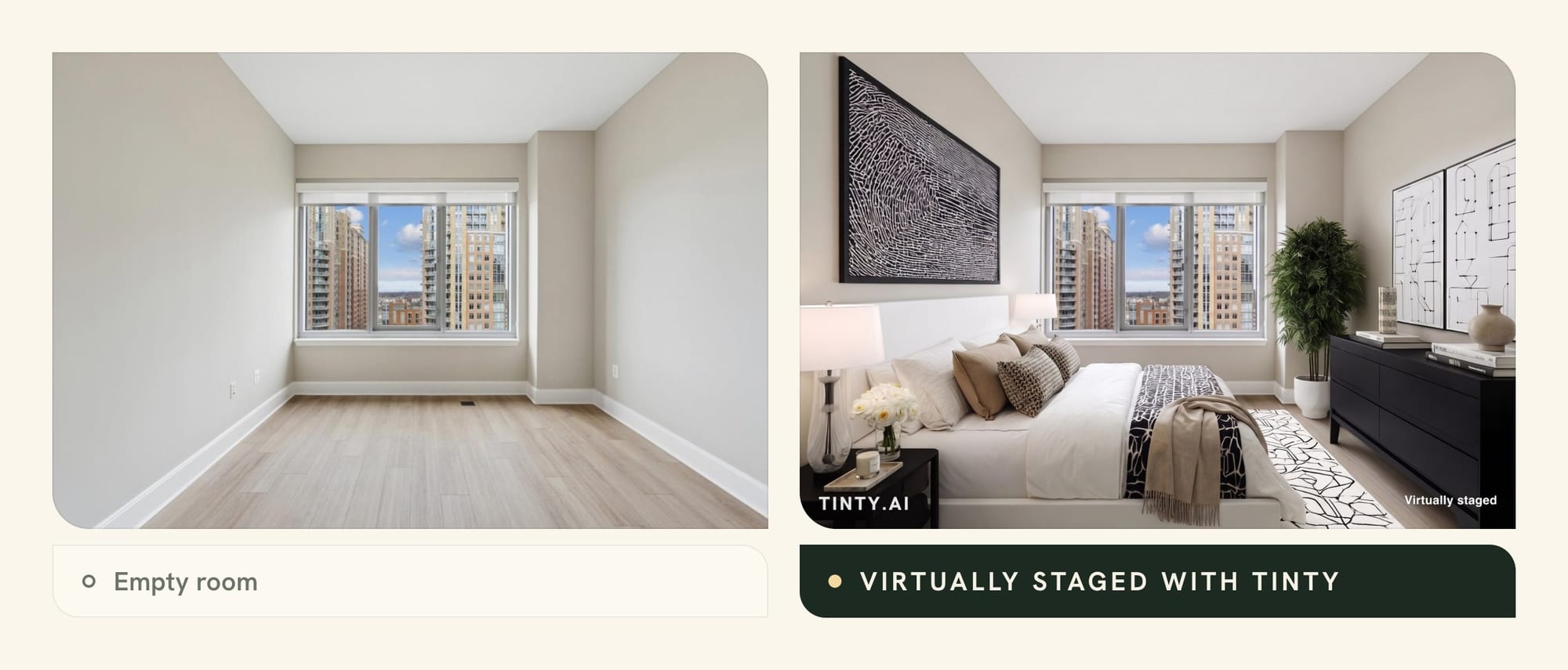
Bring proof of the relaunch. For a vacant home, show one empty room virtually staged. Use a photo the owner sends you, not the old listing photos, which belong to the photographer or the previous broker (our caution). TINTY makes free previews of bedrooms, living rooms and other living spaces in about 30 seconds.
Example script (expired): “Hi, this is [name] with [brokerage]. I saw your home on [street] came off the market. I’m not calling to criticize anyone. If you still want to sell, I have a three-step relaunch plan I can show you in 20 minutes. Would that help?”
Time and money: about an hour a day of calls. You may need a paid data service for phone numbers.
7. Offer FSBO sellers help, not pressure
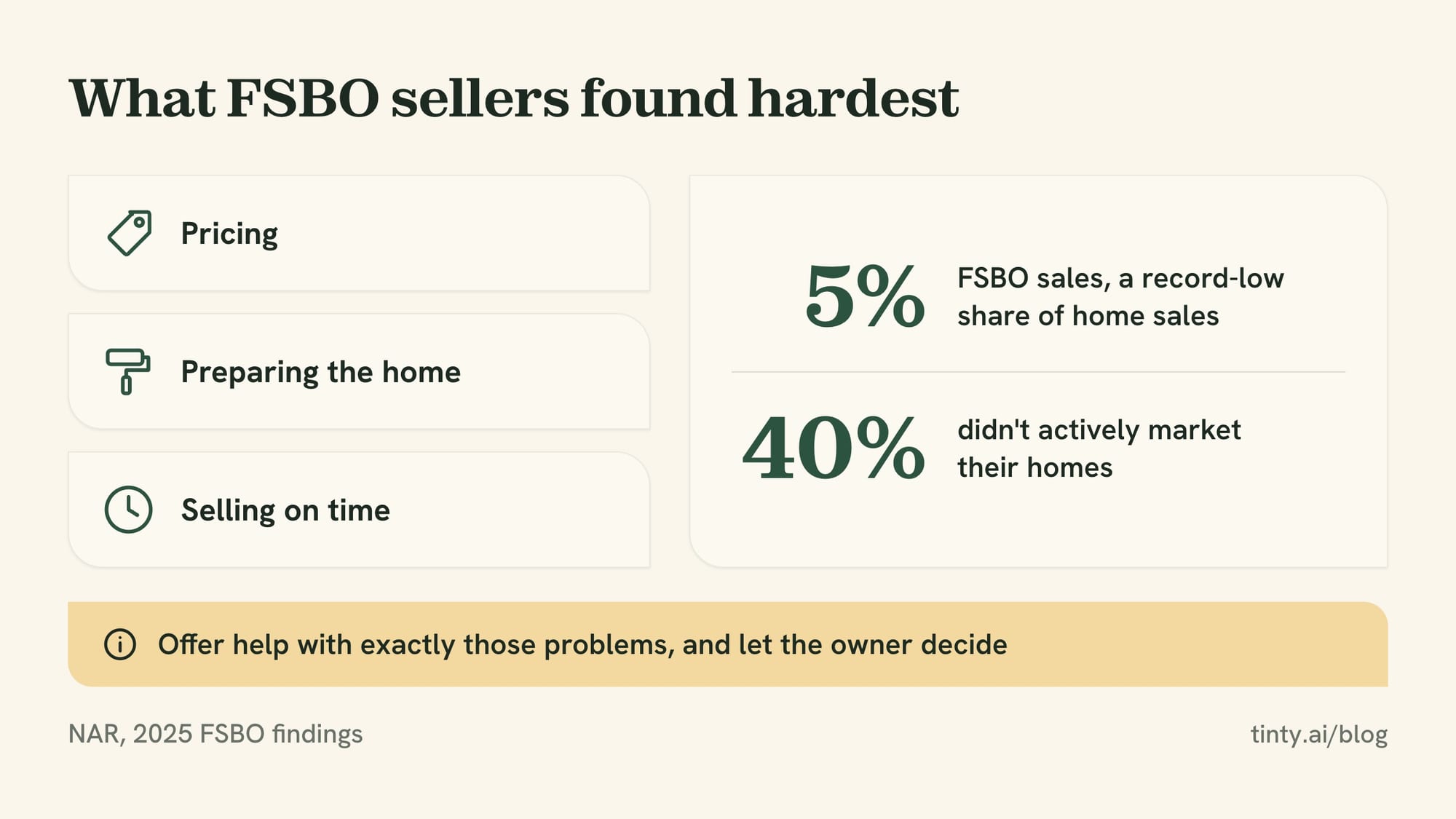
FSBO sales fell to a record-low 5% of home sales, per NAR’s 2025 FSBO findings. FSBO sellers said pricing, preparing the home and selling on time were the hardest parts, and 40% didn’t actively market their homes. Offer help with exactly those problems, and let the owner decide.
First step: call or visit with a free comparative market analysis (CMA) and a one-page marketing checklist. Scrub FSBO numbers against do-not-call lists like any other cold call. Ask your broker before you offer to host a FSBO open house. HousingWire’s guide says to have the right paperwork first, typically a disclosure form and a one-day listing agreement, or whatever your state requires.
Example script (FSBO): “Hi, I saw your sign on [street]. I made a free price report from recent nearby sales. Want me to drop it off? No pressure to list. If you ever want a second opinion, I’m a call away.”
Time and money: about 30 minutes per FSBO, then a check-in every week or two (our suggestion).
Build a local presence sellers can find
Some sellers check you out before they call. Farming, local content and online reviews make you the agent they already recognize.
8. Farm one neighborhood
Geographic farming means marketing to the same few hundred homes for a year or more, until owners know your name. With sellers staying a median of 11 years, only a small share of any farm moves each year (our reading).
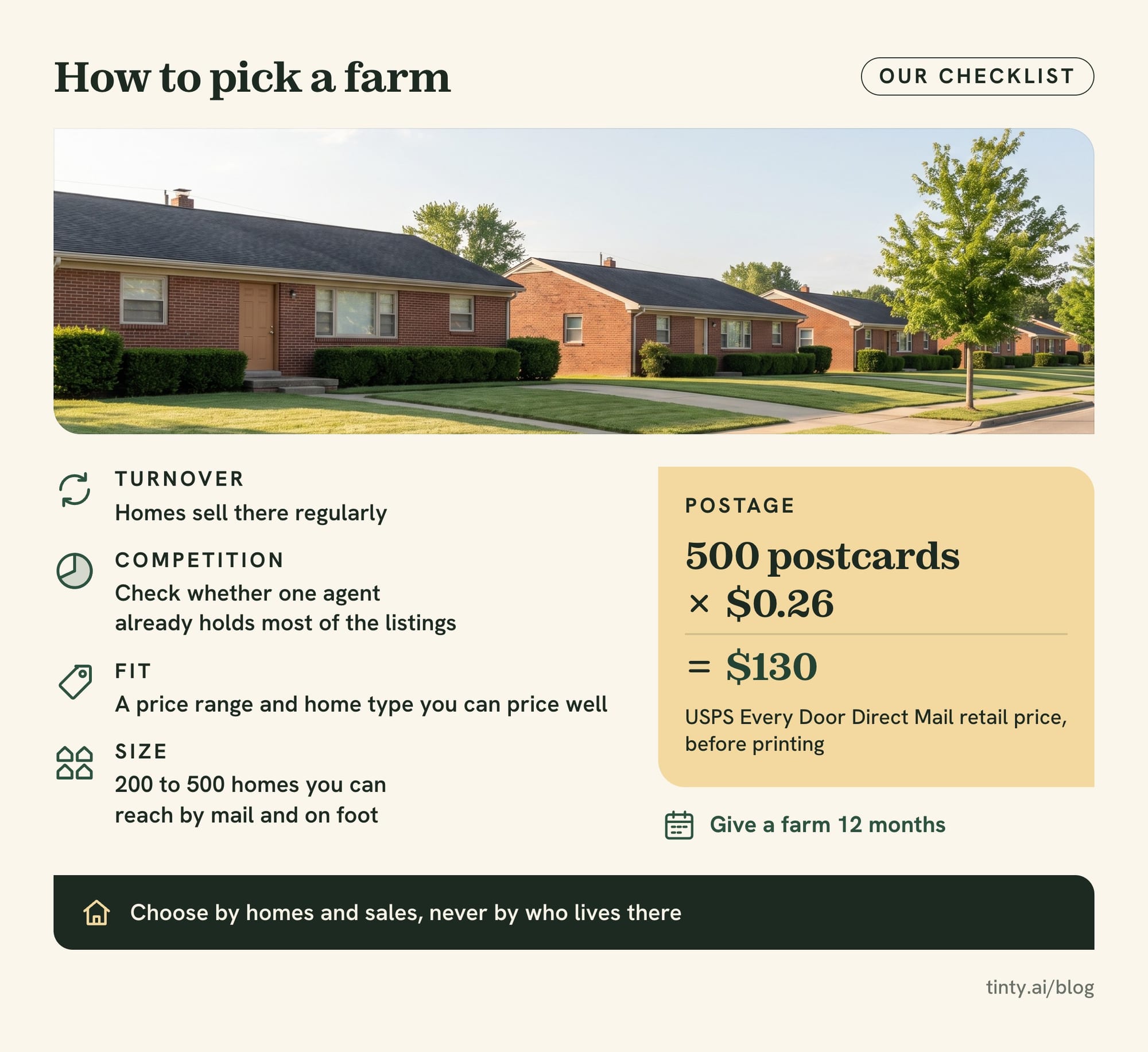
How to pick a farm (our checklist):
- Turnover: compare last year’s sales with the number of homes, and pick an area where homes sell regularly.
- Competition: check whether one agent already holds most of the listings there.
- Fit: choose a price range and home type you can price well.
- Size: start with 200 to 500 homes you can reach by mail and on foot.
Choose by homes and sales, never by who lives there. That keeps your targeting clear of Fair Housing problems (our view).
First step: pull the area’s sales from your MLS and mail a short market update to every home. Mail alone rarely brings the call: 2% of sellers found their agent through direct mail, per NAR. Pair it with open houses and door knocking in the same streets (our view).
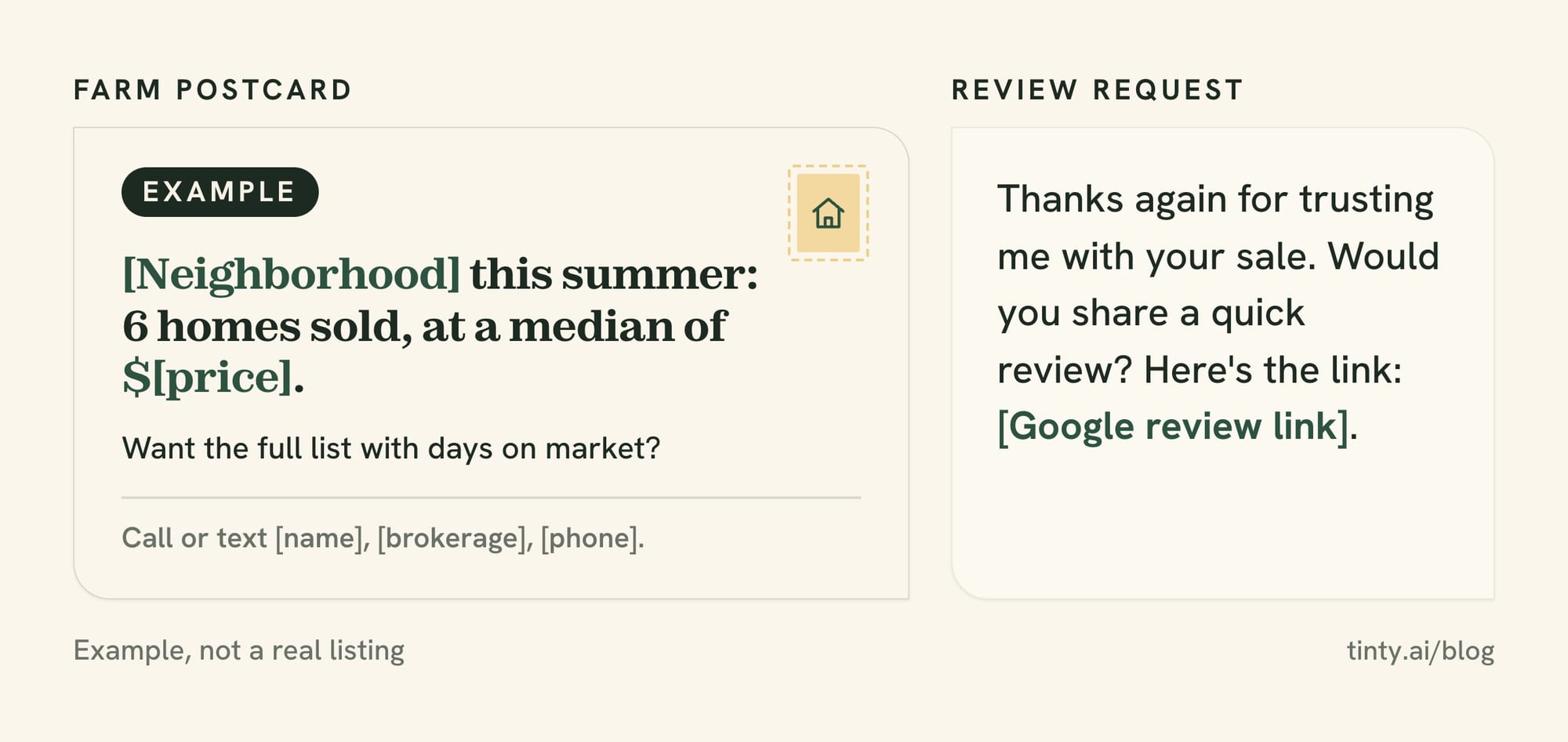
Example postcard text: “[Neighborhood] this summer: 6 homes sold, at a median of $[price]. Want the full list with days on market? Call or text [name], [brokerage], [phone].”
Time and money: USPS Every Door Direct Mail retail postage is $0.26 a piece for flat-size mail, so 500 postcards cost $130 in postage before printing. Give a farm 12 months before you judge it (our suggestion).
9. Post local content on social media
Social media keeps you in front of your sphere between deals. Only 1% of sellers found their agent through a social media page without a prior connection, per NAR. So post for the people who already know you, and the referrals follow from them (our reading).
Local post ideas that work for agents (our list):
- Market notes: one chart or number a month for your farm.
- Local spots: a new cafe, a park project or a road closure update.
- Your work: a listing’s progress, with the seller’s permission.
- Answers: one common seller question a week, answered in 30 seconds.
Every post that advertises your services should name your brokerage, per NAR’s Standard of Practice 12-5. Our guide to real estate social media posts has captions to copy for each listing stage.
Example post (market note): “[Neighborhood] in [month]: 4 homes sold, most in under two weeks. Want the list for your street? Message me. [Name], [brokerage].”
First step and cost: pick two platforms and a weekly posting slot. Expect about two hours a week, free unless you pay to boost posts.
10. Set up a Google Business Profile and collect reviews
Google’s guidelines name real estate agents as individual practitioners who can have their own Business Profile. Reviews there show up when a seller searches your name. Sellers rank reputation first: 35% called it the top factor in choosing an agent, per NAR.
Set it up in four steps:
- Create the profile in your own name. If you’re the only agent at a branded office, Google suggests “[brand]: [your name]”.
- Set a service area and hide your address if clients don’t visit you there.
- Ask every past client for a review, using Google’s review link or QR code.
- Reply to every review, good or bad, within a few days.
Watch out: Google bans offering discounts or gifts in exchange for reviews, per its Business Profile review tips. The FTC’s rule on reviews, in effect since October 21, 2024, also bans incentives that require a positive review. Ask everyone, and never pay for stars.
First step and cost: the profile is free. Setup takes about two hours, then a few minutes after each closing.
Example review request: “Thanks again for trusting me with your sale. Would you share a quick review? Here’s the link: [Google review link].”
Borrow other people’s networks
Lenders, builders and attorneys often meet future sellers before the owner calls an agent (our view). A few steady partners and a seminar widen your reach beyond your own sphere.
11. Partner with lenders, builders and attorneys
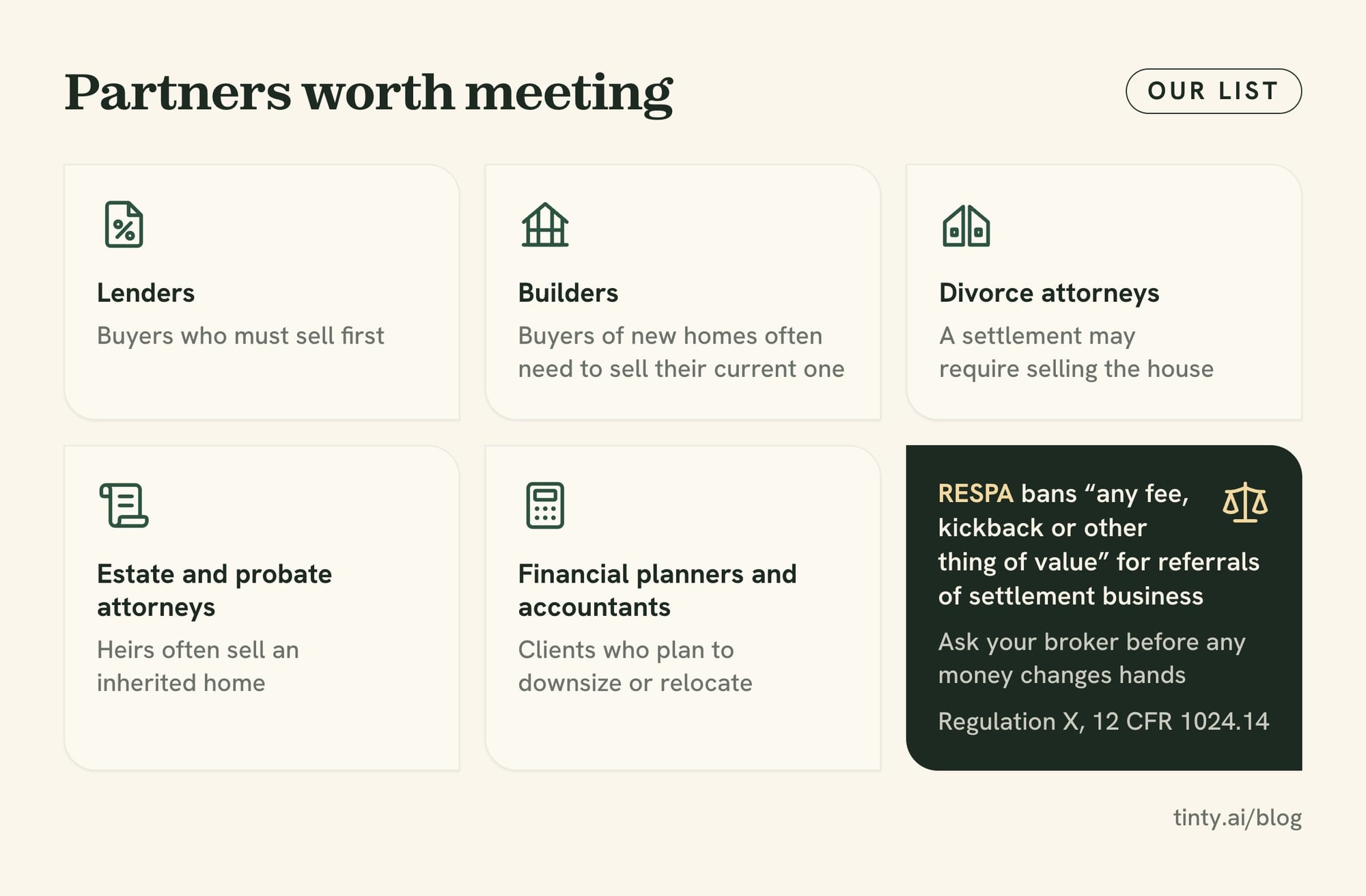
Partners worth meeting (our list):
- Lenders: buyers who must sell first, and refinance clients who mention moving.
- Builders: buyers of new homes often need to sell their current one.
- Divorce attorneys: a settlement may require selling the house.
- Estate and probate attorneys: heirs often sell an inherited home.
- Financial planners and accountants: clients who plan to downsize or relocate.
First step: ask your broker which lenders and attorneys the office already works with, then meet two a month. Help them first by sending their clients useful information.
Rule: the Real Estate Settlement Procedures Act (RESPA) bans “any fee, kickback or other thing of value” for referrals of settlement business. That covers federally related mortgage loans. Normal promotional and educational activities are allowed if they aren’t tied to referrals and don’t pay costs the referrer would otherwise carry. Source: Regulation X, 12 CFR 1024.14.
Your state’s license law may limit referral fees too, so ask your broker before any money changes hands.
Example script (attorney): “I help sellers going through life changes, and I’m careful with timing and privacy. If one of your clients needs to sell, I can give them a free price opinion and a clear plan. What do your clients usually need from an agent?”
Time and money: a few coffees a month, and no referral fees (our view).
12. Host a seller seminar
A seminar puts you in front of a room of people who are thinking about selling. Keep it educational, short and local. Topics that fit (our list):
- Downsizing: steps and timing for a move to a smaller home.
- Selling an inherited home: probate basics, co-hosted with an attorney.
- What’s my home worth: how pricing works in your area this season.
- Selling and buying at once: timing and financing options, with a lender.
First step: book your brokerage’s conference room and a co-host, then invite your sphere, farm and past clients.
Time and money: plan about 10 hours to prepare the first one. If a lender co-hosts, split costs fairly. Under Regulation X, a partner paying expenses you would otherwise carry can be a problem.
Example invite: “Thinking about selling in the next year? Join a free 45-minute talk on what [neighborhood] homes sold for this year and how to prepare. [Date], [place]. Hosted by [name], [brokerage].”
13. Co-list with a top agent in your office
Sellers pick agents on reputation, and a new agent has little to show yet. In the r/realtors thread, one commenter suggested that newer agents bring an experienced agent to listing appointments. Offer top agents help with open houses or smaller listings, and ask to co-list for a share of the commission.
First step: ask your broker who has more leads than time. Offer specific help, such as running two open houses a month.
Example script (top agent): “I’d like to learn listings the right way. Could I run your open houses and collect showing feedback this month? If a lead comes in that’s too small for you, I’d love to co-list it with you.”
Time and money: you trade part of the commission for a track record and coaching (our view).
Win the listing appointment
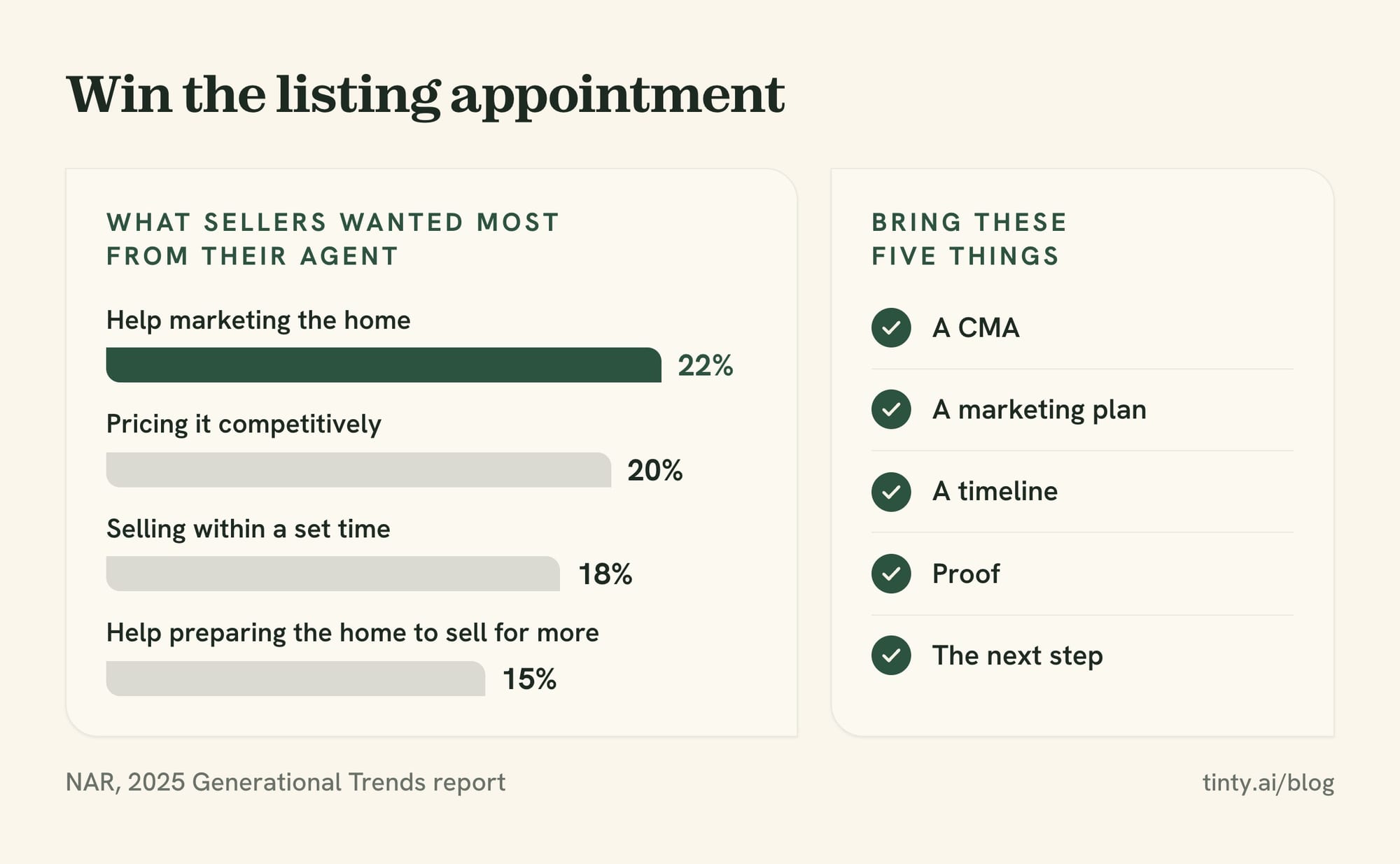
Come to the appointment with a price story and a concrete marketing plan. NAR asked sellers what they wanted most from their agent. The top answers were help marketing the home (22%), pricing it competitively (20%) and selling within a set time (18%).
14. Practice your listing presentation
A strong presentation is short, local and specific. Bring these five things:
- A CMA: recent sales, active listings and expired listings near the home, with your price range.
- A marketing plan: photos, staging, the description and where the listing will appear.
- A timeline: from prep day to the first open house.
- Proof: reviews, or co-listing results if you’re new.
- The next step: the listing agreement and how buyer-agent pay will be handled, in plain words.
Example opener (listing appointment): “Before we talk price, I’ll show you what buyers will see online in the first week. Then we’ll go through the sales behind my price range.”
Our free listing presentation templates include notes for each slide.
First step and time: role-play with a colleague or mentor, and shadow a top agent’s appointment if you can. Rehearse for about an hour before each appointment until it feels natural (our suggestion).
15. Show a marketing plan with photos and staging
Show the seller how the home will look online, rather than a list of channels. Photos matter most to buyers: 83% of buyers who searched online rated them very useful, per NAR. And 15% of sellers most wanted help preparing the home to sell for more.
What to show in the plan (our list):
- Photos: who shoots them and when. Our guide to taking listing photos with an iPhone covers the basics.
- Staging: physical staging for lived-in rooms, virtual staging for empty ones.
- Description: a draft first sentence, built from our listing description examples.
- Exposure: the MLS, portals, social posts and open house dates.
Watch out: label every virtually staged image, in your presentation and in the listing. MLS rules differ on where the label goes. Our guide to virtual staging disclosure rules compares them.
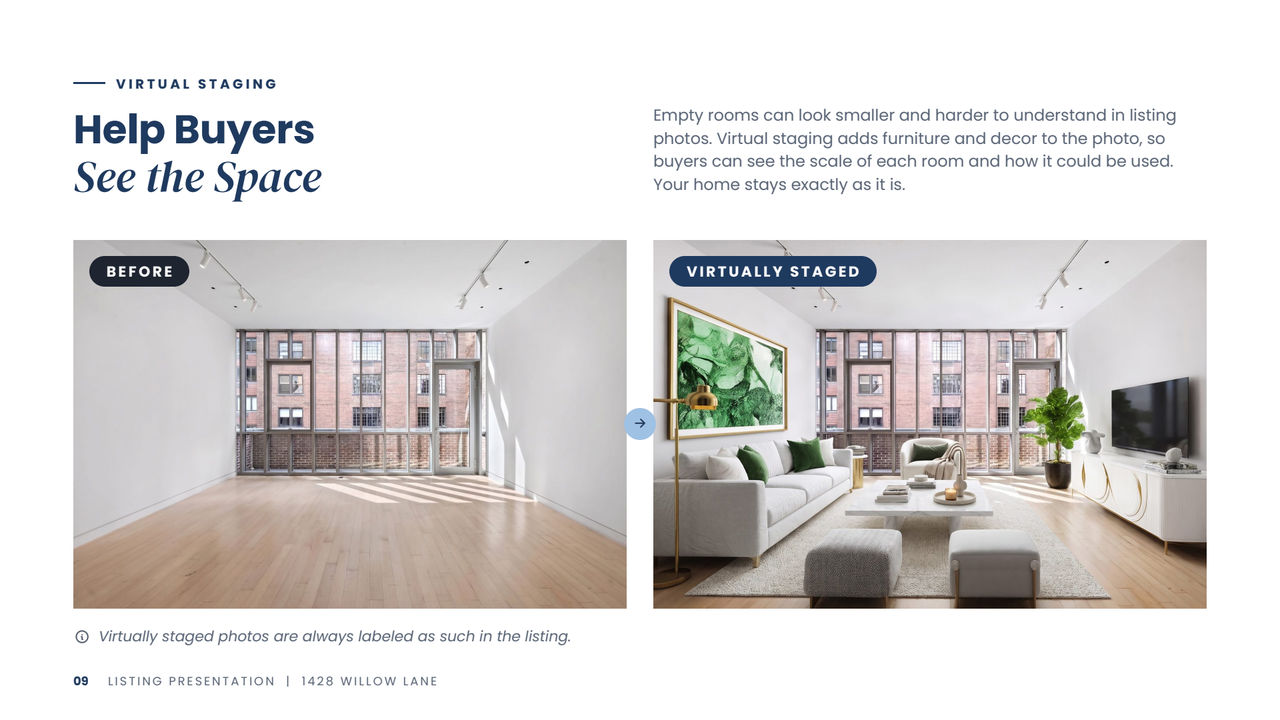
Example talk track (staging preview): “This is one way your empty [room] could look online. We’d label it as virtually staged in the listing.”
First step: ask the seller for a phone photo of one empty room before the appointment, and check your photographer’s next free date.
Time and money: about an hour to build the plan. A TINTY preview is free; professional photos and physical staging cost extra.
Where TINTY fits in your marketing plan
We make TINTY, so here’s our tool’s part, limits included:
- Preview: upload a photo of one empty room and get free, watermarked previews in about 30 seconds, on a phone or a laptop.
- Rooms: nine room types, such as bedrooms, living rooms and home offices. No kitchens, bathrooms, building exteriors or yards.
- Not yet: it doesn’t remove furniture, so it works on empty rooms.
- Label: you can add a “Virtually staged” label when you download.
Try a free TINTY preview on one empty room before the appointment, no card needed, and show it with the seller’s permission. It shows your marketing, not a promise about price.
Short on time? TINTY Studio, our done-for-you virtual staging service, stages photos you email to hello@tinty.ai in 2 to 24 hours. It’s $10 a photo from 3 photos, per TINTY’s pricing page, and you pay only if you’re happy.
Rules for calls, texts, email and door knocking
Prospecting is legal, but each channel has rules. These are plain warnings, not legal advice, and your broker or state may add more.
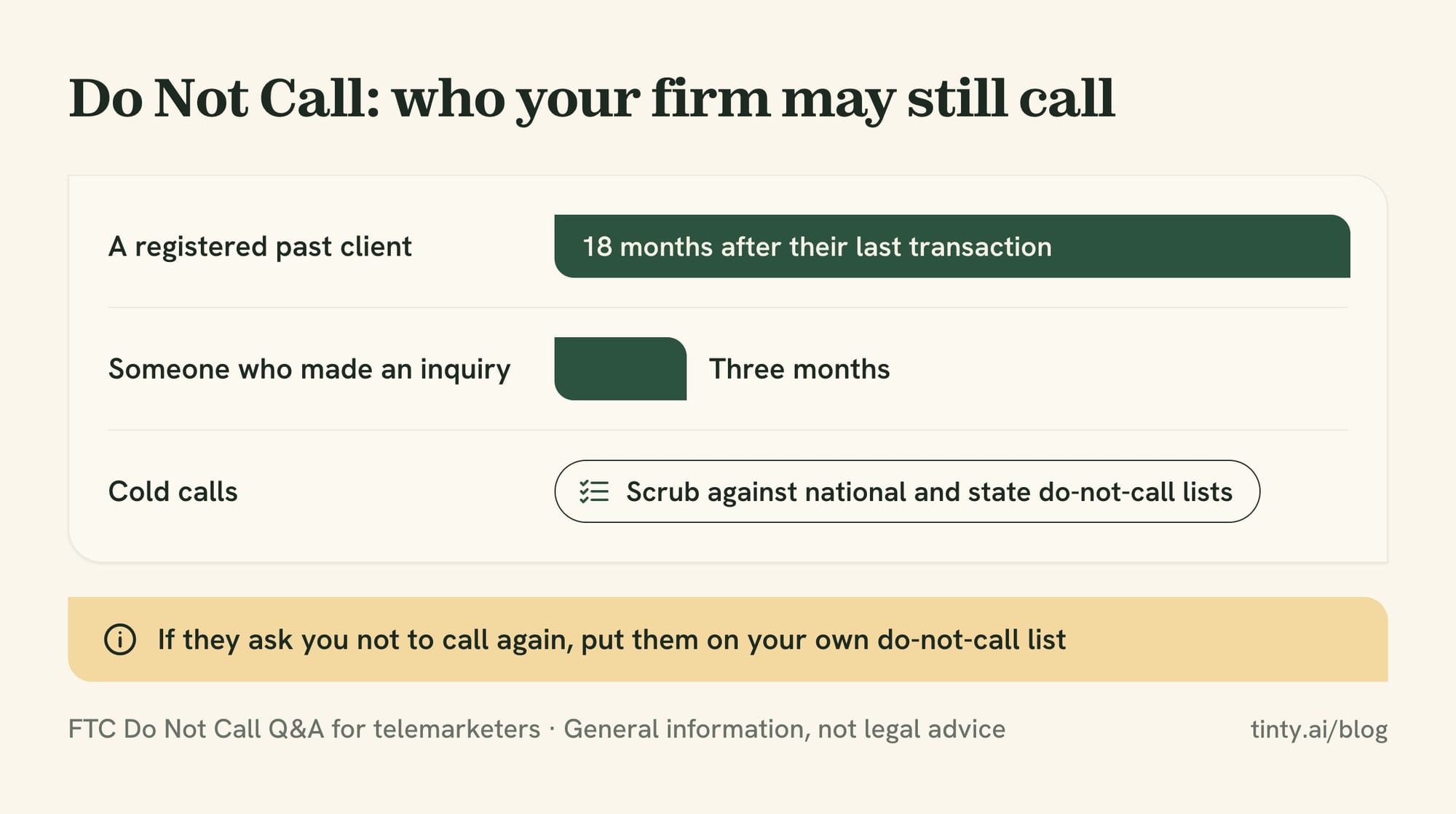
Rule: if you cold call, sync your list with the National Do Not Call Registry at least every 31 days. Your firm may still call a registered past client for 18 months after their last transaction, and someone who made an inquiry for three months. Source: FTC Do Not Call Q&A for telemarketers.
Our summary of FTC and Federal Communications Commission (FCC) pages, channel by channel:
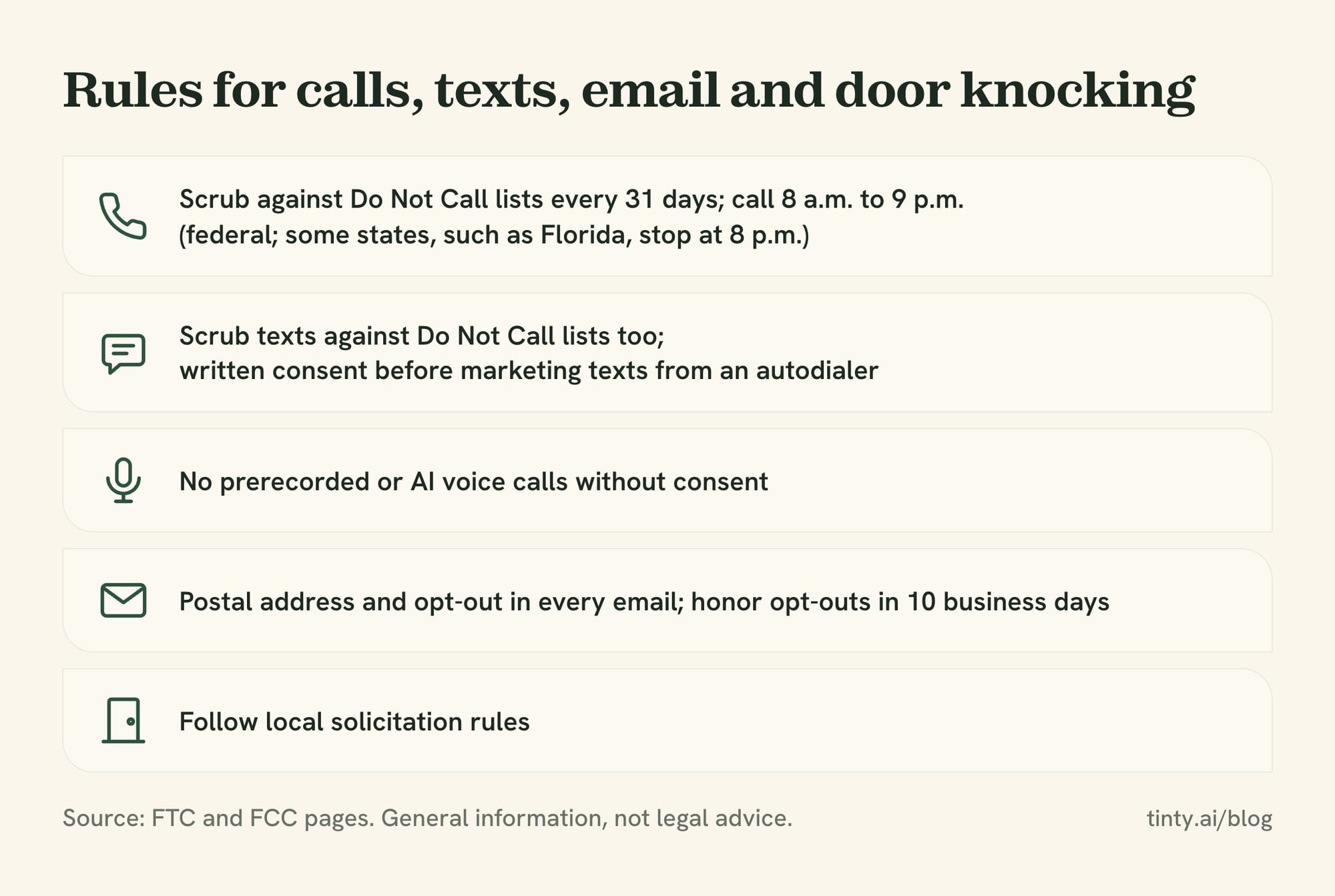
- Calls: federal rules bar telemarketing calls before 8 a.m. or after 9 p.m. Honor every “don’t call me” right away. Some states are stricter: Florida law stops sales calls at 8 p.m., and many keep their own do-not-call lists.
- Texts: Do Not Call rules cover texts too. Under the Telephone Consumer Protection Act (TCPA) and FCC rules, commercial texts sent with an autodialer need the owner’s written consent. Anyone can opt out at any time.
- Recorded and AI voices: prerecorded telemarketing calls need prior written consent, and AI-generated voice calls are illegal without consent, per the FCC.
- Email: CAN-SPAM requires honest subject lines, your postal address and an opt-out you honor within 10 business days.
- Door knocking: follow your city’s solicitation rules, skip “No soliciting” doors and leave when asked.
Rule: “Commercial texts require written consent,” says the FCC’s consumer guide, in its section on texts sent with an autodialer. Source: FCC: Stop Unwanted Robocalls and Texts, updated February 27, 2026.
The FTC’s pages list penalties of up to $53,088 per violating call, and the same cap for each email that breaks CAN-SPAM. CAN-SPAM covers all commercial email, business to business included, per the FTC’s CAN-SPAM guide.
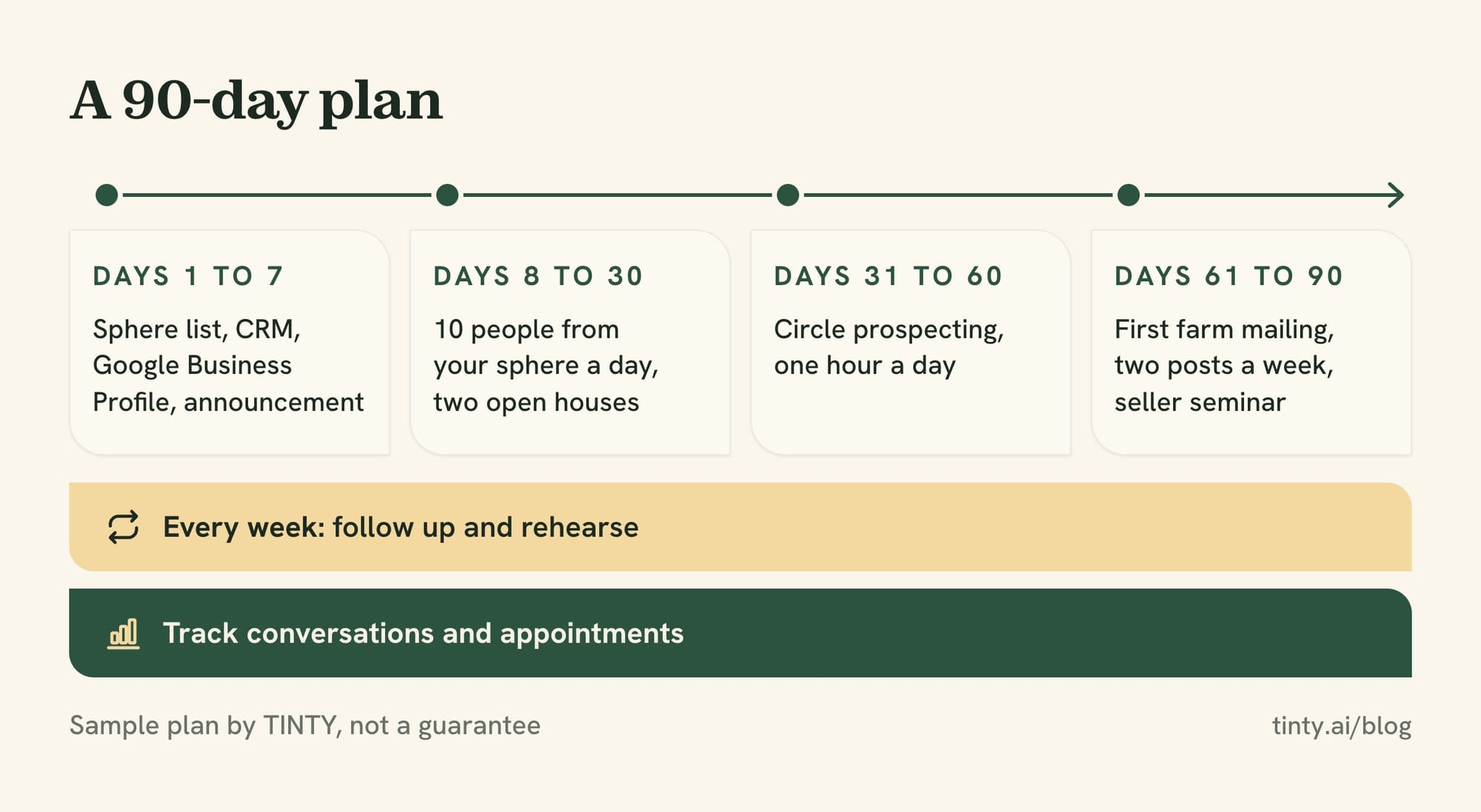
A 90-day plan: how to get listings as a real estate agent
If you’re new, run a few strategies well instead of all 15 at once. Here’s a sample plan, our suggestion and not a guarantee:
- Days 1 to 7: build your sphere list, set up a CRM and a Google Business Profile, and send your announcement.
- Days 8 to 30: contact 10 people from your sphere a day, and host two open houses for other agents.
- Days 31 to 60: circle prospect around each new listing in your chosen area, one hour a day.
- Days 61 to 90: send your first farm mailing, post twice a week and book a seller seminar.
- Every week: follow up with every lead you logged, and rehearse your listing presentation.
Track conversations and appointments, not only closings. They show which channel works for you long before the first commission check (our view).
Getting listings FAQ
How do new agents get their first listing?
Most start with their sphere, open houses for other agents and co-listing with a top agent in their office. In NAR’s 2025 Generational Trends report, 66% of sellers hired a past agent or one linked to friends, neighbors or relatives. So tell everyone you know what you do.
How do you get listings without cold calling?
Work referrals, open houses, door knocking, farm mailings, social media, reviews and partnerships with lenders and attorneys. None of these needs a cold call. They take longer to build, so start them in your first month (our view).
Show 5 more questionsShow fewer questions
Is it legal to cold call expired listings?
Generally yes, if you scrub numbers against the National Do Not Call Registry and your state’s list and honor do-not-call requests. Federal rules allow calls from 8 a.m. to 9 p.m., and some states, such as Florida, stop at 8 p.m. local time. NAR’s Code also bars soliciting a listing that’s still under an exclusive agreement. This is general information, not legal advice.
Can real estate agents text leads?
Yes, with consent. Do Not Call rules cover texts too. Under the TCPA and FCC rules, commercial texts sent with an autodialer need the person’s written consent, and anyone can opt out at any time. Get written permission on sign-in forms and listing inquiries, and stop when someone asks.
What is circle prospecting in real estate?
It’s contacting the homeowners around a new listing or recent sale, by phone, at the door or by mail. The nearby listing gives you a timely reason to reach out. Check do-not-call lists before you call, and never claim a sale that wasn’t yours.
Can a real estate agent have a Google Business Profile?
Yes. Google’s guidelines name real estate agents as individual practitioners who can have their own profile, if they’re public-facing and reachable during stated hours. Ask past clients for reviews, but never offer gifts or discounts for them.
Do open houses get you listings?
Rarely: 3% of sellers met their agent at an open house in NAR’s 2025 Generational Trends report. Open houses still help, because you meet buyers and neighbors who may sell later.
How we researched this
On October 8, 2026, we read the pages that rank in Google for this topic. They include guides from HousingWire, Century 21 Redwood, Rockwell Institute and Xara, plus an r/realtors thread.
Seller data comes from NAR’s free 2025 Generational Trends report and two NAR articles on its 2025 Profile. Member data comes from NAR’s 2026 Member Profile article. Rules come from FTC, FCC, Consumer Financial Protection Bureau, Google, NAR and Florida pages, read the same day.
Every script is ours, and we didn’t test response rates. TINTY facts come from our live pages, checked October 8, 2026. If something here is wrong, email hello@tinty.ai and we’ll fix it.
Sources
All pages read October 8, 2026. Dates in parentheses are publication or update dates.
NAR data:
- NAR 2025 Home Buyers and Sellers Generational Trends (PDF) (April 2025; Exhibits 3-6, 7-1, 7-2, 7-6 and 7-7)
- NAR: The Feature Sheet, 2026 Member Profile (August 19, 2026)
Show 23 more sourcesShow fewer sources
- NAR: 2025 Profile of Home Buyers and Sellers reveals market extremes (November 4, 2025)
- NAR: FSBOs reach all-time low as more sellers rely on agents (November 11, 2025)
Rules for calls, texts, email, reviews and referrals:
- FTC: Q&A for Telemarketers and Sellers About DNC Provisions in the TSR (edited September 2025)
- FTC: FTC announces 2027 telemarketer fees to access the National Do Not Call Registry (August 26, 2026; fees in effect October 1, 2026)
- NAR 2026 Code of Ethics and Standards of Practice (Standards of Practice 12-5, 12-7 and 16-4)
- FTC: Consumer Reviews and Testimonials Rule, Questions and Answers (November 2024)
- CFPB: Regulation X, 12 CFR 1024.14, Prohibition against kickbacks and unearned fees
- FCC: Stop Unwanted Robocalls and Texts (updated February 27, 2026)
- eCFR: 47 CFR 64.1200, delivery restrictions (paragraph (e): Do Not Call rules apply to texts)
- Florida Statutes, section 501.616: telephone solicitation hours (subsection 6(a); section 501.604 keeps it in force for real estate licensees. The state site didn’t open for our tools, so we read the text on FindLaw, current as of January 1, 2025)
- FTC: CAN-SPAM Act, A Compliance Guide for Business (August 2023, edited January 2024)
Google and USPS:
- USPS: Every Door Direct Mail (retail price $0.26 a piece)
- Google Business Profile: Guidelines for representing your business on Google (individual practitioners, service-area businesses)
- Google Business Profile Help: Tips to get more reviews
Guides that rank for this topic:
- HousingWire: How to get listings in real estate, 12 proven strategies (updated February 13, 2025)
- HousingWire: 10 simple circle prospecting tips (updated November 12, 2025)
- Century 21 Redwood: How to get listings as a rookie real estate agent (undated)
- Rockwell Institute: How to get real estate listings, proven strategies for Washington brokers (March 21, 2025, updated April 7, 2026)
- Xara: Effective tips to get real estate listings (undated)
- Follow Up Boss: Circle prospecting in real estate (November 11, 2021)
Agent discussion:
- r/realtors: How are you getting listings? (December 15, 2023)
TINTY and related guides: