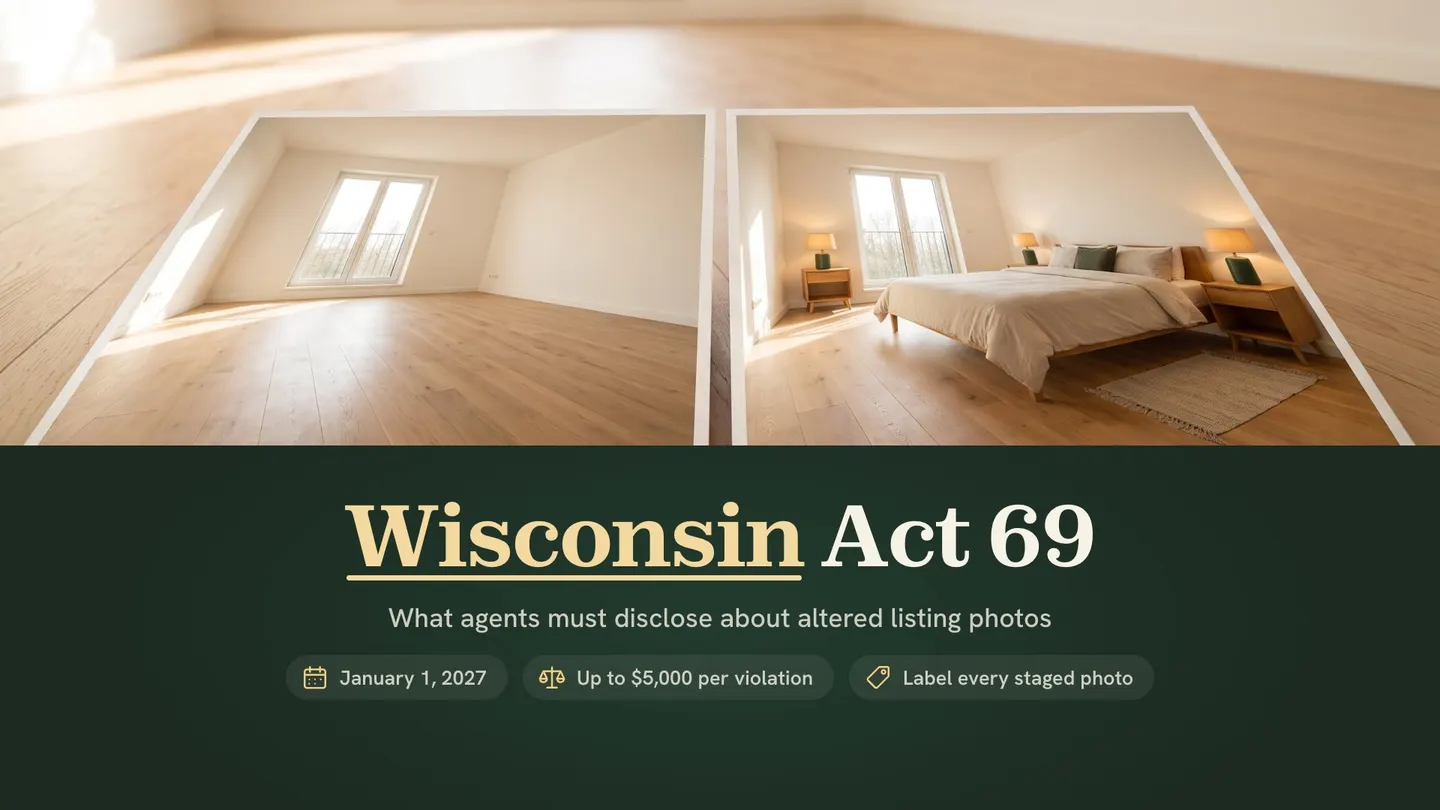
What is Wisconsin Act 69? It’s a 2025 real estate law that takes effect January 1, 2027. From then, licensees must disclose ads where technology, including AI, adds, removes or changes parts of a property and creates a false or misleading impression. Each violation risks a fine of up to $5,000 and license discipline, and a separate statute allows up to 6 months in jail.
Law text, rules and multiple listing service (MLS) policies checked October 5, 2026.
This article is general information, not legal advice. For a specific listing, ask your broker or, if you’re a member, the Wisconsin REALTORS Association (WRA) Legal Hotline. We make TINTY, an AI virtual staging app, so we have a stake in this topic. Every legal point below links to the statute or the source it comes from, and we mark our own reading.
Key takeaways
- Start date: January 1, 2027, per Section 9 of the act. Fix labels on live listings before then.
- Trigger: edits that add, remove or change parts of the property and create a false or misleading impression.
- No set wording: Act 69 sets no label text or originals rule. Metro MLS already requires both, and charges $10 for an altered photo without its watermark.
- Penalty: no new fine. The board can fine up to $5,000 per violation, plus license action. A court can fine up to $5,000, jail up to 6 months, or both.
- Safe habit: label every staged photo and never edit permanent features or defects. Checklist
On this page: What the law says · Start date · Who’s covered · Misleading edits · Penalties · Rules and forms · Metro MLS · vs California · Checklist · Sample wording · Office policy · Staging tools · FAQ · How we researched
What Wisconsin Act 69 says about listing photos
2025 Wisconsin Act 69 adds one sentence about altered images to Wisconsin’s license law. It sits in the advertising section, Wis. Stat. 452.136, as a new subsection (1m).
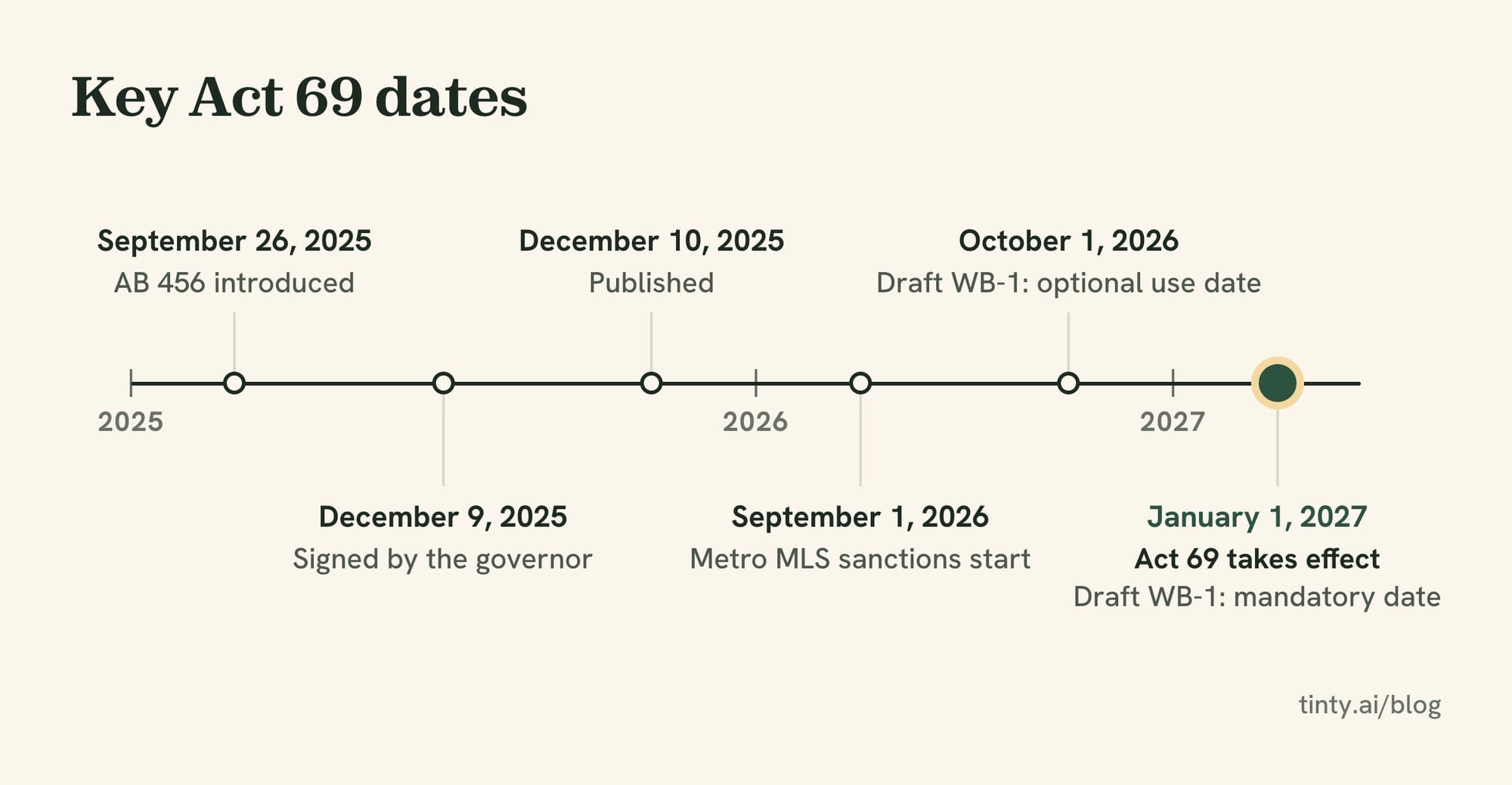
The act started as 2025 Assembly Bill 456, introduced September 26, 2025. It passed both houses that fall. Governor Tony Evers signed it on December 9, 2025, and it was published the next day.
The act does three things, per the Legislative Council act memo:
- AI disclosure: a duty to disclose technology-altered advertising, the subject of this guide.
- Public marketing: listings of 1-4 unit homes must go online within one business day, unless the owner signs an opt-out form.
- Compensation: firm-to-firm payments are banned in 1-4 unit deals, except referral or finder’s fees. Seller-paid buyer compensation must sit in the offer (452.19).
The exact words of Section 4 (Wis. Stat. 452.136(1m))
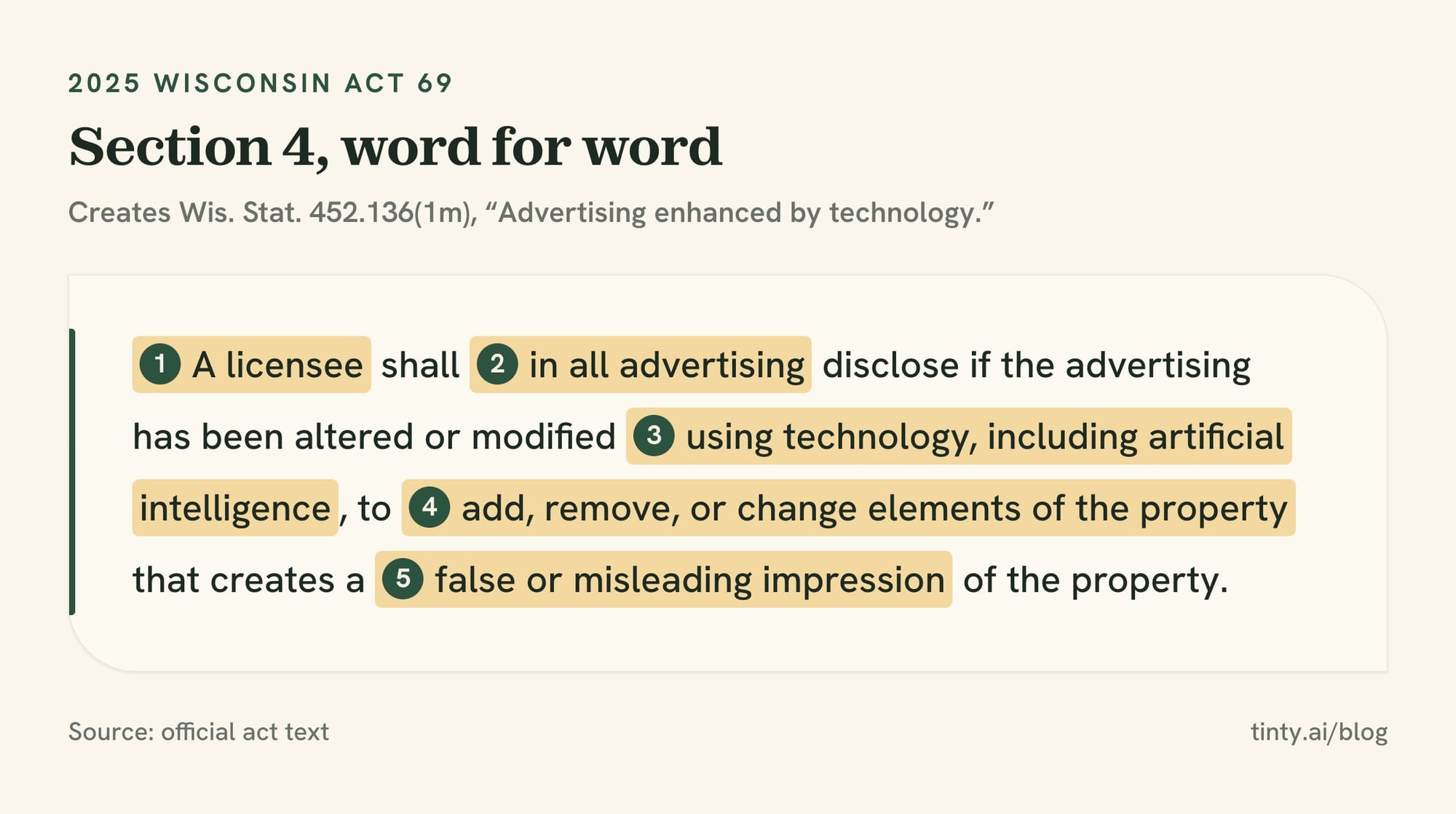
Here is Section 4 of the act, quoted in two parts from the official act text. The full sentence is in the image below.
Rule: Section 4 creates 452.136(1m), “Advertising enhanced by technology.” The duty: “A licensee shall in all advertising disclose if the advertising has been altered or modified using technology, including artificial intelligence”. The trigger: the edit must “add, remove, or change elements of the property that creates a false or misleading impression of the property.”
The statute stands next to an older rule. Subsection (1) already says a licensee “may not advertise in a manner that is false, deceptive, or misleading.” That ban is in force today.
The rule in five parts
Read the sentence one phrase at a time. Each phrase sets a limit:
- “A licensee”: licensed brokers and salespersons. The text doesn’t name sellers, photographers or software vendors.
- “In all advertising”: no channel is excluded. MLS photos, portals, flyers, social posts and your website all count (our reading).
- “Using technology, including artificial intelligence”: any editing tool, not only AI. Photoshop counts too.
- “Add, remove, or change elements of the property”: the edit must change how the property looks, such as walls, floors, views or the yard. Staged furniture likely counts too, as WRA and Metro MLS guidance suggests (our reading).
- “False or misleading impression”: the duty applies when the edit creates a false or misleading impression. Treat any edit that could mislead as covered, to be safe.
What the sentence leaves out matters just as much. It prescribes no wording, no placement and no font size. It also has no rule about keeping or linking the original photo.
When Act 69 takes effect: January 1, 2027
The whole act takes effect on January 1, 2027. Section 9 says so in one line: “This act takes effect on January 1, 2027.” The statute page repeats it in a note under subsection (1m).
You may see three dates in articles about the law. Here’s what each one means:
- December 9, 2025: the date of enactment, when the governor signed the bill.
- December 10, 2025: the date of publication. Wisconsin acts usually take effect the day after publication, but this one sets its own date.
- January 1, 2027: the effective date. From this day the disclosure duty is in force.
Watch out: a listing that goes live in December 2026 may still be advertised on January 1, 2027. From that day, its photos fall under the new rule (our reading). Fix the labels on active listings before New Year’s Day, not after.
What applies before January 1, 2027
The new subsection isn’t in force yet, but altered photos aren’t a free zone today. Three layers already apply:
- The false advertising ban: Wis. Stat. 452.136(1) bars false, deceptive or misleading ads right now.
- The duty to disclose defects: under 452.133(1)©, a firm must disclose in writing, on time, material adverse facts it knows that a party doesn’t know or can’t discover through reasonably vigilant observation.
- MLS rules: Metro MLS announced label rules for altered photos in April 2026, with sanctions from September 1, 2026.
Metro MLS makes the same point in its virtual staging guidance. It warns that undisclosed edits may break 452.136(1) “even under the current law.”
Wisconsin AI real estate disclosure: who is covered
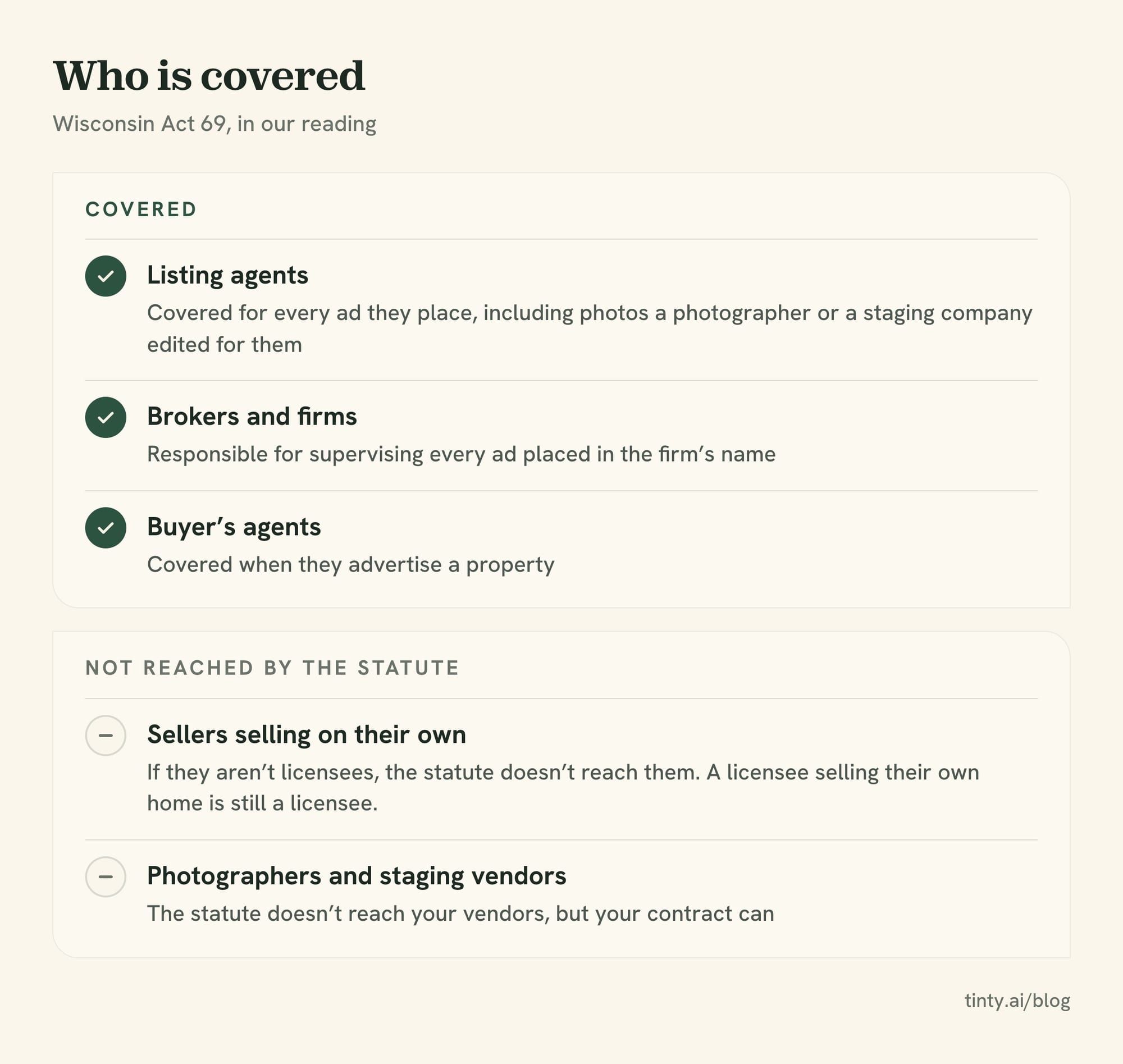
The duty falls on the licensee, and in practice on the firm that supervises the ad. Wisconsin already requires licensees to advertise “under the supervision of and in the name of the firm” (452.136(2)(b)).
Here’s how the rule lands on each role, in our reading:
- Listing agents: covered for every ad they place, including photos a photographer or a staging company edited for them.
- Brokers and firms: responsible for supervising every ad placed in the firm’s name.
- Buyer’s agents: covered when they advertise a property, for example when they share listing photos with permission.
- Sellers selling on their own: if they aren’t licensees, the statute doesn’t reach them. General consumer law still does. A licensee selling their own home is still a licensee.
Photographers and staging vendors
The statute doesn’t reach your vendors, but your contract can. Ask every photographer and staging company to deliver the original with each edited file. Ask them to list what they changed, in plain words, for every image.
Also agree on what they may not touch. A vendor who removes a crack or a power line to make the photo look nicer hands you a disclosure problem. Put the ban in the order form, where it’s on record.
Does the photo rule apply only to 1-4 unit homes?
Not by its text. Some online summaries say the AI rule covers only homes with one to four dwelling units. Section 4 has no such limit.
The confusion has a source. The unit limit appears in Section 3 (public marketing) and Sections 7 and 8 (compensation). The Legislative Reference Bureau’s analysis of the bill also opens by framing the whole bill around 1-4 unit homes.
Rentals are a similar open point. The photo rule doesn’t mention them, but it speaks of “all advertising” and “the property.” So a licensee’s rental ads look covered too (our reading).
Tip: treat the photo rule as covering every property you advertise, including condos, land, multifamily and commercial listings. If the narrow reading turns out to be right, you’ve lost nothing by labeling.
What counts as a false or misleading impression
The statute doesn’t define “false or misleading impression,” and no rule or case explains it yet. So use a simple test: would a buyer who tours the home feel the photo showed something that isn’t there?
The WRA’s own example helps. In its November 2025 explainer, it said that removing a neighboring structure or adding lush landscaping “can create a false impression of the property’s true condition.”
Edits that need a disclosure
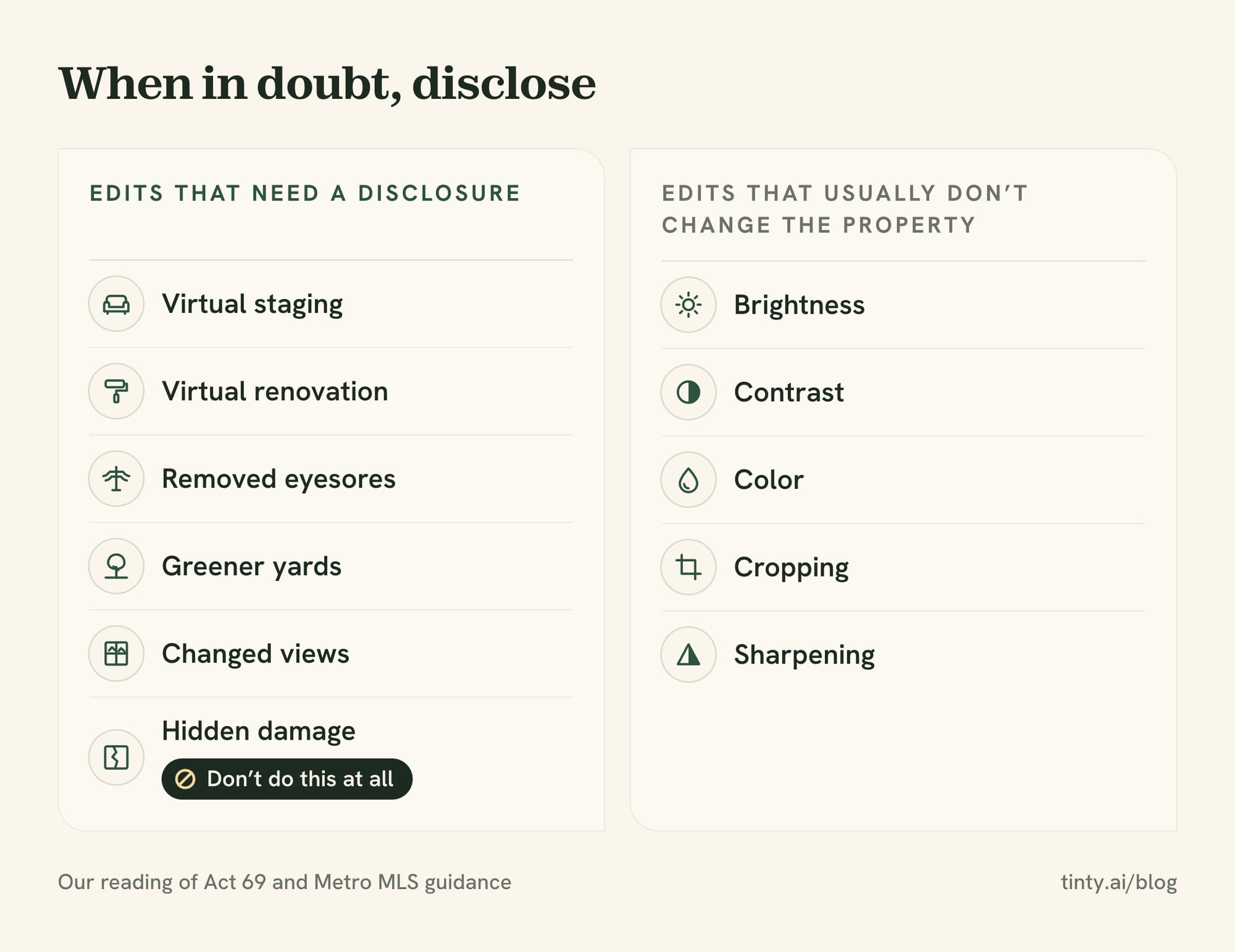
These edits change what a buyer would find on a tour. Disclose them, and think hard about whether to make them at all:
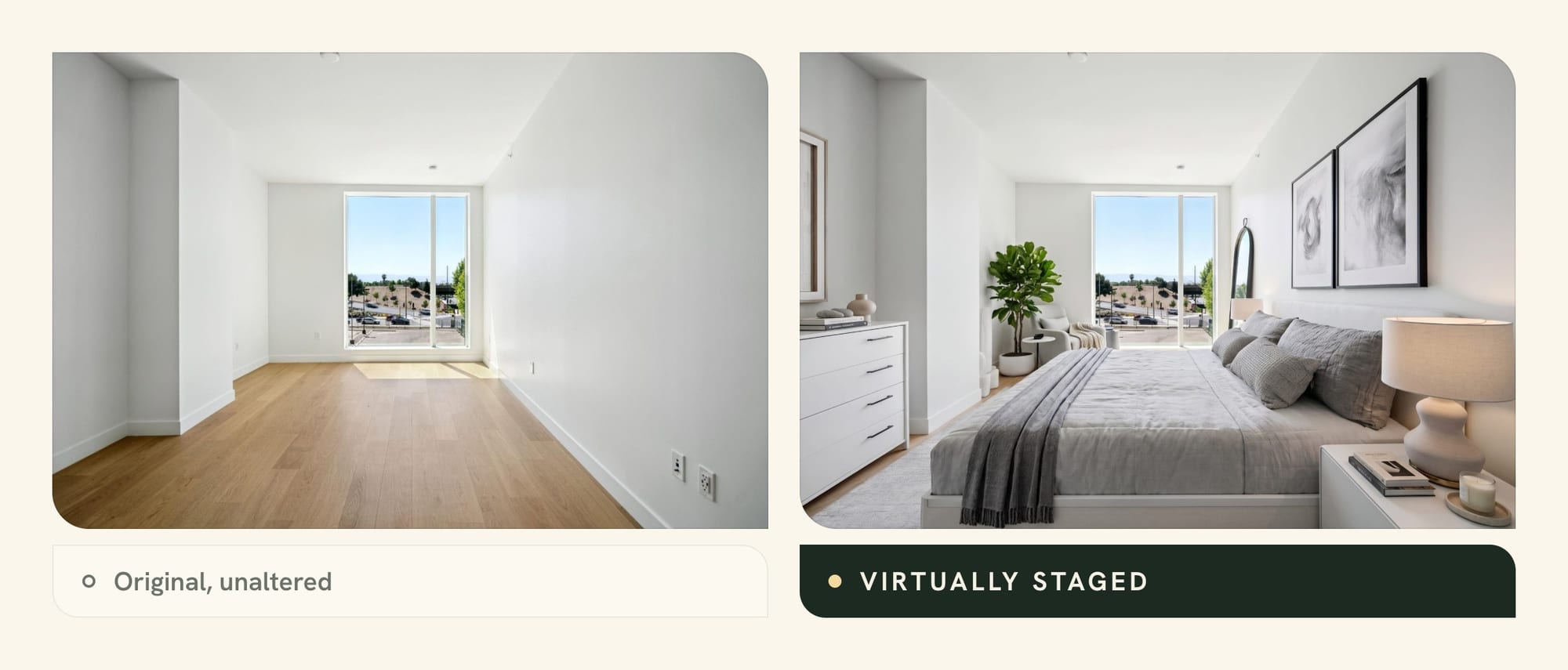
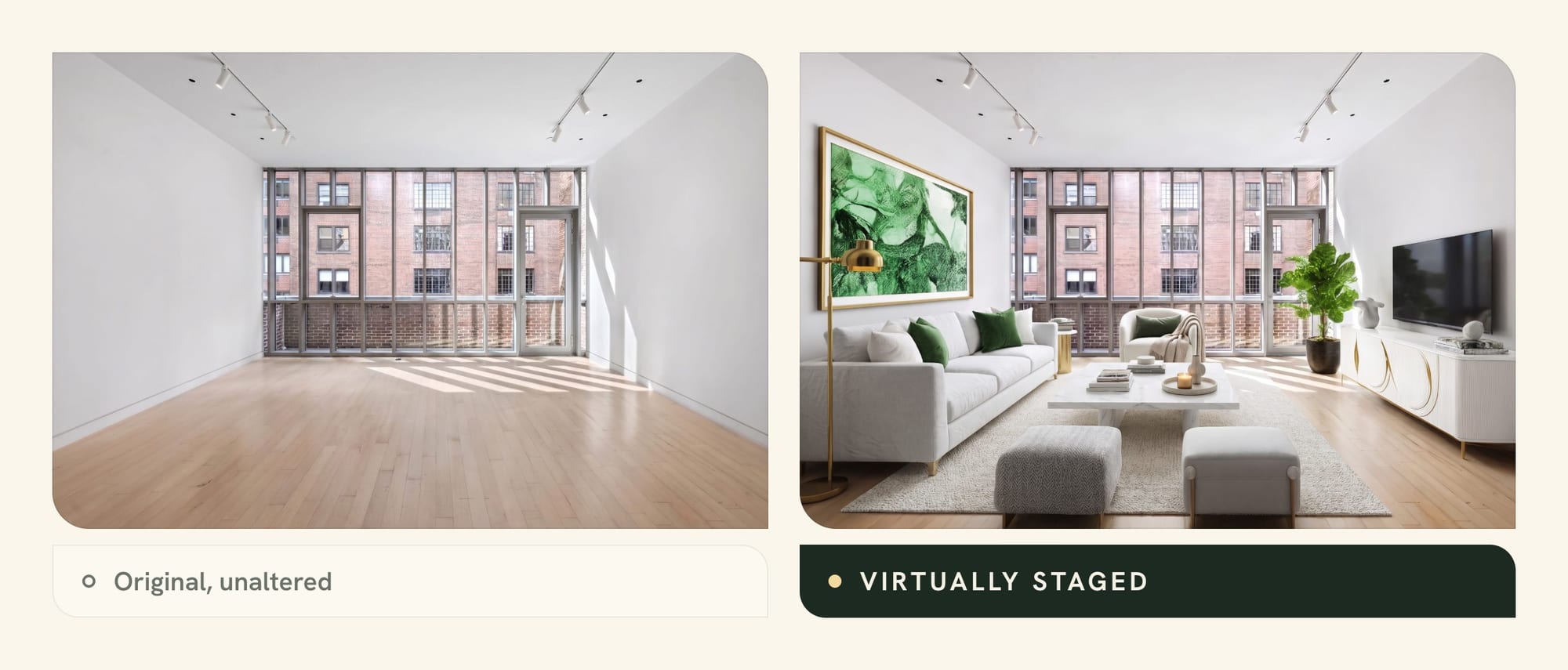
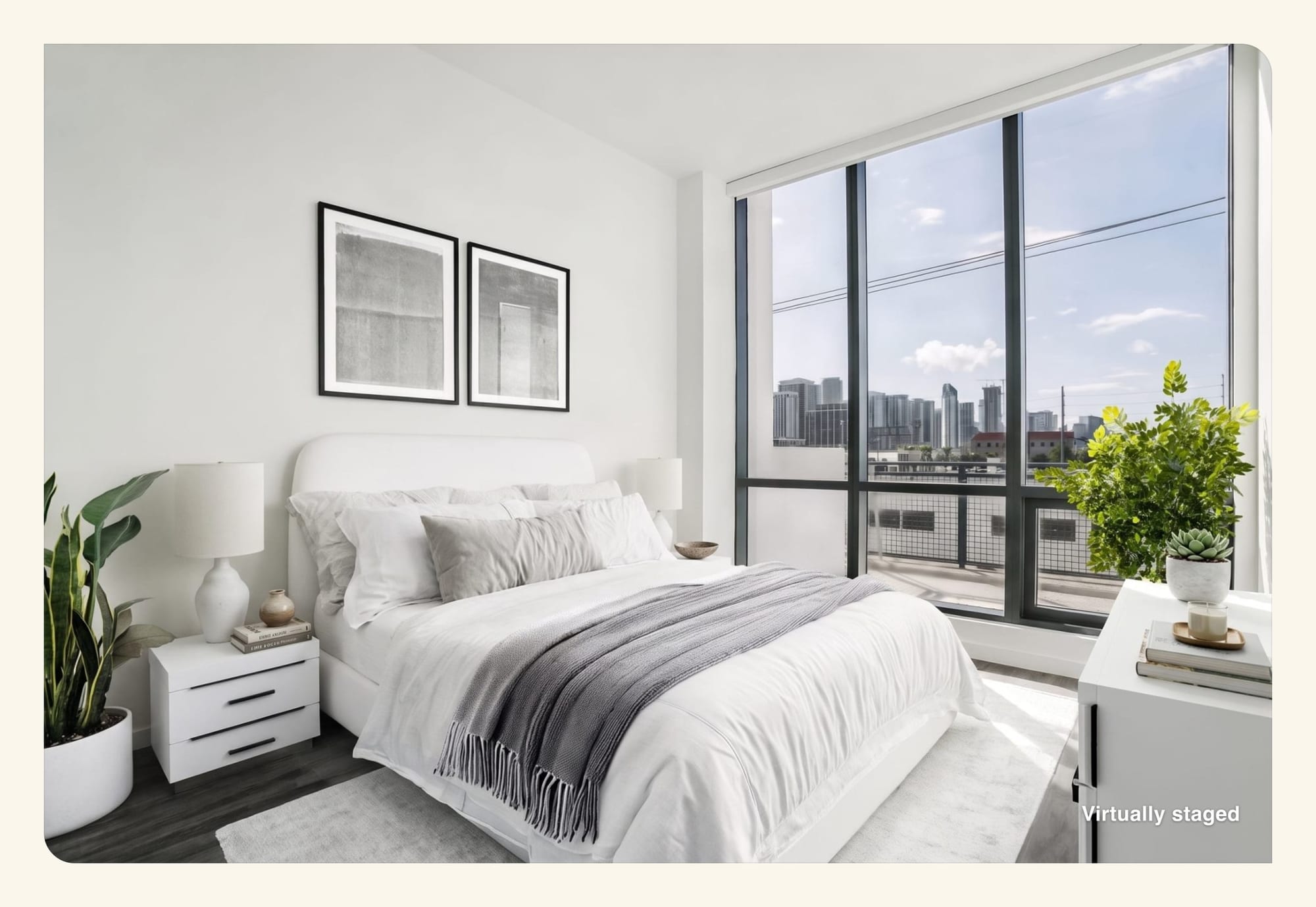
- Virtual staging: digital furniture and décor in an empty room.
- Virtual renovation: new paint colors, flooring, cabinets or a finished basement that doesn’t exist.
- Removed eyesores: power lines, a neighbor’s shed, a busy road or a cell tower erased from the frame.
- Greener yards: a brown lawn turned green, or trees and flowers added.
- Changed views: a better view pasted into a window.
- Hidden damage: water stains, cracks or worn carpet painted over. Don’t do this at all.
That last item is where a label stops helping. A disclosure doesn’t cure a photo that hides a defect. That could also break the false advertising ban and the duty to disclose material adverse facts.
Edits that usually don’t change the property
Normal photo correction doesn’t add, remove or change elements of the property. Metro MLS lists brightness, contrast, color, cropping and sharpening as not digitally altered, because they don’t change the substance of the image.
Metro MLS also lets agents skip its watermark for a realistic sky, a fire in a working fireplace, a removed yard sign, or decluttering. Its reason for yard signs and decluttering: those edits don’t change “the true and current condition of the physical house.” That’s an MLS view, not a court ruling.
Gray areas: twilight shots, decluttering and digital fires
Some edits sit in between, and no Wisconsin source settles them yet. A day-to-dusk exterior changes the sky and the lighting, not the house. It can be read as a lighting change, but a label costs nothing.
Digital decluttering removes the seller’s loose things, not parts of the house. Metro MLS doesn’t require its watermark for it. Removing a built-in, a radiator or a ceiling fan is different, because those are part of the property (our reading).
Watch out: a digital fire is fine in Metro MLS’s view only when the fireplace works. Adding fire to a fireplace that doesn’t work is staging under its procedures, and a buyer could call it misleading.
Is there a Wisconsin virtual staging law?
Act 69 is the closest thing, but it doesn’t name virtual staging. California’s law names “furniture,” while Wisconsin’s speaks only of edits that create a false or misleading impression. Our state-by-state guide covers the other states.
So is plain furniture staging misleading? A buyer who sees a furnished room and finds it empty may feel misled about space and scale.
The WRA’s view is clear: virtual staging is fine “so long as buyers know it’s virtual.” Metro MLS lists staging first among altered photos. Label it every time.
Penalties under Act 69 and who enforces them
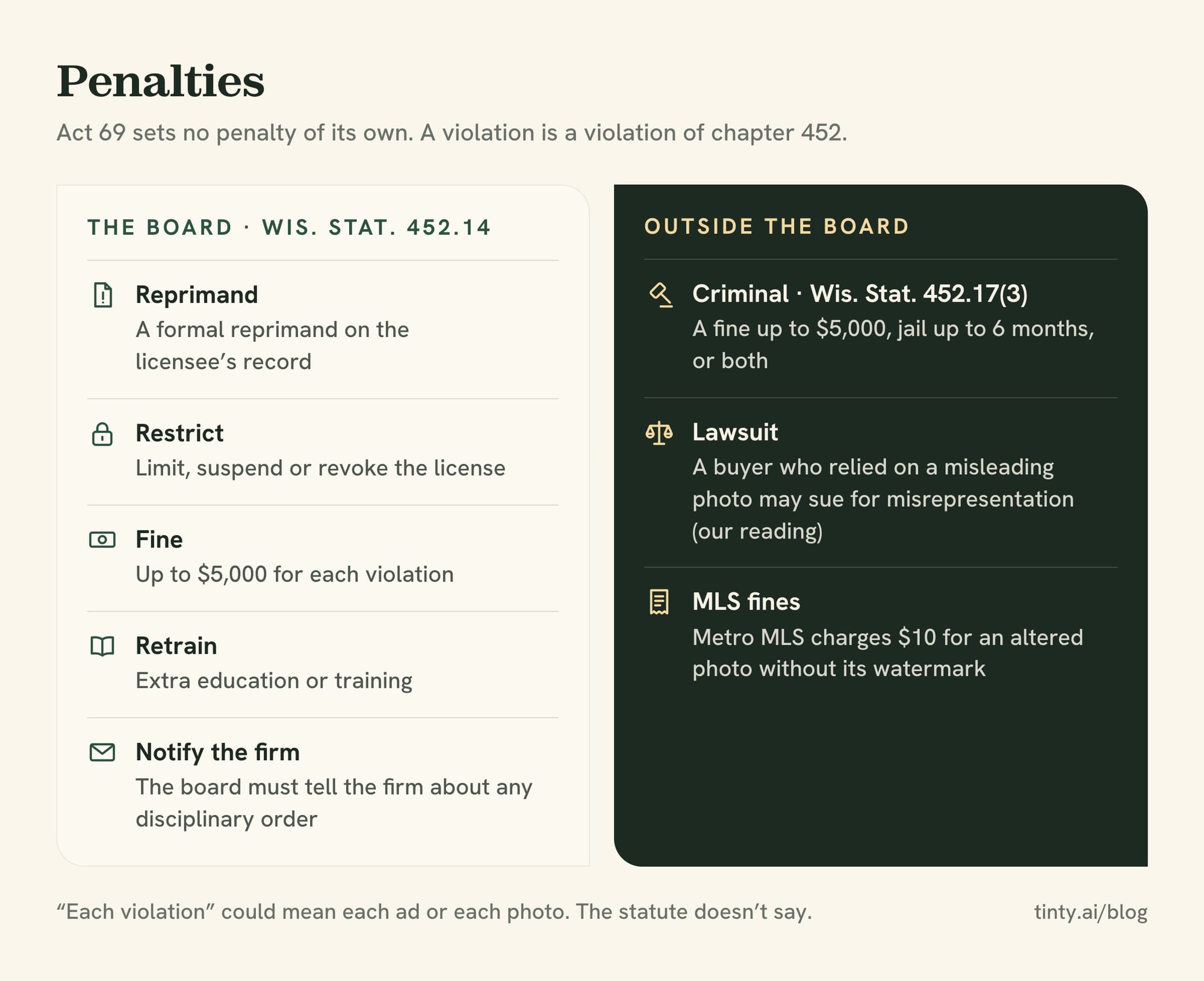
Act 69 sets no penalty of its own. A violation of 452.136(1m) is a violation of chapter 452, so the general discipline statute, Wis. Stat. 452.14, applies.
The Real Estate Examining Board (REEB) investigates complaints and decides discipline. The Department of Safety and Professional Services (DSPS) supports the board. Under Wis. Stat. 452.14, the board can:
- Reprimand: a formal reprimand on the licensee’s record.
- Restrict: limit, suspend or revoke the license.
- Fine: a forfeiture of up to $5,000 for each violation, under 452.14(4m)(a).
- Retrain: require extra education or training, under 452.14(4m)(b).
- Notify the firm: the board must tell the firm about any disciplinary order against its licensee (452.14(2)(b)).
Watch out: “each violation” could mean each ad or each photo. The statute doesn’t say, and the law has no enforcement history yet. A listing with many unlabeled photos across several channels is the risk to avoid.
Three other risks sit outside the board. The first is criminal: under Wis. Stat. 452.17(3), anyone who violates chapter 452 “may be fined not more than $5,000 or imprisoned for not more than 6 months or both.” A buyer who relied on a misleading photo may also sue for misrepresentation (our reading). Your MLS can fine you under its own rules, and Metro MLS already does.
Rules, forms and WRA guidance so far
As of October 5, 2026, no adopted rule sets label wording for altered photos in Wisconsin.
Board rules and draft forms
The Real Estate Examining Board’s August 27, 2026 meeting packet lists rule drafting for Act 69. On the photo rule, staff noted that REEB 24.04 already requires licensees to follow 452.136. So it “isn’t really necessary to recreate this provision in code unless the board wants to.”
The same packet carries draft listing and offer forms. The draft WB-1 listing contract shows an optional use date of October 1, 2026 and a mandatory date of January 1, 2027.
A draft WB-55 Public Marketing Opt-Out Agreement covers the one-business-day marketing rule. We found no photo clause in the drafts.
WRA guidance and the legal hotline
In the WRA guidance we could read, we found no label wording. Its 2025 explainer tells members to review “photos, renderings and virtual tours” so material alterations are disclosed.
WRA members can ask hotline attorneys about disclosures and REEB rules, by phone or online. The WRA’s Legal Hotline page says the service is for members only, and agents shouldn’t refer clients to it. Hotline attorneys give legal information, not an attorney-client relationship, so complex questions may still need your own lawyer.
Metro MLS already requires labels on altered photos
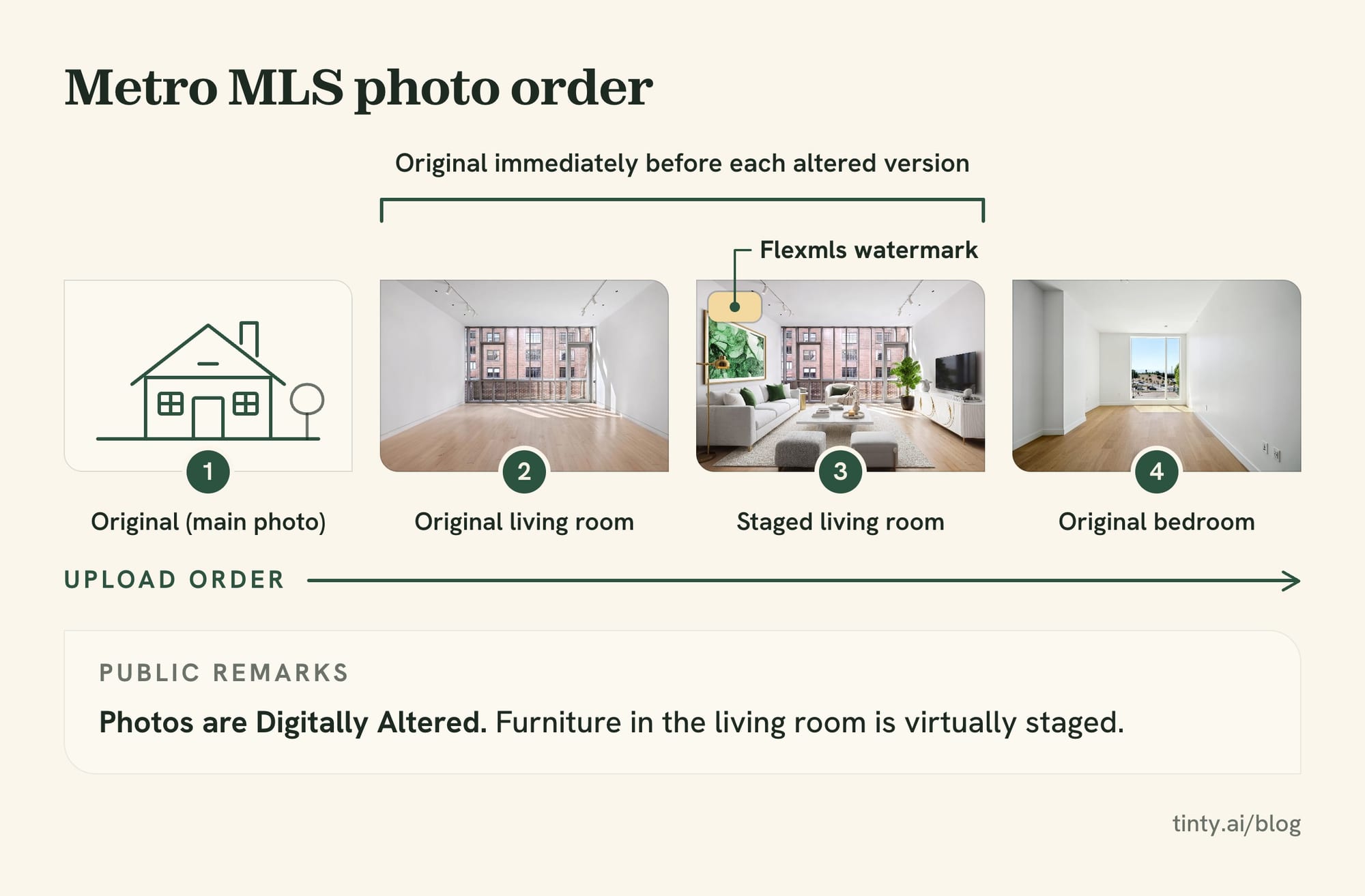
If you list in the Milwaukee area, Metro MLS rules are stricter than the statute and already in force. Its April 2026 policy post and August 2026 procedures set four requirements:
- Original first: the main listing photo must be the original, unaltered photo.
- Pairs: upload the original immediately before each altered version, and mark the altered one with the Flexmls watermark feature only.
- Remarks: include the phrase “Photos are Digitally Altered” in the public remarks, and disclose any virtual staging there.
- No text on photos: the procedures say “No wording of any kind is allowed on photos.” Use only the Flexmls watermark there.
Rule: Metro MLS charges a $10 sanction for an altered photo without its watermark, if removed. An altered primary photo costs $10 a day until it’s replaced (Metro MLS procedures).
Metro MLS defines a digitally altered image as one where software or AI “is used to add, remove or significantly change its content.” It names virtual staging, modified structures or landscaping, and changed views. Its staging guidance bans people, pets, lifestyle scenes and signage in staged photos.
Not in Metro MLS? Search your MLS rules for “altered,” “staged” and “enhanced,” and check whether text on photos is allowed. Some Wisconsin MLSs may have nothing yet. The statute still applies to you from January 1, 2027.
Wisconsin Act 69 vs California AB 723
California has had a stricter law since January 1, 2026. AB 723 added Business and Professions Code §10140.8, and it covers any digitally altered image, even one that isn’t misleading. Wisconsin and California are the only states we found with an AI real estate disclosure law for listing photos. Our guide to virtual staging laws tracks the pending bills.
Wisconsin Act 69 and California AB 723 compared (Wisconsin checked October 5, California October 1, 2026):
| Point | Wisconsin Act 69 | California AB 723 |
|---|---|---|
| In force | January 1, 2027 | January 1, 2026; rentals from January 1, 2027 (AB 2025) |
| What triggers it | Edits to the property that create a false or misleading impression | Any image altered to add, remove or change elements, furniture included |
| Label rules | None set in the law | “Reasonably conspicuous,” on or next to the image |
| Original photo | No rule | Link, URL or QR code to the unaltered image |
| Penalty | Up to $5,000 per violation, license action (452.14); criminal fine up to $5,000, jail up to 6 months, or both (452.17(3)) | DRE citation up to $2,500, license action; misdemeanor if willful (§10185) |
The biggest gap is scope. California catches all staging by definition. Wisconsin catches edits that create a false or misleading impression, which most staging arguably does.
Metro MLS fills part of the originals gap by requiring the original next to each altered photo.
Penalties in both states run through general license law. California’s citation cap is $2,500 under §10080.9, and willful violations are misdemeanors under §10185. Wisconsin’s 452.17(3) adds a criminal penalty for any chapter 452 violation. If you follow California’s rule in Wisconsin, you’ll likely meet Act 69’s disclosure duty too (our reading). The reverse isn’t true.
Licensed in both states?
Use one standard for both: California’s (our suggestion). Label every altered photo next to the image, and link to the original, as California requires. In Wisconsin, add your MLS’s own steps. Metro MLS wants the original right before each altered photo, the Flexmls watermark, its remarks phrase, no other text on photos and no web addresses in the remarks, so put the link on flyers and your own website.
Act 69 compliance checklist for Wisconsin agents

Run these steps for every listing with edited photos, starting now:
- Read your MLS rules. Search for “altered,” “staged” and “enhanced,” and follow the stricter rule.
- Decide the edits. Stage furniture and décor only. Leave walls, floors, fixtures, views, the yard and defects as they are.
- Compare with the original. Check every AI result for added windows, changed floors and furniture at the wrong scale.
- Keep the original. Save each unaltered photo with the listing file, named to match its edited twin.
- Label every edited photo. Use the caption field, the photo itself or both, as your MLS allows. Where text on photos is banned, as in Metro MLS, use the MLS’s watermark tool plus the remarks or disclosure fields.
- Add a line to the remarks. Say that some photos are virtually staged or digitally altered.
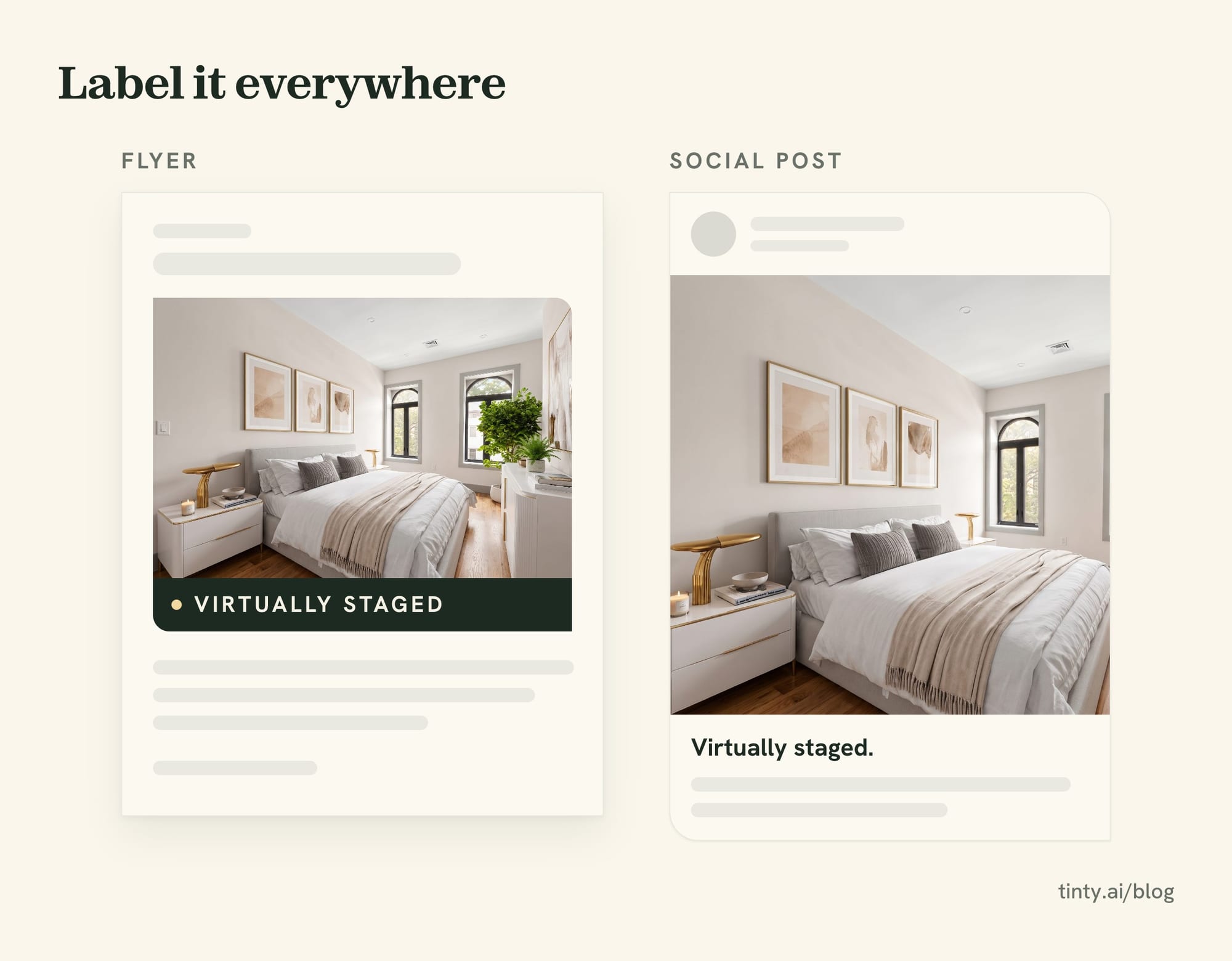
- Label it everywhere. Flyers, social posts, your website and email blasts are advertising too.
- Audit active listings. Before January 1, 2027, review every live listing with edited photos.
Act 69 adds no rule on keeping originals, but an older records rule may apply. REEB 15.04(1) makes a firm keep documents “utilized, received or prepared in connection with any transaction” for at least 2 years. Photo files may count, so keep the originals and ask your broker. If a buyer or the board asks what you changed, the original is your best answer.
Tip: ask your photographer to deliver pairs: living-room-original.jpg and living-room-staged.jpg. Matching names make the Metro MLS upload order and your records simple.
Why the one-business-day rule matters for photos
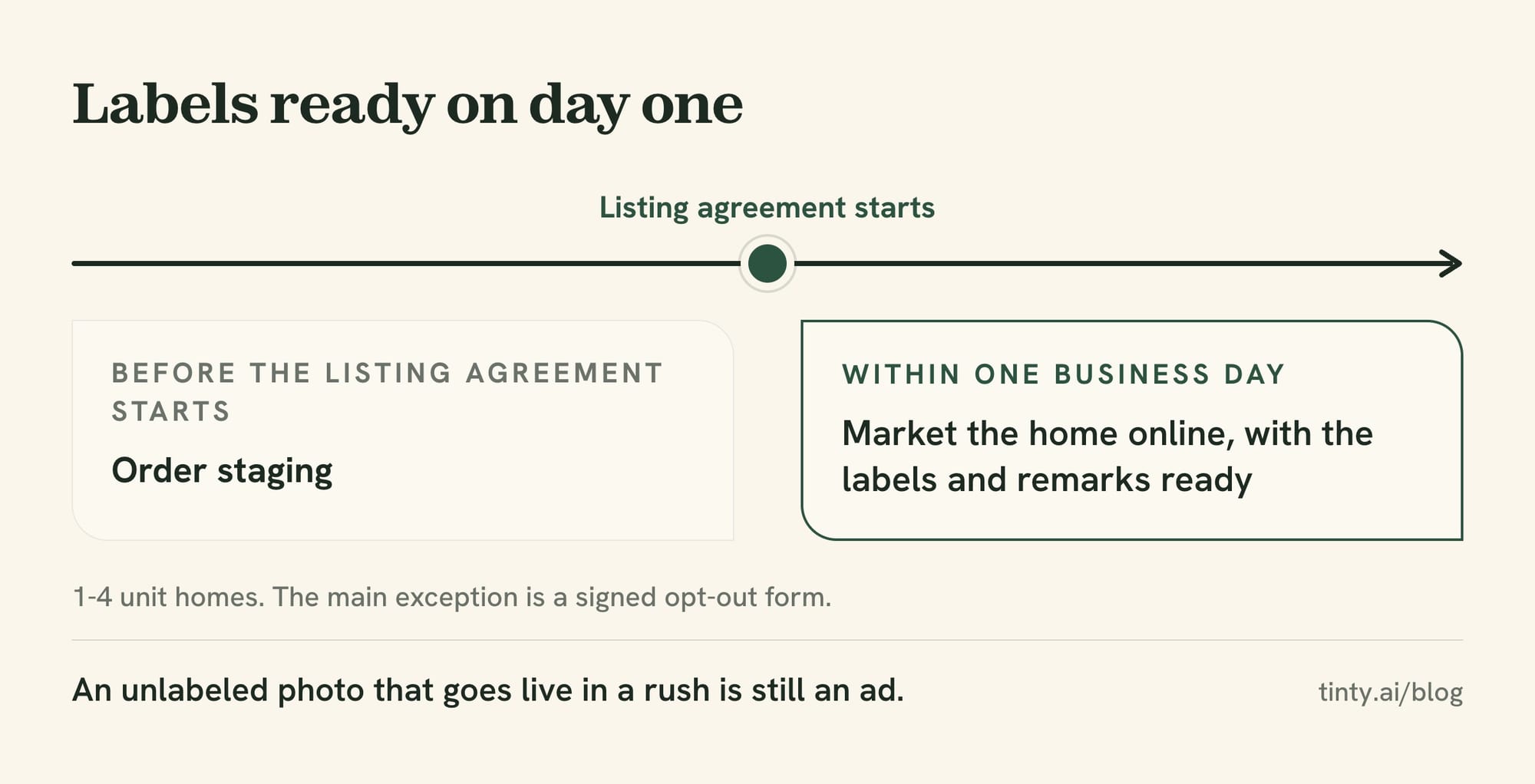
Act 69 also says a listing firm must market a 1-4 unit home online within one business day of the listing agreement’s start date (452.1355). The main exception is a signed opt-out form. Owners can also name people they won’t work with, under 452.1355(4).
That leaves little time to fix photos after signing. Order staging before the listing agreement starts, and have the labels and remarks ready on day one. An unlabeled photo that goes live in a rush is still an ad.
If a buyer says a photo misled them
Answer quickly and in writing. Pull the original photo and the edit notes from your file, and show the buyer what changed.
If the label was missing, fix every channel the same day, then tell your broker. A prompt fix won’t erase a violation, but it shows good faith. If the complaint involves a hidden defect, call your broker and an attorney before you reply.
Sample disclosure wording for photos and remarks
Act 69 gives no wording, so here are examples you can adapt. These are examples, not legal advice. Check them against your MLS rules and your broker’s policy before you use them.
Photo captions
Short captions work best next to each image. Examples:
- Staged room: “Virtually staged. Furniture and décor are digital; the room is empty.”
- Staged, with the original nearby: “Virtually staged. The original photo appears just before this one.”
- Rendering: “Digital rendering of a possible finished basement. The basement is unfinished today.”
MLS public remarks and portal descriptions
Put one plain sentence near the start of the remarks, where buyers read first. Examples:
- Metro MLS listings: “Photos are Digitally Altered. Furniture in the living room and two bedrooms is virtually staged.” The first sentence is Metro MLS’s required phrase.
- Other MLSs: “Some photos are virtually staged to show possible furniture layouts. The rooms are currently empty.”
- Mixed listings: “Photos 3, 5 and 8 are virtually staged. All other photos are unaltered.”
Example: say a vacant three-bedroom ranch listed in Metro MLS has 24 photos, 4 of them staged. The agent uploads 28 files: each staged photo follows its original and carries the Flexmls watermark. The remarks open with “Photos are Digitally Altered” and say which rooms are virtually staged.
Flyers, social posts and property websites
Captions often get lost when photos leave the MLS. The statute says “all advertising,” so the label should travel with the photo. Our suggestions:
- Flyers: print “Virtually staged” under each staged photo, in text a buyer can read.
- Social posts: put the label in the image or the first line of the caption, not after the hashtags.
- Property websites: show the original next to the staged version, or link to it.
What brokers should put in an office policy
Brokers carry the supervision duty, so a short written policy is worth the hour. Act 69 doesn’t require one. California’s Department of Real Estate (DRE) recommends written AI policies for brokers, and the same logic carries to Wisconsin (our reading).
Copy this template and fill in the brackets:
- Scope: “This policy covers every ad our licensees place for [firm name], in every channel.”
- Allowed edits: “Agents may add virtual furniture and décor and correct light, color and cropping.”
- Banned edits: “Agents may not change walls, floors, fixtures, views or landscaping, or hide any defect.”
- Labels: “Every staged photo carries the caption [approved caption]. The remarks include [approved line].”
- Review: “[Role] checks each AI image against its original before it goes live.”
- Records: “Originals and edit notes are kept in [system] for [period].” REEB 15.04 sets a 2-year minimum for transaction records.
- Vendors: “Photographers and staging companies deliver the original with every edited file.”
- Complaints: “[Name] answers any buyer who says a photo misled them, within [time].”
Train every agent on the policy before January 1, 2027, and every new agent on day one.
Brokers who want a second opinion can send the draft to their attorney. WRA members can also ask the hotline about office policies and REEB rules.
Where virtual staging tools fit, including TINTY
A staging tool can make compliance easier or harder, but the duty stays with you. In any tool, look for a label option and easy access to the original. It should also stick to furniture, and its final files shouldn’t carry a vendor logo, since a logo isn’t a disclosure and Metro MLS bans branding on photos.
Our comparison of virtual staging software covers labels, watermarks and which tools edit more than furniture. For prices, see what virtual staging costs.
Here is how TINTY handles each point:
- Label toggle: at download, you can add a “Virtually staged” label to the image. It’s optional. Use it only where your MLS allows text on photos. In Metro MLS, use its watermark and remarks instead.
- Originals: a project link shows the original next to the staged photo. That helps with clients and your records, but it isn’t a full compliance system.
- Furniture, not renovation: TINTY adds furniture and décor to empty rooms, including terraces. It doesn’t remove furniture yet, and it doesn’t stage kitchens, bathrooms, building exteriors or yards.
- Watermarks: previews and free finished photos carry a TINTY watermark. They’re for review, not your listing.
AI can still drift, so compare every render with the original before you publish. If a window moved or the floor changed, render it again.
Busy with listings? Email your empty-room photos to hello@tinty.ai with the style and each room’s purpose. TINTY Studio returns staged photos in 2 to 24 hours for $10 a photo, from 3 photos. You pay nothing up front and only if you’re happy, but the label is still your job.
New to staging? Read what virtual staging is, check TINTY’s pricing, or stage a photo free with TINTY.
Wisconsin Act 69 FAQ
When does Wisconsin Act 69 take effect?
January 1, 2027. Section 9 of the act says “This act takes effect on January 1, 2027.” Governor Evers signed it on December 9, 2025, and it was published December 10, 2025. Neither of those dates starts the duty.
Does Wisconsin Act 69 require a “Virtually staged” label?
Not in those words. The law requires disclosure when an edit to the property creates a false or misleading impression, but it sets no wording. The Wisconsin REALTORS Association says staging is fine if buyers know it’s virtual, so label every staged photo.
Show 6 more questionsShow fewer questions
Do I have to keep the original, unaltered photos?
Act 69 doesn’t say so, and unlike California’s AB 723 it has no rule about originals. But REEB 15.04 makes firms keep transaction records for at least 2 years, so ask your broker whether photo files count. Milwaukee’s Metro MLS also requires each original right before its altered version. Keeping originals protects you if anyone questions an edit.
Does Act 69 cover brightness, color or sky edits?
Normal light, color, cropping and sharpening fixes don’t add, remove or change elements of the property, so they’re outside the rule in our reading. Metro MLS lets agents skip its watermark for a realistic sky. Disclose anything that changes what a buyer would find on a tour.
What is the penalty for violating Act 69?
The act sets no penalty of its own. Under Wis. Stat. 452.14, the Real Estate Examining Board can reprimand a licensee, limit, suspend or revoke a license, and assess up to $5,000 per violation. It can also require extra education. Separately, under Wis. Stat. 452.17(3), anyone who violates chapter 452 may be fined up to $5,000, jailed up to 6 months, or both.
Does Act 69 apply to sellers or photographers?
Not directly. The duty falls on “a licensee,” meaning brokers and salespersons. A seller selling on their own isn’t covered by this statute, unless the seller is a licensee. Photographers aren’t named, but agents who use their edited files must disclose edits that create a false or misleading impression.
Does Act 69 apply to rentals or commercial listings?
The text doesn’t exclude them. It covers “all advertising” of “the property” by a licensee, with no property-type limit. So rental, commercial and land ads look covered in our reading. The 1-4 unit limit in other parts of the act doesn’t appear in the photo rule.
What about listings already on the market on January 1, 2027?
The act has no exception for them. Section 9 says only “This act takes effect on January 1, 2027,” and the rule covers “all advertising.” So a listing still advertised that day must disclose altered photos from then on (our reading). Review every active listing before that date.
How we researched this
On October 5, 2026, we read the act, the bill history, the Legislative Council memo and the current statutes on the Wisconsin Legislature’s site.
We also read the REEB’s August 2026 meeting packet, REEB 15.04, Metro MLS’s policy and procedures, and the WRA’s explainer and hotline page. California details come from our state law guide, checked October 1, 2026. Among Wisconsin MLSs, we checked only Metro MLS. We didn’t read the board’s meeting minutes, so we call the WB forms drafts. This is general information, not legal advice.
Sources
Wisconsin law (official)
Show 22 more sourcesShow fewer sources
- 2025 Assembly Bill 456, bill history · introduced text with LRB analysis
- Wis. Stat. 452.136, advertising by licensees
- Wis. Stat. 452.14, discipline and forfeitures
- Wis. Stat. 452.17, penalties
- Wis. Stat. 452.133, duties of licensees
- Wis. Stat. 452.1355, transactions involving residential property
- Wis. Stat. 452.19, fees and commissions
- Wis. Admin. Code REEB 24.04, advertising
- Wis. Admin. Code REEB 15.04, retention of records
Board, MLS and association guidance
- Real Estate Examining Board, August 27, 2026 open session packet
- Metro MLS, New Photo Upload Requirements in Flexmls (April 21, 2026)
- Metro MLS procedures, listing photo requirements (August 5, 2026)
- Metro MLS, Virtual Staging Best Practices (February 10, 2026)
- Wisconsin REALTORS Association, Promoting Transparency and Consumer Confidence (November 24, 2025)
- Wisconsin REALTORS Association, Legal Hotline
California, for comparison
- California B&P §10140.8 (AB 723)
- California B&P §10080.9
- California B&P §10185
- California DRE Licensee Advisory, “Artificial Intelligence in California Real Estate” (March 17, 2026)
TINTY (ours)