What does staging a house involve? Staging a house means getting each room ready so buyers can picture living there. First declutter, depersonalize, clean, fix small faults and brighten the light. Then style the rooms buyers’ agents rank highest: the living room, primary bedroom and kitchen, per a 2025 survey by the National Association of Realtors (NAR). Photograph the house last.
NAR figures and TINTY prices checked October 5, 2026.
We make TINTY, an AI virtual staging app, so we have a stake in one section of this guide. The rest is about real rooms, cleaning and paint, and each figure comes from NAR or another named source. For prices, see our home staging cost guide.
Key takeaways
- Start with three rooms: buyers’ agents rank the living room (37%), primary bedroom (34%) and kitchen (23%) as most important to stage.
- Work in order: declutter, depersonalize, clean, repair and light the house before you style it. Photograph it last.
- Staging spend in NAR’s 2025 survey: the median was $500 when the listing agent staged the home personally, against $1,500 with a staging service.
- Kitchens and bathrooms need real work: TINTY’s virtual staging covers bedrooms, living areas, offices and terraces, not those rooms.
- Label virtual staging: disclose every virtually staged photo and keep the original.
On this page: Which rooms · Order of work · Entry · Living room · Kitchen · Dining room · Bedrooms · Bathrooms · Office and terrace · Mistakes · DIY or pro · Virtual staging · Photo day · FAQ
Staging a house: which rooms buyers care about most
Staging a house matters most in three rooms: the living room, the primary bedroom and the kitchen. That’s how buyers’ agents ranked them in NAR’s 2025 Profile of Home Staging.
The same survey shows why staging matters at all. 83% of buyers’ agents said it made it easier for buyers to picture the home as their own. And 31% said buyers were more willing to tour a home they had first seen online.
Rooms buyers’ agents called “very important” to stage, and how often agents who stage include them (NAR, 2025)
| Room | Buyers’ agents: very important | Staged by agents who stage |
|---|---|---|
| Living room | 37% | 91% |
| Primary bedroom | 34% | 83% |
| Kitchen | 23% | 68% |
| Dining room | 17% | 69% |
| Bathroom | 13% | 47% |
| Guest or children’s bedroom | 7% to 9% | 22% |
One gap stands out. Only 13% of buyers’ agents rate bathrooms very important, yet 47% of agents who stage include them. Agents who stage also include home offices (36%) and outdoor spaces (31%), between bathrooms and secondary bedrooms.
Watch out: these are agents’ opinions from a survey with a 2.5% response rate (1,266 answers, February 2025), not sales records. Use them to set priorities, not to promise a seller results.
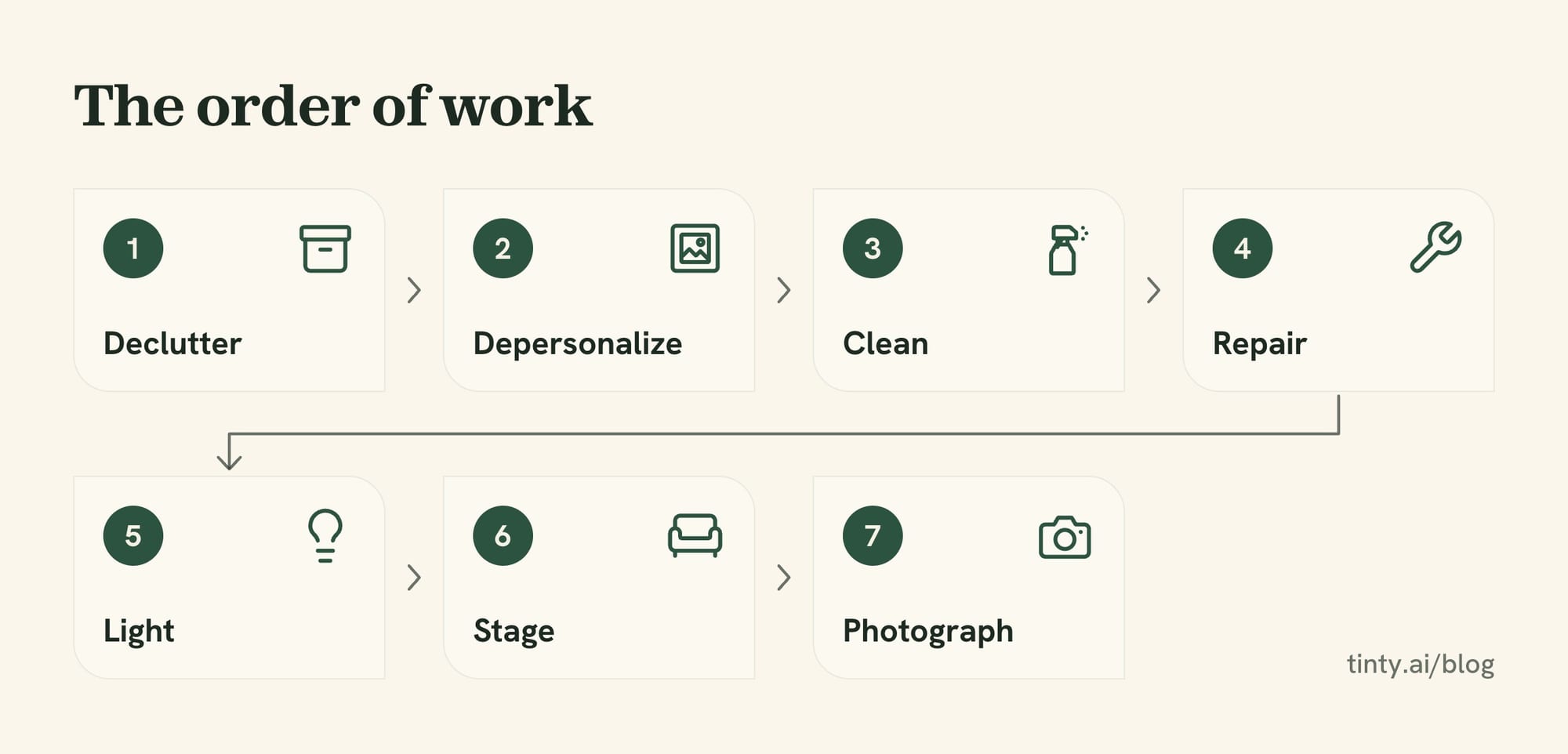
How to stage a house to sell: the order of work
Staging a house for sale goes faster when you do the jobs in this order, because each one makes the next easier. Styling a cluttered room wastes effort, and photos taken before repairs show the faults.
- Declutter. Pack away about half of what sits on shelves, counters and closet rails. Rent storage if you must.
- Depersonalize. Remove family photos, collections, religious and political items, and anything with names on it.
- Clean. Deep clean every room, including windows, baseboards, grout and carpets.
- Repair. Fix dripping taps, loose handles, sticking doors and scuffed paint.
- Light. Open the blinds, replace dead bulbs and use one bulb color in each room.
- Stage. Arrange the furniture, then add a few accessories: pillows, a throw, plants, art.
- Photograph. Book the photographer only when every room is ready.
How long it takes depends on how much stuff the house holds. In an occupied home, steps 1 to 5 take the longest, in our view, while the styling itself often fits into a day.
Tip: walk the house with your phone first and photograph each room. NAR’s consumer guide to staging suggests taking photos and checking what stands out. A photo often shows clutter your eye skips over.
Home staging tips agents give sellers first
Most agents who skip staging still give sellers jobs to do. In NAR’s survey, 51% didn’t stage but suggested decluttering or fixing faults instead. These are the home improvements agents recommended to sellers most often:
- Declutter the home: 91%.
- Clean the entire home: 88%.
- Improve curb appeal: 77%.
- Professional photos: 76%.
- Minor repairs: 75%.
- Carpet cleaning: 74%.
- Depersonalize the home: 72%.
- Paint touch-ups: 67%.
Painting whole walls (57%) and outdoor landscaping (53%) came next. Only 27% of agents asked sellers to remove pets during showings, though pet smells and bowls are hard to miss.
Paint and light: two cheap fixes with big effects
Paint and light change a room’s photo more than most furniture does. NAR’s consumer guide suggests neutral paint where needed, and 67% of agents recommended paint touch-ups.
Touch up scuffs on walls, trim and doors first. Repaint a whole room only if its color is loud or the walls are badly marked. Light, warm neutrals are the safe choice, in our view.
For light, replace every dead bulb and use one bulb color throughout each room, since mixed warm and cool bulbs look odd in photos. Clean the windows, open the curtains fully and add a lamp wherever a corner stays dark at midday. Redfin’s 2026 guide suggests a mirror opposite a window to reflect light around the room.
Entry and curb appeal: the first thing buyers see
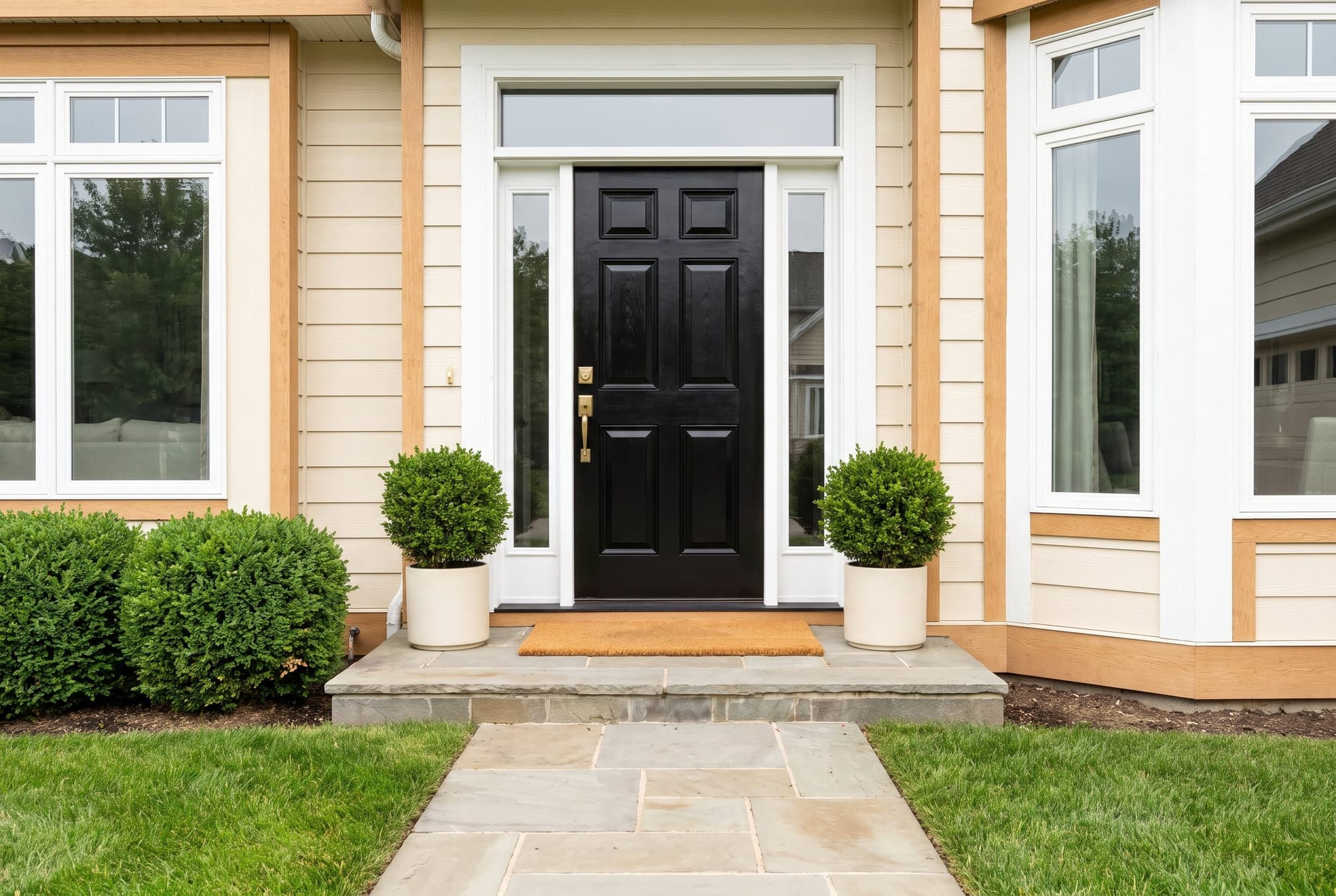
The front of the house is the first listing photo and the first thing buyers see in person. That’s why 77% of agents in NAR’s survey told sellers to improve curb appeal.
What buyers notice: the path to the door, the door itself and whether the yard looks cared for. Inside, they notice whether the entry feels cramped.
Do and don’t at the entry:
- Do: mow, edge, weed and sweep the walk. Clean the windows and the house numbers.
- Do: set a new doormat and one or two potted plants by the door.
- Do: clear the garage floor so buyers can see that a car fits.
- Don’t: leave bins, hoses, toys or cars in the front shot.
- Don’t: crowd the entry inside. A small table, a mirror and a few hooks are enough.
Budget tip: paint the front door and replace the mat before you spend on plants. Redfin’s room-by-room staging guide lists a painted door, a new doormat and new house numbers among its curb appeal steps.
TINTY can’t help here: it doesn’t stage building exteriors or yards, so the front of the house needs real work.
Living room staging: the room buyers rank first
The living room tops both of NAR’s lists. 37% of buyers’ agents called it very important to stage, and 91% of agents who stage include it. Get this room right before any other.
What buyers notice: how big it feels, where the light comes from and whether the furniture leaves a clear path through the room.
Do and don’t in the living room:
- Do: pull the sofa off the wall and group the seating around one focal point, such as a fireplace or a window.
- Do: anchor the seating with one rug big enough for at least the front legs of each piece.
- Do: add a lamp to each dark corner and a few pillows in one accent color.
- Don’t: keep oversized sectionals, recliners or extra side tables. Redfin’s guide suggests removing oversized furniture to open the room.
- Don’t: let the TV be the star. Turn it off for photos and showings.
Budget tip: borrow before you buy. Move your best chair, lamp or rug from a secondary room into this one. New pillow covers cost less than new pillows.
Tip: a crowded living room often needs only subtraction. If it holds a sectional, a recliner, two side tables and a toy bin, take out the recliner and the bin and keep one side table. The room reads as bigger in photos.
Staging a kitchen without a remodel
Staging a kitchen is mostly subtraction: clear counters, clean surfaces and good light. Buyers’ agents ranked the kitchen third (23%), and 68% of agents who stage include it.
What buyers notice: counter space, the state of the cabinets and appliances, and smells. Buyers also open cabinets and the pantry, so the inside counts too.
Do and don’t in the kitchen:
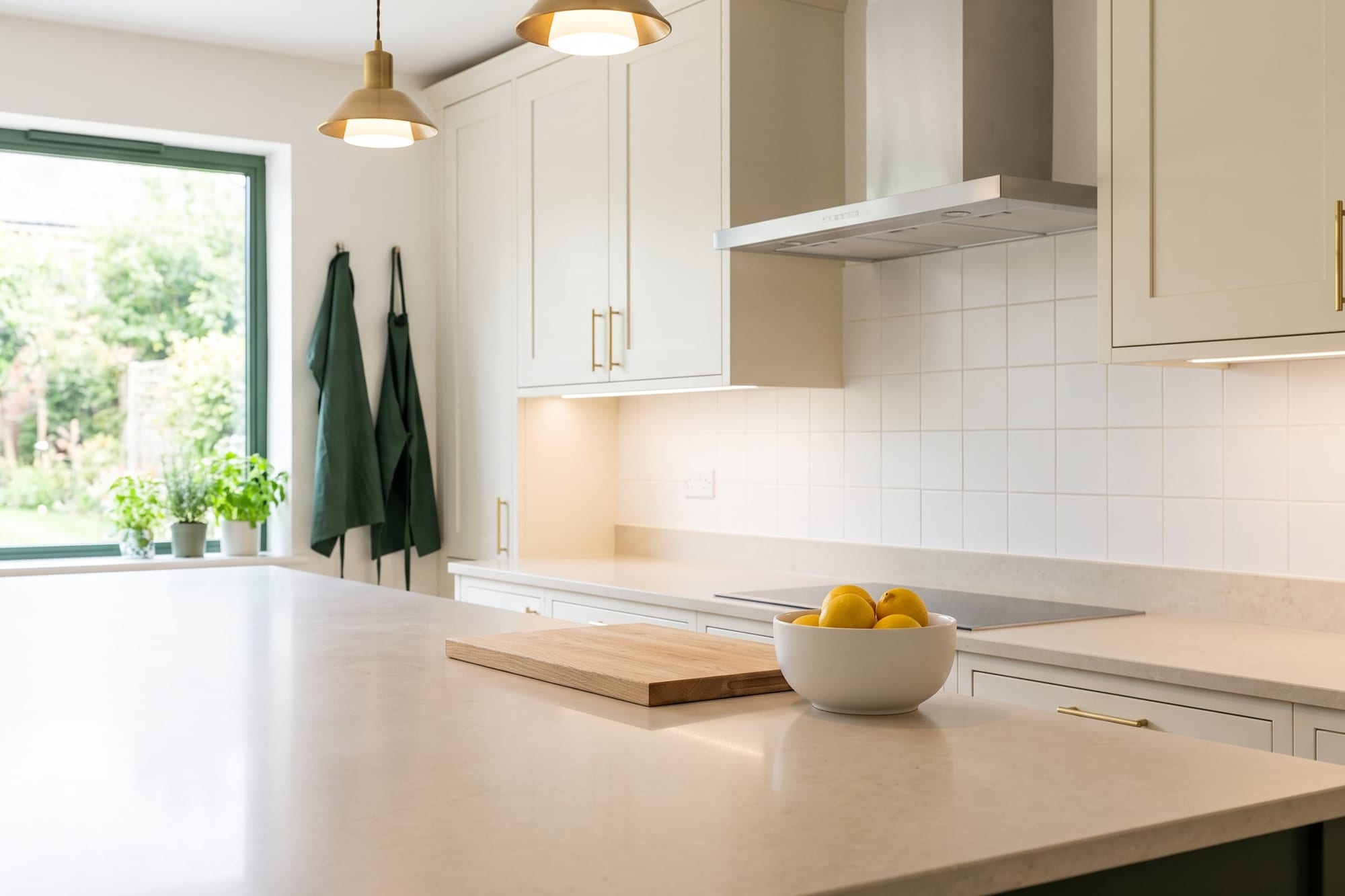
- Do: clear the counters except one or two items, such as a bowl of lemons or a cutting board.
- Do: degrease the range hood, clean the oven and wipe cabinet fronts and handles.
- Do: thin out cabinets and the pantry so they look roomy.
- Don’t: leave magnets, school papers or calendars on the fridge.
- Don’t: leave dish racks, sponges, pet bowls or the trash can in view.
Budget tip: new cabinet hardware and paint can refresh a dated kitchen without a remodel, Redfin’s guide notes. Regrout dark lines and recaulk the sink, too. Grouting made 30% of agents’ lists in NAR’s survey.
TINTY doesn’t stage kitchens at all, so a kitchen needs real cleaning and light styling before the photographer arrives.
Staging a dining room or dining area
Stage the dining room so its purpose is obvious at a glance. Agents who stage include it about as often as the kitchen (69% and 68%), while 17% of buyers’ agents rated it very important.
What buyers notice: whether a table for the household fits, and whether there’s room to pull the chairs out.
Do and don’t in the dining room:
- Do: set the table simply, with a runner, one bowl or vase and the chairs pushed in.
- Do: clear the room of anything not used for eating, as Redfin’s guide suggests.
- Don’t: lay full place settings. They look staged in the wrong way and clutter photos.
- Don’t: let the room double as an office, a playroom or a storage room.
Budget tip: if the table is too big for the room, take out the leaf and two chairs. A smaller table shows more floor and makes the room look larger.
Open-plan living-dining rooms and studios
In an open plan, buyers need to see where each zone starts and ends. Without that, one big room can read as an empty hall.
Mark each zone with its own anchor: a rug under the seating, a pendant light over the table, a bookcase or sofa back as a soft divider. Keep a clear walkway between the zones, so the eye can travel from the door to the windows.
In a studio apartment, show that a bed, a sofa and a table all fit. A daybed or a sofa facing away from the bed helps. A breakfast bar with two or three stools can stand in for a dining table in a small home.
Bedroom staging: start with the primary bedroom
The primary bedroom ranks second with buyers’ agents (34%), and 83% of agents who stage include it. Buyers want it to feel calm, roomy and restful.
What buyers notice: the bed, the closet and the light. Expect them to open the closet doors.
Do and don’t in the primary bedroom:
- Do: put the bed on the wall opposite the door if the room allows, as Redfin’s guide suggests.
- Do: use plain, light bedding, two nightstands and two matching lamps.
- Do: leave the closet about half full, so storage looks generous, per NAR’s consumer guide.
- Don’t: use a bed too big for the room. A queen often shows more floor than a king.
- Don’t: keep exercise gear, a work desk or laundry piles in the room.
Budget tip: new white bedding and two pillow shams change the photo more than any furniture, in our view. NAR’s consumer guide also suggests fresh bedding in bedrooms.
Kids rooms, nurseries and guest bedrooms
Secondary bedrooms matter less to buyers. Only 7% of buyers’ agents called the guest bedroom very important to stage, and 9% said so about children’s rooms. Among agents who stage, just 22% include each one.
So keep these rooms simple and show each one’s size and use. A bed, a nightstand and a lamp are enough for a guest room.
For a kids room, tone down bold themes and pack most toys into bins. Leave a few books and one storage piece. A nursery can stay a nursery, but neutral bedding and a clear floor help buyers see other uses.
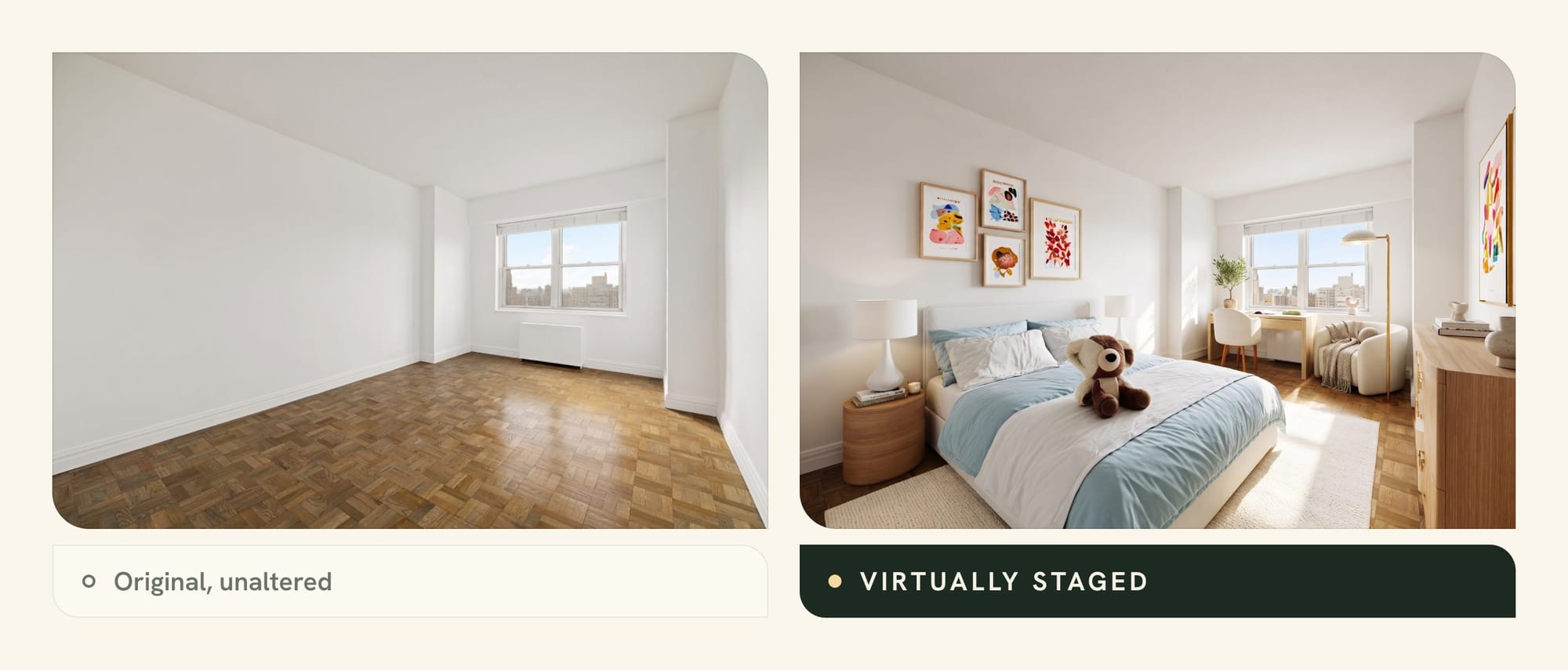
Tip: an empty spare bedroom can look small and hard to read in photos. If you can’t furnish it, a virtually staged photo can show it as a bedroom, nursery or office. Label it, as covered below.
Staging a bathroom for sale
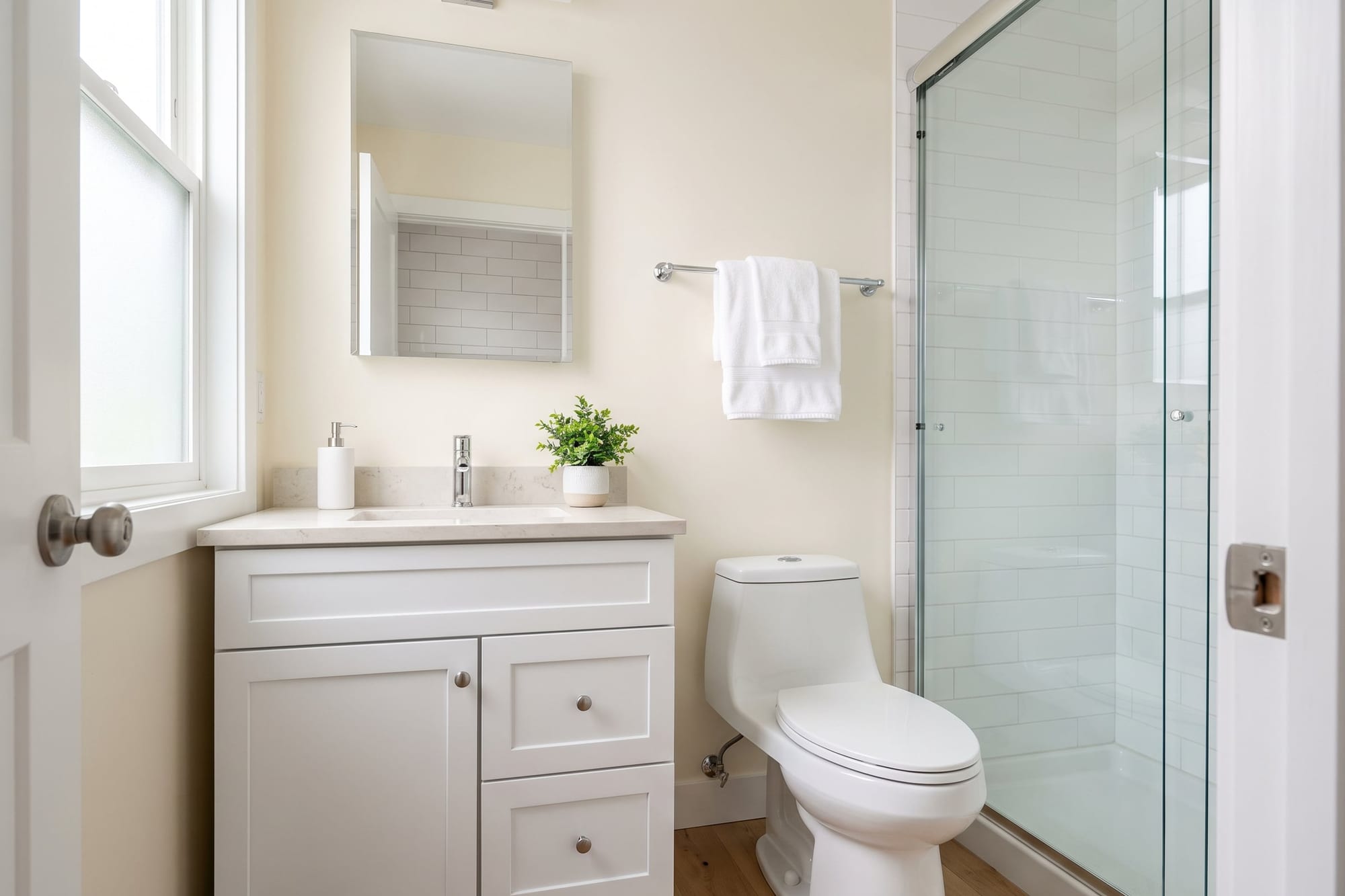
Staging a bathroom is cleaning more than decorating. Only 13% of buyers’ agents rated the bathroom very important to stage, but 47% of agents who stage include it anyway. Our guess is that a grimy bathroom stands out.
What buyers notice: grout, caulk, the mirror, the toilet and any smell.
Do and don’t in the bathroom:
- Do: scrub the grout and replace yellowed caulk around the tub and sink.
- Do: hang fluffy, new towels, as NAR’s consumer guide recommends. One matching set looks best in photos.
- Do: clear the counter except a soap dispenser and perhaps a small plant.
- Don’t: leave toiletries, razors or the bath mat in view.
- Don’t: forget the toilet. Close the lid for photos.
Budget tip: a new shower curtain and brighter bulbs over the mirror cost little. Redfin’s guide aims for a spa-like feel with fresh towels and new soap.
Watch out: pack away medicines, valuables and firearms before the first showing. NAR’s consumer guide lists all three, and visitors do open cabinets.
Like kitchens, bathrooms are outside what TINTY stages, so this room gets real cleaning, not a virtual fix.
Home office, patio and terrace
Home offices and outdoor spaces sit in the middle of NAR’s lists. Among agents who stage, 36% include an office and 31% an outdoor or yard space, while 17% of buyers’ agents rated yard or outside space very important.
Home office staging
What buyers notice: whether a desk fits with room to move, and where the light falls.
Clear the desk down to a lamp, a laptop and one plant. Hide cables and the printer. Don’t let the office become storage for everything you decluttered elsewhere.
Tip: if a small bedroom could be an office or a nursery, pick one use and stage it fully. A room with a crib in one corner and a desk in the other looks undecided.
No office in the house? A small desk in a bedroom corner or on a landing shows that someone can work from home. Redfin’s guide to staging inexpensively suggests giving unused spaces a purpose.
Budget tip: a desk and chair you already own beat a rented set. Turn the desk toward the window for the photo.
Patio, deck and terrace staging
What buyers notice: whether there’s room to sit outside, and whether it looks maintained.
Do and don’t outside:
- Do: power wash the deck or patio and clean the outdoor furniture.
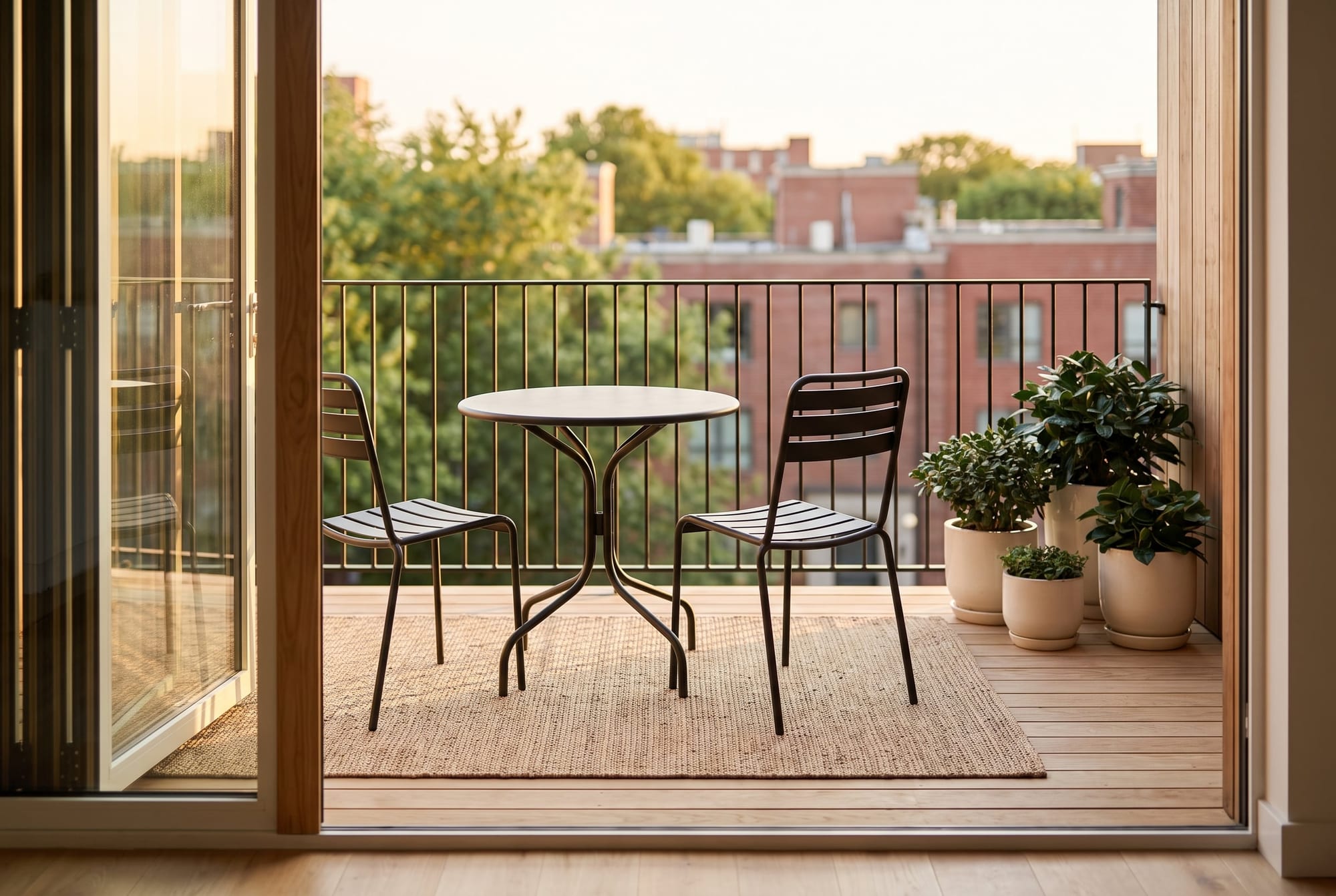
- Do: set out a small table with two chairs, or a pair of loungers.
- Do: group potted plants in matching pots near the door.
- Don’t: store grills, bikes or bins on the terrace.
Budget tip: an outdoor rug and two pots of flowers can make a bare balcony look like a room. Terrace is the one outdoor room type TINTY can stage, if it’s empty.
Home staging mistakes that cost you offers
The most common home staging mistakes come from doing too much or too little. NAR’s consumer guide names five, and we add two we see in listing photos:
- Too much furniture: overcrowded rooms look small. Take one piece out of every room.
- Dirty or untidy rooms: staging can’t hide grime, smells or pet hair.
- Personal and divisive items: political or religious items and personal information distract buyers.
- A neglected entry: NAR warns against skipping entryways and high-traffic areas.
- Loud colors and decor: bold walls and themed rooms pull attention from the space itself.
- Half-staged rooms: one lonely chair can make a room look emptier than no chair at all (our view).
- Misleading photos: editing out damage or adding features the house doesn’t have (our view, and a disclosure risk).
Some problems staging can’t solve. If the house still sits after good photos go up, price or access may be the issue, not looks. Our guide to selling a stale listing covers what to try next.
DIY home staging vs a stager vs virtual staging
DIY staging costs least and, in our view, suits most occupied homes in good shape. In NAR’s 2025 survey, staging cost a median of $500 when the listing agent staged the home personally, and $1,500 with a staging service. NAR doesn’t measure what sellers spend on DIY staging. Our guide to what staging costs has the full price ranges.
Four routes to choose from:
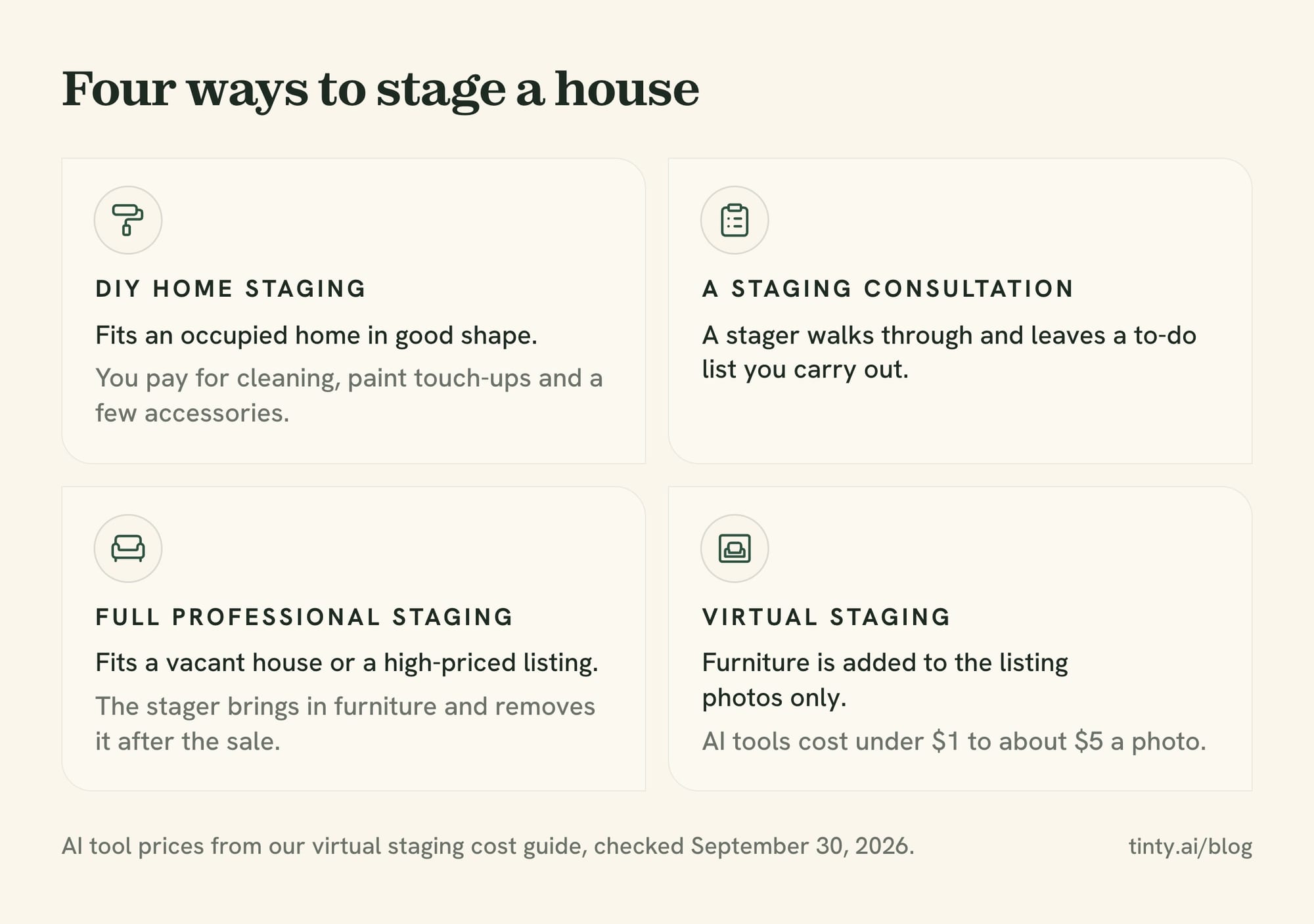
- DIY home staging: fits an occupied home in good shape. You pay for cleaning, paint touch-ups and a few accessories.
- A staging consultation: a stager walks through and leaves a to-do list you carry out. NAR’s consumer guide describes this route.
- Full professional staging: fits a vacant house or a high-priced listing. The stager brings in furniture and removes it after the sale.
- Virtual staging: furniture is added to the listing photos only. AI tools cost under $1 to about $5 a photo, per our virtual staging cost guide (prices checked September 30, 2026).
Selling an empty house? Our guide to selling a vacant house covers insurance, utilities and showings, which this guide leaves out.
When to hire a professional stager
Some houses are hard to stage alone. A pro tends to earn the fee in these cases, in our view:
- Vacant homes: there’s no furniture to work with, and buyers struggle to read empty rooms.
- Odd layouts: long, narrow or open rooms need someone who can plan the zones.
- Higher price points: buyers expect a finished look, and small flaws stand out more.
- Sellers with no time: a stager can plan and style the house in days.
In NAR’s survey, 10% of sellers’ agents staged only homes that were hard to sell. If you hire one, compare at least two quotes. Our home staging cost guide lists what to ask a stager before you sign.
Home staging ideas on a budget
Budget staging works best with what you already own. Redfin’s 2026 guide puts it plainly: declutter, clean thoroughly and make a few updates with what you have.
Move your best pieces into the rooms buyers rank highest. Swap bold pillow covers for neutral ones and replace every dead bulb. Buy one large plant rather than five small ones.
Spend on paint touch-ups before decor. In NAR’s survey, 67% of agents recommended touch-ups, more than recommended repainting whole walls.
Virtual staging for rooms you can’t furnish
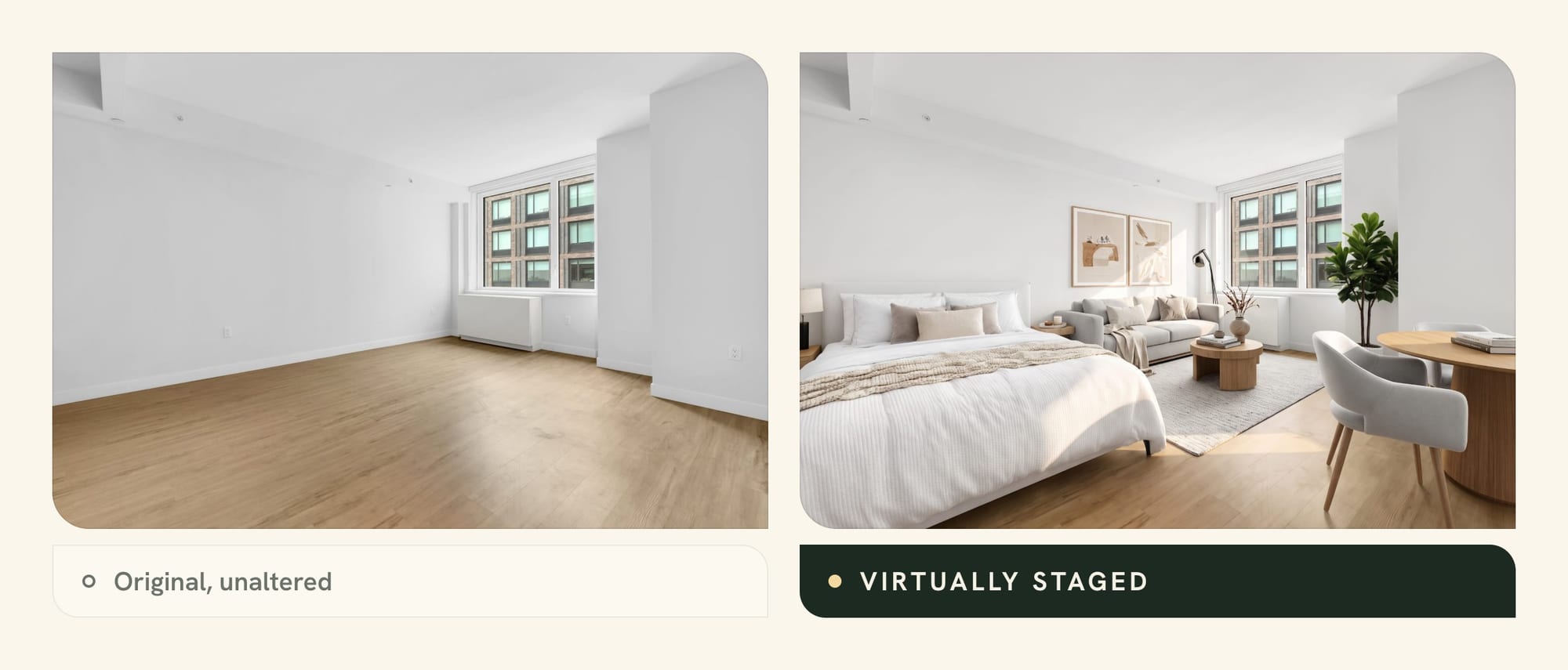
Virtual staging fixes empty rooms in photos, not dirty or dated ones. It adds furniture to a photo of an empty room, so buyers online see how the space could work. Our guide explains what virtual staging is.
We make TINTY, so here’s what it covers and what it doesn’t:
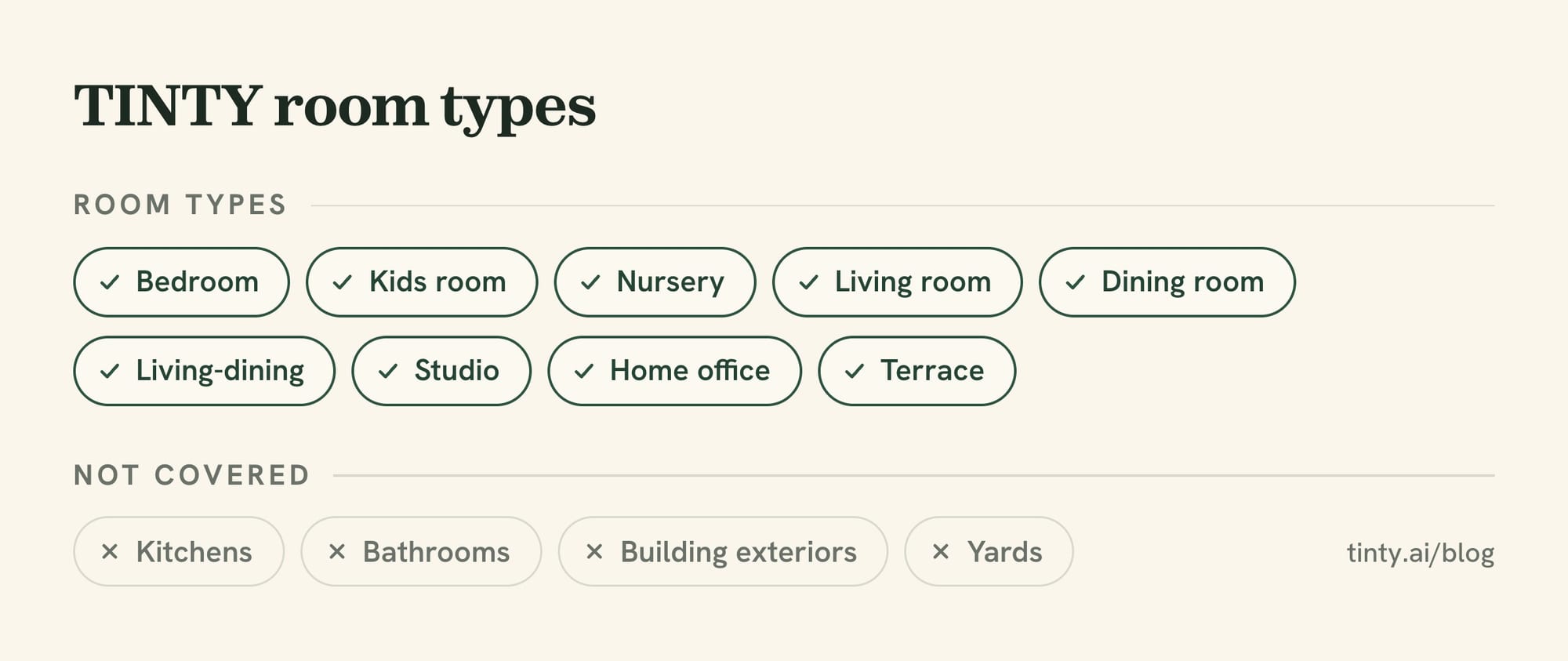
- Room types: bedroom, kids room, nursery, living room, dining room, living-dining, studio, home office and terrace.
- Not covered: kitchens, bathrooms, building exteriors and yards. Those rooms need real cleaning and styling.
- Empty rooms only: TINTY doesn’t declutter, and furniture removal is coming soon, so start with a clear room.
- Output: six styles and 2K files, about 2,500 px on the long side, while some tools sell 4K.
Previews take about 30 seconds. A free TINTY account gets six previews per photo (up to 20 a month) and three watermarked finished photos, with no card. Plans are on our pricing page. Try free virtual staging with TINTY on your own empty-room photo.
Busy agent with no time for this? TINTY Studio does it for you: email the empty-room photos to hello@tinty.ai with the style and what each room is for. Staged photos arrive on a private link in 2 to 24 hours. It’s $10 a photo from 3 photos, with no account or prepayment: you pay only if you’re happy.
To compare other tools, see the best virtual staging software and the best free virtual staging apps. Agents can see how TINTY fits a listing on our virtual staging for real estate page.
Disclose every virtually staged photo
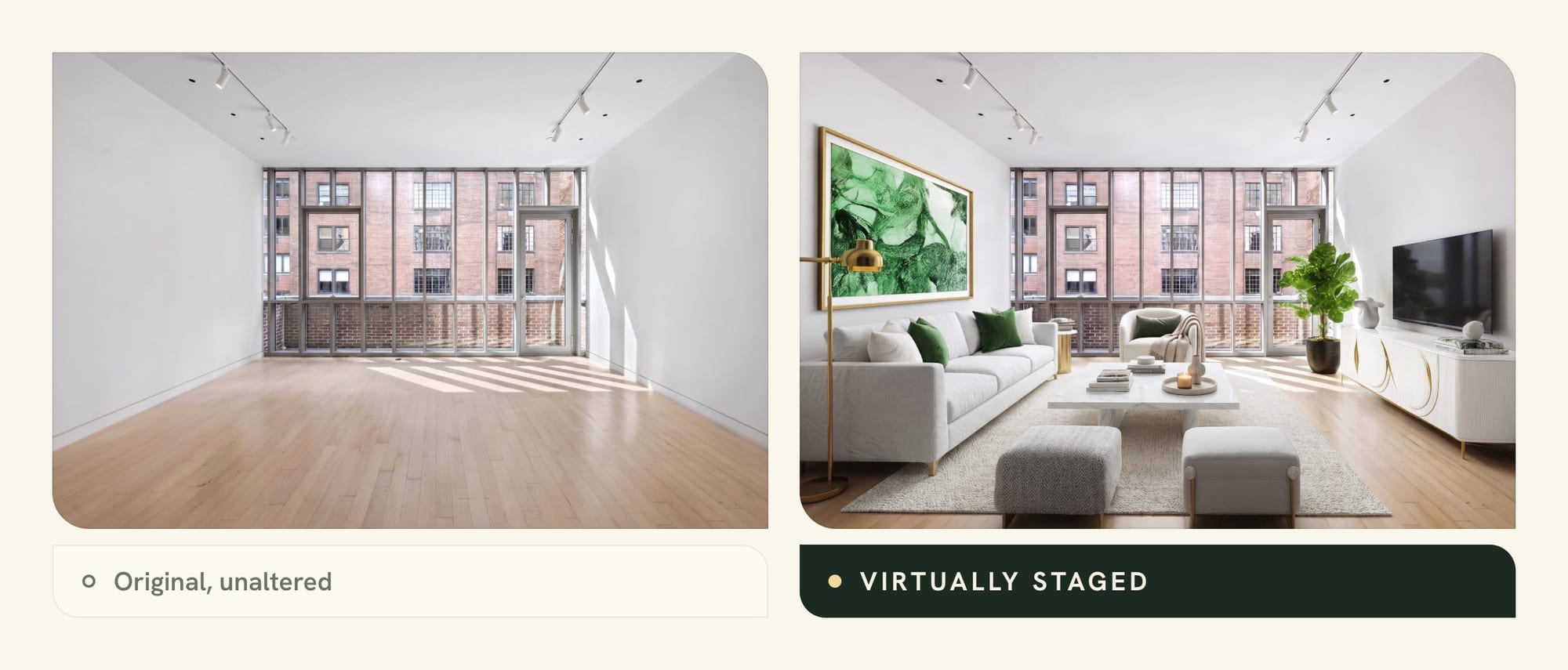
Label each virtually staged photo and keep the original in the gallery. NAR’s consumer guide says photo changes that materially alter the property should be disclosed.
Rule: California’s AB 723 has applied since January 1, 2026. A listing must disclose that an image was altered and give access to the unaltered original.
TINTY lets you add a “Virtually staged” label when you download. Stage furniture and decor only, and never hide damage. Our guide on whether virtual staging is legal covers state laws and multiple listing service (MLS) rules.
Photo day: home staging before and after pictures
Photo day is where staging pays off, because buyers see the photos before the house. In NAR’s survey, 88% of sellers’ agents said photos were more or much more important to their clients, and 76% recommended professional photos.
Our checklist for the morning of the shoot:
- Lights: turn on every light and lamp, and open every blind.
- Surfaces: clear counters, tables and nightstands one more time.
- Bathrooms: close toilet lids, hide the bath mats and hang one set of fresh towels.
- Outside: move cars, bins and hoses out of the front shot.
- Pets: take pets, bowls, beds and toys out of the house.
- Screens: turn off TVs and monitors, and tuck away cords.
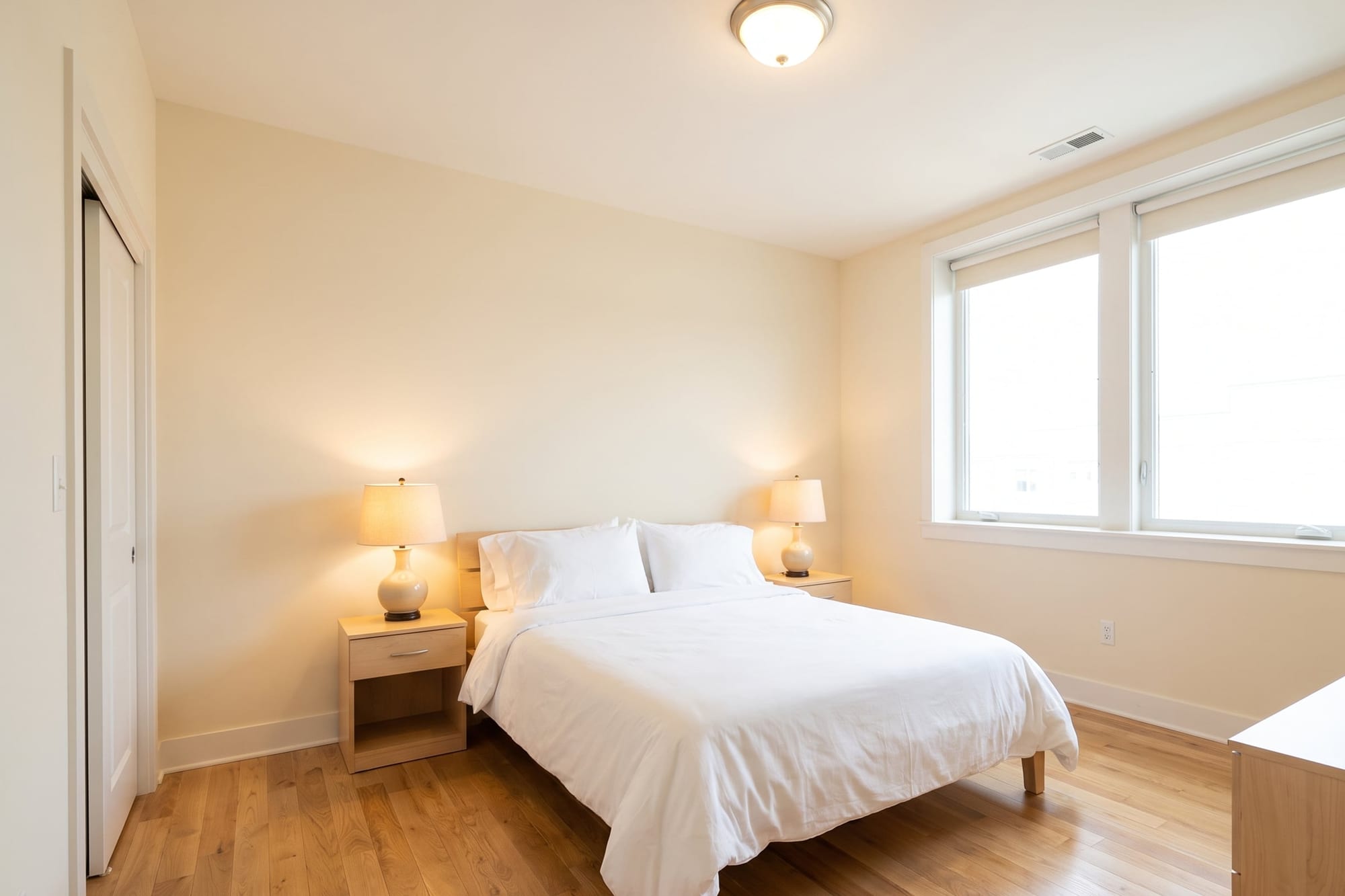
If you plan to stage some rooms virtually, shoot them empty. A level, wide shot from a corner that shows the floor and two walls gives software the most to work with, in our view.
Keep each original next to its staged version. You’ll need it for disclosure, and the pair doubles as an honest before-and-after for social posts. Our virtual staging examples show more before and after pairs.
Staging for showings as well as photos
Staging has to hold up in person, beyond the photos. A showing reveals everything the frame leaves out: closets, smells, noise, temperature and the view from every window.
Before each showing, open the blinds, turn on the lights and set the thermostat to a comfortable level. Empty the trash, and take pets out if you can. Air the house out and skip strong air fresheners, as Redfin’s 2026 guide advises. Buyers open closets and cabinets, so keep them as tidy as the rooms.
This is also where virtual staging stops. Buyers who tour a virtually staged house walk into empty rooms, so those rooms must at least be clean, bright and fault-free.
Staging a house FAQ
What does staging a home for sale include?
Staging a home for sale includes decluttering, cleaning, small repairs and arranging furniture and decor so each room shows its size and use. NAR’s consumer guide describes three routes: in-person staging, a consultation that leaves you a to-do list, and virtual staging of the listing photos.
Which rooms should you stage first?
The living room, primary bedroom and kitchen. Buyers’ agents in NAR’s 2025 survey called them very important to stage at 37%, 34% and 23%. Guest bedrooms ranked last, at 7%, so stage them last or simply.
Show 6 more questionsShow fewer questions
What is the first step in staging a house?
Declutter. In NAR’s 2025 survey, 91% of sellers’ agents recommended decluttering, more than any other step. Pack away about half of what’s on surfaces and in closets before you clean, repair or style anything.
How do you stage a house on a budget?
Use what you own. Declutter, deep clean, fix small faults and move your best furniture into the main rooms. Then spend on paint touch-ups and new bulbs before decor.
Can you stage a house while living in it?
Yes. Most staging advice assumes an occupied home: pack away half your things, then keep a daily routine. Make the beds, clear the counters and hide laundry and pet bowls before each showing.
What are the most common home staging mistakes?
Too much furniture, dirty rooms, personal or divisive items, a neglected entry and loud colors, per NAR’s consumer guide. We’d add half-staged rooms and photos that hide damage or add features the house lacks.
Can virtual staging replace staging a kitchen or bathroom?
Not really. Buyers notice grout, cabinets and smells in these rooms, so they need real cleaning, clear counters and fresh towels. TINTY doesn’t stage kitchens or bathrooms at all. It covers bedrooms, kids rooms, nurseries, living and dining rooms, studios, home offices and terraces.
Do you have to disclose virtual staging?
In California, yes for agents and anyone acting for them: since January 1, 2026, AB 723 has required a label and a link to the original. Elsewhere, most MLSs we’ve read require a label, and NAR’s consumer guide says material photo changes should be disclosed. We’d label every virtually staged photo and keep the original next to it.
How we researched this
On October 5, 2026, we reread NAR’s full 2025 Profile of Home Staging and read NAR’s March 2026 consumer guide and two Redfin staging guides. We also read the pages ranking for “staging a house” and “how to stage a house to sell” to see what they cover.
TINTY facts come from our live pages, checked October 5, 2026. Tips without a named source, including the do and don’t lists, are our own judgment. If something here is wrong, email hello@tinty.ai and we’ll fix it.
Sources
All pages read October 5, 2026, unless a date is given.
Survey data and guidance:
- NAR 2025 Profile of Home Staging (full report, PDF) (May 2025; 1,266 responses, February 2025)
- NAR consumer guide: Staging your house for a sale (March 18, 2026)
Show 5 more sourcesShow fewer sources
Staging guides:
- Redfin: How to stage a house, a room by room guide (Ryan Castillo, November 2, 2021)
- Redfin: How to stage a house inexpensively and quickly (Allie Drinkward, March 4, 2026)
Disclosure:
- California Business and Professions Code §10140.8 (AB 723) (checked October 3, 2026)
TINTY and related guides:
- TINTY · Free virtual staging · TINTY pricing · TINTY Studio · Virtual staging for real estate · Virtual staging examples
- Home staging cost · How to sell a stale listing · Virtual staging cost (prices checked September 30, 2026) · Selling a vacant house · What is virtual staging · Best virtual staging software · Best free virtual staging apps · Is virtual staging legal?