How do you write a real estate listing description? Open with the one feature that sets the home apart. Add three or four facts buyers can’t see in the photos, walk through the rooms in tour order, say what’s nearby and close with a plain invitation. Keep every claim accurate, and describe the home, never the buyer.
MLS rules, laws and TINTY facts checked October 7, 2026.
We make TINTY, an AI virtual staging app, so one section of this guide covers listings with virtually staged photos. The rules here come from the National Association of Realtors (NAR), the federal Fair Housing regulation and the published rules of several multiple listing services (MLS). This is general information, not legal advice.
Key takeaways
- Formula: hook, best features, room flow, neighborhood, call to action. Write the first two sentences for buyers who read nothing else.
- Be specific: “new roof in 2022” beats “lots of updates.” Mention bed and bath counts once, since the listing fields already show them.
- Fair Housing: describe the property, never the buyer. “Perfect for young families” can signal a familial-status preference the law bans.
- Virtual staging: describe the room, not the virtual sofa, and put a disclosure line where your MLS wants it.
- AI drafts: a fine start, but check every fact, room count and school claim before you publish.
On this page: What it does · Formula · 10 examples · Virtual staging · Words · Fair Housing · Accuracy · MLS rules · AI prompts · FAQ
What the description has to do
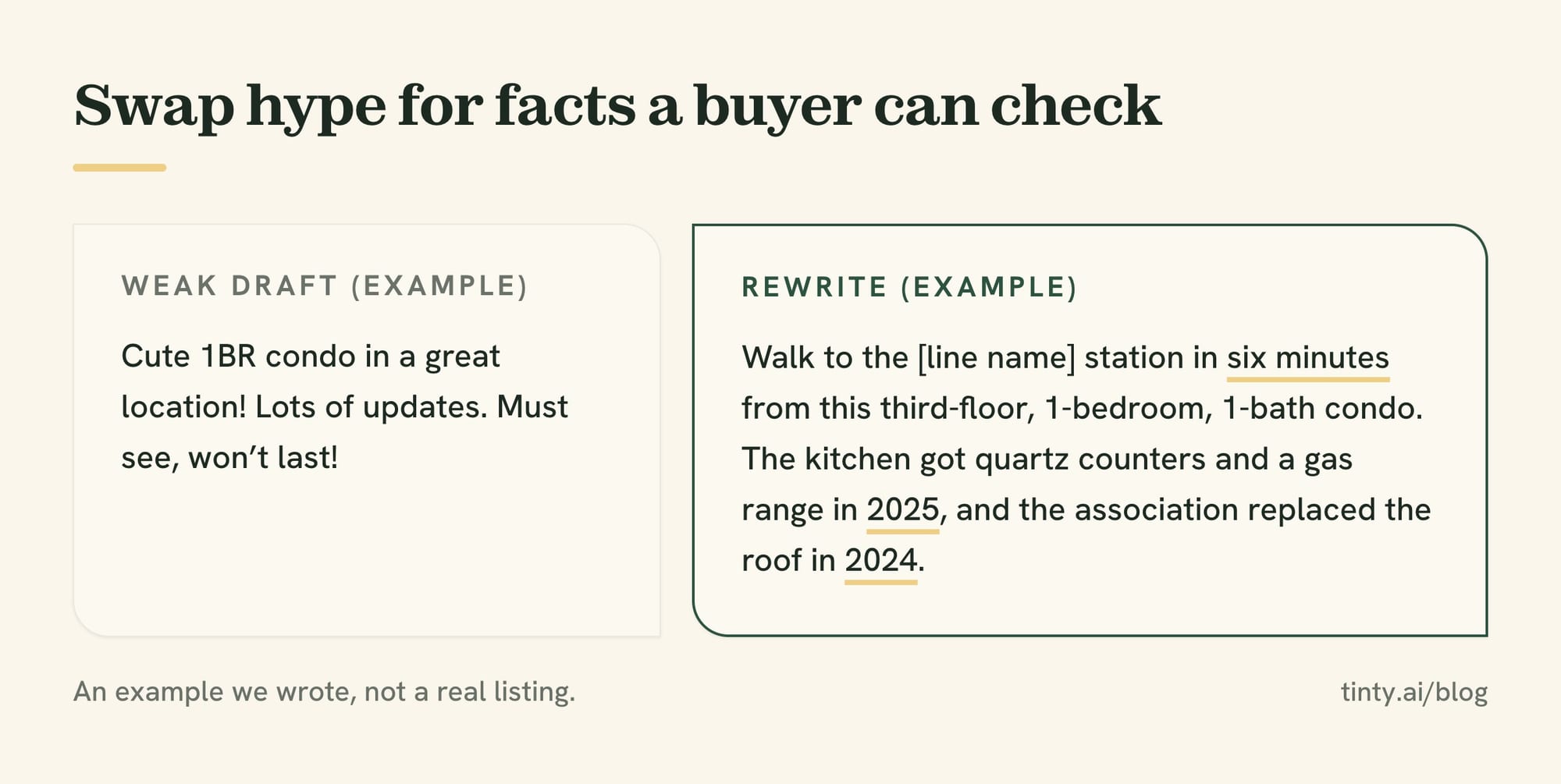
A good description tells buyers what the photos and the data fields can’t. The fields already show beds, baths and square footage. The photos show the rooms. The words explain what’s new, what’s unusual and how the home lives.
Buyers value those details. In NAR’s 2025 Home Buyers and Sellers Generational Trends report, 79% of buyers who searched online rated detailed property information very useful. Only photos scored higher, at 83%.
In a March 2025 r/realtors thread about listing remarks, the top reply listed what buyers want, in that commenter’s view:
- Rare features: anything unusual for the property type at that price.
- Real updates: a new roof, mechanicals or a deck, not fresh paint.
- Plain meanings: what “finished basement” or “playroom” actually means.
- Nearby places: parks, shopping and transit that are truly close.
- No repeats: skip long sentences about beds and baths that buyers see at a glance.
Zillow’s property descriptions guide notes that a description also ends up on flyers, social posts and open house materials. Write it once, carefully, and reuse it. Our real estate social media post ideas come with example captions. Our guide to taking listing photos with an iPhone covers the pictures that sit next to it.
How to write a listing description in 5 parts
Start with facts, then fit them into five parts. Zillow’s guide and McKissock’s listing guide use a similar outline: a strong opening, the best features and a call to action. Ours splits the middle into room flow and the neighborhood.
Before you write: build a fact sheet
Collect these before you type a word. They keep the draft honest and give an AI tool something true to work from.
- Numbers: beds, baths, square footage and its source, lot size and year built.
- What’s new: each update with its year, like “roof 2022” or “furnace 2024.”
- What’s rare: the feature that’s unusual at this price, like a third garage bay.
- Light and layout: which way the main windows face and what opens to what.
- Nearby: transit, parks and shops, with walking times you’ve checked yourself.
- Costs and terms: homeowners association (HOA) dues, special assessments, rental limits and as-is terms.
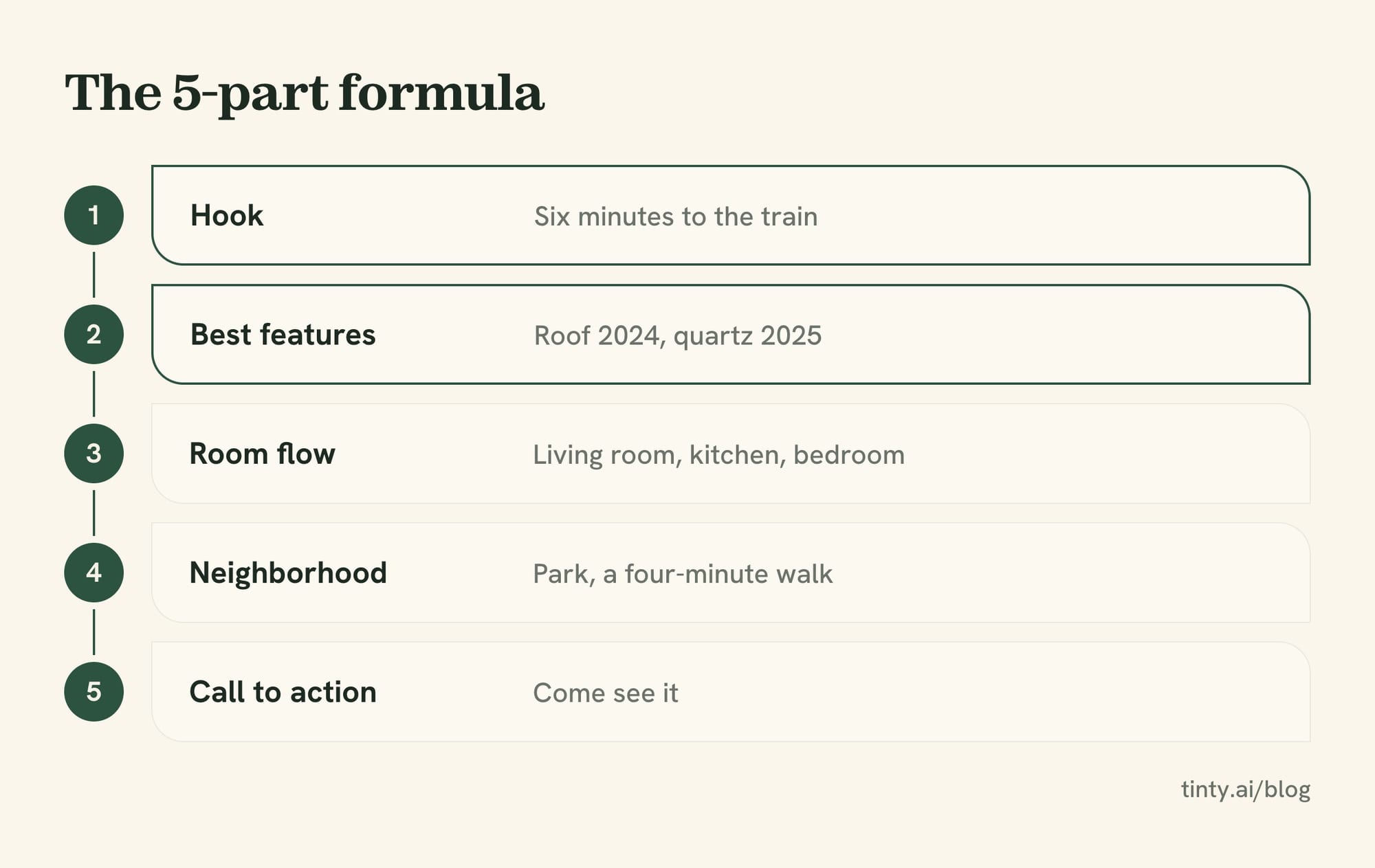
The 5-part formula
Write the parts in this order. Each one is a sentence or two.
- Hook: one sentence with the feature that sets this home apart, with a number or a name in it.
- Best features: three or four facts buyers can’t see in the photos, such as updates with years, systems and storage.
- Room flow: walk the rooms in tour order, so the text matches the photo gallery.
- Neighborhood: what’s nearby, with times you’ve checked. Describe places, not neighbors.
- Call to action: one plain line inviting a visit. In MLS remarks, leave out phone numbers and showing times.
Zillow’s and McKissock’s outlines both start with a headline. If your MLS or website has a separate headline field, put the hook there in a few words.
A fill-in-the-blank template
Copy this template and replace every bracket with a fact from your sheet. Delete any sentence you can’t fill truthfully.
[Hook: the one feature that sets the home apart.] This [beds]-bedroom, [baths]-bath [home type] sits on [lot or floor]. [Update and year], [update and year] and [rare feature] come with it. [Room flow: entry, living area, kitchen, bedrooms, outdoor space.] [Nearby place] is [checked time] away. [Plain invitation to see it.]
Read the result aloud. If a sentence could sit in any other listing, it’s missing a fact.
Tip: write two or three versions that lead with different features, as Zillow’s guide suggests. Read each first sentence alone and keep the one that would make you click.
If a listing has already sat for weeks, start from buyer feedback instead. Our guide to rewriting the remarks of a stale listing covers that case.
Real estate listing description examples
These home listing description examples cover ten common home types, from a starter condo to a vacant house with staged photos. Every description below is an example we wrote for this guide. None is a real listing, and every detail is invented, so swap in your own facts.
Each example shows a weak draft, a rewrite and a note on why the rewrite works. Use these listing description examples as patterns, not copy.
Watch out: don’t paste another agent’s remarks into your listing, even as a starting point. Write from your own fact sheet, so every claim is one you can back up.
1. Starter condo: lead with the commute
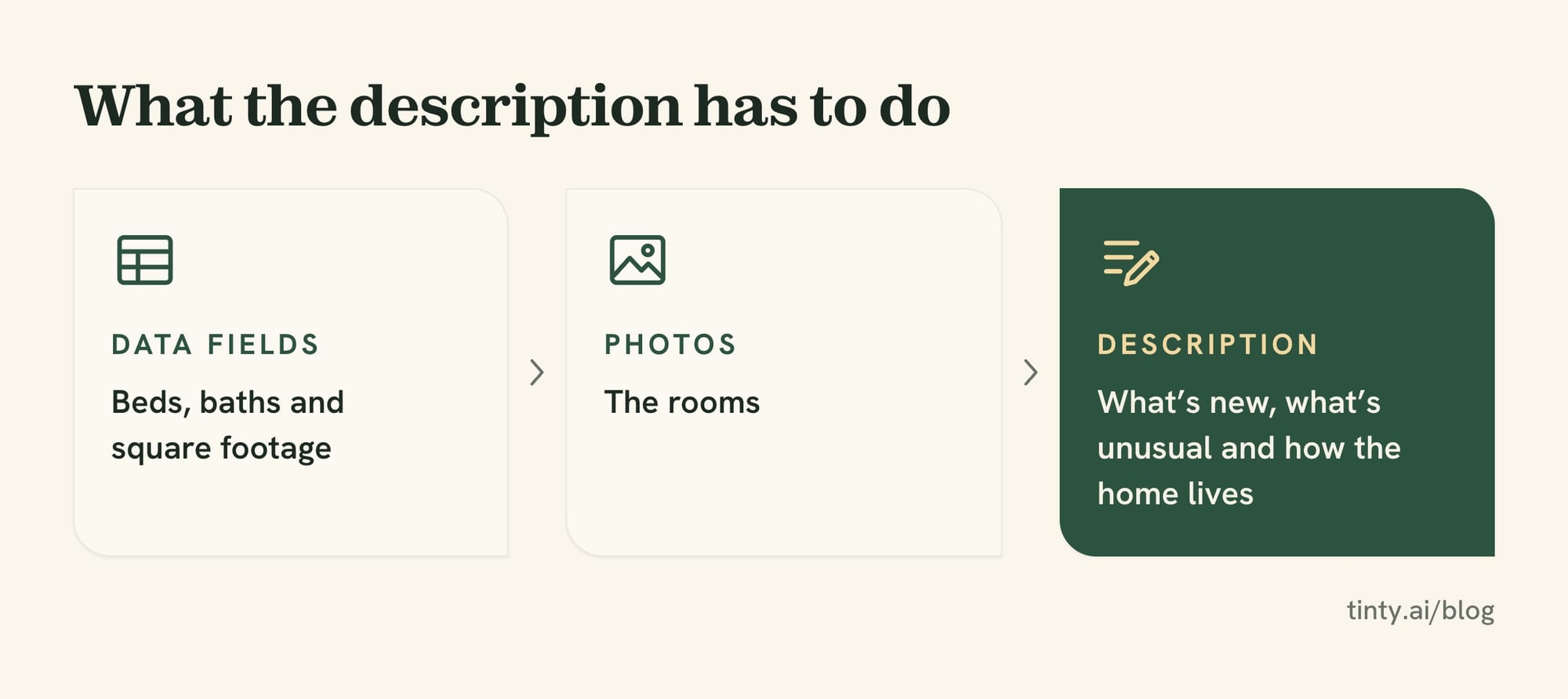
Weak draft: Cute 1BR condo in a great location! Lots of updates. Must see, won’t last!
Rewrite: Walk to the [line name] station in six minutes from this third-floor, 1-bedroom, 1-bath condo. The kitchen got quartz counters and a gas range in 2025, and the association replaced the roof in 2024. Two south windows light the living room, and the bedroom fits a queen bed and a desk. In-unit laundry and one deeded parking space are included. HOA dues are $[amount] a month. Come see the morning light for yourself.
Why it works: the commute leads, each update has a year, and the dues answer a question every condo buyer asks.
2. Single-family house: show the yard, skip the buyer
Weak draft: Beautiful family home in a highly sought-after neighborhood. Perfect for growing families! Great schools nearby.
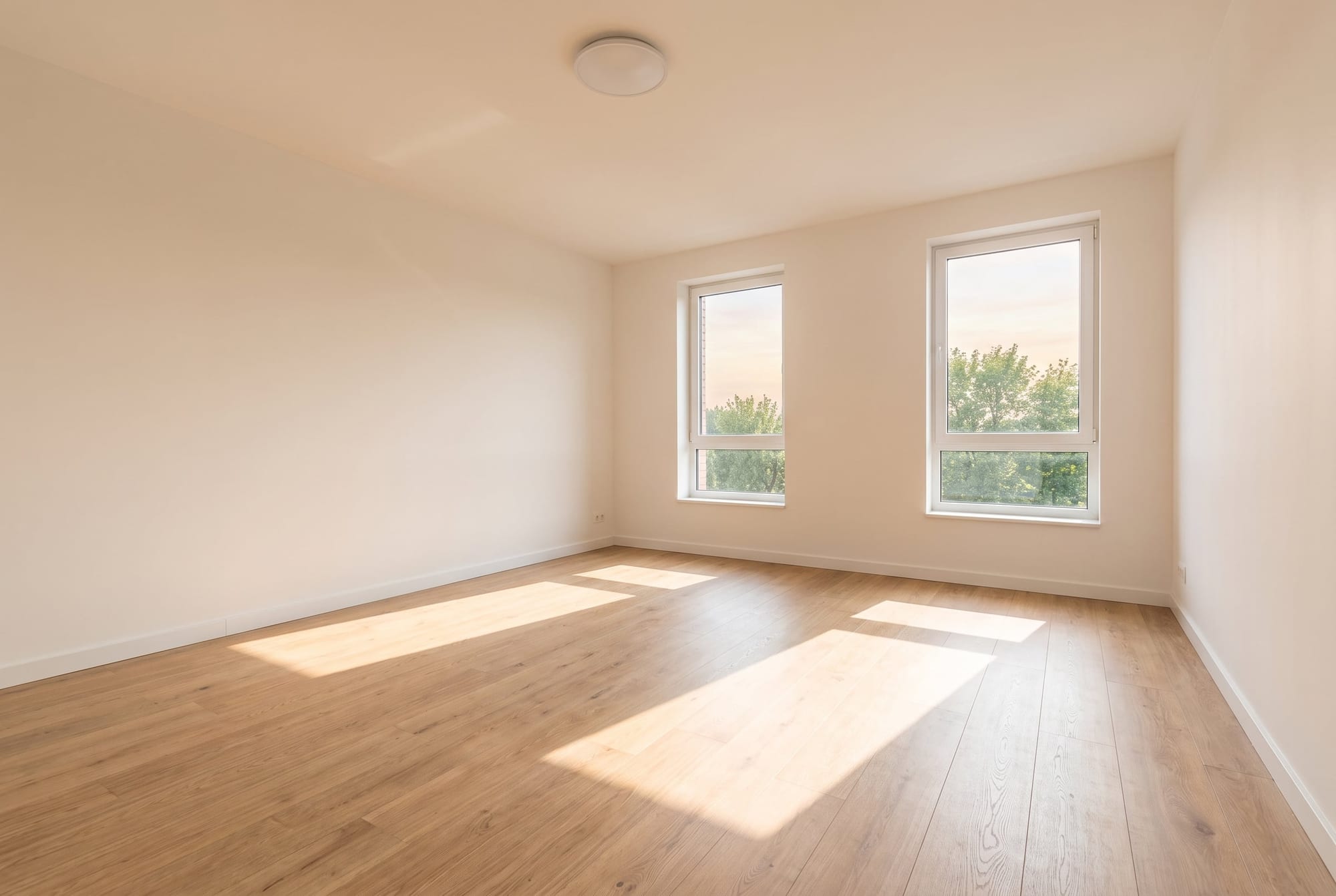
Rewrite: A fenced backyard with a 2023 cedar deck opens off the kitchen of this 3-bedroom, 2-bath ranch on a quarter-acre lot. The kitchen and family room share a gas fireplace. The primary suite has a walk-in closet and a double vanity. A finished basement adds a 14-by-20-foot rec room with an egress window. The furnace dates from 2024. [Park name] is a four-minute walk.
Why it works: “family room” names a room, while “perfect for growing families” names a buyer. The rewrite also drops the school claim, which needs checking first.
3. Luxury home: name what nobody else has
Weak draft: Stunning luxury estate with breathtaking views and amazing finishes throughout. Truly one of a kind!
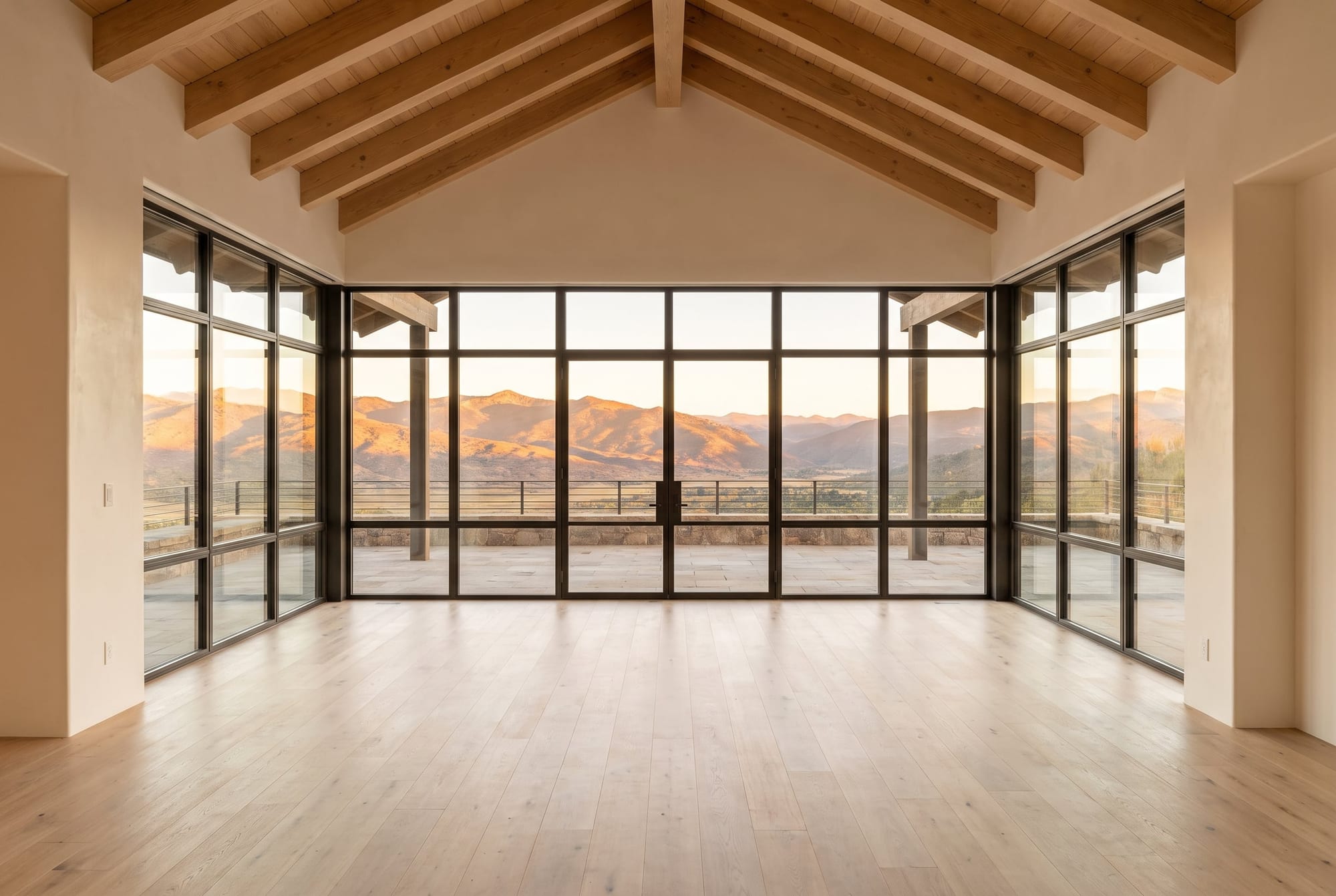
Rewrite: Floor-to-ceiling glass on the west wall frames the [range name] from the great room of this 5-bedroom, 6-bath home on 2.1 acres. Architect [name] designed it in 2019 around a courtyard with a heated saltwater pool. The kitchen has two islands and a walk-in pantry, and the primary suite takes the whole east wing. A four-car garage, a 900-bottle wine room and a whole-house generator complete it.
Why it works: “stunning” could describe any house. A named architect and a bottle count are details only this house has.
4. Fixer-upper: say what’s done and what isn’t
Weak draft: Handyman special! Bring your imagination. Investor opportunity, needs TLC. Sold as-is.
Rewrite: Priced for the work it needs, this 1950s 3-bedroom, 1-bath brick ranch sits on a 7,000-square-foot lot. The roof was replaced in 2022 and the electrical panel in 2023. The kitchen, bath and floors need full updates. Hardwood sits under the carpet in two bedrooms, per the seller. A contractor’s estimate from [month and year] is available. Sold as-is, with no repairs by the seller.
Why it works: buyers who want a project read on, and the rest move on. “Per the seller” marks a claim you haven’t checked yourself.
5. Rental apartment: answer the renter’s first three questions
Weak draft: Great apartment for young professionals! Close to everything. Quiet building, no kids.
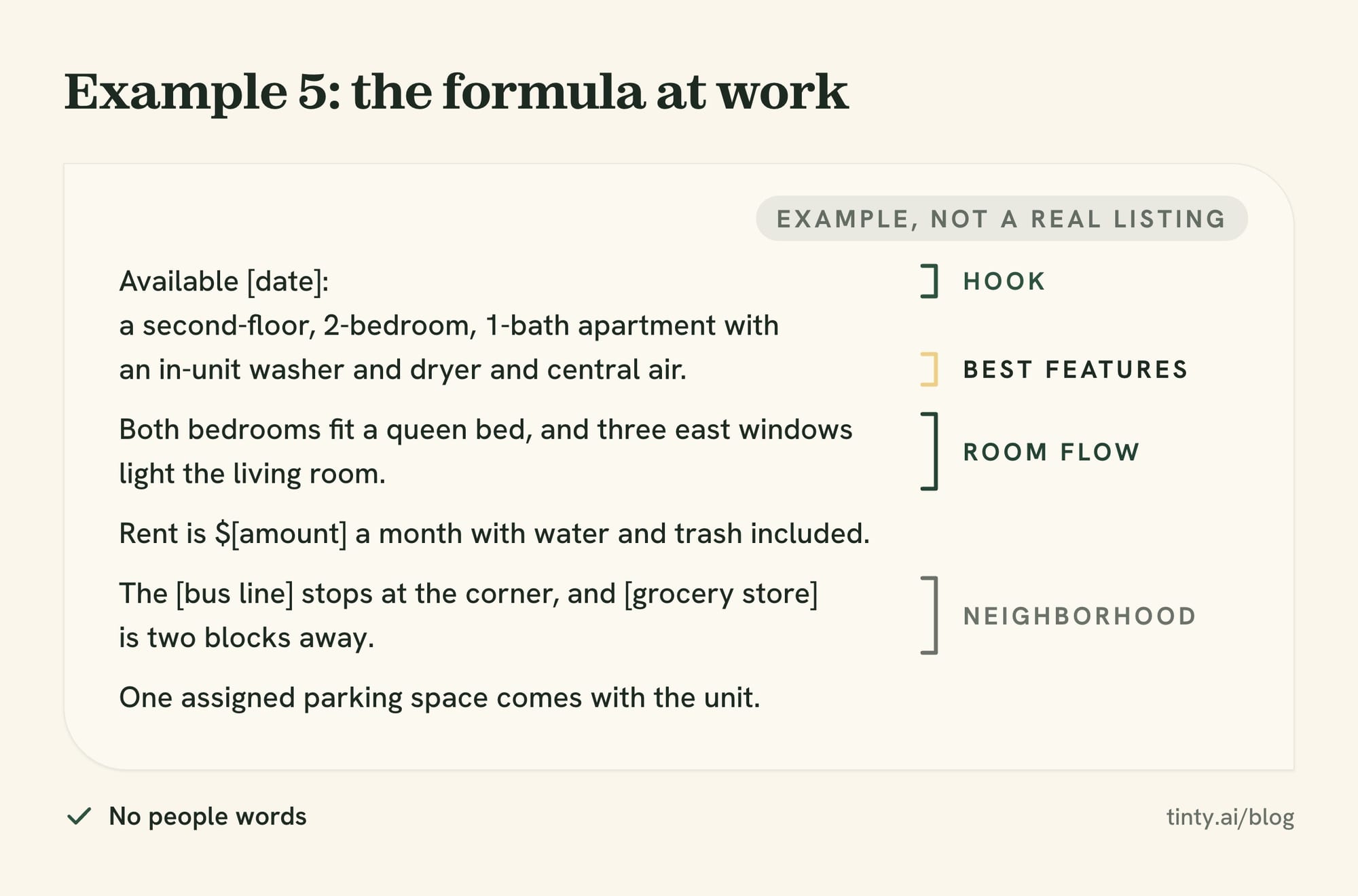
Rewrite: Available [date]: a second-floor, 2-bedroom, 1-bath apartment with an in-unit washer and dryer and central air. Both bedrooms fit a queen bed, and three east windows light the living room. Rent is $[amount] a month with water and trash included. The [bus line] stops at the corner, and [grocery store] is two blocks away. One assigned parking space comes with the unit.
Why it works: the move-in date, the rent and what’s included lead. “No kids” states a limitation based on familial status, which the Fair Housing Act bans, and “young professionals” points the same way (our reading).
6. Vacant home with virtually staged photos
Weak draft: Gorgeous move-in-ready home! Relax on the plush sectional in the sunny living room, and the dining set seats eight.
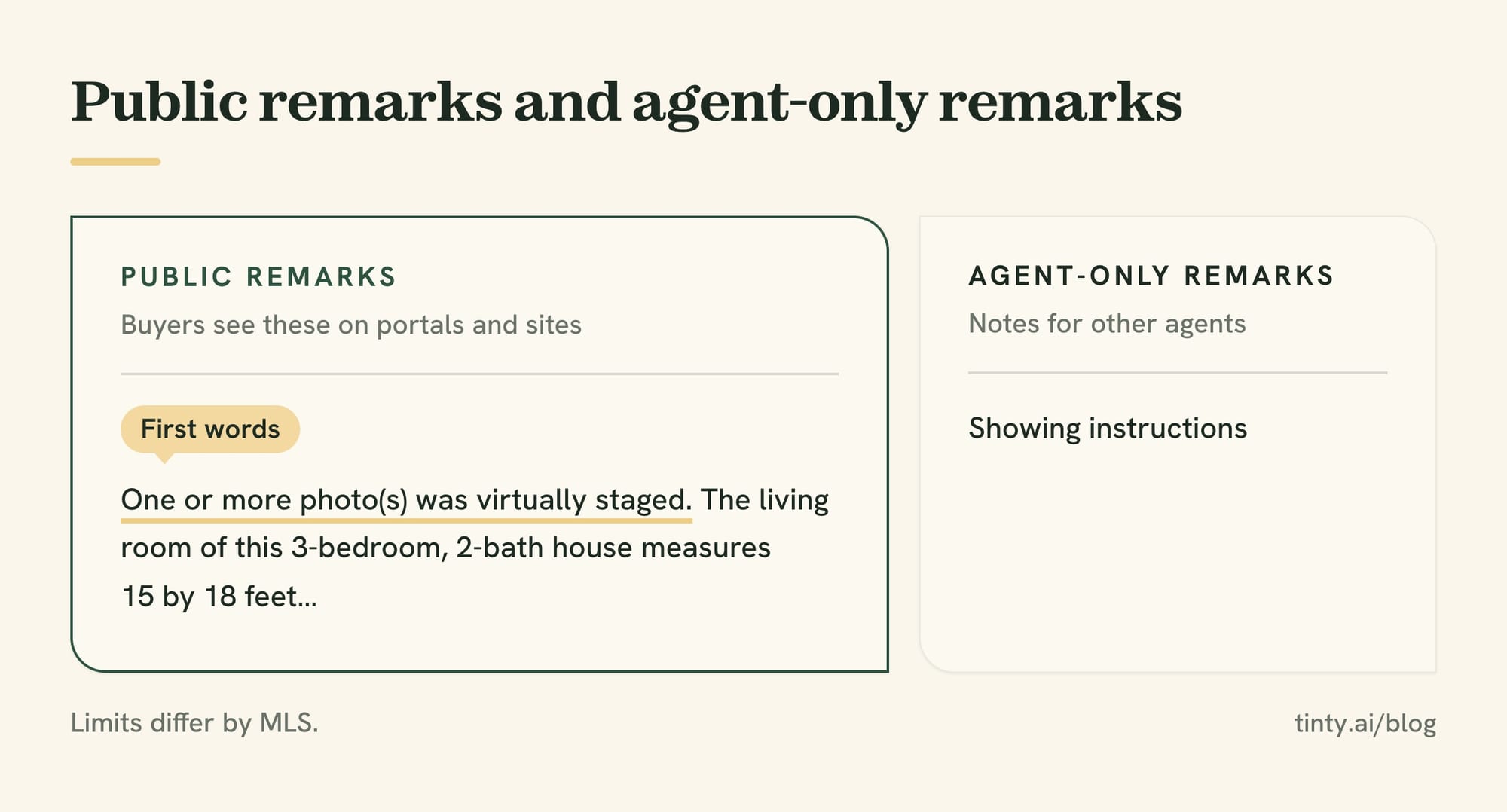
Rewrite: One or more photo(s) was virtually staged. The living room of this 3-bedroom, 2-bath house measures 15 by 18 feet, with two west windows and oak floors refinished in 2025. The dining room fits a table for eight and opens to a covered patio. Each upstairs bedroom has a double closet. The furniture and decor in the photos are virtual and don’t convey. The seller is open to a quick close.
Why it works: it describes sizes, windows and floors that buyers will find at the tour, not the sofa they saw online. It also never calls the house vacant, a word our guide to selling a vacant house keeps out of public remarks.
7. Townhouse: give the square footage a source
Weak draft: Spacious townhome with lots of space and modern updates. Close to shopping and dining.
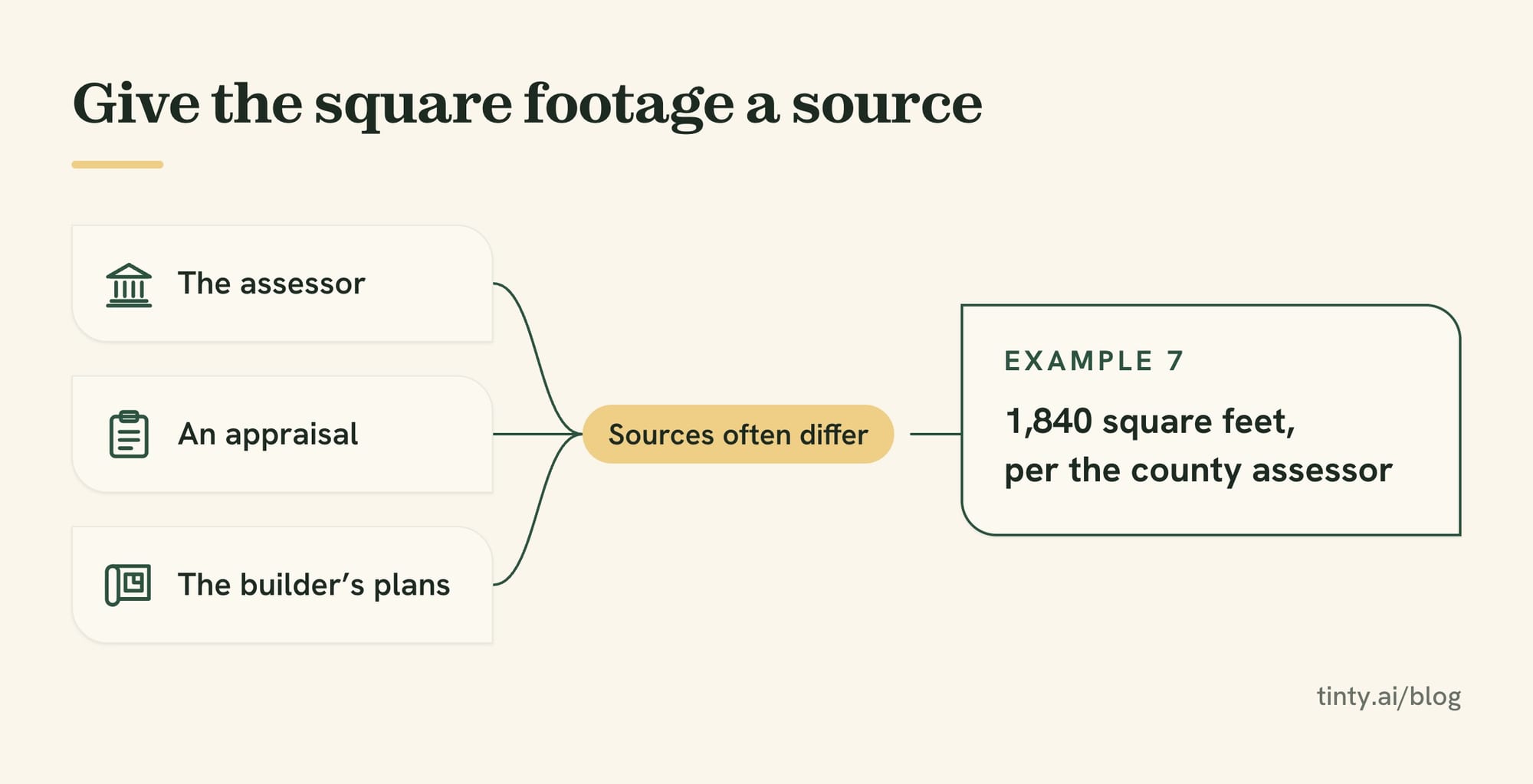
Rewrite: Three levels and a two-car tandem garage give this end-unit townhouse 1,840 square feet, per the county assessor. The main level runs from the kitchen to a 10-by-12-foot balcony. Two bedrooms and a laundry closet share the top floor. A flex room off the garage works as an office or a guest room. New windows went in throughout in 2024. [Shopping district] is a 10-minute walk.
Why it works: “end unit,” a sourced square footage and a flex room with two real uses replace “spacious” twice.
8. Single-level ranch: describe access, not age
Weak draft: Perfect for empty nesters or retirees! Low-maintenance living in a great neighborhood.
Rewrite: Every room sits on one level in this 2-bedroom, 2-bath ranch, with a zero-step entry from the garage. Doorways are 36 inches wide, and the primary bath has a curbless walk-in shower with grab bars. Gravel and native plants on drip irrigation fill the yard. A 2025 heat pump handles heating and cooling. The community center and a walking path are across the street.
Why it works: buyers who need one level will search for exactly these features. “Empty nesters” and “retirees” describe people, so they go.
9. Older home: what’s original and what’s updated
Weak draft: Charming older home with tons of character. Needs some updating but has great bones!
Rewrite: Built in 1926, this 4-bedroom, 2-bath Craftsman keeps its built-in bookcases, leaded-glass windows and brick fireplace. The plumbing was replaced in 2020, and the electrical service was upgraded to 200 amps in 2021. The kitchen is original and ready for its next owner’s plans. A front porch spans the full width of the house. [Main street] shops and the library are a six-minute walk.
Why it works: old-house buyers ask two things, what’s original and what’s been brought up to date. This version answers both.
10. New construction: status first, then the base price
Weak draft: Brand new construction with all the latest upgrades! The builder’s finest work. Hurry!
Rewrite: Under Construction. Estimated completion [month and year]. This 4-bedroom, 3-bath two-story by [builder] includes quartz counters, 9-foot first-floor ceilings and a tankless water heater in the base price. The photos show the [model name] model, so finishes in this home may differ. A 10-year structural warranty transfers to the buyer, per the builder.
Why it works: it says what the base price includes and flags the model photos. Stellar MLS in Florida requires “Under Construction.” as the first words for these listings, so check your own MLS.
Describe the room, not the virtual sofa
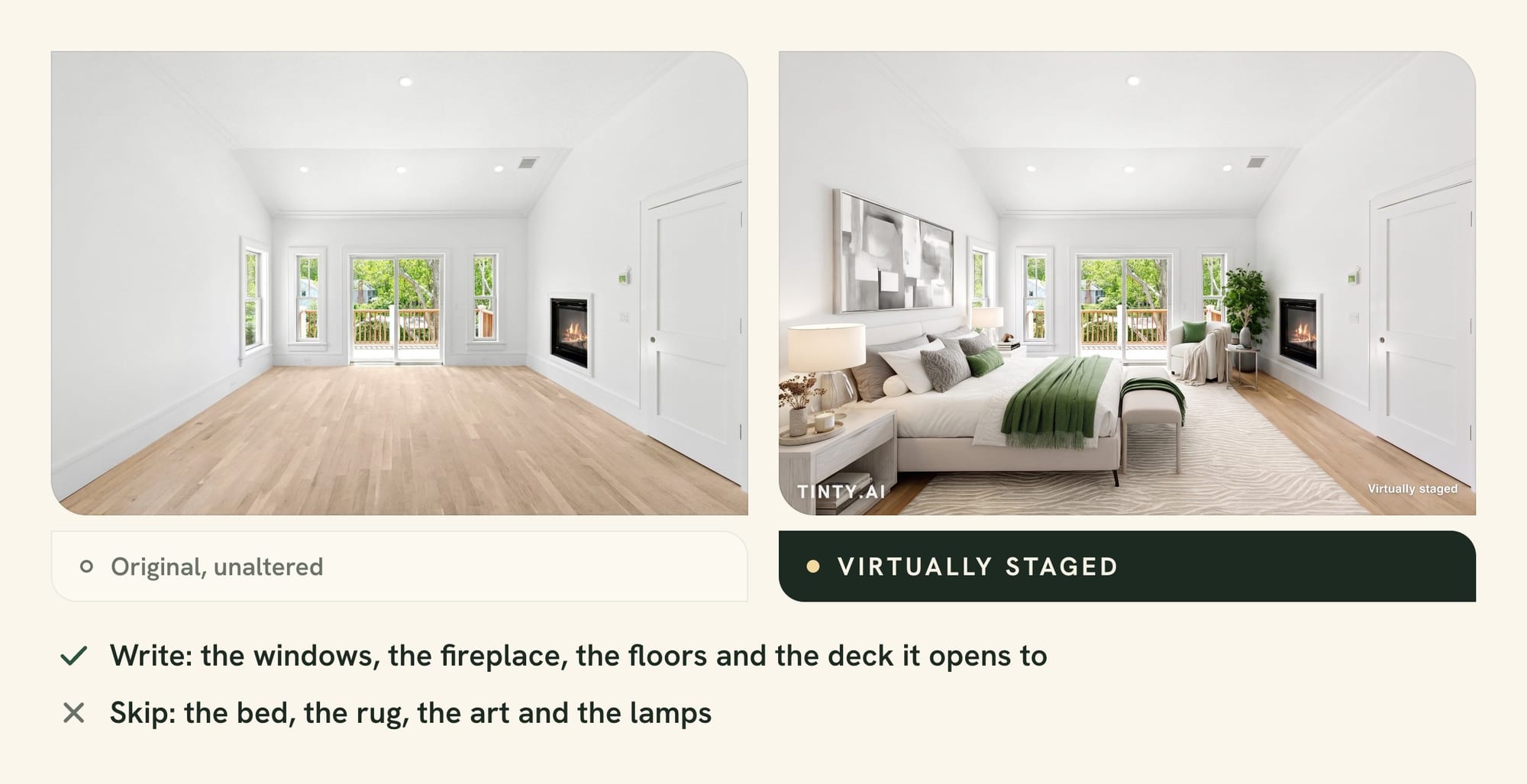
When photos are virtually staged, write about what conveys: room sizes, light, floors and built-ins. Never describe the virtual furniture.
Virtual staging adds furniture that isn’t part of the sale. Stellar MLS, for example, permits staging with “personal property items not conveyed with the real property.” So a line like “relax on the sectional” describes something the buyer won’t get. In our view, that clashes with NAR’s rule that Realtors present a “true picture” in their ads.
Here’s what to write about a staged room instead:
- Size: dimensions, or what fits, like “fits a king bed and two nightstands,” only if it’s true.
- Light: how many windows and which way they face.
- Surfaces: floors, ceiling height, built-ins and the fireplace.
- Connections: what the room opens to, such as a deck, a patio or the kitchen.
- Leave out: the virtual sofa, bed, rug, art, lamps and plants.
A disclosure line you can paste
Both MLS staging rules we read require a label, but they disagree on where it goes. Stellar MLS wants it in the photo description and at the start of the public remarks, not on the photo. Canopy MLS wants it on the image itself. Our guide to virtual staging disclosure rules compares the MLS rules and state laws.
For remarks, this two-sentence line works as a template. The first sentence is Stellar MLS’s exact wording:
One or more photo(s) was virtually staged. The furniture and decor shown are virtual and don’t convey.
In California, AB 723 has applied since January 1, 2026. An agent’s or broker’s ad with a digitally altered image must say so on or next to the image. It must also point to the unaltered original through a link, URL or QR code. The remarks line above doesn’t meet that rule, or Canopy’s, on its own.
Wisconsin’s Act 69 adds a disclosure rule for misleading photo edits from January 1, 2027.
Rule: Stellar MLS requires “Virtually staged” in the photo description field. The first words of the public remarks “must read ‘One or more photo(s) was virtually staged.’” Source: Stellar MLS rules, updated September 15, 2025.
Where TINTY fits when you prepare the photos
We make TINTY, so here’s our tool’s part in this, limits included:
- Rooms: nine room types, such as bedrooms, living rooms, dining rooms and home offices.
- Not covered: kitchens, bathrooms, building exteriors and yards. It doesn’t declutter or remove furniture yet.
- Speed: free previews in about 30 seconds, on a phone or a laptop.
- Label: you can add a “Virtually staged” label to the image when you download. Check your MLS first: Stellar, for one, bans words on listing photos.
Try TINTY’s free virtual staging previews on one empty room, then write the description from the empty photo, not the render. In the Refine step you can type a note such as “add plants.” Anything you add there is decor, so it stays out of your remarks.
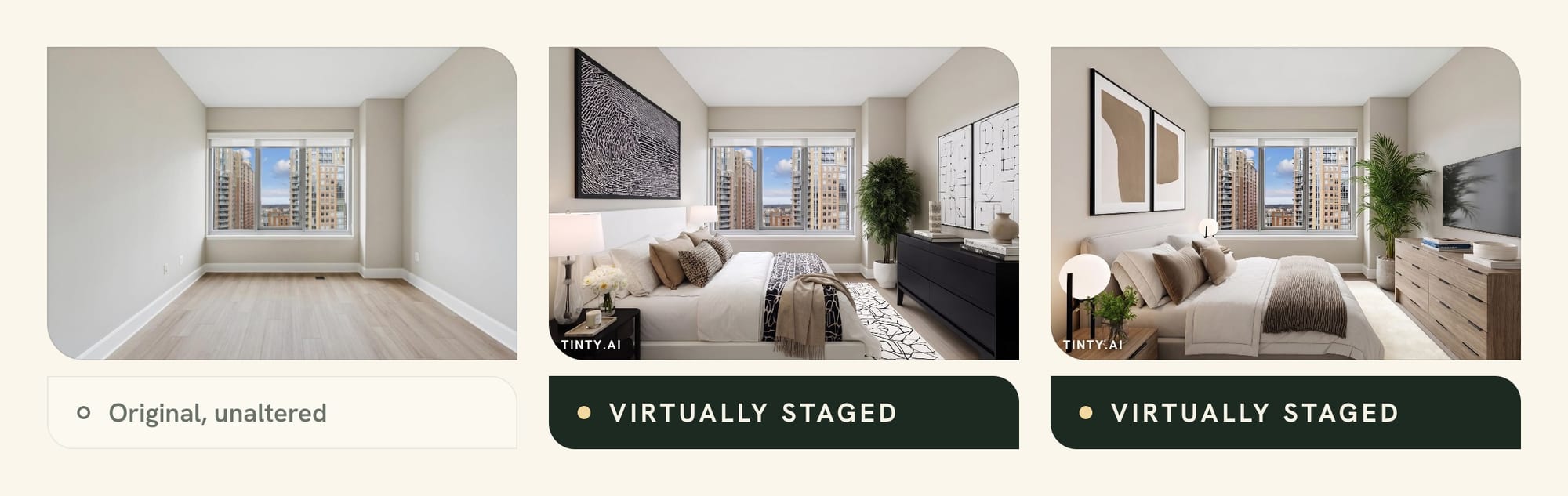
Our before and after examples show real renders. Short on time? TINTY Studio, our done-for-you virtual staging service, stages photos you email to hello@tinty.ai in 2 to 24 hours. It’s $10 a photo from 3 photos, per TINTY’s pricing page, and you pay only if you’re happy.
Words that work, and words to avoid
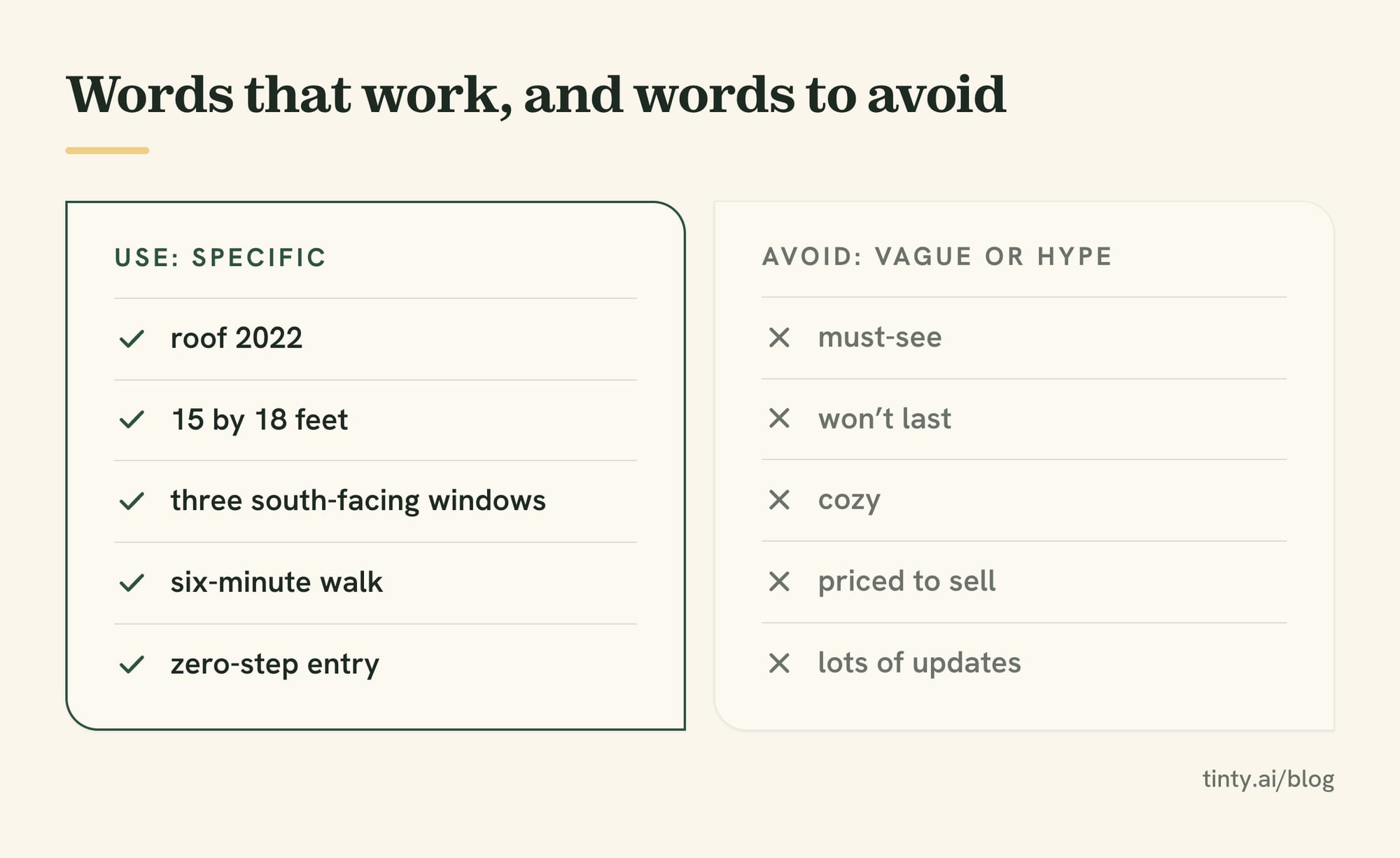
The words that work are specific and checkable. The words to avoid are vague, overused or about people. The table shows the swap.
Vague phrases and specific rewrites
| Vague | Specific (example) | What buyers learn |
|---|---|---|
| Lots of updates | New roof (2022) and furnace (2024) | What they won’t pay for soon |
| Spacious living room | 15-by-18-foot living room | Whether their furniture fits |
| Sun-filled | Three south-facing windows | Where the light comes from |
| Great location | Six-minute walk to the train | The commute |
| Move-in ready | Fresh paint, floors refinished in 2025 | What was actually done |
| Must see! | Cut it | Nothing, so it goes |
Words to cut, or use only when they’re true:
- Hype: “must-see,” “won’t last” and “priced to sell.” Luxury Presence’s word list calls these overused.
- Size code: “cozy” and “charming” often read as “small,” per Luxury Presence, and McKissock flags “cozy” too.
- Project words: “fixer,” “potential” and “opportunity.” Zillow’s 2019 guide reports “fixer” listings sold for 11.1% less than expected, across 24,000 homes it analyzed.
- Shorthand: “3/2” or “CAC” saves space but slows readers. Zillow says to spell out words buyers search for, like “waterfront.”
- Shouting: all caps and stacks of exclamation points, which Zillow says feel like yelling.
- People words: anything about who should live there. That’s the next section.
Treat Zillow’s word data as a hint, not a rule. It’s a pattern in past sales, it’s several years old, and it doesn’t prove the word caused the price (our reading).
Fair Housing words to avoid in your remarks
Describe the property, never who should live there. Federal Fair Housing rules, in the Code of Federal Regulations (CFR), ban ads that signal a preference for or against protected groups.
Rule: 24 CFR 100.75 bans ads that indicate “any preference, limitation or discrimination” based on race, color, religion, sex, handicap, familial status or national origin. That includes “words, phrases, photographs, illustrations, symbols.”
For Realtors, NAR’s Standard of Practice 10-3 adds two more classes: sexual orientation and gender identity.
Agents long relied on a 1995 memo on advertising words from the U.S. Department of Housing and Urban Development (HUD). Oregon REALTORS reported in April 2026 that HUD removed that memo without notice and posted nothing in its place. It advises treating any old guidance that restricts a practice as still valid until HUD says otherwise. The regulation itself is unchanged.
Phrases to cut, and what to write instead:
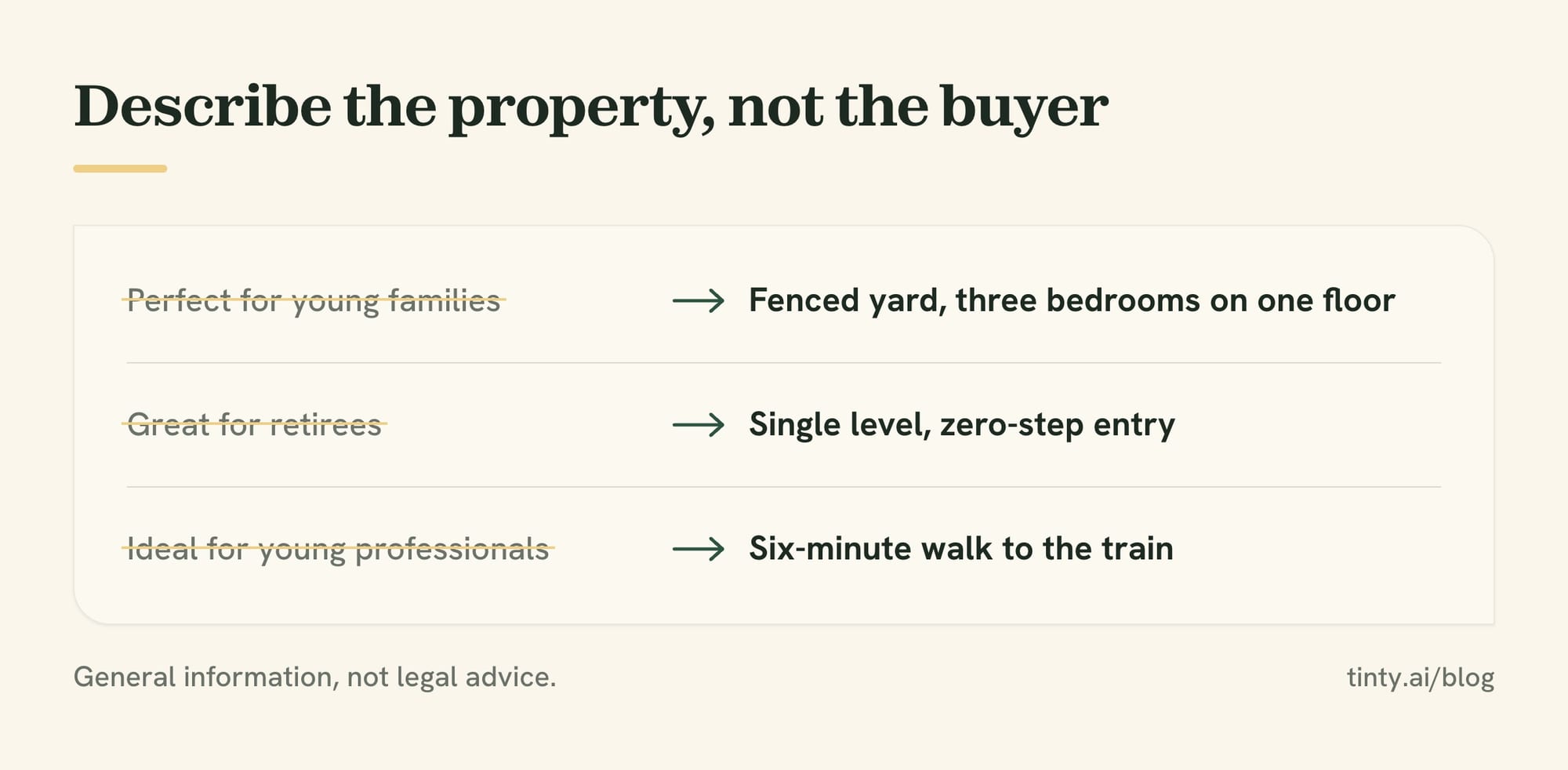
- “Perfect for young families”: write “fenced yard” or “three bedrooms on one floor.”
- “Great for empty nesters” or “retirees”: write “single level with a zero-step entry.”
- “Ideal for young professionals”: write “six-minute walk to the train.” It hints at who should live there (our reading).
- “No children” or “adults only”: cut it. Qualified housing for older persons, such as a 55-plus community, is the exception, and Stellar MLS has a separate field for it.
- “Walking distance to [a named house of worship]”: point to a street or a park instead. Luxury Presence’s guide lists this phrase as one to avoid.
Room names like “master bedroom”
The 1995 memo treated “master bedroom” and “mother-in-law suite” as physical descriptions, not violations, Oregon REALTORS wrote in 2024. Per the same post, the Houston Association of REALTORS began encouraging “primary bedroom” around June 2020, and our examples use “primary suite.” Luxury Presence’s guide adds that requirements vary by state and MLS, so check yours too.
Accuracy checks: square footage, room counts and schools
Every number and claim in your remarks has to match the home. NAR’s 2026 Code of Ethics tells Realtors to avoid “exaggeration, misrepresentation, or concealment” of pertinent facts (Article 2) and to present a “true picture” in ads (Article 12).
Example: in NAR case interpretation #12-2, an ad promised a “modern 3-bedroom home, well maintained,” about 20 miles from the city. The house was 36 miles out, at least 80 years old, with broken windows and missing steps. The panel found “gross exaggeration” and a violation of Article 12.
Your MLS won’t catch errors for you. Stellar MLS says it passes listing data on “verbatim as filed” and doesn’t verify it. Its rules also require every listing to be “complete and accurate.”
Run these checks before you publish:
- Square footage: say where the number comes from, such as the assessor, an appraisal or the builder’s plans. Sources often differ.
- Bedrooms: count a room as a bedroom only if it meets your local rules. Otherwise, call it an office or a bonus room.
- Schools: name assigned schools only after checking the district’s boundary lookup, and skip “top-rated.” Boundaries change.
- Updates: “renovated kitchen” means more than new counters. Zillow’s guide makes the same point.
- Seller claims: if you haven’t seen it yourself, write “per the seller.”
- Distances: time the walk on a map yourself, at a normal pace.
MLS rules for public remarks: length and banned content
Each MLS sets its own length limit and content rules for the public remarks, so check yours. Here’s what three published rule sets say.
How long the remarks can be
Limits differ by MLS. The Southwest MLS in Albuquerque expanded its Flexmls property remarks to up to 4,000 characters on July 22, 2026. For two days, remarks didn’t reach some portals until a vendor updated its data feed.
Zillow’s guide suggests 250 words or less, headline included, and advises using all 250. The 10 rewrites above are shorter, about 350 to 420 characters each.
What MLSs ban from the public remarks
Stellar MLS bans these items from public remarks, among others:
- Contact details: the agent’s or company’s phone number, email or other details.
- Links: any website or URL.
- Showings: showing instructions and open house information.
- Security: lockbox references and gate or alarm codes.
- Owners: the owner of record’s name or contact information.
ARMLS, the Arizona Regional MLS, enforces its rules in software. Its system blocks compensation terms, URLs and phone numbers, and warns on words like “call” and “contact.” A public remarks violation there can cost $200, per a 2024 ARMLS post.
Some first words are required, too. Stellar MLS wants “short sale” first for short sales, “Under Construction.” for homes being built and its staging line for staged photos. Showing details belong in agent-only fields, such as Stellar’s showing instructions. Stellar allows lockbox, gate and alarm codes only in its secure Showing Assist program, not in any listing field.
Tip: front-load. A Miami REALTORS trainer cited in Dotloop’s guide advises making the first two sentences the strongest, because some sites cut off the end of the remarks.
How to use AI to write the description, with a fact check
Descriptions top the list of AI tasks for agents. In NAR’s 2026 REALTORS Technology Report, writing listing descriptions was the top AI use, cited by 75% of AI users. The draft is the easy part. The fact check is your job.
Three prompts to copy
Give the tool your fact sheet, not a vague request or a set of staged photos. An image model may describe virtual furniture as part of the home (our view). Three prompts we suggest, each in plain words:
Prompt 1, the draft: Write a property description of 120 to 180 words using only the facts below. Add nothing that isn’t in the facts. Open with [feature]. Describe the rooms in this order: [order]. Don’t describe who should live here, and don’t mention furniture or decor. Use plain words and no exclamation points. Facts: [paste your fact sheet].
Prompt 2, the claim list: List every factual claim in this description as a numbered list. Mark each one “in my facts” or “not in my facts.” Facts: [paste]. Description: [paste].
Prompt 3, the people check: Flag every word or phrase that describes people instead of the property. That includes race, color, religion, sex, disability, family status, national origin, sexual orientation, gender identity and age. Suggest a rewrite about the property for each.
The tool’s check isn’t legal review. You’re still responsible for every word that goes out under your name.
Watch out: in our view, the biggest AI risk is a feature the home doesn’t have, like a fireplace, a finished basement or a “top-rated” school. Check the draft against the home, not against how good it sounds.
What to check in every AI draft
Check these before anything goes live:
- Invented features: anything not on your fact sheet.
- Numbers: square footage, lot size, year built, and bed and bath counts against the listing fields.
- Schools and distances: any claim you didn’t verify yourself.
- Virtual furniture: a sofa, rug or bed that came from staged photos.
- People words: “families,” “professionals,” “retirees” and anything similar.
- Banned MLS content: phone numbers, links and showing times.
Readers notice the stock phrases, too. In the r/realtors thread above, several commenters complained about AI-written remarks, and one said they’re obvious within three words. Others mocked worn phrases like “nestled” and “highly sought-after.”
Listing description FAQ
How long should a listing description be?
Zillow’s guide suggests 250 words or less, headline included, and advises using all 250. MLS limits vary: the Southwest MLS in Albuquerque has allowed up to 4,000 characters since July 2026. Whatever the limit, put the strongest facts in the first two sentences.
What should the description include?
A hook, three or four facts buyers can’t see in the photos, the rooms in tour order, what’s nearby and a plain invitation. Give updates with their years. Mention bed and bath counts once, in passing, since the listing fields already show them.
Show 6 more questionsShow fewer questions
What words should you avoid in a real estate listing?
Avoid hype like “must-see” and “won’t last,” vague size words like “cozy,” and any word about who should live there, like “perfect for families.” Zillow’s 2019 guide links “fixer” to lower sale prices, so use project words only when they’re true.
Can you use ChatGPT to write the description?
Yes, as a first draft. Give it a fact sheet and tell it to add nothing else. Then check every claim, number and school name, and scan for words about people. Under NAR’s Code of Ethics, the Realtor answers for the ad, whoever drafted it (our reading).
Do you have to disclose virtual staging in the description?
It depends on your MLS. Stellar MLS requires the remarks to start with “One or more photo(s) was virtually staged.” Others want the label in the photo field or on the image. California’s AB 723 also requires a statement on or next to the image and a link, URL or QR code to the original.
Is “master bedroom” a Fair Housing violation?
Not under HUD’s 1995 advertising memo, which treated it as a physical description, according to Oregon REALTORS. HUD has since removed that memo without a replacement. Some associations now prefer “primary bedroom”; the Houston Association of REALTORS began encouraging it in 2020. “Primary bedroom” is the simpler choice today, in our view.
Should you mention schools in the remarks?
Only assigned schools you’ve confirmed with the district, because boundaries change. Name the school and leave out ratings and words like “great for kids,” which describe buyers. You can also leave schools out and point buyers to the district’s lookup.
What’s the difference between public remarks and agent remarks?
Public remarks are the description buyers see on portals and sites. Agent-only remarks, which Stellar MLS calls Realtor Only Remarks, hold notes for other agents. Showing times go in agent-only fields, not the public one. Lockbox and alarm codes need more care: Stellar allows them only in its secure Showing Assist program.
How we researched this
On October 7, 2026, we read the pages that rank in Google for this topic. They include guides from Orchard, McKissock, Dotloop, GrammarPros, Zillow and Luxury Presence, plus an r/realtors thread.
We also read the Fair Housing regulation, NAR’s 2026 Code of Ethics and its Article 12 cases. For MLS rules, we read what Stellar MLS, Canopy MLS, ARMLS and the Southwest MLS publish. The 1995 memo’s status comes from Oregon REALTORS. The 75% figure comes from the key findings page of NAR’s report; we didn’t buy the full paid report.
Every example description is ours, and every detail in them is invented. We didn’t test AI tools for this guide. TINTY facts come from our live pages, checked October 7, 2026. If something here is wrong, email hello@tinty.ai and we’ll fix it.
Sources
All pages read October 7, 2026. Dates in parentheses are publication or update dates.
Fair Housing and ethics:
- 24 CFR 100.75, Discriminatory advertisements, statements and notices (eCFR) (54 FR 3283, January 23, 1989; eCFR lists no later amendment)
- Oregon REALTORS: Fair Housing Compliance After the Guidance Reset (April 17, 2026)
Show 19 more sourcesShow fewer sources
- Oregon REALTORS: Permissible Advertisements Under the Fair Housing Act (May 3, 2024)
- NAR 2026 Code of Ethics and Standards of Practice (Articles 2, 10 and 12; Standard of Practice 10-3)
- NAR case interpretations related to Article 12 (case #12-2)
MLS rules and disclosure law:
- Stellar MLS Rules and Regulations (PDF) (last updated September 15, 2025; Articles 04.04, 04.06, 04.11, 04.16, 04.22, 04.25, 04.26 and 13.02)
- Canopy MLS: Digital, Virtually Staged, and AI-enhanced Images (last updated February 27, 2026)
- ARMLS: New Text Constraint Warning in Public Remarks (August 16, 2024)
- Greater Albuquerque Association of REALTORS: Expanded Flexmls Remarks to 4,000 Characters (July 22, 2026)
- California Business and Professions Code §10140.8 (AB 723) (effective January 1, 2026)
NAR data:
- NAR 2026 REALTORS Technology Report, key findings (September 2026)
- NAR 2025 Home Buyers and Sellers Generational Trends (PDF) (April 2025; Exhibit 3-6, page 56)
Listing description guides:
- Zillow: Property Descriptions 101, How to Write Listing Descriptions That Sell (November 26, 2019)
- Dotloop: How Do You Write a Great Real Estate Listing Description? (undated)
- McKissock: The Essential Guide to Writing Real Estate Listings That Sell (December 24, 2025)
- Luxury Presence: 250+ Essential Real Estate Words to Use in Your Property Listings (July 9, 2026)
- Orchard: Examples of creative real estate listing descriptions, and how to write them (August 3, 2023)
- GrammarPros: 10 Creative Real Estate Listing Descriptions That Will Make Buyers Fall in Love (July 2023, updated March 2026)
Agent discussion:
- r/realtors: Listing Description (March 28, 2025)
TINTY and related guides:
- TINTY, AI virtual staging app · Before and after examples · Done-for-you virtual staging service · TINTY pricing
- Is virtual staging legal? · How to sell a stale listing · Selling a vacant house · How to take real estate photos with an iPhone · Wisconsin Act 69 · AI adoption in real estate · Real estate social media posts