What should a real estate newsletter include? One short issue a month. It holds a local market snapshot with its source, one useful article, your own listing or recent sale, a local event and one call to action. Send it to people who know you or signed up, with your address and an unsubscribe link.
We make TINTY, an AI virtual staging app, so one section covers listing photos. We don’t sell email software. Every real estate newsletter example and subject line below is one we wrote, with placeholders in [brackets]. Notes on rules are general information, not legal advice.
Key takeaways
- Why bother: 66% of sellers hired an agent they were referred to or had used before, per the National Association of Realtors (NAR). A newsletter keeps you remembered.
- One issue, five parts: a market snapshot with its source, one useful article, your own listing, a local event and one call to action.
- Pace: send monthly on the same day. A pace you can keep beats a burst of weekly emails (our view).
- Rules: a postal address, an unsubscribe honored within 10 business days and honest subject lines, per the Federal Trade Commission (FTC).
- Measure: count clicks, replies and referrals, not opens. Apple Mail can make unread emails look opened.
On this page: Why send one · Email or print · One issue · 24 ideas · 12-month plan · Examples · How often · Tools · Rules · Measure · FAQ
Why agents send a monthly newsletter
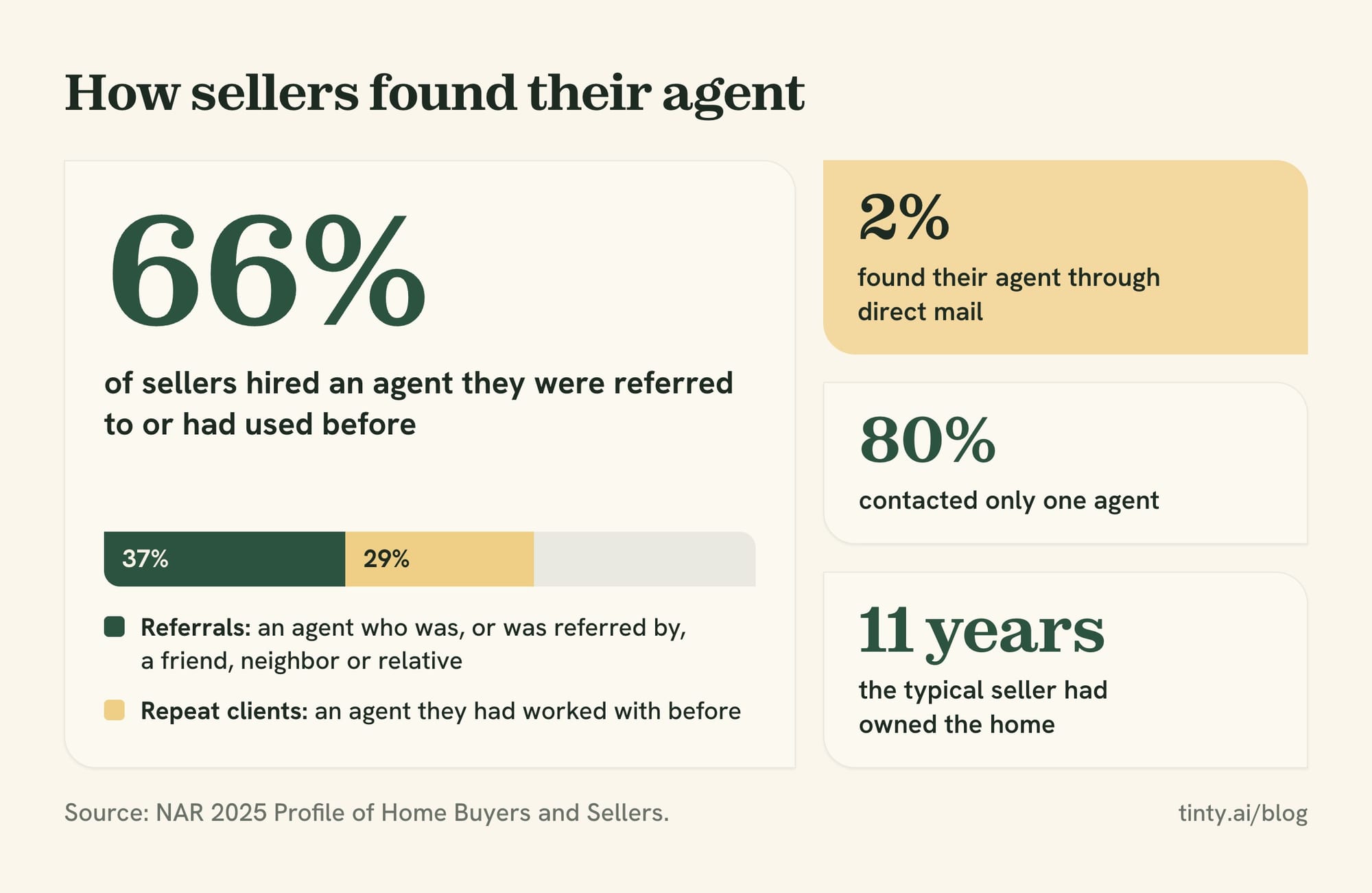
A newsletter keeps you remembered between deals, and most sellers hire through referrals or past ties. In NAR’s 2025 Profile of Home Buyers and Sellers, 66% of sellers hired an agent they were referred to or had used before.
That’s the latest edition as of October 20, 2026. It covers people who bought a home from July 2024 to June 2025, and seller figures come from buyers who also sold. What it found:
- Referrals: 37% of sellers used an agent who was, or was referred by, a friend, neighbor or relative.
- Repeat clients: 29% of sellers used an agent they had worked with before.
- Buyers: 43% were referred to their agent by a friend, neighbor or relative.
- One call: 80% of sellers contacted only one agent before choosing.
- Long gaps: the typical seller had owned the home for 11 years, a record high, per NAR’s news release.
Eleven years is a long time to stay in mind. A monthly email is a cheap way to do it (our view), and our guide on how to get listings shows where referrals fit in a bigger plan.
A newsletter is a reminder, not a lead machine (our view). Only 2% of sellers in the same report found their agent through direct mail, such as a newsletter, flyer or postcard. NAR has no separate line for email newsletters. Judge it by the referrals and repeat clients it keeps warm.
Email or print: which format fits
Email is the default: it’s cheap, quick to send and easy to measure. Print costs more per piece but lands in hand, so it suits a farm area and your best past clients (our view). One workable mix is a real estate email newsletter every month and a printed issue once a quarter.
Email: cheap, quick and measurable
An email tool sends one issue to your whole list and shows who clicked. Mailchimp has a free plan for small lists, as the tools section shows. Email has rules, too: a postal address and a working unsubscribe link in every issue.
Print: for your farm and your best clients
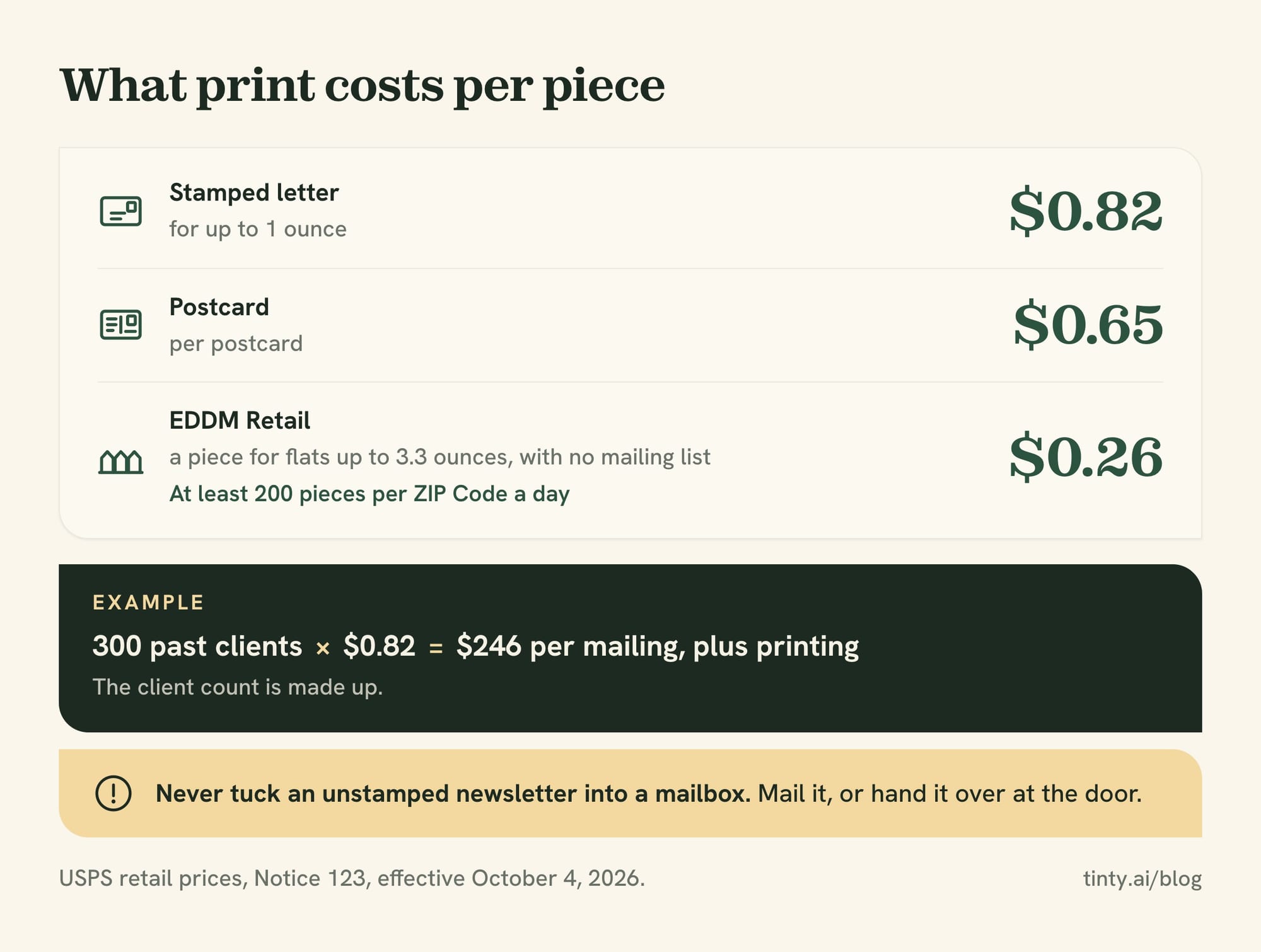
Print adds postage and printing to every issue. These are US Postal Service (USPS) retail prices from Notice 123, effective October 4, 2026, and checked October 20, 2026:
- Stamped letter: $0.82 for up to 1 ounce.
- Postcard: $0.65.
- Every Door Direct Mail (EDDM) Retail: $0.26 a piece for flats up to 3.3 ounces, with no mailing list.
EDDM mails every address on a carrier route. You need at least 200 pieces per ZIP Code a day, per USPS’s EDDM rules. Each piece must be longer than 10.5 inches, taller than 6.125 inches or thicker than 0.25 inch. A standard 4-by-6 postcard doesn’t qualify (our reading).
Example: 300 past clients get a printed letter each quarter. Postage is 300 × $0.82 = $246 per mailing, plus printing. The client count is made up; the price is USPS’s.
If you farm a neighborhood, a printed issue can be your monthly mail, as in our real estate farming plan.
Watch out: never tuck an unstamped newsletter into a mailbox. USPS rules let mailboxes hold only matter that bears postage. Mail it, or hand it over at the door.
Real estate newsletter template: what goes in one issue
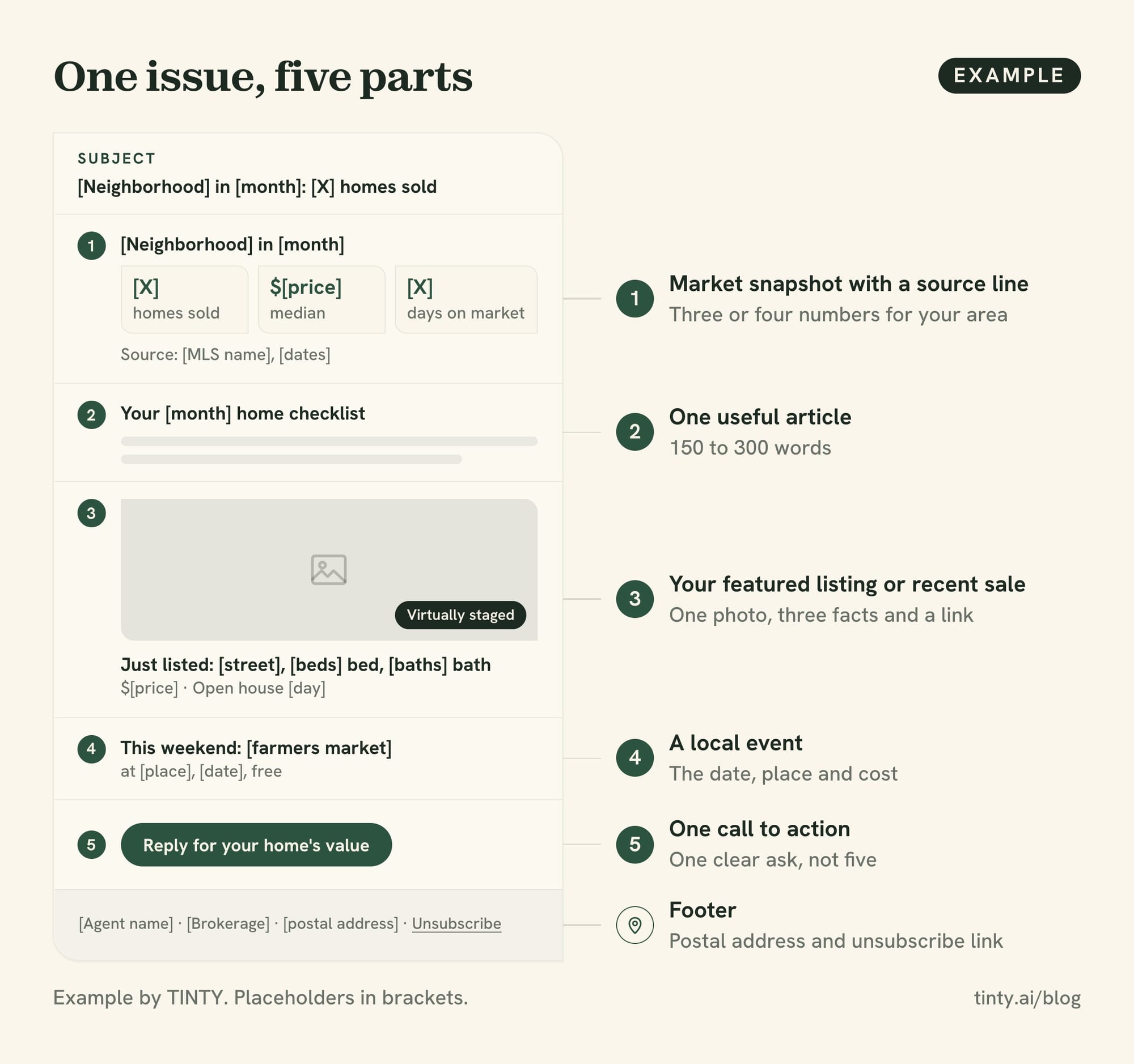
Keep each issue short enough to read in about two minutes (our view). This real estate newsletter template has five parts in a fixed order, so readers learn where to look. The examples are ours, with placeholders.
1. Market snapshot with a source line
Give three or four numbers for your area, each compared with last month or last year. Pull them from your multiple listing service (MLS), and don’t forecast prices (our suggestion).
Example market snapshot: “[Neighborhood] in [month]: [X] homes sold, at a median of $[price], up [X]% from last year. They sold in [X] days on average. New listings: [X]. Source: [MLS name], [dates].”
NAR’s 2026 MLS policy handbook says ads based on MLS data must disclose the source and the period covered (Policy Statement 7.80). That’s why many MLSs require that line.
2. One useful article
Pick one question your clients ask and answer it in 150 to 300 words. Good picks are a seasonal checklist, a cost explained in plain numbers or one step of a sale.
Reuse the article afterward as a post. Our guide to real estate social media posts has captions you can adapt.
3. Your featured listing or recent sale
Feature your own new listing, open house or recent sale with one photo, three facts and a link. Two lines from your listing description are enough.
Watch out: only Realtors who took part in a sale may claim they “sold” it (Standard of Practice 12-7). Standard of Practice 12-4 bars advertising property without authority. So feature other agents’ listings only with the listing broker’s OK and if your MLS allows it. Otherwise, show them as market data.
Here’s a featured listing block you can copy:
Example featured listing: “Just listed: [street], [beds] bed, [baths] bath, $[price]. Open house [day], [time]. The bedroom photo is virtually staged; see the original at [link]. [Agent name], [brokerage].”
Stage an empty listing before you feature it
An empty home makes a weak featured photo, because bare rooms are hard to judge at email size (our view). A virtually staged photo shows how a room can be used, as long as it’s labeled.
We make TINTY, an AI web app that stages photos of empty rooms. You upload a photo, pick the room type, style, furniture amount and a color palette (or Auto), and get a staged photo in about a minute. Try TINTY on your listing’s empty rooms: sign in with Google or an email code and get 6 free staged photos, no card.
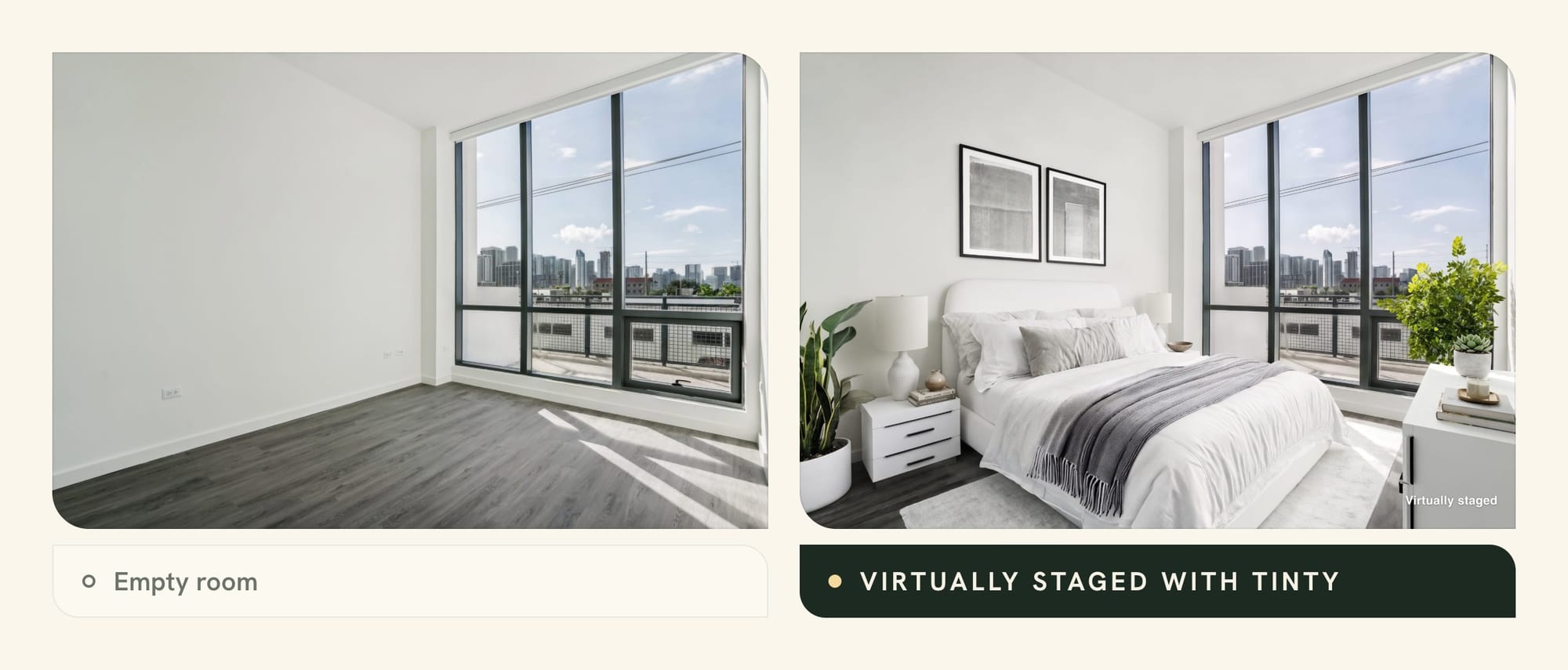
Free photos carry a light watermark, so they’re for testing. For clean 2K files, plans start at $9 a month for 10 staged photos, or a Listing pack costs $29 once for 30, per TINTY’s pricing page. That page labels these launch prices, so they may change.
TINTY stages 9 room types and doesn’t do kitchens, bathrooms, building exteriors or yards. It doesn’t remove furniture either. You can switch on a “Virtually staged” label for your photos, and your MLS may require more.
In California, a sale ad with an altered photo needs a disclosure and a link to the original, per Business and Professions Code 10140.8. Our guide to whether virtual staging is legal covers MLS rules.
4. A local event
List one event with the date, place and cost, such as a farmers market, a park cleanup or a library talk. Check the details with the organizer before you send (our suggestion).
5. One call to action
End with one clear ask, not five. “Reply for your home’s value” works, and so does “Know someone moving? Reply with their name.” Then add the footer the rules section describes.
Real estate newsletter ideas: 24 topics by type
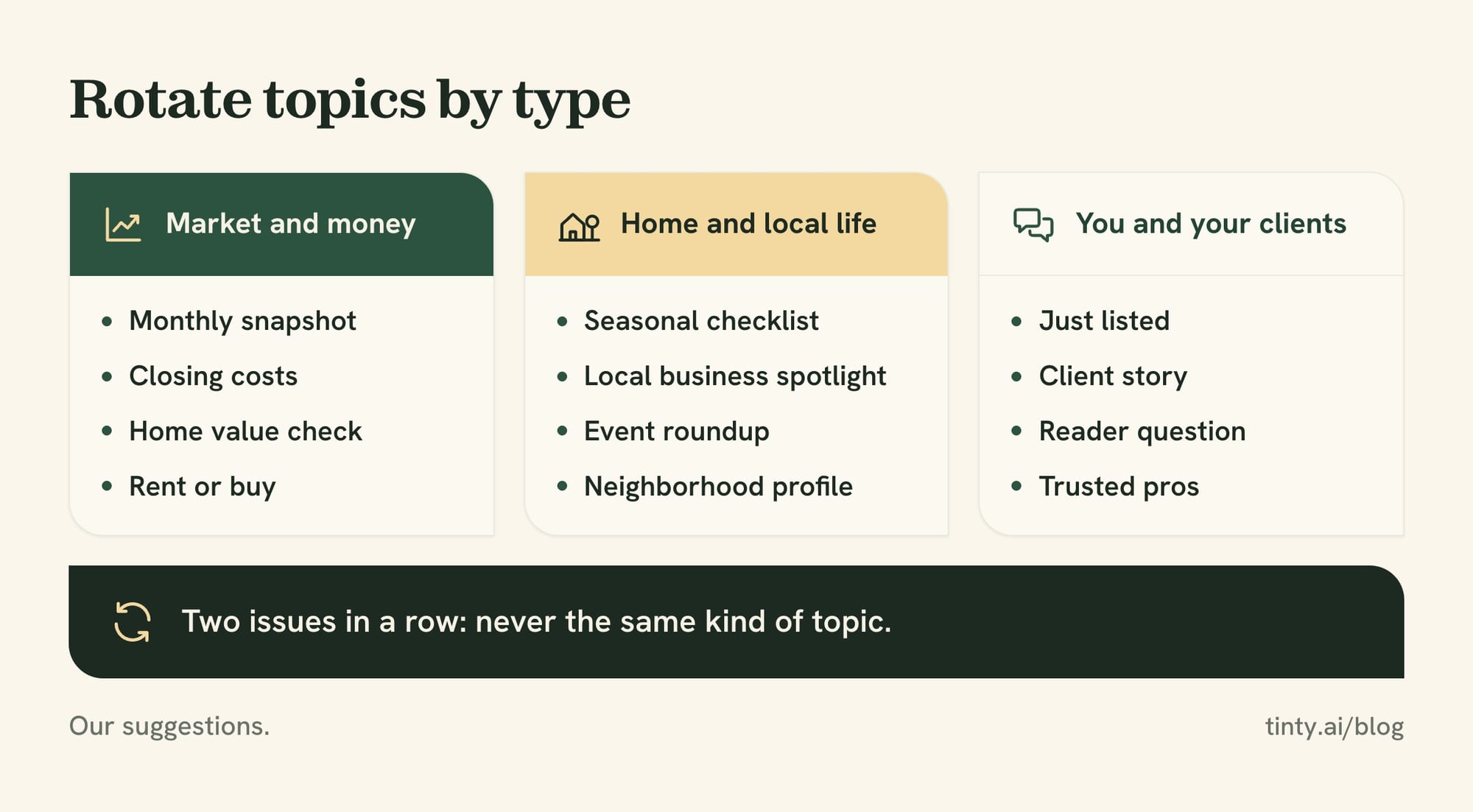
Rotate these so two issues in a row don’t cover the same kind of topic (our suggestion).
Market and money
- Monthly snapshot: sales, median price and days on market for one area.
- Price per square foot: how it differs between two nearby neighborhoods.
- Rates explained: what a rate change means for a monthly payment, with a lender’s figures.
- Closing costs: what buyers and sellers usually pay at closing in your state.
- Property taxes: when bills arrive and how an assessment appeal works.
- Home value check: an offer to estimate what a reader’s home is worth.
- Year in review: last year’s numbers next to the year before.
- Rent or buy: a worked example with today’s local rents.
Home and local life
- Seasonal checklist: gutters, filters, smoke alarms and other jobs for the month.
- Cost of a fix: what a roof, water heater or furnace costs locally.
- Local business spotlight: a cafe, hardware store or contractor, with their OK.
- Event roundup: three things to do this month.
- Neighborhood profile: parks, transit, shops and recent sales in one area.
- City news: openings, road work and projects that affect homes.
- Trash and utilities: holiday schedule changes and bulk pickup dates.
- Yard and garden: what to plant or prune this month in your climate.
You and your clients
- Just listed: your own new listing, staged if the rooms are empty.
- Just sold: your own closed sale, with the seller’s permission.
- Client story: how you solved one problem, with the client’s OK.
- Behind the scenes: what happens between the offer and closing.
- Reader question: answer one question a month.
- Myth or fact: one common belief about buying or selling, checked.
- Thank-you note: thanks to everyone who sent a referral, without names.
- Trusted pros: inspectors, movers and handymen you’d hire yourself.
A 12-month newsletter calendar
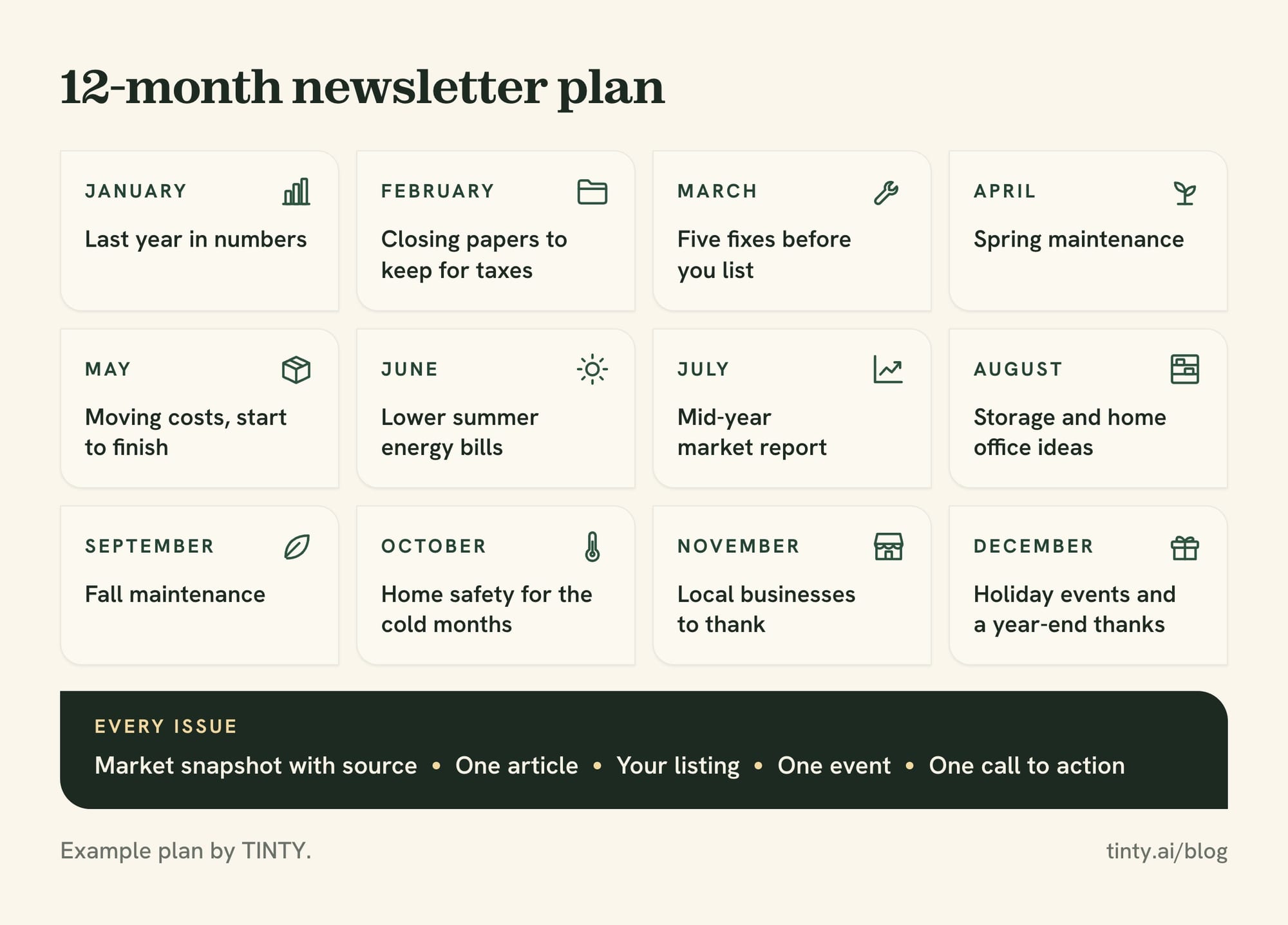
Give each month one theme and keep the market snapshot in every issue. This plan follows the seasons in most of the US, so shift it for your climate (our plan).
A sample year: one theme a month. Our example plan, not a rule.
| Quarter | Month 1 | Month 2 | Month 3 |
|---|---|---|---|
| Q1 | January: last year in numbers | February: closing papers to keep for taxes | March: five fixes before you list |
| Q2 | April: spring maintenance | May: moving costs, start to finish | June: lower summer energy bills |
| Q3 | July: mid-year market report | August: storage and home office ideas | September: fall maintenance |
| Q4 | October: home safety for the cold months | November: local businesses to thank | December: holiday events and a year-end thanks |
Tip: write two or three issues in one sitting and schedule them, if your plan allows it. Mailchimp’s free plan, for example, can’t schedule a send.
Pair the quarterly print issue with a visit to your best clients. Our pop-by ideas for realtors has small seasonal gifts that fit each quarter.
Real estate newsletter examples: one issue, 12 subject lines
Here’s one full issue in the five-part order. We wrote it; fill in the brackets.
Example issue. Subject: “[Neighborhood] in [month]: [X] homes sold”
Market: [X] homes sold at a median of $[price], up [X]% from last year, in [X] days on average. Source: [MLS name], [dates].
Tip of the month: test your smoke alarms and replace the furnace filter before the cold.
Just listed by me: [street], [beds] bed, [baths] bath, open house [day]. The bedroom photo is virtually staged; see the original at [link].
This weekend: [farmers market] at [place], [date], free.
Moving next year? Reply and I’ll send your home’s value.
[Agent name] · [Brokerage] · [postal address] · Unsubscribe
A subject line must match what’s inside: the FTC’s CAN-SPAM guide says not to use deceptive ones. Every line below is an example we wrote. Use the listing lines only for your own listings and sales.
Market and money
- “[Neighborhood] in [month]: [X] homes sold”
- “Home prices near [street]: [month] in numbers”
- “Your home’s value: a free estimate for [month]”
- “Closing costs in [state], in plain numbers”
- “[Year] in review: [city] home prices”
- “Rates moved. What it means for a $[X] payment”
Home and local
- “Your [month] home checklist: 6 quick jobs”
- “This weekend in [neighborhood]: 3 free events”
- “Just listed on [street]: open house [day]”
- “Sold on [street]: what the sellers did first”
- “Meet [business], [neighborhood]'s new bakery”
- “A reader asked: [question]?”
For one-to-one emails to leads and past clients, see our real estate email templates.
How often to send a newsletter
Monthly suits most agents: often enough to be remembered, rare enough to have real news (our view). No law or survey we found sets the right frequency, so pick one you can keep for a year.
Send on the same day each month, such as the second Tuesday. Readers learn when to expect you, and you get a deadline (our suggestion).
Weekly email works only if you have fresh local news every week (our view). For active buyers, use automatic listing alerts they asked for, and keep those separate from the newsletter.
Newsletter tools and what they cost
A general email tool is enough for a list of a few hundred (our view). A customer relationship manager (CRM) with email keeps the newsletter next to your contacts and deals. Prices were checked on each vendor’s site on October 20, 2026, in US dollars:
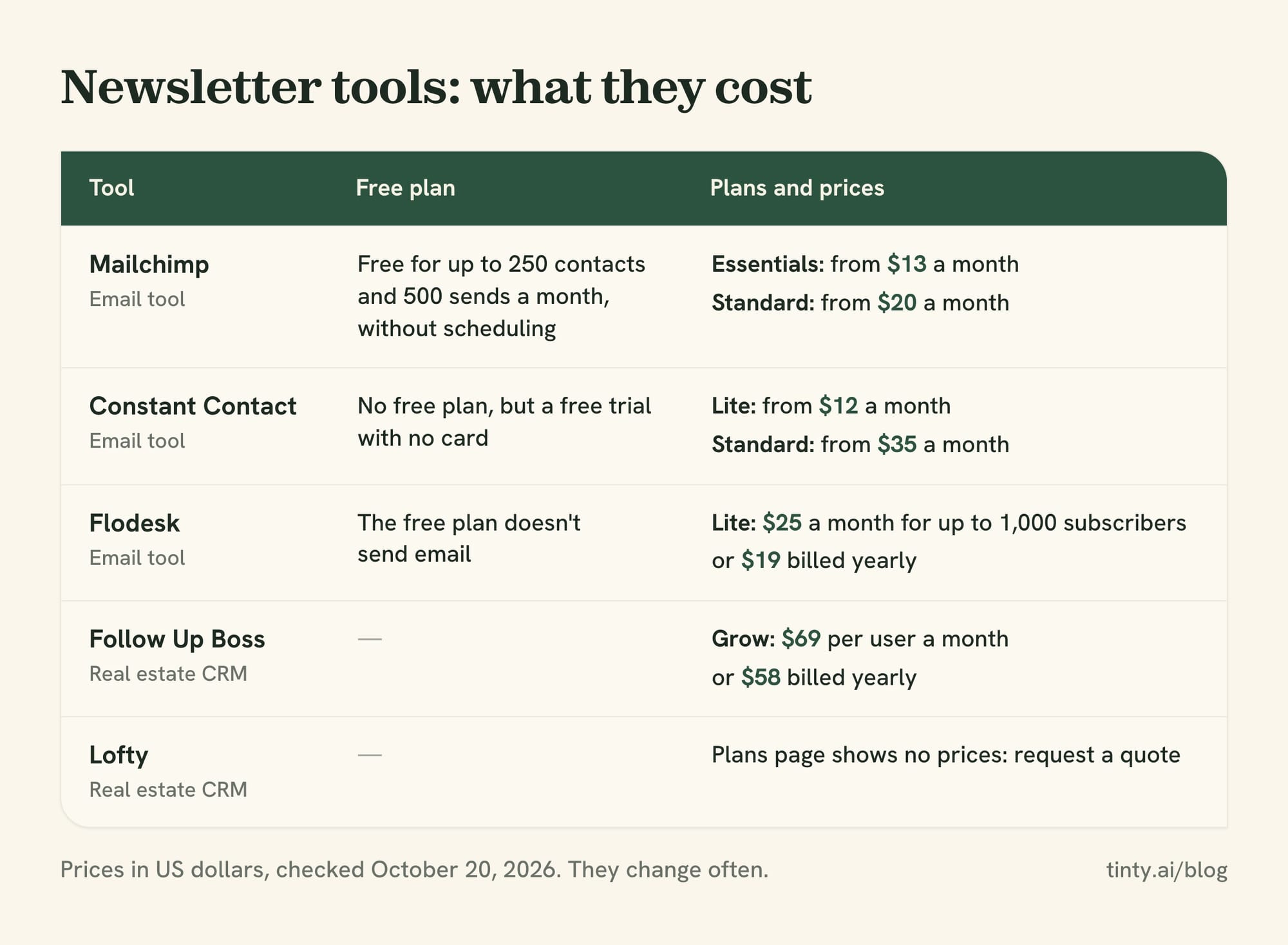
- Mailchimp: free for up to 250 contacts and 500 sends a month, without scheduling. Essentials starts at $13 a month and Standard at $20, per Mailchimp’s pricing.
- Constant Contact: no free plan, but a free trial with no card. Lite starts at $12 a month and Standard at $35, per Constant Contact’s pricing.
- Flodesk: the free plan collects subscribers but doesn’t send email. Flodesk’s Lite plan is $25 a month for up to 1,000 subscribers, or $19 billed yearly.
- Follow Up Boss: a real estate CRM with batch email and click tracking on every plan. Grow costs $69 per user a month, or $58 billed yearly, per Follow Up Boss pricing.
- Lofty: a real estate CRM with mass and automatic email. Lofty’s plans page shows no prices, so you request a quote.
If you already pay for a CRM, check its email features before you add another tool (our suggestion). Prices depend on list size and change often, so check them before you buy.
Rules: consent, CAN-SPAM and fair housing
Three sets of rules touch every issue: who you add, what each email must include and how you describe homes and places.
Who you can add to your list
CAN-SPAM works on opt-out: people must be able to unsubscribe, per the FTC’s guide. Email tools can be stricter. Mailchimp’s Acceptable Use Policy bans sending to “purchased, rented, third-party” lists. Google’s sender guidelines ask senders to keep reported spam below 0.3%, ideally under 0.1%.
Ways to grow a list people want (our suggestions):
- Past clients and sphere: ask once by text or email if they’d like your monthly update.
- Open house sign-ins: add a checkbox that says “Send me the monthly market update.”
- Website and social profiles: a signup form, or a link to one.
- Print pieces: a QR code that opens the same form.
- Never: bought lists, scraped emails or cards from an event, added without asking.
What every issue needs
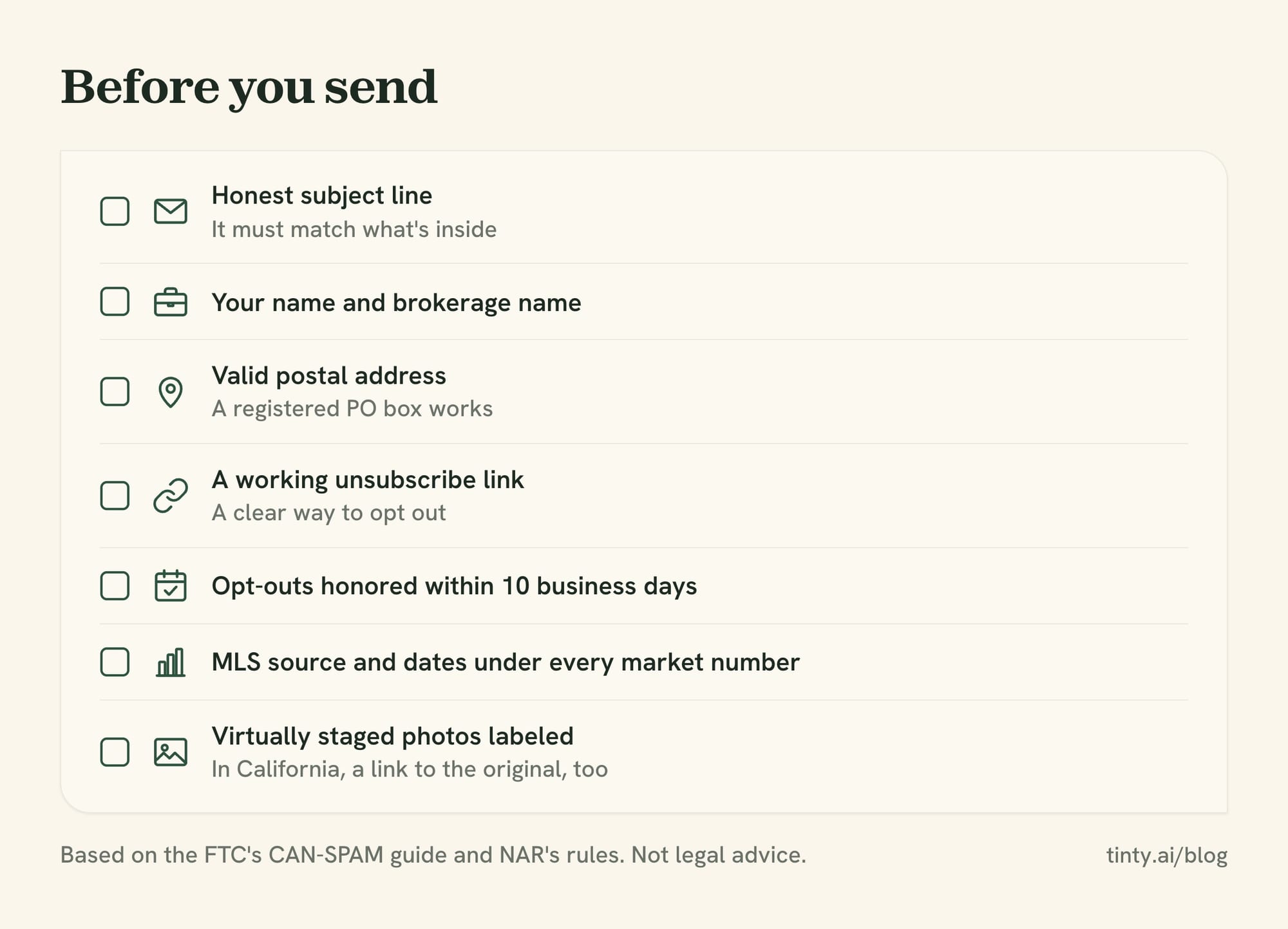
Rule: the FTC’s CAN-SPAM guide asks for a valid postal address, and a registered PO box works. You need a clear way to opt out, opt-outs honored within 10 business days and honest subject lines. Each violating email can cost up to $53,088.
The guide also says the message must be clearly identified as an ad, unless the reader agreed to get it (15 U.S.C. 7704). NAR’s Code of Ethics asks Realtors to show their firm’s name in every ad (Standard of Practice 12-5). Article 12 asks them to make clear they’re real estate professionals.
Fair housing in every section
Describe homes and places, never who should live there. A federal rule, 24 CFR 100.75, bans housing ads that indicate “any preference, limitation or discrimination” based on a protected class.
It also covers choosing media or locations that keep a group from learning about housing. So write “two blocks from a park”, not “great for young families” (our reading). Mail a printed issue to a whole area, not to streets picked by who lives there. Our listing description guide lists fair housing words to avoid.
How to measure your newsletter
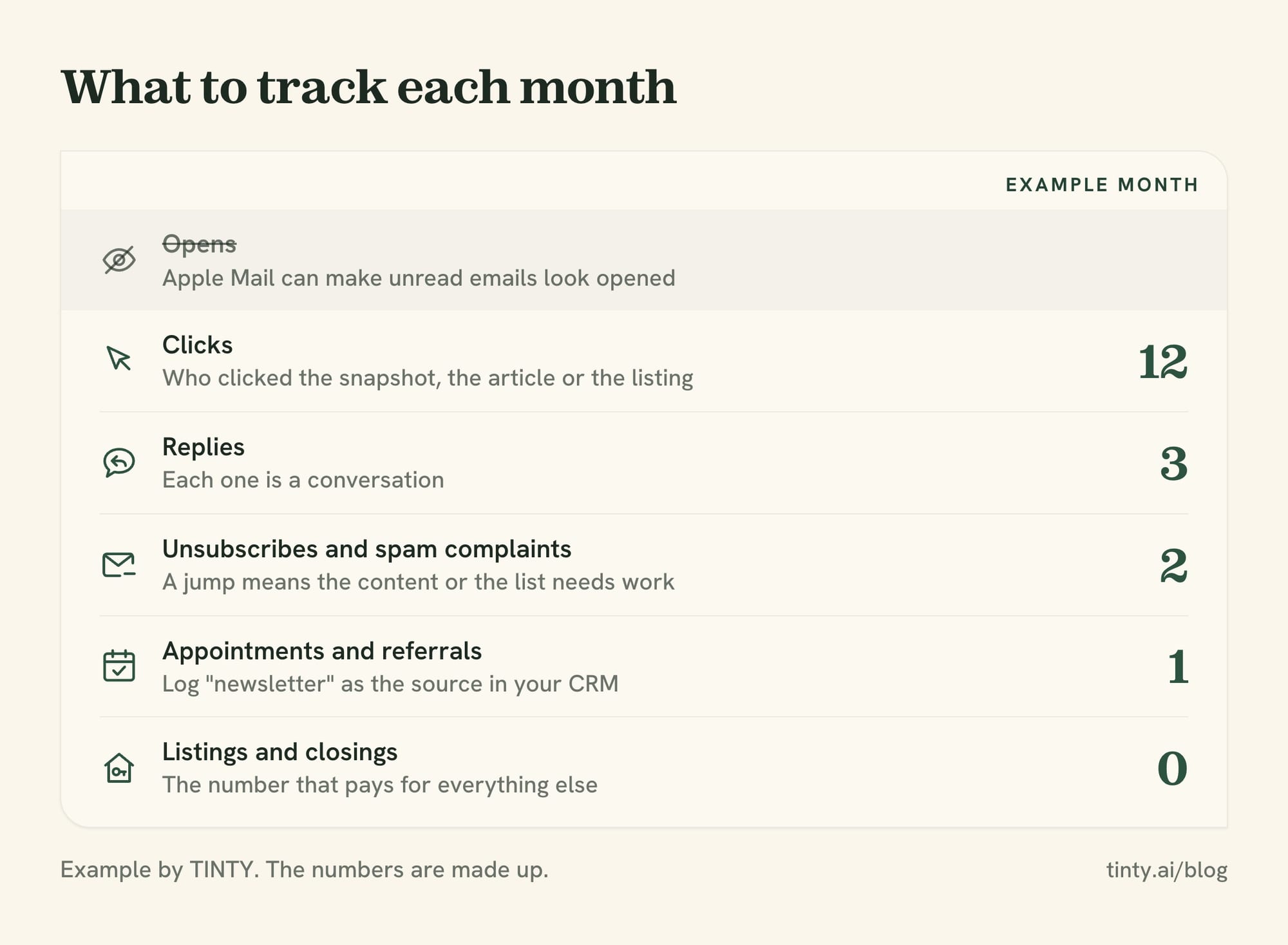
Judge a newsletter by what readers do, not by opens. Apple’s Mail Privacy Protection “prevents senders from seeing if you’ve opened” an email, once the reader turns it on.
Track these each month (our list):
- Clicks: who clicked the snapshot, the article or the listing.
- Replies: each one is a conversation, so answer it the same day.
- Unsubscribes and spam complaints: a jump means the content or the list needs work.
- Appointments and referrals: log “newsletter” as the source in your CRM.
- Listings and closings: the number that pays for everything else.
Watch out: a high open rate can be Apple Mail loading the email, not a person reading it. Mailchimp’s help page says these emails are reported as opened “regardless of the contact’s activity.” Clicks aren’t affected.
Give it a year before you judge (our view). A seller who reads you in March may not call until the next spring.
Newsletter FAQ for agents
What is a real estate newsletter?
It’s a regular email or printed update an agent sends to past clients, friends and a farm area. It mixes local market numbers, useful tips and the agent’s own listings. Its job is to keep you remembered between deals.
How often should a realtor send a newsletter?
Monthly is a pace most agents can keep (our view), and no law sets a frequency. Pick one day, such as the second Tuesday, and keep it for a year before you judge the results.
Show 4 more questionsShow fewer questions
Do I need permission to email past clients?
Not under federal law. CAN-SPAM works on opt-out, not opt-in, so every marketing email needs a working unsubscribe link and your postal address. Your email tool may be stricter, and asking first keeps spam complaints down (our suggestion).
Do real estate newsletters work?
They work best as a reminder, not as a lead source on their own (our view). Only 2% of sellers found their agent through direct mail, per NAR’s 2025 Profile, while 66% used a referral or an agent they’d used before.
What is the best free tool for a real estate newsletter?
For a small list, Mailchimp’s free plan covers up to 250 contacts and 500 sends a month, as of October 20, 2026, but it can’t schedule. Flodesk’s free plan doesn’t send email, and Constant Contact offers a trial only.
Can I feature another agent’s listing in my newsletter?
Not as your own. NAR’s Standard of Practice 12-4 bars advertising property without authority, and NAR’s 2026 MLS handbook lets an MLS ban ads for other brokers’ listings. Without the listing broker’s OK, show those homes as market data, such as “3 homes sold”.
How we researched this
On October 20, 2026, we searched for “real estate newsletter” and five close variants. We read six of the ranking guides: HousingWire, Brevo, MyRealPage, Follow Up Boss, Hostinger and The Close. We left out Pinterest, Canva’s template gallery and done-for-you newsletter services. We read AirDNA’s list of newsletters for investors and three Reddit threads for context only, and we don’t cite them.
None of the six guides mentions CAN-SPAM, fair housing or Apple’s Mail Privacy Protection. Figures come from NAR, the FTC, USPS, Apple, Google, Mailchimp and each vendor’s own pages, read the same day. If something here is wrong, email hello@tinty.ai and we’ll fix it.
Sources
All pages read October 20, 2026. Dates in parentheses are publication or update dates.
Data and rules:
- NAR 2025 Profile of Home Buyers and Sellers, full report (PDF) (November 2025; Exhibits 4-6 and 7-2 to 7-3; the copy posted by the Long Island Board of REALTORS, since NAR offers the full report free to members only)
- NAR: 2025 Profile of Home Buyers and Sellers news release (November 4, 2025; 11 years in the home before selling)
Show 25 more sourcesShow fewer sources
- NAR: Highlights From the Profile of Home Buyers and Sellers (2025 edition, sales from July 2024 to June 2025)
- USPS Notice 123, price list (effective October 4, 2026)
- USPS DMM 143, EDDM Retail · USPS Every Door Direct Mail · USPS DMM 508, mail receptacles
- NAR Handbook on Multiple Listing Policy, 2026 edition (PDF) (36th edition, January 2026; Policy Statement 7.80)
- NAR 2026 Code of Ethics and Standards of Practice (Article 12; Standards of Practice 12-4, 12-5 and 12-7)
- California Business and Professions Code 10140.8 (AB 723)
- FTC: CAN-SPAM Act, a compliance guide for business (August 2023; edited January 2024) · Cornell LII: 15 U.S.C. 7704 (section 7704(a)(5): no ad label needed after prior affirmative consent)
- Federal Register: FTC Civil Penalty Inflation Adjustments (PDF) (September 15, 2026; penalty amounts unchanged for 2026)
- Mailchimp Acceptable Use Policy (updated September 26, 2025)
- Google: Email sender guidelines
- eCFR: 24 CFR 100.75, Discriminatory advertisements, statements and notices
- Apple: Use Mail Privacy Protection on iPhone · Mailchimp: About Apple Mail Privacy Protection
Newsletter tools (prices checked October 20, 2026):
- Mailchimp pricing · Mailchimp: About pricing plans (Free plan limits)
- Constant Contact pricing
- Flodesk pricing
- Follow Up Boss pricing
- Lofty pricing
Articles that rank for this topic:
- HousingWire: Real estate newsletters, the ultimate playbook (December 6, 2024; updated December 16, 2025)
- Brevo: How to create a real estate newsletter (June 16, 2026; updated June 24, 2026)
- MyRealPage: Real estate newsletter, how to create one that converts (June 20, 2025; updated October 27, 2025)
- Follow Up Boss: 13 real estate newsletter examples and templates (June 4, 2025)
- Hostinger: 16 real estate newsletter examples for agents and brokers (May 29, 2026)
- The Close: Top 20 real estate newsletter templates and tips (August 13, 2024; updated December 9, 2024)
TINTY and related guides: