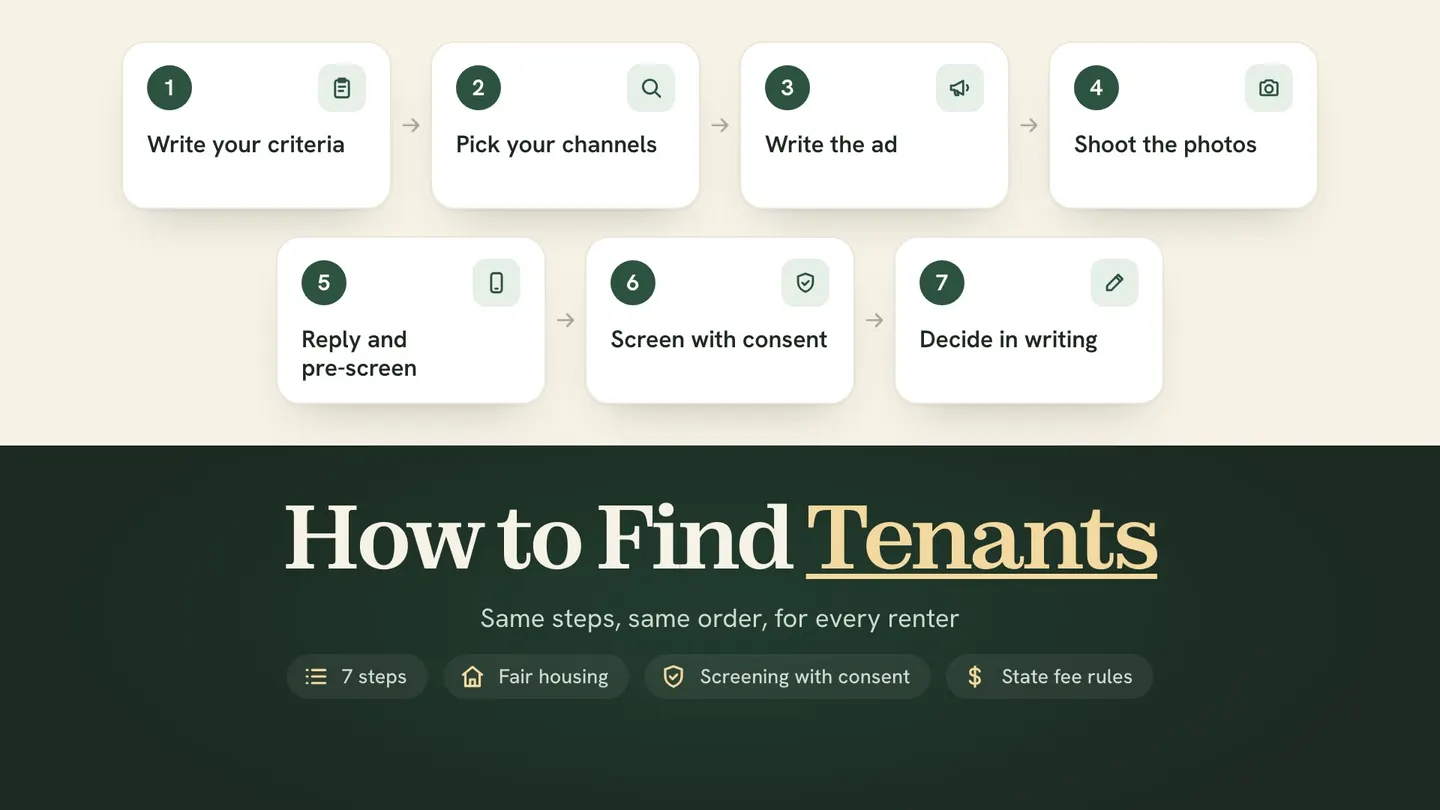
How do you find tenants fast? Write your screening criteria first. Then list the unit on the big rental sites with photos of the actual unit, the full price and the move-in date. Add a yard sign and ask for referrals. Reply within a day, ask every renter the same questions, screen with written consent, and put any denial in writing.
Laws, rental data and TINTY prices checked October 31, 2026.
We make TINTY, an AI virtual staging app, so we have a stake in one step here: the listing photos. We don’t sell listings or tenant screening, and no company below paid to be named. Laws here are general information, not legal advice. Rules vary by state and city, so check yours or ask a local attorney.
Key takeaways
- Criteria first: write your income, credit and rental history rules before you list. Use the same rules, fee and checks for every applicant.
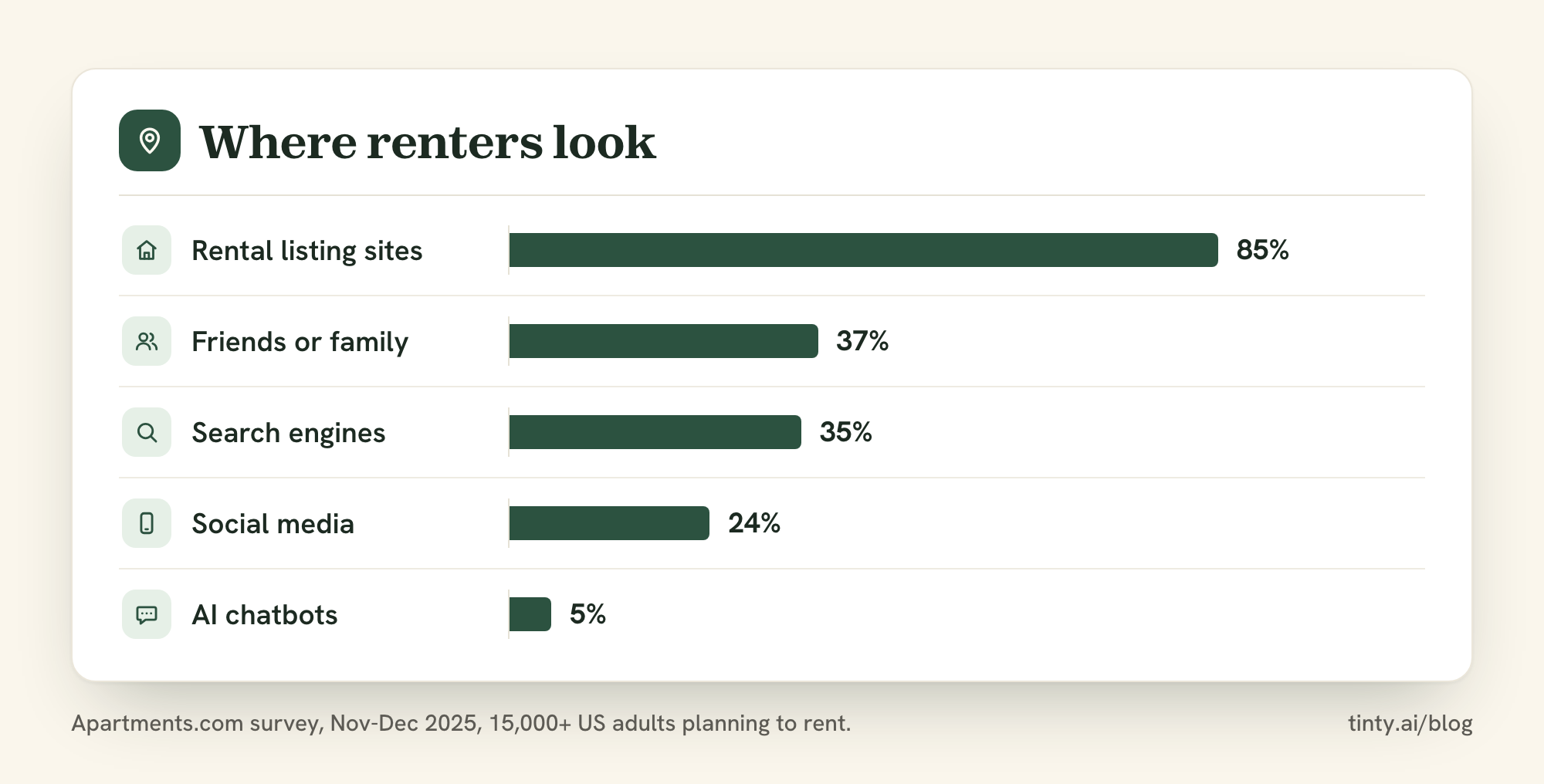
- Channels: 85% of renters in an Apartments.com survey use or plan to use rental listing sites, so start there. Add a yard sign, referrals and Facebook Marketplace.
- The ad: show the rent with all fees, the move-in date and photos of the actual unit. Half of renters in that survey rule out listings without unit photos.
- Denials: if a screening report leads to a denial, a co-signer or a bigger deposit, federal law requires an adverse action notice. Put it in writing.
- State and D.C. rules: New York caps application fees at your cost or $20, whichever is less. California, New York, Washington and D.C. protect renters’ source of income.
On this page: Criteria · Channels · The ad · Photos · Reply fast · Screening · Denials · Fees and vouchers · FAQ
How to find good tenants: write your criteria first
Good tenants start with written criteria you set before the ad goes live. Using the same standards, fees and checks for every applicant is the safest habit (our suggestion).
A rule from the U.S. Department of Housing and Urban Development (HUD) bans different qualification criteria because of a protected trait, from income standards to application fees. Put these in writing before you list:
- Income: your rule, such as a set multiple of the rent.
- Credit and rental history: what you accept and what you don’t.
- Records: which reports you pull and how far back.
- Pets: your policy. Assistance animals are a separate request.
- Money: the application fee, deposit and move-in costs.
- Order: complete applications reviewed as they arrive (our suggestion).
Washington requires written notice, before you screen, of what criteria may lead to a denial. California requires written criteria with the application form if you charge a fee under the first-come option in Civil Code 1950.6.
Watch out: a no-pets rule doesn’t settle an assistance animal request from a person with a disability. HUD’s accommodation rule uses a guide dog in a no-pets building as an example of a required accommodation. HUD withdrew its animal guidance in 2025, but the rule still stands.
Where to find tenants: the channels renters use
To find tenants for a rental property, start where most renters already look: the big rental listing sites.
A survey by Apartments.com, which sells rental listings, asked over 15,000 US adults planning to rent in late 2025. Of those, 85% use or plan to use rental listing sites. Another 37% ask friends or family, 35% use search engines, 24% social media and 5% AI chatbots.
Rental listing sites: where most renters look
One listing on a big rental site can show up on several sites at once. Apartments.com says a listing published there also appears on Homes.com and across its network. Post the same rent, fees, photos and criteria everywhere (our suggestion). We couldn’t verify Zillow’s, Craigslist’s or Facebook’s listing fees, so check each site’s pricing first.
Facebook Marketplace and Craigslist
Facebook Marketplace and Craigslist reach local renters, and fair housing rules apply there too. In the Apartments.com survey, 24% of renters use social media to search. Meta’s Commerce Policies say listings must not “suggest a preference for or against people because of a personal characteristic.”
Rule: HUD bans picking ad media or locations that keep groups protected by fair housing law from hearing about a rental. Our suggestion: always post on at least one channel open to everyone, such as a big listing site.
Signs, referrals and your local housing agency
Three cheap local channels still work:
- Referrals: 37% of renters in the Apartments.com survey ask friends or family for recommendations. Tell current tenants and neighbors (our suggestion).
- Signs: HUD counts signs as written notices, so the same wording rules apply. Check any homeowners association (HOA) rules first.
- Housing agency list: a public housing agency (PHA) gives voucher families a list of landlords who may be willing to rent to them, or other search resources. Ask yours to add you (our reading).
Screening stays with you: under HUD’s voucher rule, the owner is responsible for screening and selecting the family.
What to put in your rental ad
Put the rent with every fee, the move-in date and your key rules in the ad (our view). In the Apartments.com survey, 85% prefer to see the total price, fees included, and 54% cross a place off if fees push the price above the ad. Over half won’t rent without air conditioning or an in-unit washer and dryer, so name those up front.
Put these in every rental ad:
- Price: rent plus every recurring fee.
- Move-in costs: the deposit and the application fee.
- Dates: move-in date and lease length.
- What’s included: utilities, parking, laundry, air conditioning.
- Pet policy: yours (assistance animals are a separate request).
- Next step: how to tour, how to apply and where to read your criteria.
Fair housing: describe the unit, not the renter
Describe the unit, never the renter you want. Federal law bans rental ads that signal a preference based on race, color, religion, sex, disability, familial status or national origin.
The Fair Housing Act’s ad rule covers any “notice, statement, or advertisement,” and HUD’s rule adds photographs and symbols. Familial status means children under 18 living with a parent or guardian, plus pregnancy. So “no kids” or “adults only” signal a preference (our reading).
Rule: the federal ban on discriminatory rental ads covers even an owner renting out one house without an agent. The exemptions in 42 U.S.C. 3603(b) and 24 CFR 100.10 don’t reach the ad rule, and state or city laws may apply too.
Our fair housing words to avoid come with safer swaps. The Act doesn’t require the Equal Housing Opportunity logo, though some federal programs and a few states call for it. Our Equal Housing Opportunity logo guide shows where it goes.
Listing photos for an empty or occupied unit
Lead with a bright interior photo of the actual unit, and stage only the empty living spaces. For half of renters in the Apartments.com survey, a listing without photos of the actual unit is a deal-breaker.
Apartments.com also says its analysis of primary photos found interiors work best for older or more modest buildings: kitchens, living rooms and bedrooms did best. That’s most small-landlord units (our reading).
How to handle the three common cases:
- Empty unit: shoot it clean and empty. Stage the living room and bedrooms, label each staged photo “Virtually staged” and post the original next to it.
- Occupied unit: shooting after move-out is simplest. If you can’t wait, keep people and personal photos out of frame, and label any edit.
- Your own camera: our guide to taking listing photos with an iPhone covers settings and empty rooms.
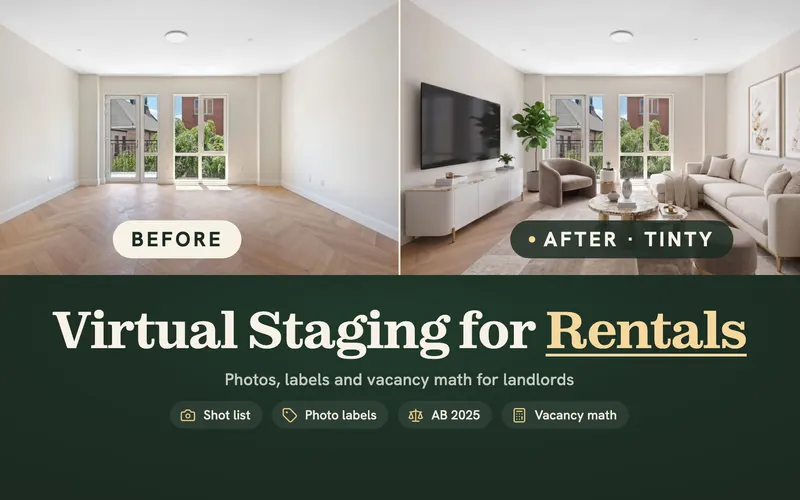
In California, from January 1, 2027, AB 2025 requires a label and the original for digitally altered rental photos. Our virtual staging laws guide covers fair housing for staged rooms, and our guide to virtual staging for rentals covers labels and vacancy costs.
Where TINTY fits in the photo step
TINTY, our AI web app, stages a photo of an empty room in about a minute.
What TINTY does for a rental listing:
- Rooms: living spaces such as a studio, bedroom, living room or home office, not kitchens, bathrooms or exteriors.
- Furnished rooms: TINTY can remove the furniture and decor from a furnished room first, keep built-ins like cabinets and radiators, and then stage the empty room. Each removal uses one photo.
- Files: 2K, about 2,500 px on the long side. You pick the room, style and furniture.
- Label: an optional “Virtually staged” label on staged photos.
AI can still misjudge scale or place a piece oddly, so check every staged photo before it goes in your ad.
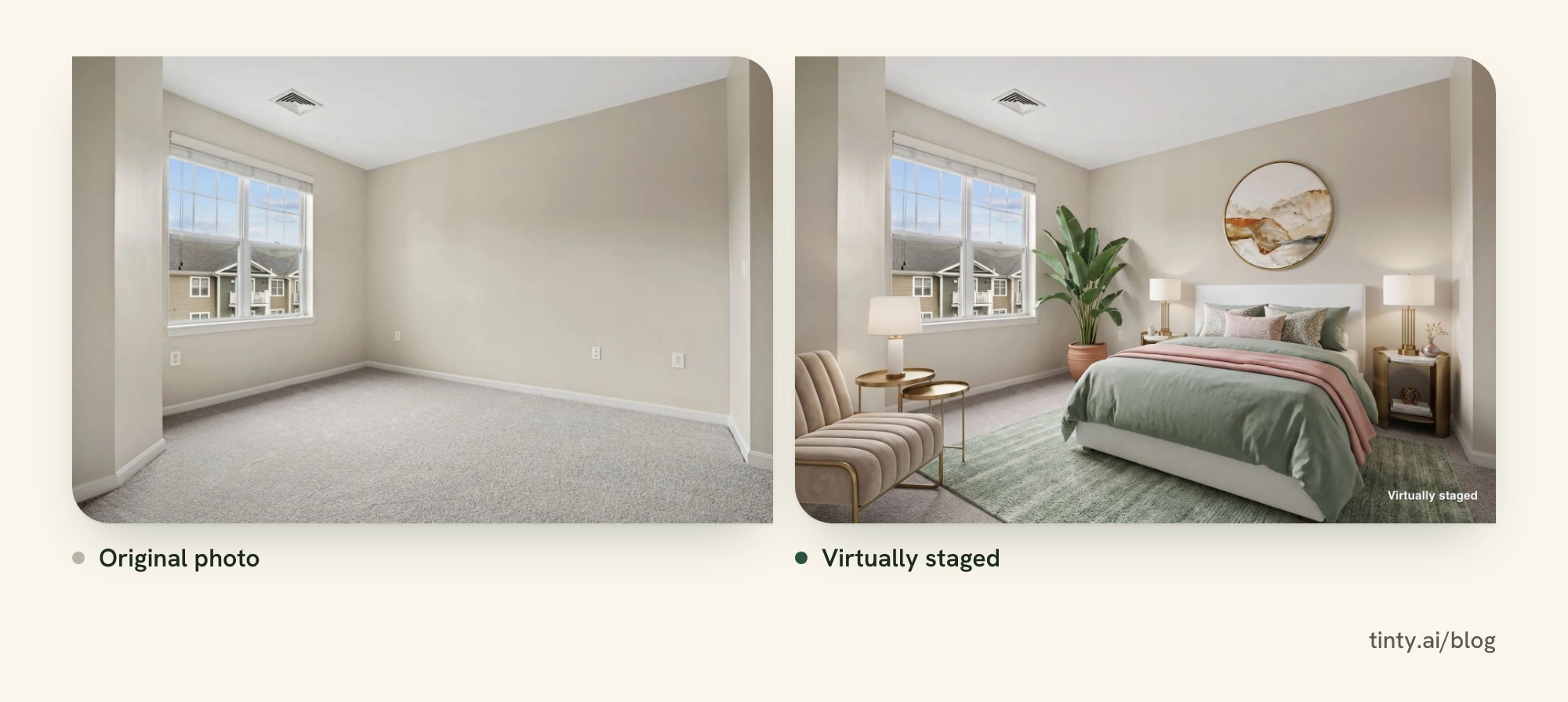
Try TINTY free on your empty unit: 6 staged photos with a light watermark, no card. Use them to test, not in your rental ad.
For one vacancy, the Listing pack is $29 once for 30 staged photos, valid for 12 months. Plans start at $9 a month for 10, per TINTY’s pricing page. These are launch prices, so they may change.
Too busy to stage the photos yourself? Landlords and property managers can email them, empty or furnished, to hello@tinty.ai with the style and what each room is for. TINTY Studio, our done-for-you service, removes furniture, stages each photo with AI and finishes it by hand. You get a private link in 2 to 24 hours and pay $10 a photo, from 3 photos, only if you’re happy.
How to find tenants fast: reply within a day
Speed comes from answering fast and moving every renter through the same steps in the same order. In a 2024 Apartments.com survey, 87% of renters expected a reply by the end of the next day. The company’s renter satisfaction survey found 40% didn’t hear back in time.
Renters have choices: rental vacancy hit 7.6% in the third quarter of 2026, the highest since early 2014, by Census Bureau estimates. Zillow saw renter activity peak in the first week of June in 2023 and 2024, so list once you know the move-out date (our suggestion).
More than half of renters say a private tour is a must, Zillow says, yet 40% in the late-2025 Apartments.com survey would likely rent sight unseen. Offer tours in the order inquiries arrive (our suggestion).
Pre-screening questions to ask every renter
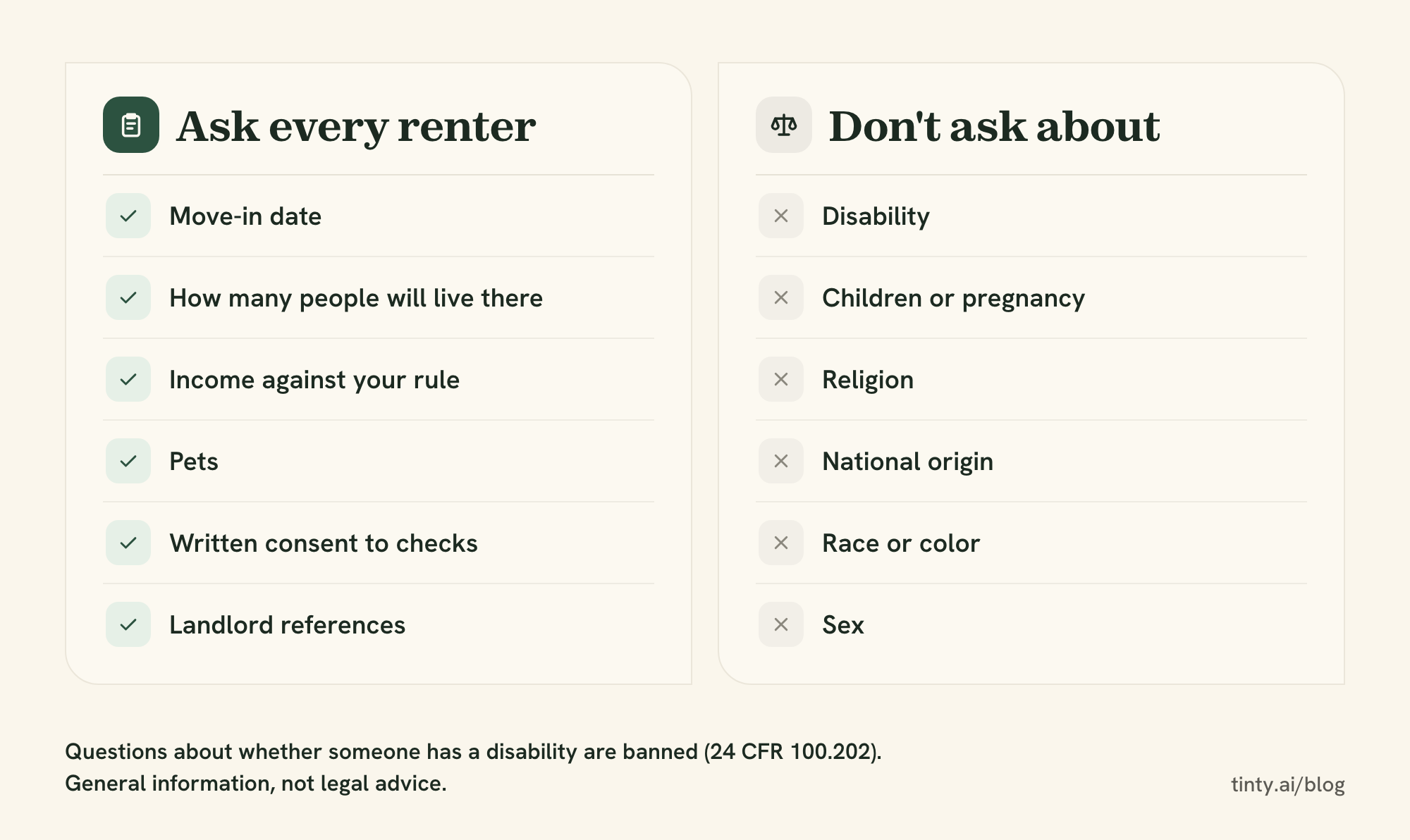
Ask every renter the same short set of questions before a showing, and skip anything about protected traits. Questions you can ask everyone:
- When do you want to move in?
- How many people will live in the unit?
- Does your household income meet our income rule? (State the rule.)
- Do you have pets?
- Will you agree, in writing, to a credit and background check?
- May I contact your current and previous landlords?
HUD’s rule on disability questions bans asking whether an applicant has a disability, or about its nature or severity. You may ask everyone if they can meet the lease terms, currently use illegal drugs, or have a conviction for making or selling them.
Skip questions about children, pregnancy, religion, national origin, race or sex too (our reading). Leave eviction history to the screening report: some places limit eviction records, and D.C. protects sealed ones.
Tip: ask every caller the same questions in the same order and write down the answers. If someone later says you treated them differently, your notes show what you asked everyone (our suggestion).
How to screen tenants: application, reports and references
Screen with a written application, the applicant’s consent and the same checks for everyone. Then decide against the criteria you wrote down.
Get the application and written consent
Use one application form and one fee for everyone, and get written consent before you pull any report. HUD’s ad rule also covers “applications,” so a biased question on the form is a problem too (our reading).
A screening company may furnish a report for a legitimate business need tied to a deal the consumer started, such as a rental application. The Federal Trade Commission (FTC) says landlords must certify they’ll use reports only for housing. Written consent is the cleanest proof of that purpose (our suggestion).
Check income, credit and rental history
Check the same things for every applicant, in the same order, against your written rules:
- Identity: a photo ID that matches the application.
- Proof of income: pay stubs, an offer letter or benefit letters. Count a voucher where source of income is protected.
- Credit: a report from a screening company, pulled with consent.
- Court records: evictions and other civil cases, within local limits.
- References: current and previous landlords.
When you’re done, shred or securely delete the reports. Federal disposal rules require “reasonable measures,” such as “burning, pulverizing, or shredding of papers.”
Criminal records after HUD’s 2025 withdrawals
HUD has withdrawn its main guidance on criminal records, but the Fair Housing Act still applies and some cities limit criminal checks.
HUD withdrew its 2016 criminal records guidance, effective September 25, 2025, per a July 2026 Federal Register notice. Its 2022 follow-up memo was withdrawn too, effective September 17, 2025. HUD has proposed removing its disparate-impact rule, but there’s no final rule.
Three points still hold:
- FTC: its July 2023 landlord guide predates the withdrawals. It says “a blanket policy of refusing to rent to anyone with a criminal record may violate the Fair Housing Act.”
- Drug convictions: federal law allows acting on a conviction for making or distributing illegal drugs.
- City rules: Washington, D.C., for example, bars criminal history questions before a conditional offer, then allows only listed offenses from the past 7 years, never arrests. Check your city.
Our suggestion: write your rule down, weigh what each record was for and how old it is, and skip blanket bans.
Watch out: a withdrawn guidance isn’t a green light. The Fair Housing Act didn’t change, HUD’s disparate-impact rule is still on the books, and renters can still sue within two years.
Approve or deny in writing: the adverse action notice
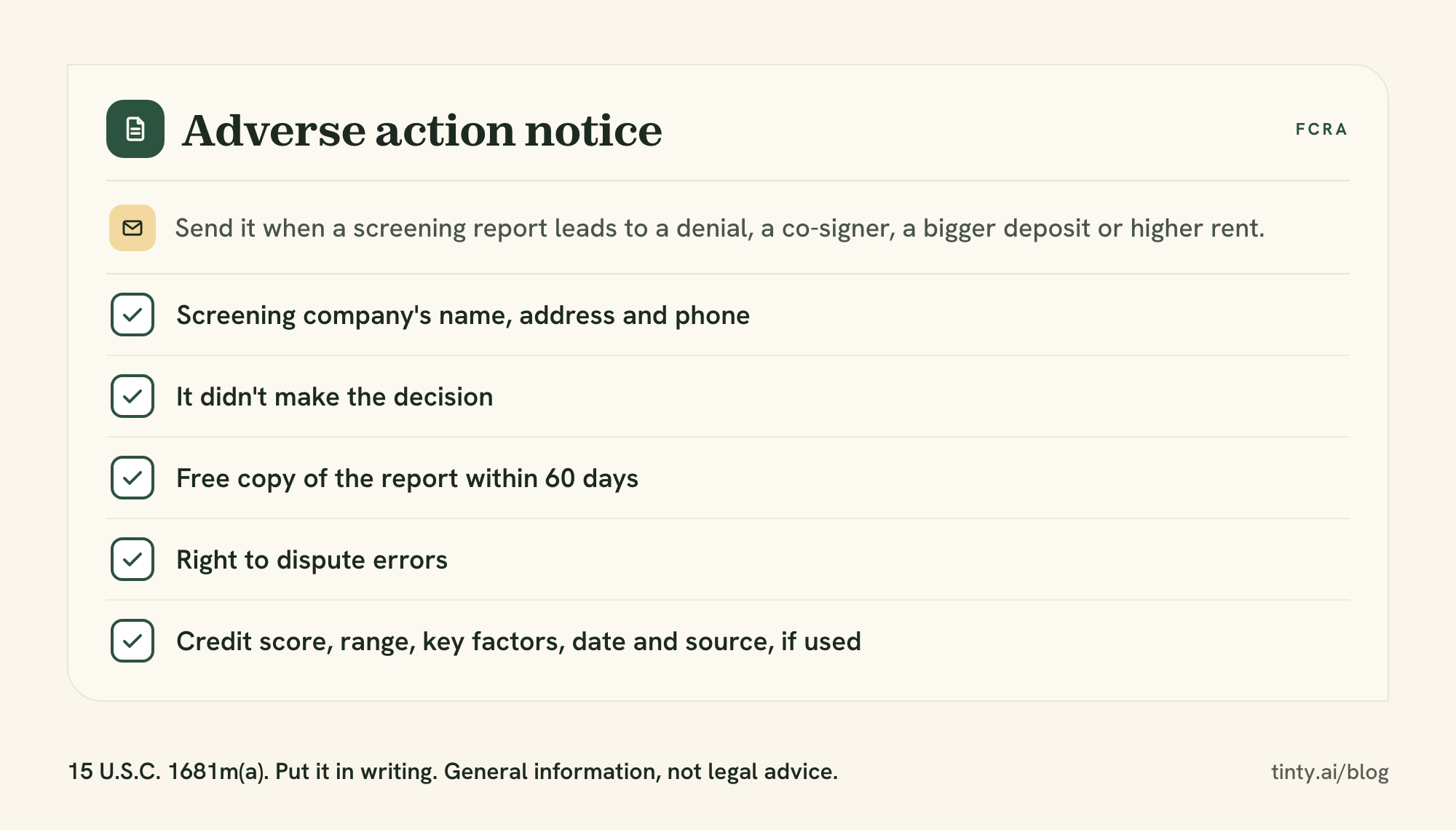
A screening report that leads to a denial, a co-signer, a bigger deposit or higher rent triggers a federal adverse action notice.
Under the Fair Credit Reporting Act (FCRA), adverse action includes any decision on an application that’s “adverse to the interests of the consumer.” The FTC lists all four of those as examples.
Under the FCRA’s notice section, the notice must include:
- The screening company: its name, address and phone number.
- Who decided: a statement that the company didn’t decide and can’t explain why.
- A free copy: the right to a free copy of the report if requested within 60 days.
- Disputes: the right to dispute inaccurate or incomplete information with the company.
- Credit score: if you used one, the score, its range, the key factors that hurt it, the date and who provided it.
The law allows an oral, written or electronic notice, but the FTC calls a written one the best practice, because it proves you sent it. The Consumer Financial Protection Bureau (CFPB) explains the same rights to renters. Washington also wants written reasons in a set format.
Watch out: the notice is due even if the report played only a small part in your decision, the FTC says. A willful violation can cost actual damages or $100 to $1,000, plus punitive damages and attorney’s fees (15 U.S.C. 1681n).
Application fees and housing vouchers: state rules
Federal fair housing law doesn’t protect source of income, and we found no federal cap on application fees. Some states and cities set rules on one or both. Here’s what the codes say in the places we verified:
State codes read on October 31, 2026 (California through CalMatters Digital Democracy’s copy of the official bill text). General information, not legal advice; cities can add rules.
| State | Application fee | Renters with vouchers |
|---|---|---|
| California | Your actual cost, capped at $30 adjusted for inflation since 1998 | Can’t refuse them; Section 8 counts as source of income, and income rules apply to the renter’s share |
| New York | Your actual cost or $20, whichever is less | Can’t refuse over “lawful source of income” |
| Washington | Your actual cost, only after written notice of your criteria | Can’t refuse them; apply income rules to the rent minus the voucher |
More from the same codes, plus Washington, D.C.:
- California: to charge a fee, review complete applications in order and approve the first who meets your written criteria. Otherwise, refund everyone not selected within 7 days of choosing a tenant (or 30 days after they applied, if sooner).
- New York: waive the fee if the applicant brings a background or credit check from the past 30 days (Real Property Law 238-a).
- Washington: a source-of-income violation can cost up to 4.5 times the monthly rent, plus costs and attorney’s fees (RCW 59.18.255).
- Washington, D.C.: source of income is protected. With an income-based subsidy, you can’t judge income level (beyond a legal threshold) or credit score unless federal law requires it (D.C. Code 2-1402.21).
California’s voucher rule is Government Code 12955, and New York’s is Executive Law 296. For other states and cities, check with your state’s civil rights agency or a local attorney.
Finding and screening tenants FAQ
How long does it take to find a tenant?
About three weeks of listing time, by two companies that share few details on their methods. Rental Beast’s metro data shows a median of 19 days in the third quarter of 2026, and Hemlane, a platform for independent landlords, 24 days in August. At the Census median asking rent of $1,541, each empty day costs about $51 (our math). Our vacancy loss math for rentals shows how to run it.
What are red flags when screening tenants?
Tie every red flag to a rule you wrote down in advance (our suggestion). Examples: income you can’t verify, details that don’t match across documents, references you can’t reach, or a report that breaks one of your criteria. A protected trait is never a red flag, and neither is a housing voucher where source of income is protected.
Show 4 more questionsShow fewer questions
Who pays for tenant screening?
Often the applicant pays through an application fee, and federal rules ban charging different fees because of a protected trait. New York caps it at your actual cost or $20, whichever is less, and you must waive it for a check from the past 30 days. California caps it at $30, adjusted for inflation since 1998. Washington allows only your actual cost.
Should you hire a property manager or agent to find tenants?
Consider it if you live far from the unit, rent several units, or don’t want to handle fair housing and screening paperwork yourself (our view). Ask what they charge, where they advertise and how they screen. One side effect: the Fair Housing Act’s exemption for an owner renting a single-family house doesn’t apply if you rent through a broker or agent.
Can you list a rental before the current tenant moves out?
Yes, and listing once you know the move-out date gives renters time to plan (our view). Give the notice your lease and state law require before you show or photograph the unit. TINTY can remove a tenant’s furniture from a photo, but label the edit. In California, AB 2025 also requires the original from January 1, 2027, so reshooting after move-out is simplest.
Do you have to rent to the first qualified applicant?
Federal law doesn’t name a winner, but it bans different standards because of a protected trait (24 CFR 100.60). California ties the order to fees: to charge one, review complete applications in order and approve the first who qualifies. The other option is refunding everyone not selected within 7 days of choosing a tenant, or 30 days after they applied if sooner. Processing in order is our suggestion everywhere.
How we researched this
To write this guide on how to find tenants, we read federal law first. That means the Fair Housing Act, the credit reporting law, HUD’s rules and withdrawal notices, and FTC and CFPB guides.
For state rules we read official code texts. California’s Legislature site blocked us, so we read CalMatters Digital Democracy’s copy of the official text. Rental data comes from the Census Bureau, Apartments.com, Zillow, Rental Beast and Hemlane.
We couldn’t confirm HUD’s 2024 screening guidance, listing site fees or other states’ rules. If something here is wrong, email hello@tinty.ai and we’ll fix it.
Sources
All pages read October 31, 2026, unless marked. Dates in parentheses are publication or update dates.
Federal fair housing and credit report law:
- 42 U.S.C. § 3604, Fair Housing Act (GovInfo) (2023 edition): protected classes; the ad rule in (c)
- 15 U.S.C. § 1681m, Fair Credit Reporting Act (GovInfo): what an adverse action notice must contain
Show 38 more sourcesShow fewer sources
- 24 CFR § 100.60 (eCFR) (up to date as of October 29, 2026): same criteria, fees and credit analysis for everyone
- 24 CFR § 100.204 (eCFR): reasonable accommodations, guide dog example
- 24 CFR § 100.75 (eCFR): words and photographs, media selection, applications and signs
- 42 U.S.C. § 3602 (GovInfo): familial status
- 42 U.S.C. § 3603 (GovInfo) and 24 CFR § 100.10 (eCFR): exemptions that don’t reach the ad rule; the broker condition
- 24 CFR § 100.202 (eCFR): disability questions
- 42 U.S.C. § 3607 (GovInfo): drug manufacturing or distribution convictions
- 15 U.S.C. § 1681b (GovInfo): permissible purpose
- 15 U.S.C. § 1681a (GovInfo): definition of adverse action
- 15 U.S.C. § 1681n (GovInfo): willful noncompliance
- 16 CFR § 682.3 (eCFR): disposal of consumer report information
HUD withdrawals and proposals:
- Federal Register: Notification of Withdrawal of Fair Housing and Equal Opportunity Guidance Documents (FR Doc. 2026-06624, April 6, 2026; withdrawals effective September 17, 2025)
- Federal Register: Notice of the Withdrawal of OGC Guidance Documents (91 FR 44867, July 17, 2026; 2016 criminal records guidance withdrawn effective September 25, 2025)
- 24 CFR § 100.500 (eCFR) (in force as of October 29, 2026) and HUD’s proposed rules of January 14, 2026 and August 10, 2026 (no final rule as of October 31, 2026)
FTC and CFPB:
- FTC: Using Consumer Reports: What Landlords Need to Know (July 2023)
- CFPB: What should I do if I’m denied rental housing because of information in my tenant screening report? (last reviewed July 1, 2021)
State and city codes:
- Washington: RCW 59.18.257: screening notice, fees, adverse action format
- California: Civil Code § 1950.6 as amended by AB 2493 (CalMatters Digital Democracy) (Chapter 966, Statutes of 2024; copy of the official text)
- New York: Real Property Law § 238-a (NY Senate) (revision of October 17, 2025)
- California: Government Code § 12955 as amended by SB 329 (CalMatters Digital Democracy) (Chapter 600, Statutes of 2019)
- New York: Executive Law § 296 (NY Senate) (revision of June 5, 2026)
- Washington: RCW 59.18.255: source of income
- Washington, D.C.: D.C. Code § 2-1402.21: source of income, sealed eviction records, subsidy holders
- Washington, D.C.: D.C. Code § 42-3541.02: criminal history after a conditional offer
Housing vouchers:
- 24 CFR § 982.301 (eCFR) and 24 CFR § 982.307 (eCFR) (up to date as of October 29, 2026)
Renter and market data:
- Apartments.com: Survey: How Today’s Renters Choose a Place (February 21, 2026) and the National Apartment Association’s summary (May 29, 2026)
- Apartments.com: Multimedia in Your Listing: A Key to Better Lead Quality (January 12, 2026)
- Apartments.com: Renter Survey Reveals Accelerated Moving Schedules (July 2, 2024)
- U.S. Census Bureau: Quarterly Residential Vacancies and Homeownership, Third Quarter 2026 (PDF) (release CB26-161, October 28, 2026; historical tables): 7.6% rental vacancy, $1,541 median asking rent
- Zillow: Rental-hunting season hits fever pitch as June begins (May 28, 2025)
- Zillow: It’s a renter’s market: 2 in 5 listings come with a deal this spring (May 27, 2026)
- Rental Beast: Q3 2026 Rental Market Report (October 26, 2026)
- Hemlane: August 2026 Rental Market Report (September 1, 2026)
Listing sites:
- Apartments.com: Rental Manager
- Meta: Commerce Policies (read October 28, 2026)
California photo rule:
- AB 2025, Tenancy: digitally altered images: disclosure (CalMatters Digital Democracy) (copy of the official text; read October 28, 2026)
TINTY (ours):
- tinty.ai · TINTY pricing (launch pricing) · virtual staging for real estate (room types, furniture removal, limits) · free virtual staging · terms (last updated October 30, 2026)
Related guides on our blog: