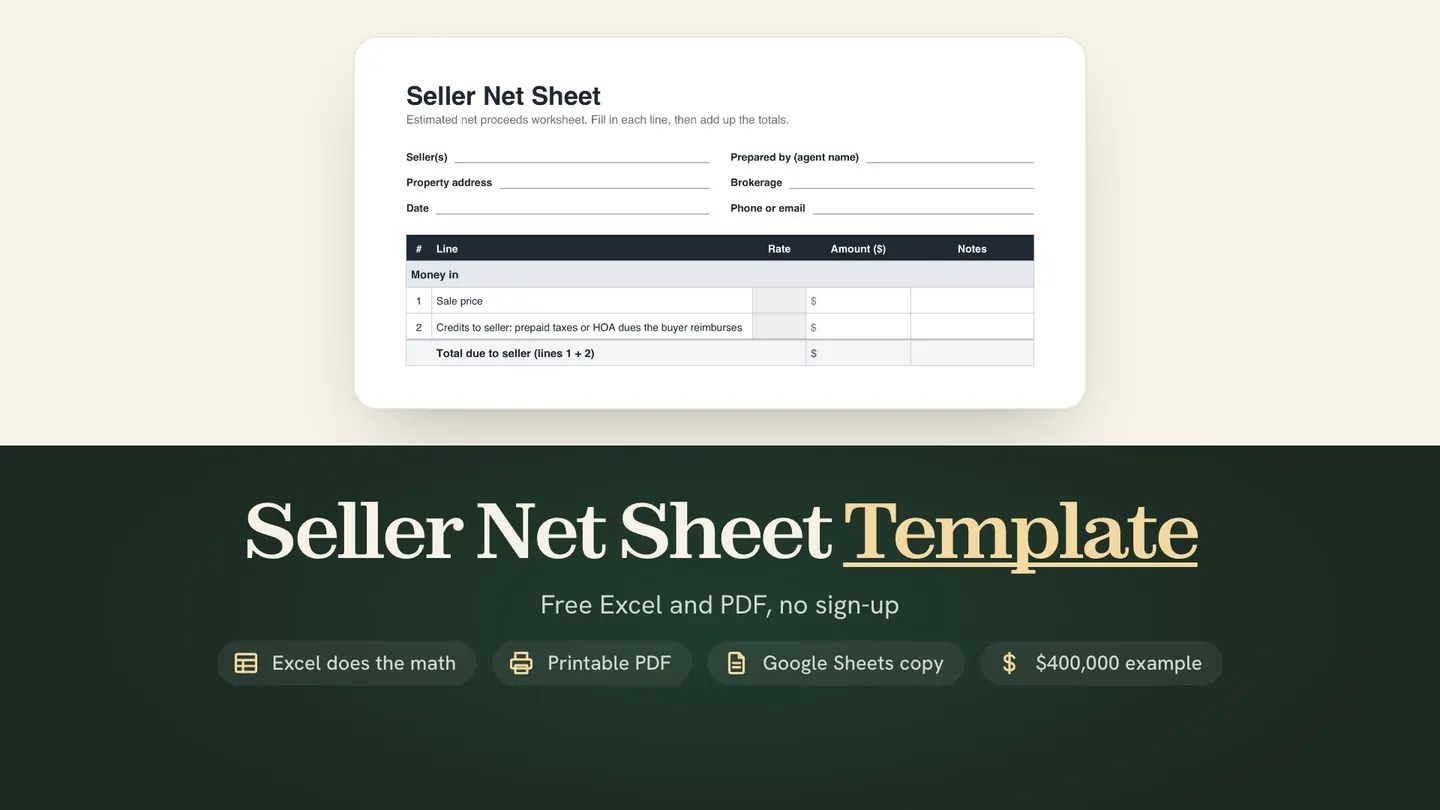
What is a seller net sheet? It’s an estimate of the cash a home seller keeps at closing: the sale price minus mortgage payoffs, agent compensation, concessions and closing costs, adjusted for prorated taxes. Listing agents prepare one at the listing appointment and again for each offer. Our free template comes as an Excel file and a printable PDF.
Download free, no sign-up:
Google Sheets: make a copy of the net sheet in your own Google Drive (you need a Google account).
The Excel file does the math. The PDF is a one-page worksheet to print and fill in by hand.
We make TINTY, an AI virtual staging app for real estate agents, and we built this template. It gives an estimate, not financial, legal or tax advice. Rates, who pays what and homeowners association (HOA) fees vary by state, county and contract.
Rules and TINTY prices checked October 31, 2026.
Key takeaways
- Free files: an Excel net sheet that adds up the costs and estimated net proceeds, plus a one-page printable PDF. No sign-up and no state rates built in.
- Payoffs: enter the lender’s payoff figure, not the statement balance. The payoff adds interest through the payoff day and can include unpaid fees.
- Compensation: the listing and buyer-agent lines are separate percentages you enter. Both are negotiable, and since August 17, 2024, buyer-agent offers stay off the multiple listing service (MLS).
- Official numbers: only the settlement agent’s Closing Disclosure or settlement statement is final. Get local fees, taxes and who pays from the title or escrow company.
On this page: How it works · Template · Payoffs · Commission · Title and taxes · Repairs and prep · Example · When to run it · Closing Disclosure · FAQ
How a real estate net sheet works
A real estate net sheet starts with the sale price and subtracts what the seller pays at closing. The bottom line estimates the cash the seller walks away with.
It’s the same math the settlement agent does later on the seller’s Closing Disclosure, the federal closing form in most financed sales. The seller’s side of that form, set out in the Code of Federal Regulations (CFR) at 12 CFR 1026.38(k), covers these items:
- Due to the seller: the sale price, plus taxes or assessments the seller prepaid that the buyer reimburses.
- Loan payoffs: the first and second mortgage, plus any lien-related payoffs.
- Seller credit: what the seller agreed to put toward the buyer’s costs.
- Closing costs: charges marked as seller-paid, such as title fees and transfer taxes.
- Unpaid items: taxes for the seller’s time in the home that the buyer will pay later.
- Cash: the bottom line the seller receives.
Our template uses the same two halves, money in and money out. In one line: estimated net proceeds equal the sale price, plus credits to the seller, minus everything the seller pays.
Free seller net sheet template: Excel and PDF
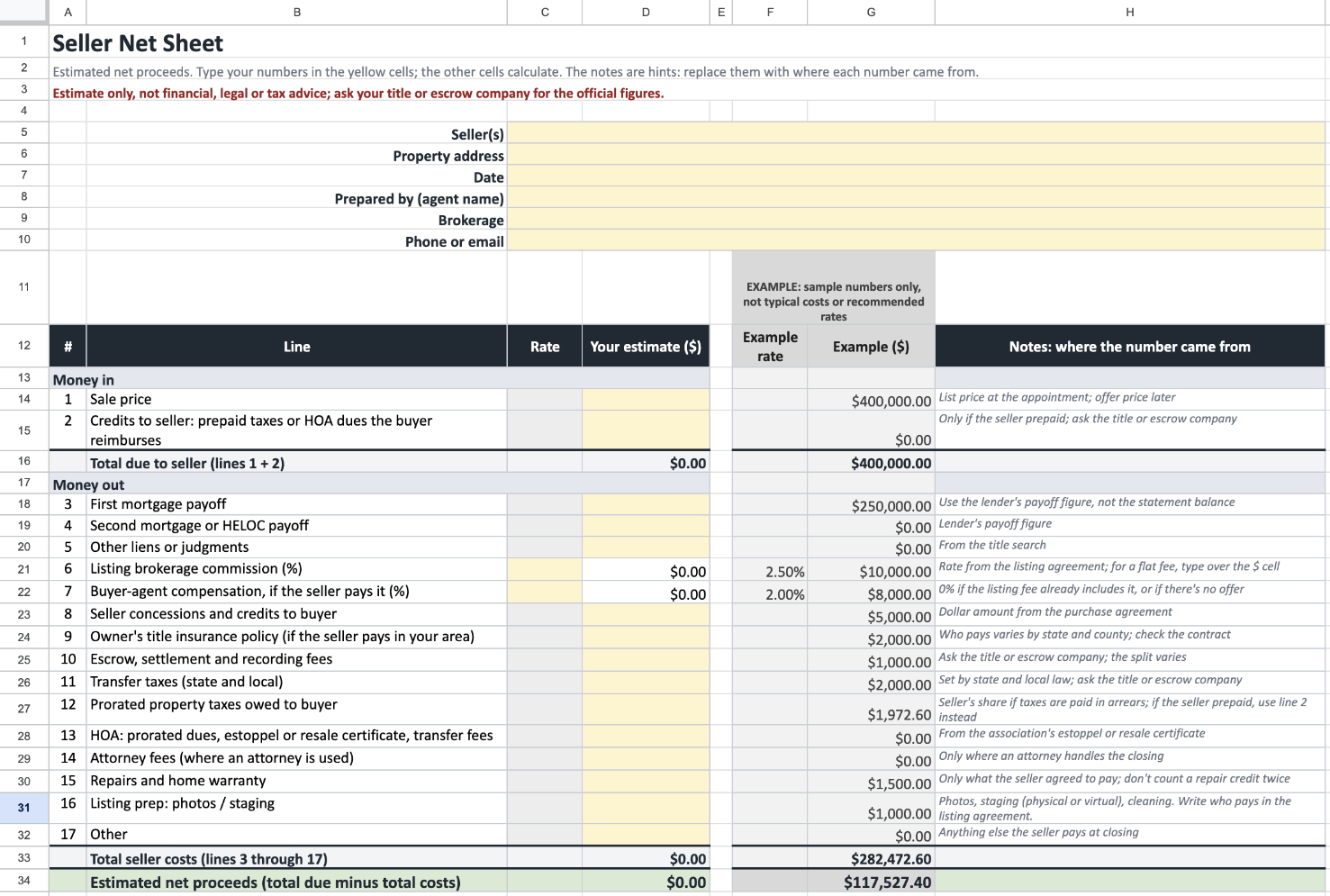
Both files of our seller net sheet template are free, with no sign-up, and share the same 17 lines. In the Excel file:
- Input cells: yellow cells for the sale price and every cost line.
- Two percentage lines: listing commission and buyer-agent compensation, each multiplied by the sale price.
- Totals by formula: total due to the seller, total seller costs and estimated net proceeds.
- Example column: sample numbers for a $400,000 sale, set apart in gray.
- Notes column: a hint on each line, to replace with your source, such as “payoff quote.”
It works like a seller net sheet calculator, but you keep a file per listing and per offer. No state rates are built in, so you enter local numbers. Both have fields for the seller, property, date, your name and brokerage, and the PDF leaves the amounts blank for handwriting.
How to fill in the template in 6 steps
Fill it in from the top down, and swap estimates for quotes as they come in:
- Save a copy for each listing, and another for each price or offer. The Google Sheets link makes a copy in your own Google Drive.
- Enter the sale price: the list price at the appointment, the offer price later.
- Enter the payoffs from the seller’s statements, then swap in the lender’s payoff figures.
- Type both compensation rates from the listing agreement and any written buyer-agent offer. Leave a line blank if there’s none.
- Ask the title or escrow company for the title premium, escrow and recording fees, transfer taxes and the tax proration.
- Add the rest (concessions, HOA, attorney, repairs, listing prep), note each source and print a copy for the seller.
Mortgage payoffs: use the payoff figure, not the balance
Enter the lender’s payoff figure, not the balance on the seller’s last statement. The payoff adds interest through the payoff day and can include fees not yet paid.
The Consumer Financial Protection Bureau (CFPB) says a payoff amount “is different from your current balance.” Besides interest, it may include unpaid fees and, for an early payoff, a prepayment penalty.
The template gives each debt its own line: the first mortgage, a second mortgage or home equity line of credit (HELOC), and other liens. At the appointment, enter the statement balance as a placeholder and note it, then swap in the payoff figure (our suggestion).
Rule: in most cases, the lender or servicer must send an accurate payoff statement within seven business days of a written request (12 CFR 1026.36(c)(3)). The seller or someone acting for them can ask. Request it once the sale is under contract (our suggestion).
Commission and buyer-agent pay after the NAR settlement
Enter the listing commission and any buyer-agent compensation as two separate percentage lines. The seller approves each one, and both are negotiable.
The National Association of Realtors (NAR) settlement changed how the second line works:
Rule: NAR says commissions are “not set by law” and are “fully negotiable.” Since August 17, 2024, offers of compensation to buyer agents can’t be shared on the MLS. A seller can still make one off the MLS, approved in writing in advance with the amount or rate (NAR settlement FAQs).
Listing brokerage commission line
Type the rate from the listing agreement, and the file turns it into dollars at the sale price. Each 1% of a $400,000 price is $4,000 (our arithmetic). If the agreement sets a flat fee instead, type the dollar amount over the formula cell.
The file has no default or “typical” rate: NAR calls the fee negotiable, and we found no official figure to cite. When the seller asks about the fee, our commission objection scripts give honest answers in plain words.
Buyer-agent compensation line
This line is optional. NAR’s guide to offers of compensation says offers to a buyer’s agent aren’t mandatory and need the seller’s written approval of the amount. Three ways it can land on the net sheet:
- Shared from the listing fee: the listing broker passes part of its fee on. If the listing rate already includes it, leave this line blank so it isn’t counted twice.
- Flat fee paid directly: type the set amount over the dollar cell.
- No offer: leave the line blank, and the file reads it as zero.
NAR’s seller concessions guide adds that a payment toward the buyer’s broker fee is excluded from the limits the buyer’s lender sets on concessions.
Seller concessions and credits
Enter concessions as a dollar amount, because that’s how a purchase agreement often writes them. NAR’s seller concessions guide defines a concession as the seller paying certain costs of buying for the buyer. Examples include inspection, title search, loan origination, HOA costs and repairs.
The cap depends on the buyer’s lender and state law. Fannie Mae, for one, caps them at 3% to 9% of the lower of the price or appraised value on a main or second home (Selling Guide B3-4.1-02). The smaller the down payment, the lower the cap: above 90% loan-to-value (LTV), it’s 3%, or $12,000 on a $400,000 price and appraisal (our arithmetic).
On the Closing Disclosure, a lump-sum credit shows up as “Seller Credit.” A repair credit after inspection goes here or on the repairs line, not both (our suggestion). A credit can help a buyer more than the same money off the price, and our stale listing guide compares a 2-1 buydown with a price cut.
Title, escrow, transfer tax and proration lines
These lines change the most from place to place, so get them from the title or escrow company that will close the sale. Ask the title or escrow company for:
- The owner’s title premium, and who usually pays it locally
- The escrow or settlement fee, and how it’s split
- Recording fees
- State and local transfer taxes
- The property tax proration for your closing date
The Closing Disclosure lists every cost with a column for who paid it: the borrower, the seller or others. So almost any of these lines can land on either side.
Owner’s title insurance and escrow fees
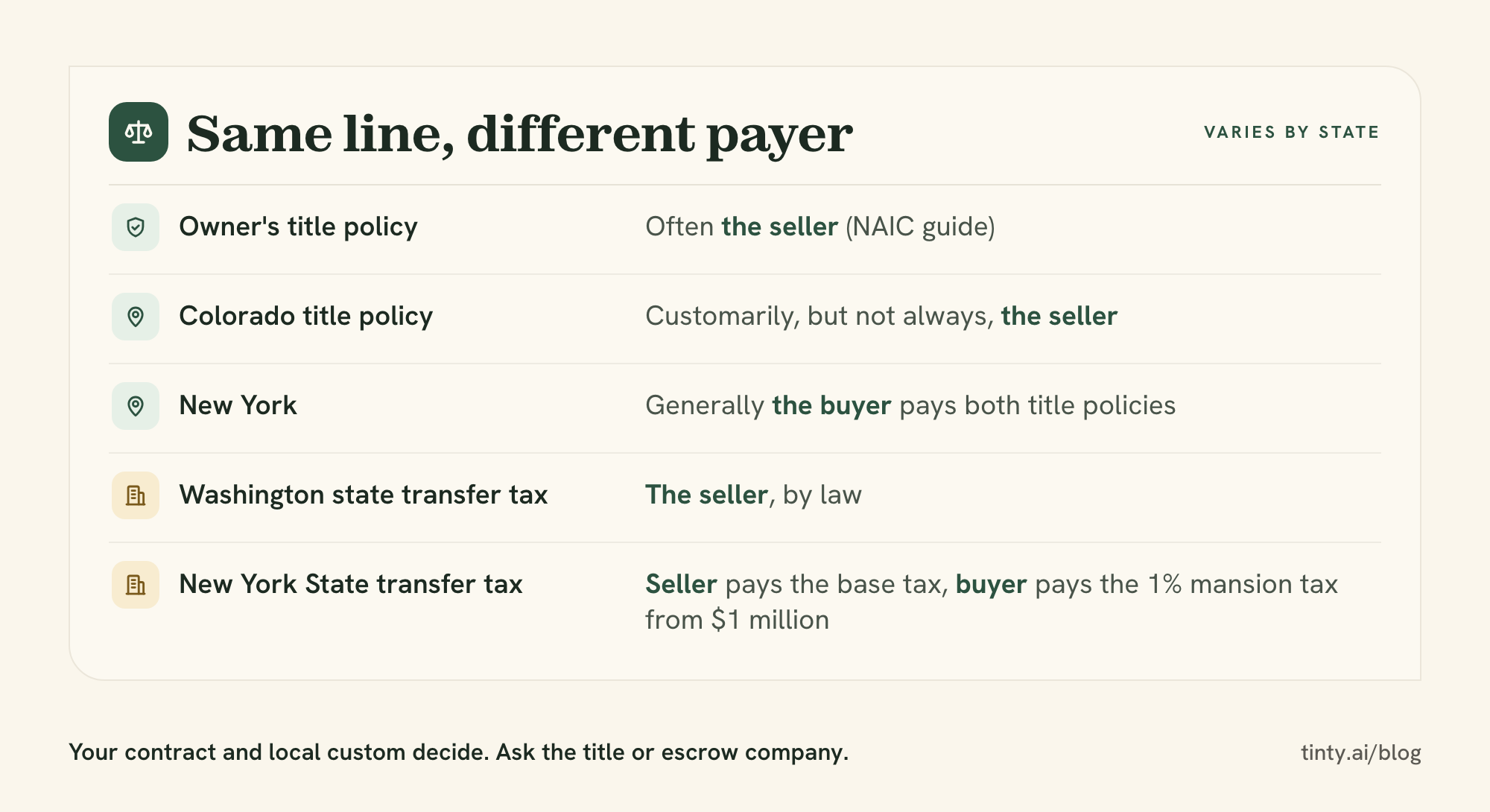
Who pays for the owner’s title policy depends on local custom and the contract: often the seller, but not everywhere. Lenders usually require a lender’s policy, while an owner’s policy can help protect the buyer’s investment, the CFPB explains.
The National Association of Insurance Commissioners (NAIC) title insurance guide says who pays “depends on local rules and traditions.” Colorado’s insurance regulator says the seller pays “customarily, but not always.” New York’s regulator says the buyer is generally responsible for both policies.
The template has no default premium, because rates differ by state. We found no national rule on who pays the escrow fee, so it depends on the area and the contract. Closing agents can be title agents or attorneys (NAIC), so the attorney line applies only where an attorney is used.
Transfer taxes
Transfer taxes are set by state and local law, which sometimes also says who pays. So one sale can carry a state line and a local line, and the Closing Disclosure names the government that charges each one.
Example: on a $400,000 sale, Washington’s state tax at 1.1% is $4,400, and the law makes it the seller’s obligation. New York State’s base tax of $2 per $500 comes to $1,600, also paid by the seller. New York’s 1% mansion tax starts at $1 million and falls on the buyer.
Both figures are state taxes only (our arithmetic), and in New York a contract can shift the base tax. We found no official table for all states, so ask for local rates.
Prorated property taxes and HOA fees
Prorations can go either way. If the seller hasn’t paid taxes for their months in the home, they credit the buyer; if they prepaid, the buyer reimburses them.
Which way yours goes depends on how your county bills. Cook County, Illinois, for example, collects property taxes “in arrears,” so there the seller usually credits the buyer (our reading).
Example: say $6,000 a year in taxes is unpaid and closing falls 120 days into the tax year. The seller credits the buyer $6,000 x 120 / 365 = $1,972.60 (our arithmetic). Day counts differ by area, so the title or escrow company uses its local method.
The HOA line covers prorated dues, the estoppel or resale certificate and any transfer fee. Florida, for example, caps HOA estoppel certificate fees, adjusts the caps every five years and requires delivery within 10 business days of a request (§ 720.30851). The statute doesn’t say who pays, so check the purchase contract.
Repairs, home warranty and listing prep
Add these lines only for costs the seller agrees to pay, and write down who pays before the listing goes live.
Repairs and home warranty
Repairs can come up before listing and again after inspection, so give each one a single home on the sheet. NAR counts “home repairs and updates” among seller concessions. Price each repair from a contractor’s quote, and add a home warranty only if the seller offers one (our suggestion).
Listing prep: photos and staging
Listing prep covers photos, staging and cleaning. It belongs on the net sheet whenever the seller pays for it, now or at closing.
No rule decides who pays; the listing agreement does. If you pay and don’t recover it, the seller’s line is $0. If you pay up front and get repaid at closing, it lowers the net. Our home staging cost guide shows four common setups, including repayment at closing.
Watch out: label staged photos the way your MLS and state require, and never use staging or furniture removal to hide a defect. TINTY can add an optional “Virtually staged” label. Our virtual staging laws by state cover the rules.
Virtual staging on the listing prep line
With TINTY, five empty rooms fit one month of Base, $9 for 10 staged photos. A Listing pack is $29 once for 30, valid 12 months, per TINTY’s pricing page. These are launch prices, so they may change.
Lived-in rooms work too. TINTY can remove the furniture and decor first, keep built-ins like cabinets and radiators, and then stage the empty room. Each removal uses one photo, so five furnished rooms use 10 photos (our arithmetic).

It doesn’t stage kitchens, bathrooms, building exteriors or yards, and staged photos are 2K, not 4K. Before the appointment, stage one of the seller’s rooms free with TINTY in about a minute. You get 6 free staged photos once, with a light watermark and no card, so use them to show the seller, not on the MLS.
Between appointments with no time to stage? Email the photos to hello@tinty.ai, empty or lived in, with the room type and style for each. TINTY Studio, our done-for-you service, removes the furniture if needed, stages each photo with our AI tools and finishes it by hand. You get a private link in 2 to 24 hours and pay $10 a photo, from 3 photos, only if you’re happy.
Seller net sheet example: estimated net proceeds at $400,000
On a sample $400,000 sale, the example column in our template shows estimated net proceeds of $117,527.40. Here’s that column in five groups, from the sale price down to the net:
Sample numbers only, not typical costs or recommended rates. Your title or escrow company has the official figures.
| Line on the net sheet | Example | How the example gets it |
|---|---|---|
| Sale price | $400,000 | The accepted offer |
| Mortgage payoff | -$250,000 | The lender’s payoff figure |
| Listing and buyer-agent compensation | -$18,000 | Sample rates of 2.5% and 2% x $400,000 |
| Concessions, repairs, listing prep | -$7,500 | $5,000 + $1,500 + $1,000 |
| Title, escrow, transfer tax, tax proration | -$6,972.60 | $2,000 + $1,000 + $2,000 + $1,972.60 |
| Estimated net proceeds | $117,527.40 | Sale price minus the four lines above |
Swap in your own numbers and the file recalculates. At this price, each 1% of compensation moves the net by $4,000 (our arithmetic).
When to run a seller net sheet
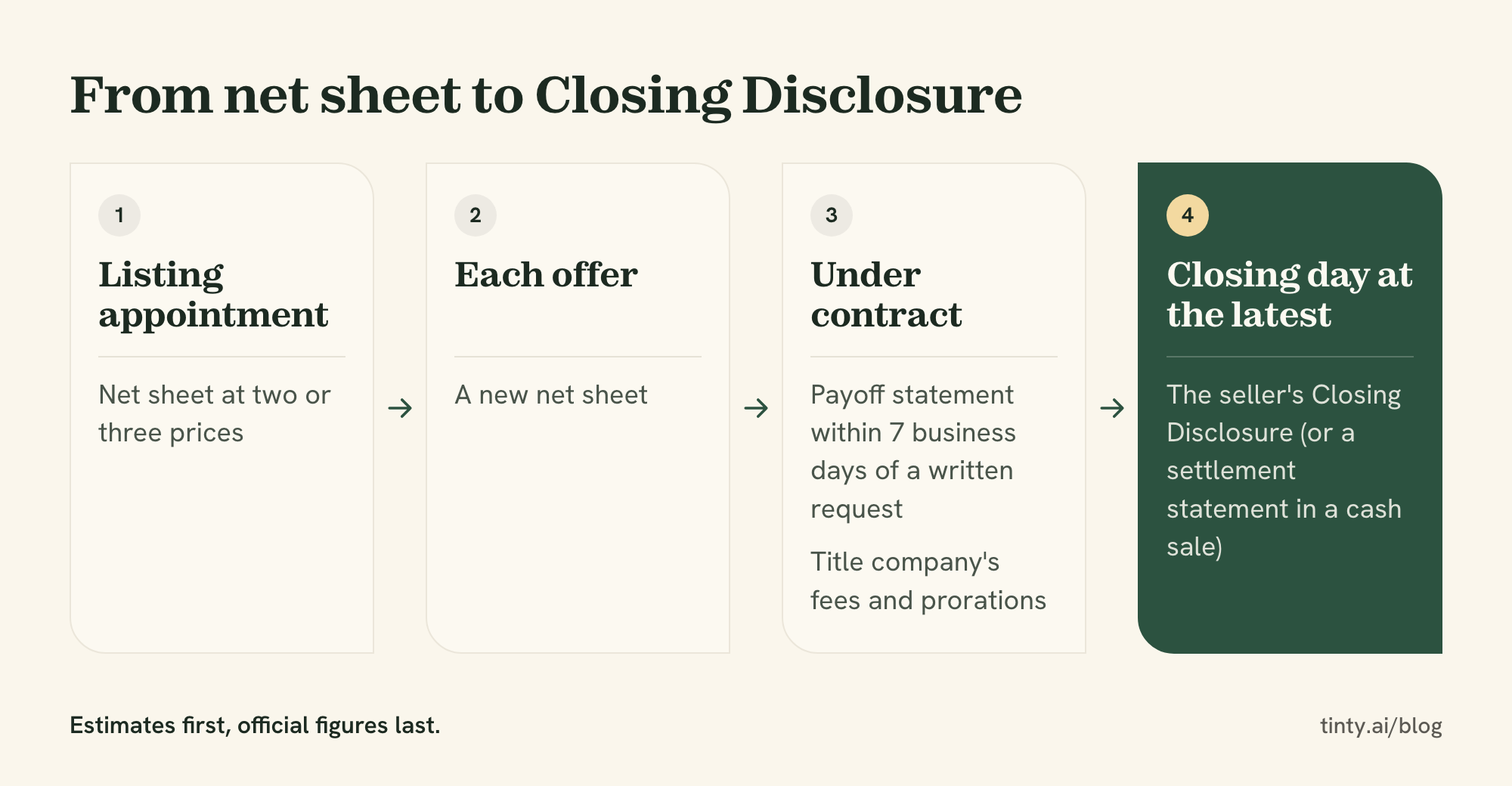
Run a seller net sheet at the listing appointment, again before any price change and again for every offer, because each one moves the net. Four moments to run one:
- Listing appointment: at the list price and one or two lower prices, so the seller sees what a price cut costs in net.
- Before a price change: rerun it at the new price before the seller signs off.
- Every offer: price, credits, compensation terms and the closing date all move the net.
- Prospecting: a free net sheet is a low-pressure offer to an owner selling alone.
Bring the net sheet with your comparative market analysis (CMA) and the listing agreement. Our listing presentation guide lists what else goes in the bag. With a for sale by owner (FSBO) seller, our FSBO commission script shows how to offer one.
Tip: compare offers on net, not on price. A $405,000 offer with a $10,000 credit nets less than a $400,000 offer with none, because the credit is bigger than the price gap (our arithmetic).
Net sheet vs Closing Disclosure: which numbers are official
Only the settlement agent’s document is official: the seller’s Closing Disclosure in most financed sales, or a settlement statement in a cash sale. Three documents, three jobs:
- Your net sheet: an estimate you or a title company prepare before the numbers are final.
- The seller’s Closing Disclosure: the settlement agent gives it to the seller no later than closing day (12 CFR 1026.19(f)(4)). The buyer gets theirs at least three business days before closing, per the CFPB.
- A settlement statement: an all-cash sale has no Closing Disclosure. Settlement agents use a statement such as the American Land Title Association’s (ALTA) standard forms for cash sales and sellers.
Lay your last net sheet next to the seller’s Closing Disclosure; a gap usually points to a fee or proration estimated differently (our suggestion). If what the seller paid changes within 30 days after closing, the settlement agent sends a corrected disclosure.
Seller net sheet FAQ
Who provides the seller net sheet?
Usually the listing agent, at the listing appointment and again for each offer. Title and escrow companies prepare net sheets too, and many publish free calculators for the areas they close in. The official figures come later from the settlement agent, a title agent or an attorney, on the seller’s Closing Disclosure or a settlement statement.
How do I create a seller’s net sheet?
Start with the sale price and add any credits to the seller. Then subtract the payoff figures, both compensation lines, concessions, closing costs and the tax proration. Our free Excel template does the math, and the six steps above walk through it. Rerun it for each price and each offer.
Show 4 more questionsShow fewer questions
How much is the commission on a $300,000 house?
It depends on the rates in the listing agreement and any offer to the buyer’s agent. Each 1% of a $300,000 price is $3,000, so multiply by the rates the seller agreed to. No law sets the rate: NAR says commissions are “not set by law” and are “fully negotiable,” and the buyer-agent part can be zero.
Who pays the most closing costs, the buyer or the seller?
No national rule decides it. Local custom and the purchase contract split each cost, and the Closing Disclosure marks every charge as paid by the borrower, the seller or others. Title insurance shows how it varies: the seller often pays for the owner’s policy, but in New York the buyer generally pays for both policies.
Are seller net proceeds taxable?
Net proceeds aren’t the same as taxable gain, and a net sheet doesn’t estimate tax. Sellers who owned and lived in the home 2 of the last 5 years may exclude up to $250,000 of gain, or $500,000 for some joint returns. Internal Revenue Service (IRS) Topic 701 and Publication 523 explain the rules, including selling expenses like commissions. Send tax questions to a tax professional.
What does a seller net sheet leave out?
Costs paid before or outside closing: the mortgage payments, insurance and utilities while the home is for sale, moving costs and any income tax on the gain. Our template doesn’t include them. Our vacant house carrying cost example adds up what a home costs each month it’s for sale.
How we researched this
We read every source on October 31, 2026. They include the federal closing and payoff rules, CFPB and NAR guides, Fannie Mae’s Selling Guide, ALTA’s forms and the NAIC title guide. We also read two state insurance regulators, state transfer tax and HOA law, Cook County’s tax pamphlet and the IRS. Then we compared the pages that rank for “seller net sheet,” mostly title-company calculators.
We couldn’t confirm a typical commission rate, who usually pays escrow fees, which states require a closing attorney or what a home warranty costs. If something here is wrong, email hello@tinty.ai and we’ll fix it.
Sources
All pages read October 31, 2026. Dates in parentheses are publication or update dates.
Federal rules and NAR:
- 12 CFR 1026.38, Closing Disclosure content (eCFR) (current as of October 29, 2026): the seller’s transaction table, who-paid columns, transfer taxes by government
- NAR: NAR Settlement FAQs (updated September 5, 2024; FAQ 50 updated October 17, 2025)
Show 22 more sourcesShow fewer sources
- NAR: Home Sellers: What the NAR Settlement Means for You
- NAR: Consumer Guide: Offers of Compensation
- NAR: Consumer Guide: Seller Concessions
Payoffs and closing documents:
- CFPB: What is a payoff amount? Is it the same as my current balance? (last reviewed August 28, 2026)
- 12 CFR 1026.36(c)(3), payoff statements (eCFR)
- 12 CFR 1026.19(f)(4), the seller’s disclosure (eCFR)
- CFPB: What is a Closing Disclosure?
- CFPB: Closing disclosure explainer (updated October 10, 2023)
- ALTA: Settlement Statements
Concessions and lenders:
- Fannie Mae Selling Guide B3-4.1-02: Interested Party Contributions (section dated May 7, 2025)
Title insurance:
- CFPB: What is owner’s title insurance?
- NAIC: Consumer Guide to Title Insurance (PDF) (2026), pages 7 and 9
- Colorado Division of Insurance: What is title insurance? (PDF)
- New York Department of Financial Services: Title Insurance
Transfer taxes, prorations and HOA fees:
- RCW 82.45.060, Washington: tax rates · RCW 82.45.080, Washington: payment of tax
- New York State Department of Taxation and Finance: Real estate transfer tax (updated June 1, 2026)
- Cook County Treasurer: property tax pamphlet (PDF)
- Florida Statutes § 720.30851, estoppel certificates (2026)
Tax:
- IRS: Topic 701, Sale of your home (updated October 12, 2026)
- IRS: Publication 523, Selling Your Home (for 2025 returns)
TINTY (ours):
- tinty.ai · TINTY pricing (launch pricing, checked October 31, 2026) · free virtual staging (furniture removal) · terms (last updated October 30, 2026)
Related guides on our blog: