

How do you do real estate social media marketing? Pick one or two platforms where your past clients and local buyers already spend time, usually Facebook and Instagram. Post three to five times a week from a few content pillars, reply to every message fast and track leads instead of likes. Name your brokerage in every ad.
Platform data, ad rules, state rules and tool plans checked October 27, 2026.
This guide to social media marketing for real estate agents is the plan around your posts. For ready-made post ideas and captions, see our 45 real estate social media posts. We make TINTY, an AI virtual staging app, so one section covers the kind of tool we sell. The rules below are general information, not legal advice.
Key takeaways
- Platforms: Facebook (76%) and Instagram (57%) lead among Realtors, per NAR’s 2026 Member Profile. Start with one or two.
- Content: rotate five pillars: listings, local life, market lessons, client stories and you at work (our mix).
- Ads: Meta’s Housing category limits age, gender, ZIP code and lookalike targeting for US housing ads.
- Rules: name your brokerage in ads, add a license number where your state asks, and label virtually staged photos.
- Metrics: count messages, calls and appointments. Likes alone don’t show leads.
On this page: Goal · Platforms · Content and cadence · Weekly plan · Listing photos · Video · Facebook ads · Compliance · Metrics · Mistakes · FAQ
Set a goal and an audience before you post
Social media for real estate agents works best as a way to stay in front of people who already know you (our view). NAR’s 2026 Member Profile found the typical member earned 28% of their business from past clients and customers, and another 22% from their referrals. Many of those people already follow you, so serve them first (our view).
Pick one main goal for the next 90 days:
- Stay top of mind: past clients, friends and your sphere see you at work every week.
- Win listings in one area: owners in your farm see local sales, prices and how you market a home.
- Reach buyers: people searching your town find listings, open houses and neighborhood tours.
- Build a referral network: lenders, attorneys and agents in other cities learn your niche.
Then write one line about your audience, such as “owners of 1990s homes in [neighborhood] who may sell in the next year.” Every post should make sense to that reader. A farm needs an offline plan, too; our real estate farming guide covers mail, visits and events.
Tip: before your first post, search your own name the way a seller would. Your photo, bio, brokerage and latest post should match. Our real estate agent bio templates help with the bio.
Best social media platforms for real estate agents
Start where your audience already is, and add a second platform only when the first runs on a schedule (our view). NAR’s 2026 Member Profile lists the platforms members use most for business.
Where Realtors post, and what each platform suits (share from NAR; the rest is our view)
| Platform | NAR members using it | Best for | Main formats |
|---|---|---|---|
| 76% | Sphere, past clients, local groups | Photo posts, events, ads | |
| 57% | Local buyers, listing visuals | Carousels, Reels, stories | |
| 55% | Referral partners, relocation contacts | Market notes, deal stories | |
| YouTube | 31% | Search questions about your area | Tours, guides, Shorts |
| TikTok | 16% | Reach beyond your sphere | Short vertical video |
Facebook: your sphere, groups and events
Facebook suits your sphere: past clients, neighbors and friends of friends (our view). Local community groups and event pages work for open houses. Ask the admin or check a group’s rules before you post a listing.
Instagram for real estate agents
Instagram is the shop window for listings and neighborhoods. Switch to a professional account to get Instagram’s business tools, including insights on your growth. Instagram’s help page warns that a private account becomes public when you switch.
Your bio needs your name, brokerage, service area and one link (our checklist). Pin three posts that show a listing, a local guide and a client review.
LinkedIn, YouTube and TikTok
LinkedIn reaches lenders, attorneys and relocation managers more than buyers (our view). YouTube answers search questions, such as what living in your town costs, and a good neighborhood video can keep getting views for a long time (our view). TikTok reaches strangers fast, but only 16% of NAR members use it for business, so it suits agents who enjoy filming.
Content pillars and how often to post
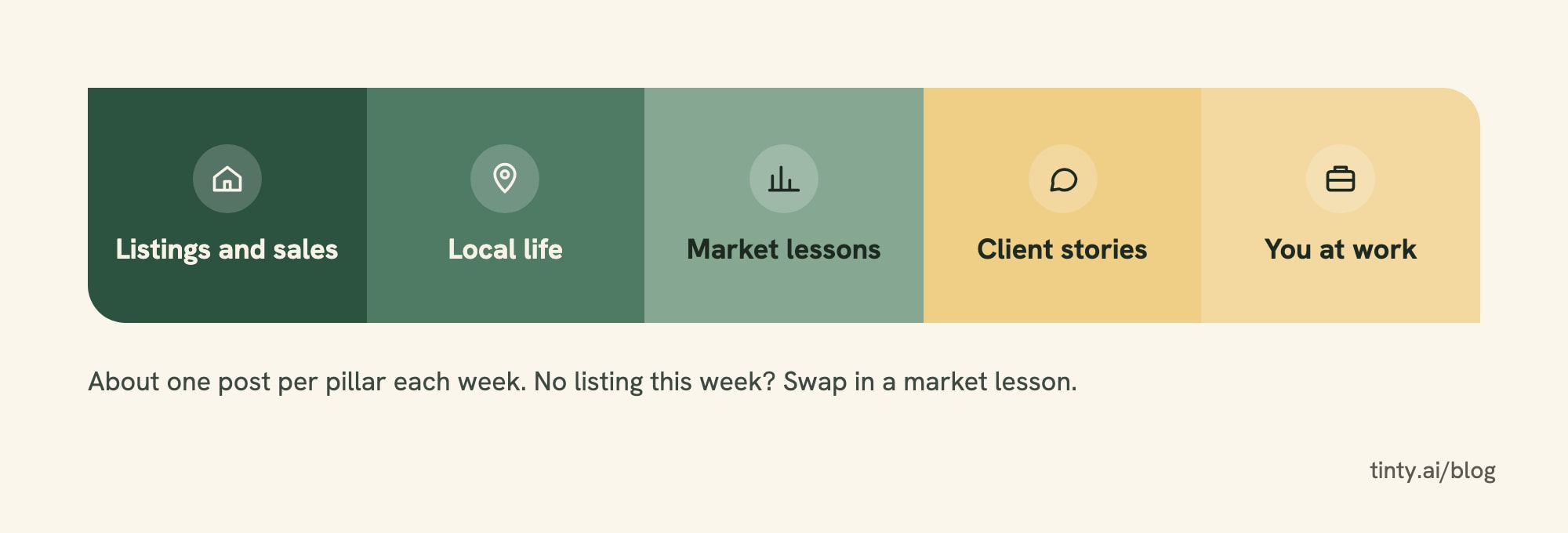
A content pillar is a topic you return to every week. Five pillars cover most agents’ feeds, and listings are one of them: never the whole feed, and no more than about a third of it (our view).
Five content pillars for a real estate feed
Rotate these five (our mix):
- Listings and sales: coming soon, just listed, open house, under contract and sold.
- Local life: a new cafe, a park, a farmers market, a road project.
- Market lessons: one number from your local data, explained in plain words.
- Client stories: reviews and move-in photos, shared with permission.
- You at work: a showing day, an inspection, a closing table, your team.
Give each pillar about one post a week. When there’s no new listing, a market lesson or a local guide takes its slot. A strong post can also become a section of your real estate newsletter, which reaches past clients who skip social media.
Posting cadence you can keep
Three to five posts a week is a pace most solo agents can keep (our view). No research we found gives agents a proven number. A steady three a week beats ten in one week and then silence (our view).
Replies are part of the cadence. Answer comments and messages the same day, because a message is often the lead itself (our view).
A simple weekly real estate social media plan
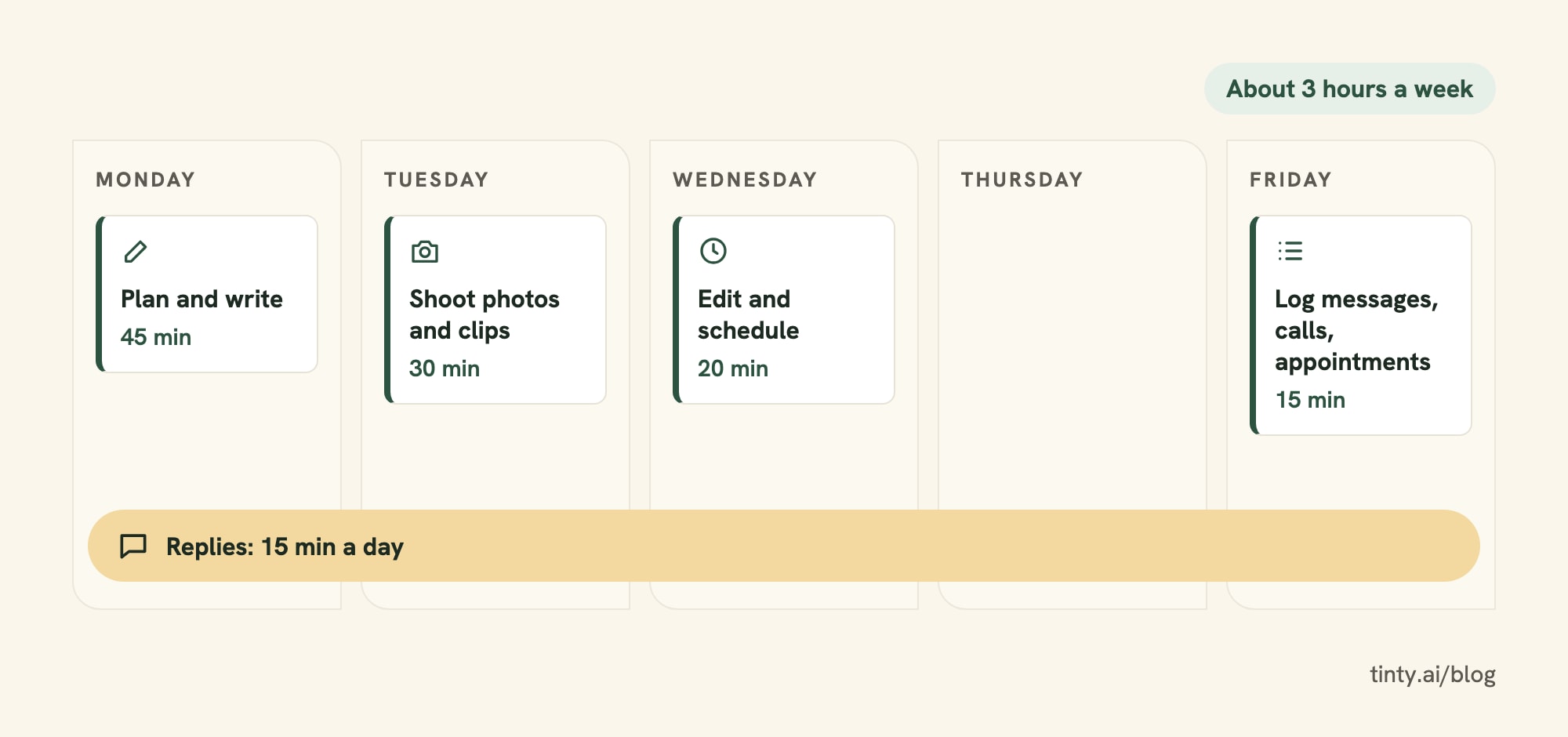
This plan takes about three hours a week once it runs (our estimate). It batches the work, so one busy week of closings doesn’t leave the feed empty.
Here’s the week (our plan):
- Monday, 45 minutes: pick five posts, one per pillar, and write the captions.
- Tuesday, 30 minutes: shoot photos and short clips on one drive past your listings and local spots.
- Wednesday, 20 minutes: edit, add your brokerage line and schedule the posts.
- Every weekday, 15 minutes: reply to comments and messages, and log each lead in your customer relationship management (CRM) system.
- Friday, 15 minutes: write down the week’s messages, calls and appointments in one sheet.
Tools that save time
These tools cover most of the plan:
- Meta Business Suite: Meta’s own tool to create and schedule Facebook and Instagram posts, stories and ads, with insights.
- Buffer: its free plan connects up to 3 channels, with 10 scheduled posts per channel.
- A design app: for listing graphics and covers. Check current plans on the vendor’s own site.
- An AI assistant: drafts captions from your notes. Our ChatGPT guide for real estate agents has prompts, and you check every fact.
Watch out: a scheduler can’t answer a buyer at 9 pm. Keep message notifications on, even when every post is scheduled (our tip).
Listing content: make empty rooms stop the scroll
Listing posts draw the most local interest, and empty rooms are their weak spot (our view). A bare room in a small feed photo gives a buyer little to judge: no scale, no layout, no reason to stop.
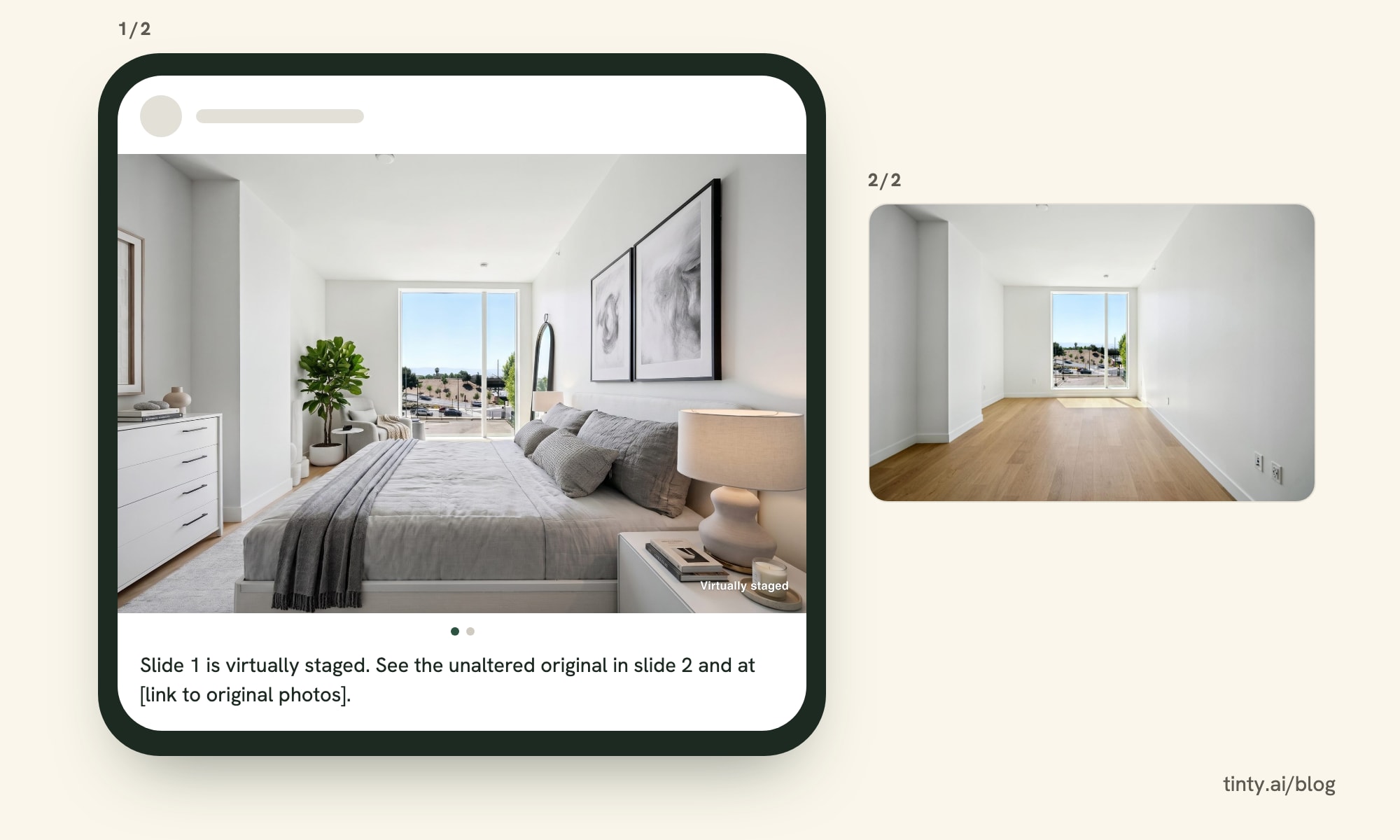
A before/after pair fixes that. Post the virtually staged photo first and the empty original second, with the same crop. Our post ideas guide shows how to build a before/after staging carousel, step by step.
To make the staged photo, you can stage an empty room free with TINTY. Pick the room, style and furniture, and TINTY makes a staged photo in about a minute. A free account gets 6 staged photos with a light watermark, no card. Before you post, check these:
- Room types: TINTY stages 9 room types, such as bedrooms, living rooms and home offices, but not kitchens, bathrooms or exteriors.
- The label: TINTY can add an optional “Virtually staged” label to your staged photos.
- Clean files: free photos carry a watermark, so don’t crop it out. Plans start at $9 a month for 10 staged photos, per TINTY’s pricing page.
- The caption: say which slide is staged and add a link or QR code to the original. California’s AB 723 requires one, so a second slide alone may not be enough (our reading).
Watch out: TINTY can remove the furniture from a furnished room first, but it clears the whole room, not single pieces. It doesn’t match furniture across several angles of one room, and files are 2K, not 4K.
No time to stage photos yourself, or need one room from several angles? Email them to hello@tinty.ai, and TINTY Studio stages them for you in 2 to 24 hours. It’s $10 a photo from 3 photos, and you pay only if you’re happy.
Video and short-form: what to film
Short vertical video works across Instagram Reels, Facebook, TikTok and YouTube Shorts, so one clip can serve four places (our view). You don’t need a studio, only a phone and a plan.
Four videos that fit any market (our list):
- Listing walk-through: 30 to 60 seconds, front door to best room, filmed slowly.
- Neighborhood minute: three places a new owner would use in the first week.
- Market minute: one number from this month and what it means for sellers.
- Question of the week: a question a client asked you, answered in under a minute.
Film with the phone upright, add captions and put the point in the first seconds (our tips). Open houses give you a ready clip each weekend; our open house ideas include a day-of reminder and a recap post.
Facebook ads for realtors: rules and a simple setup
Paid ads put a listing or an offer in front of people who don’t follow you yet. On Facebook and Instagram, every housing ad runs under limits meant to prevent discrimination.
Real estate Facebook ads use the Housing category
When you create a campaign, Meta asks whether it’s a Special Ad Category, and housing is one. Meta’s help page lists what’s limited or unavailable for US housing ads:
- Who: age, gender and some interests.
- Where: ZIP code targeting. City and pin-drop audiences get an expanded radius.
- Audiences: exclusion targeting, lookalike audiences and saved audiences.
The same limits apply to Meta’s Advantage+ catalog ads. A boosted listing post is a housing ad too, so pick the Housing category when you boost it (our reading).
Fair Housing applies to targeting, too
HUD’s advertising rule, 24 CFR 100.75, covers more than words and photos. It also bars choosing media or locations that keep housing information from people because of race, color, religion, sex, handicap, familial status or national origin.
Rule: HUD withdrew its 2024 guidance on digital housing ads, effective September 17, 2025, per its Federal Register notice. The same notice says conduct that breaks the Fair Housing Act is still subject to enforcement.
Our equal housing opportunity logo guide explains when the logo belongs on a social post.
Facebook ads for real estate agents: what to run first
Start small, with one job per ad (our view). A listing ad shows your best photo from your own listing, the price and one next step, such as “message me for a showing.” An open house ad gives the date, time and address and runs for the few days before. A seller offer promotes a local market report or a home value review, with a form or a message button.
Set a daily budget you can afford to learn with, and judge each ad by messages and form leads, not reach (our view). Every ad carries your brokerage name, as the next section explains.
Compliance: brokerage name, license number and labels
Posts that promote a listing or your services count as ads. The rules vary by state, so check yours and ask your broker.
Brokerage name: NAR and three state examples
NAR’s Code of Ethics Article 12 requires Realtors to present a true picture in their ads. Standard of Practice 12-5 requires your firm’s name “in a reasonable and readily apparent manner.” Online, a link to a page with all the disclosures also meets it.
Three state examples, read October 27, 2026:
- Florida: every real estate ad must include the brokerage firm’s licensed name. Online, it sits next to, above or below your contact details (Rule 61J2-10.025).
- New York: ads give the broker’s name plus the broker’s address or phone number, and state your license type (19 NYCRR 175.25).
- California: first-contact materials, including electronic ads you place, need your 8-digit license number and your broker’s name (10 CCR 2773).
Label virtually staged photos
Label every virtually staged photo in a post, the same as in your listing (our view). California’s AB 723, in force since January 1, 2026, goes further. It covers digitally altered images in any ad or promotional material for a home sale, including listing posts (our reading). Each one needs a statement on or next to it, plus a link, URL or QR code to the original.
Watch out: California’s law counts furniture added or removed with photo software or AI as an alteration. Basic fixes such as exposure, cropping or white balance don’t count.
For MLS labels and other states’ rules, see our virtual staging disclosure rules.
Real estate social media marketing metrics that matter
Track what turns into business: conversations, appointments and closings. Likes and reach tell you a post was seen, not that it worked (our view).
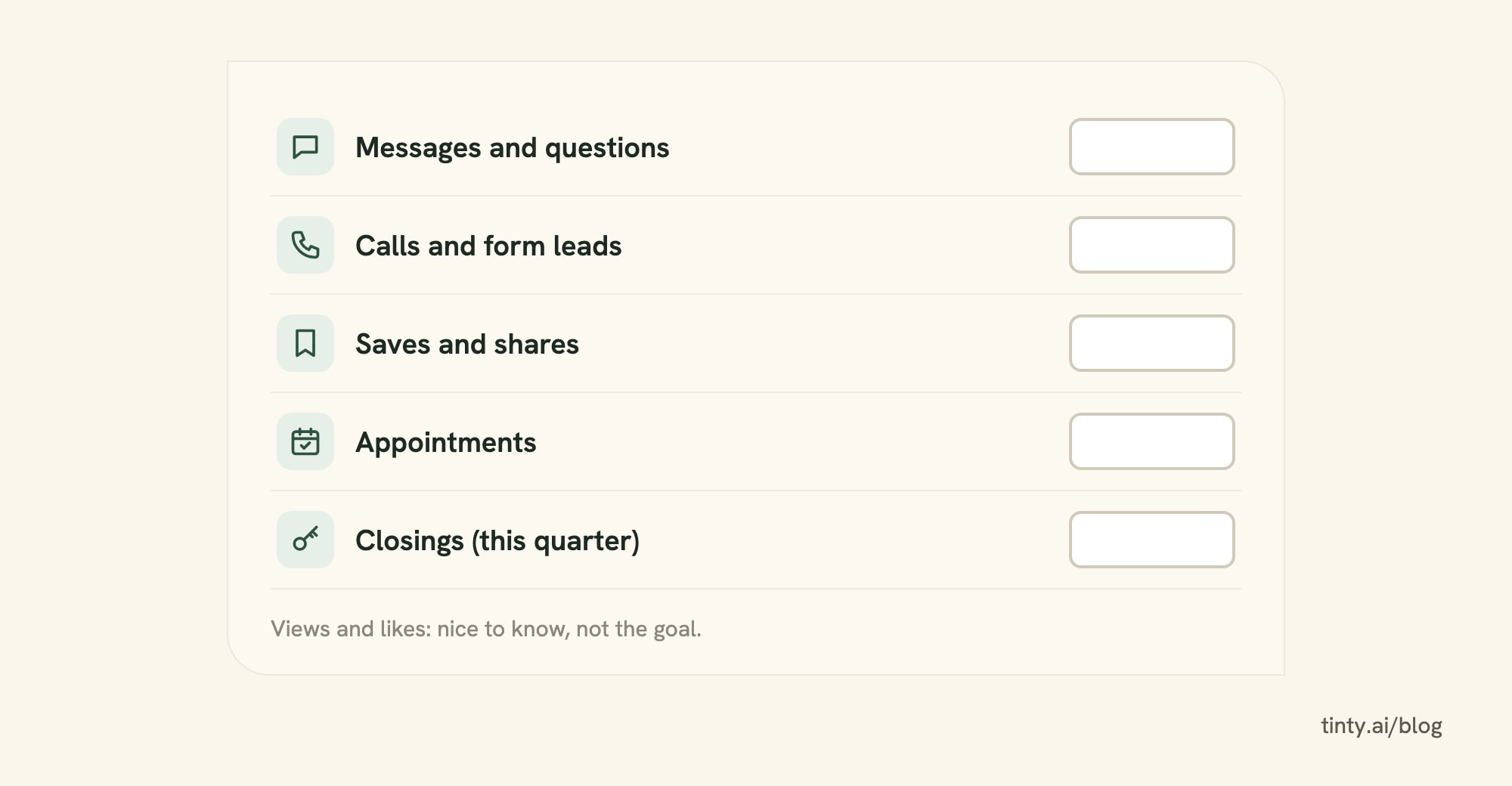
Watch these, from first signal to closing (our list):
- Messages and comments with a question: each one is a possible lead.
- Calls, form leads and link taps: someone took a step toward you.
- Saves and shares: people kept the post or sent it to someone they know.
- Appointments: showings, listing presentations and buyer consultations that started on social media.
- Closings by source: counted once a quarter, so you know which platform earns its time.
Example: in one month, 16 posts bring 2,000 views, 9 messages, 3 calls and 1 listing appointment. The 12 conversations and 1 appointment are the result to grow, not the views. All numbers here are made up.
Common social media mistakes agents make
Most of these cost leads quietly. Avoid them (our list):
- Listings only: a feed of ads gives followers no reason to stay.
- Five platforms at once: a thin presence everywhere is weaker than one platform done well.
- Unlabeled staged photos: a buyer who feels misled at the showing remembers it.
- No brokerage name: NAR’s Code and many states require it in ads.
- Audiences picked by who lives where: housing ads can’t target or exclude protected groups.
- Slow replies: a message answered two days later may already have gone to another agent.
Social media marketing FAQ for agents
What is the best social media platform for real estate agents?
Facebook, by use: 76% of NAR members use it for business, per the 2026 Member Profile, ahead of Instagram at 57%. The best one for you is where your past clients and target buyers already spend time (our view).
How much time does social media marketing take for an agent?
About three hours a week with our weekly plan. That’s 45 minutes to plan and write, 30 to shoot, 20 to schedule, 15 minutes a day for replies and 15 on Friday to log results. Video adds time, so start with one clip a week (our estimate).
Show 4 more questionsShow fewer questions
Do Facebook ads work for real estate agents?
They can bring listing views, open house visitors and seller leads, but results vary by market and offer (our view). Run one ad at a time, judge it by messages and form leads, and choose Meta’s Housing category every time.
Can I target ZIP codes with real estate Facebook ads?
Not in a housing ad. Meta lists ZIP code targeting as limited or unavailable for US housing ads, along with age, gender, exclusion, lookalike and saved audiences. City and pin-drop audiences get an expanded radius.
Do I need my license number on social media posts?
It depends on your state. California requires your license number and your broker’s name on first-contact materials, including electronic ads you place. New York requires your license type. Ask your broker what applies to you.
Is social media worth it for real estate agents?
Yes, mostly to stay in touch with past clients and your sphere (our view). NAR’s 2026 Member Profile found the typical member earned 28% of their business from past clients. In two October 2026 r/realtors threads, some agents said clients look them up before a listing appointment, while others said door knocking and open houses work better.
How we researched this
On October 27, 2026, we read the pages that rank for real estate social media marketing, including McKissock, HousingWire, Canva and NAR’s social media page. We also read agent threads on Reddit’s r/realtors about whether social media brings business.
Platform data comes from NAR’s 2026 Member Profile. Ad rules come from Meta’s Business Help Center, HUD’s advertising rule and the Federal Register. State rules come from the Florida, New York and California texts. The weekly plan, pillars and metrics are our own suggestions.
TINTY facts come from our live pages, checked the same day. If something here is wrong, email hello@tinty.ai and we’ll fix it.
Sources
Platform data and platform help pages
- NAR, “Even in a Tougher Market, REALTORS Are Holding Their Ground” (2026 Member Profile, June 25, 2026)
- Instagram Help Center: set up a professional account
Show 13 more sourcesShow fewer sources
- NAR, “The Feature Sheet: 2026 Member Profile”
- Meta Business Suite
- Buffer pricing (free plan checked October 27, 2026)
Ad rules and Fair Housing
- Meta Business Help Center: how to choose a Special Ad Category
- HUD advertising rule, 24 CFR 100.75
- Federal Register: HUD withdrawal of fair housing guidance documents (April 6, 2026)
Ethics and state advertising rules
- NAR 2026 Code of Ethics and Standards of Practice
- Florida Administrative Code, Rule 61J2-10.025
- New York, 19 NYCRR 175.25, Advertising
- California, 10 CCR 2773, license number on first-contact materials
- California Business and Professions Code 10140.8 (AB 723)
TINTY and related guides