
What does a real estate transaction coordinator do? A transaction coordinator (TC) runs the paperwork and deadlines of a home sale from signed contract to closing. They open the file, track dates, schedule inspections, chase lenders and title, and update everyone. Six published rate cards we checked charge $300 to $500 per side. You keep the advice and negotiation.
Prices checked on each company’s own site on October 23, 2026.
We compare a transaction coordinator, real estate assistant and doing it yourself. We make TINTY, an AI virtual staging app. We don’t sell coordination services or transaction software, and no company below paid to be named. State rules here are general information, not legal advice.
Key takeaways
- Scope: a TC runs the file from signed contract to closing. Pricing, advice and negotiation stay with you.
- Cost: six published rate cards we checked charge $300 to $500 for one side. Several bill only when the deal closes.
- License: rules vary by state. Texas requires a license to show a home; Colorado lets an unlicensed assistant show one if authorized.
- Hire when: dates nearly slip, or paperwork eats the hours you need for clients and listings (our view).
On this page: Duties · Limits · Cost · TC vs assistant · When to hire · How to hire · Checklist · Listing tasks · FAQ
What does a transaction coordinator do? Tasks by stage
A TC owns the file from the signed contract until the deal closes and the file is complete. The job is dates, documents and follow-up, not advice. Here’s the usual work by stage; your contract and your broker set the details.
Under contract: open the file
The first two days set the pace (our view). The TC logs the executed contract, checks it for missing initials and signatures, and builds a timeline from every deadline in it.
Then they send intro emails to your client, the other agent, the lender and title or escrow. They confirm the earnest money arrives on time and upload the file to your brokerage’s compliance system.
Inspections and repairs
The TC schedules inspections, books access with the listing side and tracks the inspection deadline. Reports go to you the day they arrive.
The repair request is yours. You advise the client and negotiate it. If your broker and state allow it, the TC fills in the form from your notes and tracks the response date.
Appraisal and financing
The TC checks that the appraisal is ordered, asks the lender for status and logs the loan approval date. They collect what the lender needs from your client and flag any risk to the financing deadline early. A low appraisal goes straight to you.
Title and escrow
The TC sends the contract to title or escrow and tracks the title commitment and any homeowners association (HOA) documents. They make sure required disclosures go out and come back signed.
Final week and closing
In the last week, the TC confirms the final walk-through, the closing time and place, and who signs. They request your commission disbursement form and send the settlement statement to you for review.
After closing
The file isn’t done at the closing table. The TC uploads final documents for your broker’s audit and sets your follow-ups: a six-month check-in, a review request and a home anniversary. Our real estate email templates include those messages.
Tip: ask your TC to email one timeline to every party on day one, with each deadline and who owns it. Everyone then works from the same dates, and late documents show up early.
What a TC doesn’t do: license limits by state
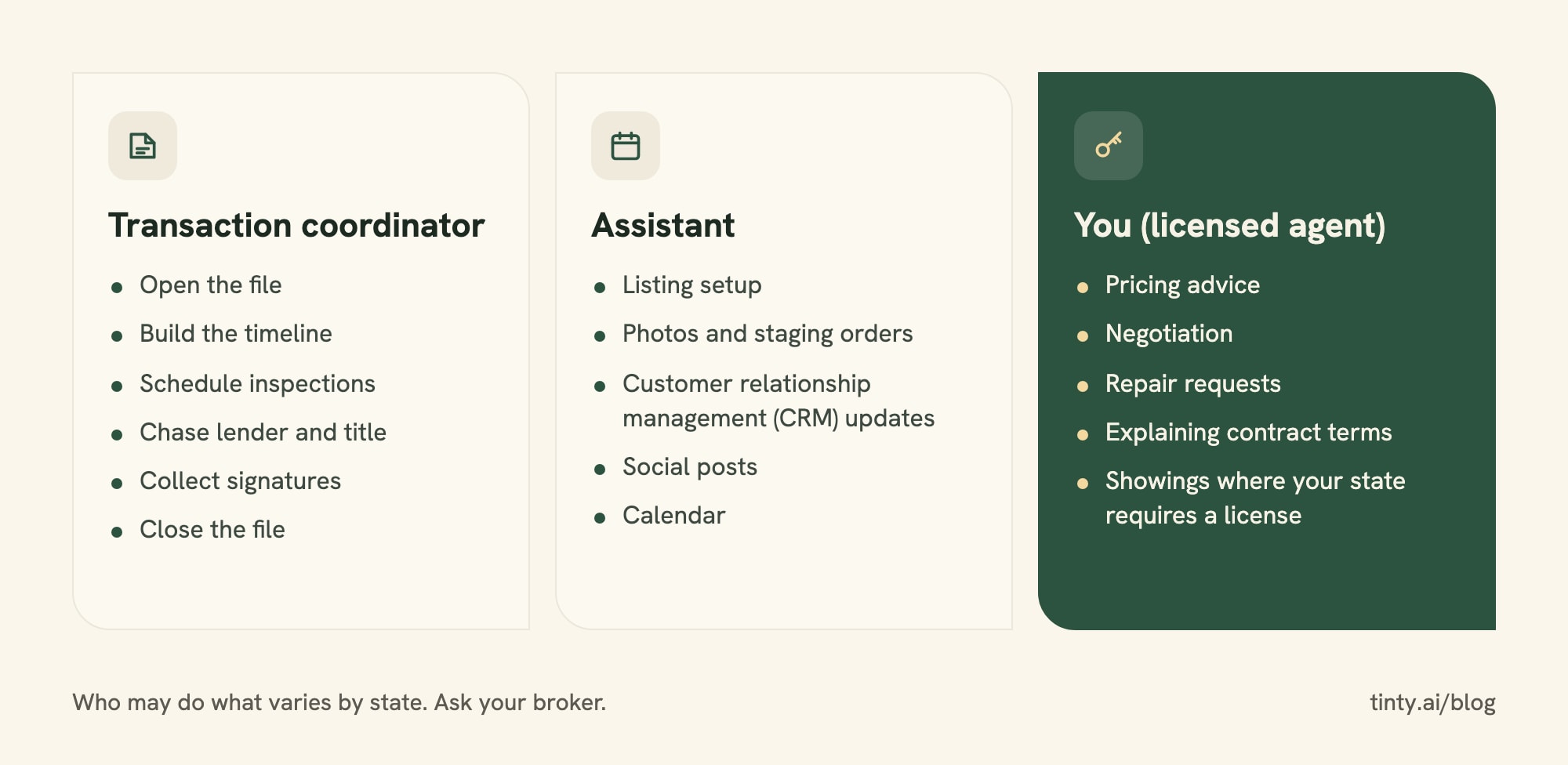
A TC handles the file, but licensed work stays with you. In the state sources we read, paperwork and scheduling are clerical, advice and negotiation are not, and some states add showings (our reading).
Keep these with a licensed agent:
- Advice: price, terms, which contingency to waive, or whether to accept a counteroffer.
- Negotiation: repair requests, credits and deadline extensions with the other side.
- Explaining documents: what a clause means for your client, even when the TC prepared the form.
- Showings: in some states, only a licensee may let a buyer into a home.
State rules vary: Texas, Colorado, California
The sources we read regulate tasks, not job titles (our reading). Three examples, read October 23, 2026:
- Texas: you need a license to show a property, which Texas rule 535.4 says includes giving a buyer access or hosting an open house.
- Colorado: an unlicensed TC may order title, collect earnest money and even show a home if authorized. They can’t complete standard forms alone or interpret them, per Colorado Real Estate Commission Position 20.
- California: an unlicensed assistant may order inspections, title and appraisals, and prepare documents a licensee reviews first. They may not discuss what a document means, per the California Department of Real Estate (DRE) guidelines.
Rule: Colorado’s Commission says a licensed TC who negotiates inspection items needs a brokerage relationship with the client, often a co-listing. And TCs, “whether licensed or not, may need their own separate errors and omissions insurance policy.” Source: Colorado Real Estate Manual, CP-20.
California’s guidelines add a warning: “it does not take very much to go from unlicensed to licensed activity.” Ask your managing broker which tasks your TC may do before the first file.
Transaction coordinator cost: flat fee per file or salary
Five of the six TC companies we checked charge a flat fee per file, often only when the deal closes. An in-house TC on salary costs far more, so it fits teams with steady volume (our view).
Flat fee per file
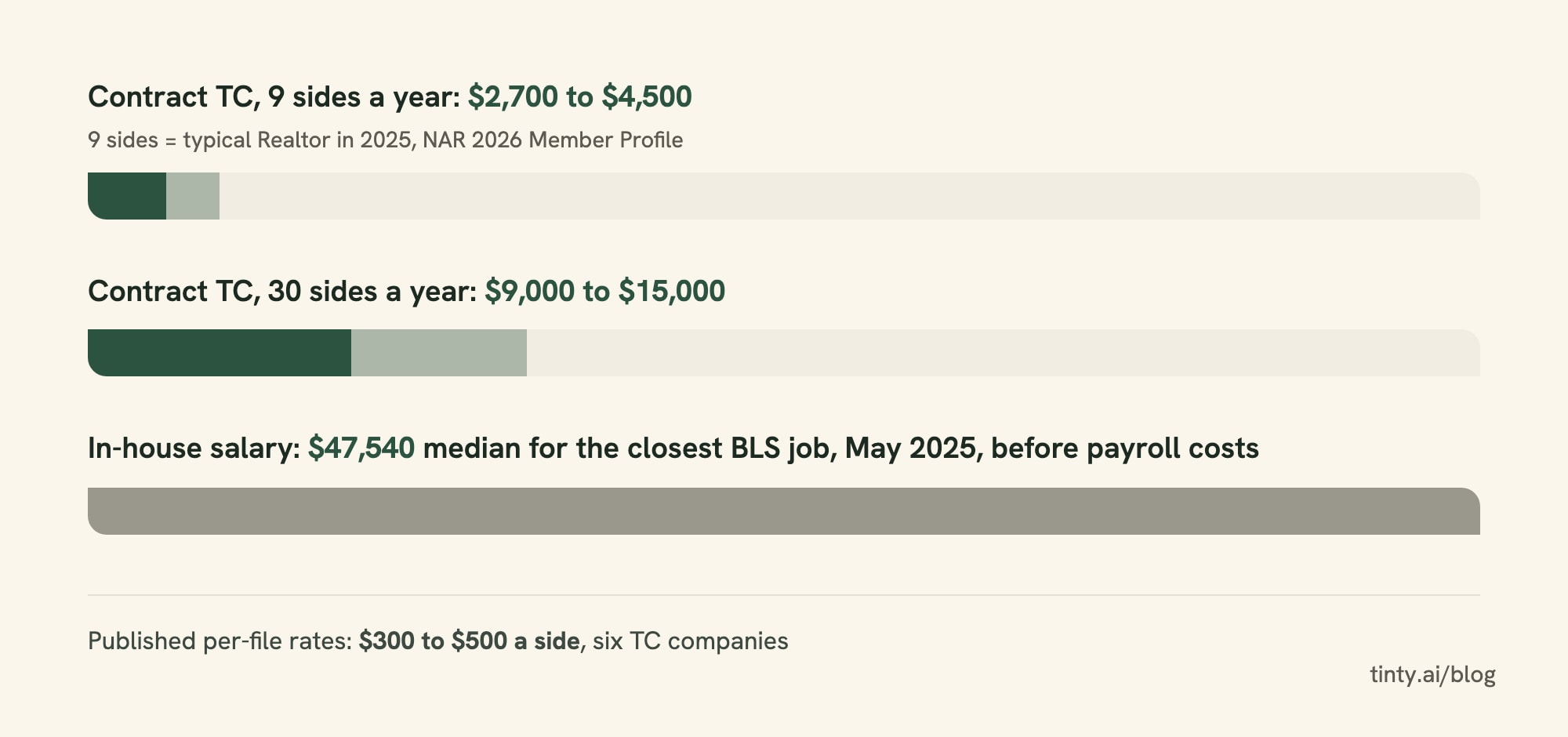
Here’s what six TC companies charge for one side of a contract-to-close file, from their own pricing pages:
- Notable Transactions: $300, or $450 for both sides, with no fee if the deal doesn’t close.
- Quill: $350 per file, billed only when the deal closes.
- Transactly: $399 a transaction on its pay-as-you-go plan.
- CTC Transaction Coordinators: $400 a side, $700 for both, with $50 of it due upfront and non-refundable.
- Empower Transactions: $400, or $500 in California, with a $500 monthly minimum.
- Simply Closed: from $500 a side, $900 for both.
Treat these as examples, not a market average. Listing coordination is often a separate fee, from $100 at Notable to $350 at Simply Closed.
Watch out: “pay only if it closes” sounds safe. But Colorado’s Commission warns that paying an unlicensed TC contingent on closing may violate the Real Estate Settlement Procedures Act (RESPA). Ask your broker how to pay TC fees in your state.
Salary for an in-house TC
The Bureau of Labor Statistics (BLS) has no job category for transaction coordinators. The closest one we found, secretaries and administrative assistants, had a median of $47,540 a year in May 2025. Payroll taxes, benefits and software come on top.
Example: the typical Realtor completed nine transaction sides in 2025, per the National Association of Realtors’ 2026 Member Profile. At $300 to $500 a file, that’s $2,700 to $4,500 a year. A $47,540 salary buys 95 to 158 files at those rates (our arithmetic).
Transaction coordinator, real estate assistant or DIY
A TC fits agents who want the contract-to-close file off their desk. An assistant fits agents who want help with everything around it. Doing it yourself works at low volume, if you run a written checklist (our view).
| Option | What it covers | What it costs | Watch for |
|---|---|---|---|
| Contract TC | Contract to close, one file at a time | $300-$500 a side on the rate cards above | Licensed tasks stay with you |
| In-house TC | Every file your team writes | A salary; $47,540 median for the closest BLS job | Pays off only at steady volume |
| Assistant | Listing setup, client database, marketing, scheduling | Hourly or salary | Not a contract specialist; state task limits apply |
| Do it yourself | Everything | Your evenings | Dates slip in your busiest weeks |
You can mix them: a contract TC for files and a part-time assistant for listings (our view). A licensed assistant can take on more, within what your broker allows.
When to hire a real estate transaction coordinator
Hire a TC before a missed deadline forces the decision. These signals point that way (our view):
- Volume: you often carry three or more files under contract at once.
- Close calls: a contingency date nearly slipped, or your broker sent a file back incomplete.
- Evenings: you do paperwork after showings, at the cost of family time or sleep.
- Growth: admin eats the hours you need for getting new listings.
- Both sides: you represent buyer and seller, so one deal brings two sets of paperwork.
- Seasons: spring brings bursts of contracts you can’t staff all year.
If you close a few deals a year and like the paperwork, the checklist below may be enough.
How to hire a TC and hand off each file
Hire on process, not price. A TC who shows you their timeline, email templates and backup plan beats one who is $50 cheaper per file (our view).
To find one, ask your broker and the agents in your office for referrals, or compare TC companies like the six above. In California, the California Association of Realtors keeps a directory of TCs who finished its Certified TC program. Most of the job is remote, so a virtual TC is fine if they know your state’s forms (our view).
Questions to ask before you hire
Ask these before you send the first file:
- Scope: which tasks are included, which cost extra, and which stay with you?
- License: are you licensed, and which of these tasks need a license in my state?
- Dead deals: what do I owe if the contract terminates?
- Insurance: do you carry your own errors and omissions (E&O) coverage?
- Backup: who covers my files when you’re out?
- Security: who sends wire instructions, and how do you protect your email?
- Updates: how often will you update me and my clients, and by which channel?
Software TCs use, with prices
Most TCs work in a transaction management tool, and many can use yours (our view). Empower Transactions, for example, says it plugs into SkySlope, Dotloop, Brokermint or whatever you use. Published prices, checked October 23, 2026:
- Dotloop Premium: $34.99 a month or $344 a year for unlimited transactions. A free account covers up to 10.
- Open To Close: Grow plan at $99 a month for one user, plus $69 per extra user.
- ListedKit: $14.99 per transaction credit, first one free; a listing-to-close file uses two.
- SkySlope Suite: brokerage software from $340 a month.
Brokermint’s site now shows it as BoldTrail BackOffice, with no public price list we could find. For AI tools that read contracts and build task lists, see our guide to the best AI tools for realtors.
Your handoff for every new file
A clean handoff saves your TC a day of chasing (our view). Send these within hours of acceptance:
- Executed contract with every addendum, counteroffer and disclosure.
- Contacts: client, other agent, lender, title or escrow, and any attorney.
- Dates you agreed to that the contract doesn’t show.
- Client notes: how they like updates, and who makes decisions.
- Your rules: what the TC may tell clients, and what comes to you.
- Brokerage checklist for the compliance file.
Tell sellers about your TC in your listing presentation, so updates from a new name don’t surprise them.
Watch out: a TC is one more inbox in the deal. The FBI’s 2025 internet crime report describes someone closing on a property who got a compromised “title company” email with wire instructions for over $1.3 million. Tell clients to confirm wire instructions by phone with title, at a number they already know (our suggestion).
Transaction coordinator checklist: contract to close
Use this checklist yourself or hand it to your TC. It’s our checklist, not a legal standard, so adapt it to your state, contract and brokerage.
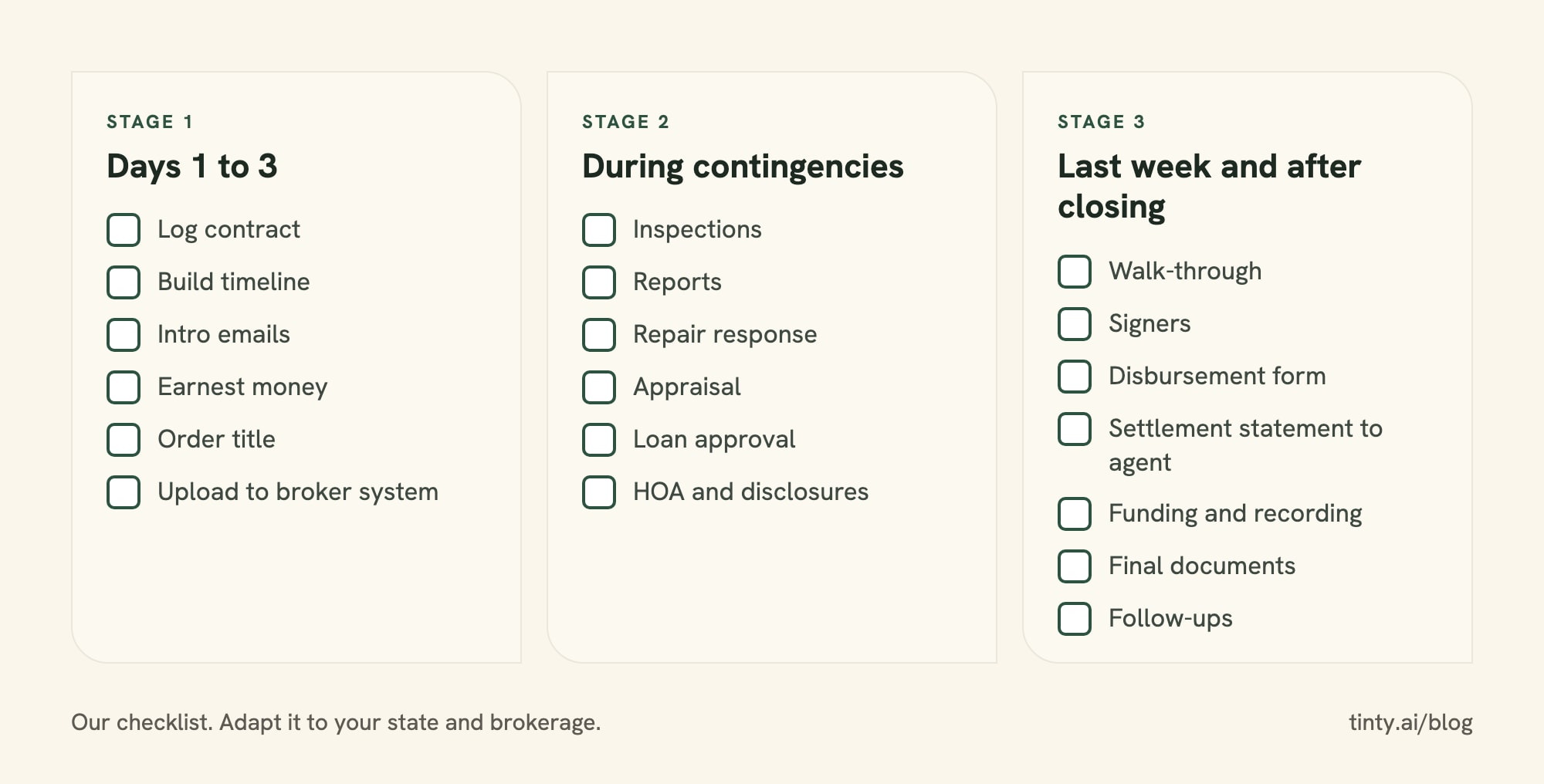
Days 1 to 3: open the file
Do these as soon as the contract is signed:
- Log the contract and addenda, and chase missing initials, signatures and dates.
- Build the timeline: each contingency, notice deadline and the closing date.
- Send intro emails to the client, other agent, lender and title or escrow.
- Confirm the earnest money is delivered, and file the receipt.
- Send the contract to the lender and title, and order the title commitment.
- Upload everything to your brokerage system.
During contingencies
Track these until every contingency is met or waived:
- Schedule inspections and confirm access with the listing side.
- Send each report to the agent the day it arrives.
- Track the repair response date and the signed amendment.
- Confirm the appraisal is ordered, then log the value.
- Ask the lender for status weekly, and log the loan approval date.
- Collect HOA documents and required disclosures, signed.
Last week and after closing
Finish with these, then close the file:
- Confirm the closing time, place and signers, and book the walk-through.
- Request the commission disbursement form.
- Send the settlement statement to the agent for review.
- Remind the client to bring ID, set up utilities and confirm wire instructions by phone.
- Confirm funding and recording, then upload final documents for the broker.
- Set the review request and home anniversary follow-ups.
Before the contract: listing tasks you can delegate
Most TCs start at the signed contract, so listing launch work isn’t theirs unless you buy listing coordination (our reading). Photos, staging and the description still take hours in launch week, and you can hand those off too (our view). For the copy, see our guide to writing a listing description.
For empty rooms, TINTY, our AI web app, stages listing photos. Pick the room, style and furniture, and a staged photo takes about a minute. Try TINTY on an empty room: sign in for 6 free staged photos with a light watermark, no card.
Watch out: TINTY stages 9 room types, not kitchens, bathrooms or exteriors, and files are 2K, not 4K. The app can clear a furnished room before staging, but it removes all the furniture, not just some pieces. It doesn’t match furniture across angles yet. TINTY can also add an optional “Virtually staged” label.
Short on time? TINTY Studio does it for busy agents: email the photos to hello@tinty.ai and get them back in 2 to 24 hours. You pay only if you’re happy.
Plans start at $9 a month for 10 staged photos, and Studio costs $10 a photo from 3 photos, per TINTY’s pricing page. These are launch prices, so they may change.
Transaction coordinator FAQ
How do real estate transaction coordinators get paid?
The six TC companies we checked charge a fee per file, often taken from the agent’s commission at closing. Their rate cards run $300 to $500 for one side. Some TCs work on salary for a brokerage or team instead.
Does a transaction coordinator need a real estate license?
Not for purely clerical work, per Colorado’s and California’s guidance. Some tasks need one: Texas requires a license to show a home, and in Colorado only a licensed TC with a brokerage relationship may negotiate. Ask your broker.
Show 4 more questionsShow fewer questions
Who pays the transaction coordinator fee?
Usually the agent, out of their commission (our view). Colorado’s Commission warns that charging the consumer a separate fee for work that helps the broker meet their own duties may violate RESPA. Check your state and brokerage rules.
What is the average salary for a transaction coordinator in the US?
The BLS doesn’t track transaction coordinators. The closest job it tracks, secretaries and administrative assistants, had a median of $47,540 a year in May 2025.
Is a transaction coordinator worth it for a new agent?
Often not at first (our view). At a few deals a year, a written checklist and a transaction tool may be enough. A TC starts to pay when files overlap and paperwork pushes out time with clients.
How do you become a real estate transaction coordinator?
Learn the contract-to-close process first, often as an assistant, then your state’s limits on unlicensed work (our view). The California Association of Realtors (C.A.R.) runs a 17-plus-hour Certified TC program.
How we researched this
On October 23, 2026, we searched for “real estate transaction coordinator” and two related searches. We read the guides that rank for them, from The Close, Clever, Tom Ferry, Wise Pelican and Corefact, and skipped job boards and forum threads.
Prices come from each company’s own pricing page that day. Rules come from the Texas Administrative Code, Colorado’s Real Estate Manual and California’s DRE. Texas Real Estate Commission pages didn’t load for us, so we cite the rule text instead. If something here is wrong, email hello@tinty.ai and we’ll fix it.
Sources
All pages read October 23, 2026. Dates in parentheses are publication or update dates.
State rules:
- Cornell LII: 22 Tex. Admin. Code § 535.4, License Required (Texas Real Estate Commission rule, as amended effective January 1, 2024; subsection (c) on showings)
- Colorado Real Estate Manual 2026, Chapter 3: Commission Position Statements (PDF) (2026 edition; CP-20 on licensed and unlicensed Real Estate Administrative Professionals, recodified June 7, 2022, pages 3-27 to 3-29)
Show 9 more sourcesShow fewer sources
- California DRE: Guidelines for Unlicensed Assistants (PDF) (last revised January 5, 2018)
TC pricing pages:
- Notable Transactions: pricing · Quill: pricing · Transactly: pricing · CTC Transaction Coordinators: pricing · Empower Transactions: transaction coordination · Simply Closed: pricing
Pay and volume data:
- BLS: Occupational Employment and Wage Statistics, secretaries and administrative assistants (43-6014) (May 2025 estimates)
- NAR: The Feature Sheet, 2026 Member Profile (August 19, 2026)
Software pricing pages:
Training and fraud data:
- California Association of Realtors: Transaction Coordinator Directory and Certified TC program
- FBI Internet Crime Complaint Center: 2025 IC3 Report (PDF) (page 23: a March 2025 case of a compromised “title company” email with wire instructions for over $1.3 million)
TINTY (ours):
- TINTY · TINTY pricing (launch pricing, checked October 23, 2026)
Related guides on our blog: