What goes in a real estate agent business plan? Six parts: an income goal, the closings and conversations it takes, your lead sources, a budget, a weekly schedule and review dates. Our free template covers all six in a Word file and a PDF. An Excel calculator turns the income goal into weekly numbers.
Download free, no sign-up:
We make TINTY, an AI virtual staging app for real estate agents, and we built this template. It’s a planning aid, not financial, legal or tax advice. Template made and sources checked November 25, 2026.
Key takeaways
- Start from income: what you want to keep plus your expenses, divided by your split, is the commission you must bring in.
- Work back to a week: closings become appointments, and appointments become conversations a week.
- Use your own rates: NAR’s typical agent closed nine sides in 2025. Your prices and conversion rates set your plan.
- Review every quarter: compare closings, leads by source and cost per closing, then adjust.
On this page: What’s in a plan · Template · Goal math · Lead sources · Budget · Schedule · Review · New agents · FAQ
What a real estate agent business plan includes
A real estate business plan answers one question: what will you do each week to reach your goal? For a solo agent it fits on a few pages. It needs six parts:
- An income goal: the amount you want to keep this year.
- The numbers behind it: commission income, closings, appointments and weekly conversations.
- Lead sources: three to five ways you’ll find clients, each with a number.
- A budget: what you’ll spend by month and by year.
- A weekly schedule: hours blocked for lead generation and follow-up.
- Review dates: one per quarter, to compare results with the plan.
A brokerage, a team or an investor needs more, such as staffing and financing. This guide and template are for individual agents.
The free real estate business plan template
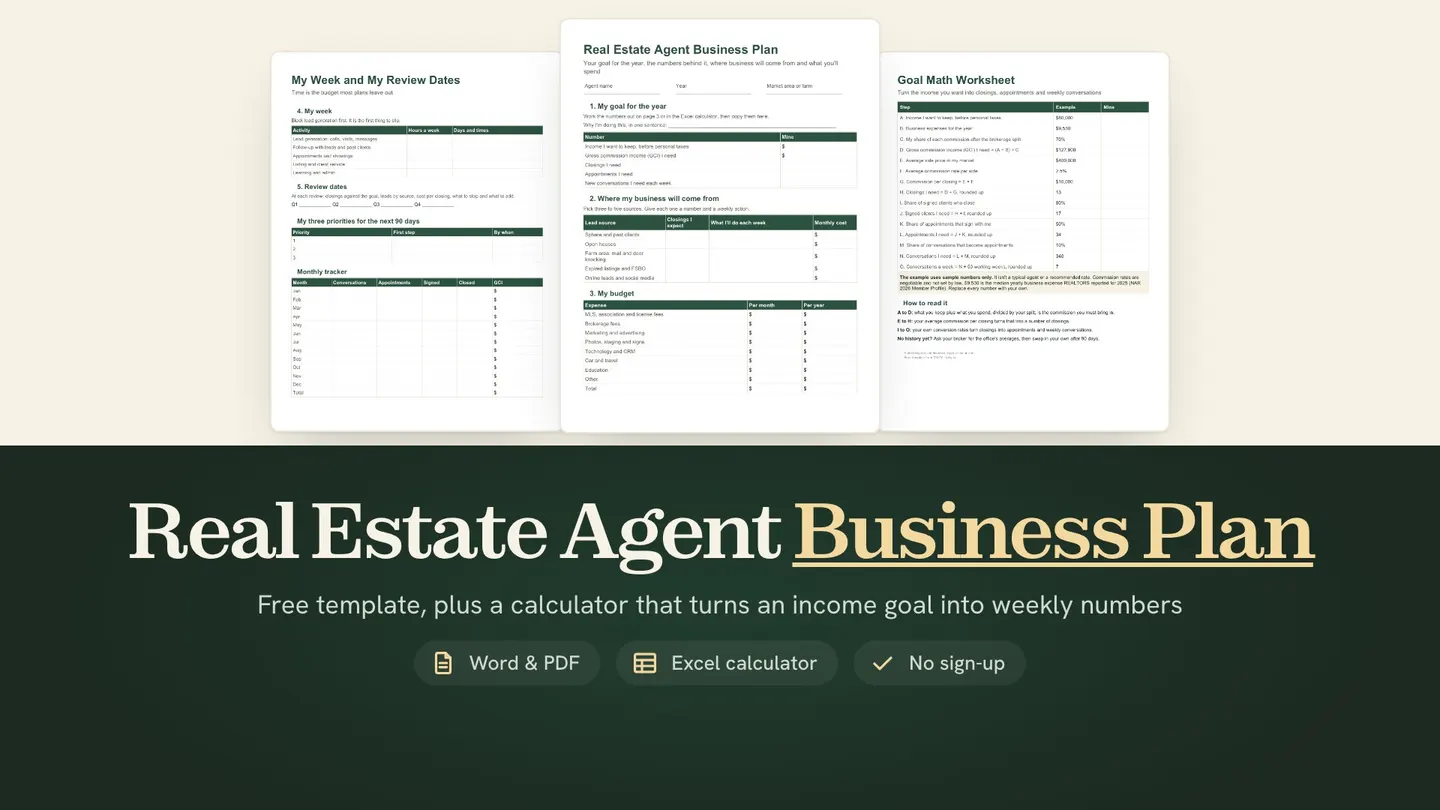
The Word file and the PDF have the same three pages. Page 1 is the plan: your goal, lead sources and budget. Page 2 holds your week, review dates, a 90-day action list and a monthly tracker. Page 3 is a goal math worksheet with an example.
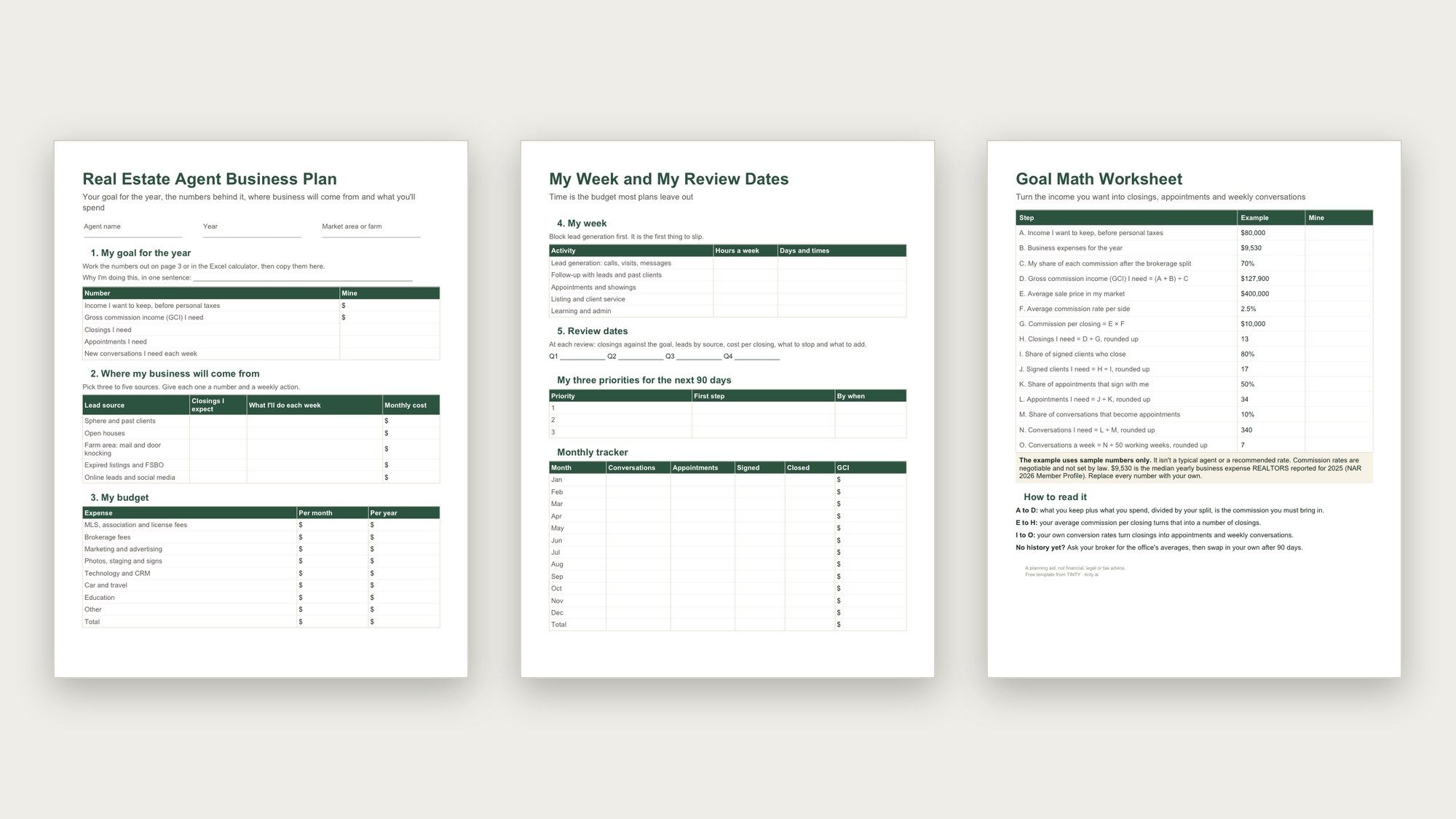
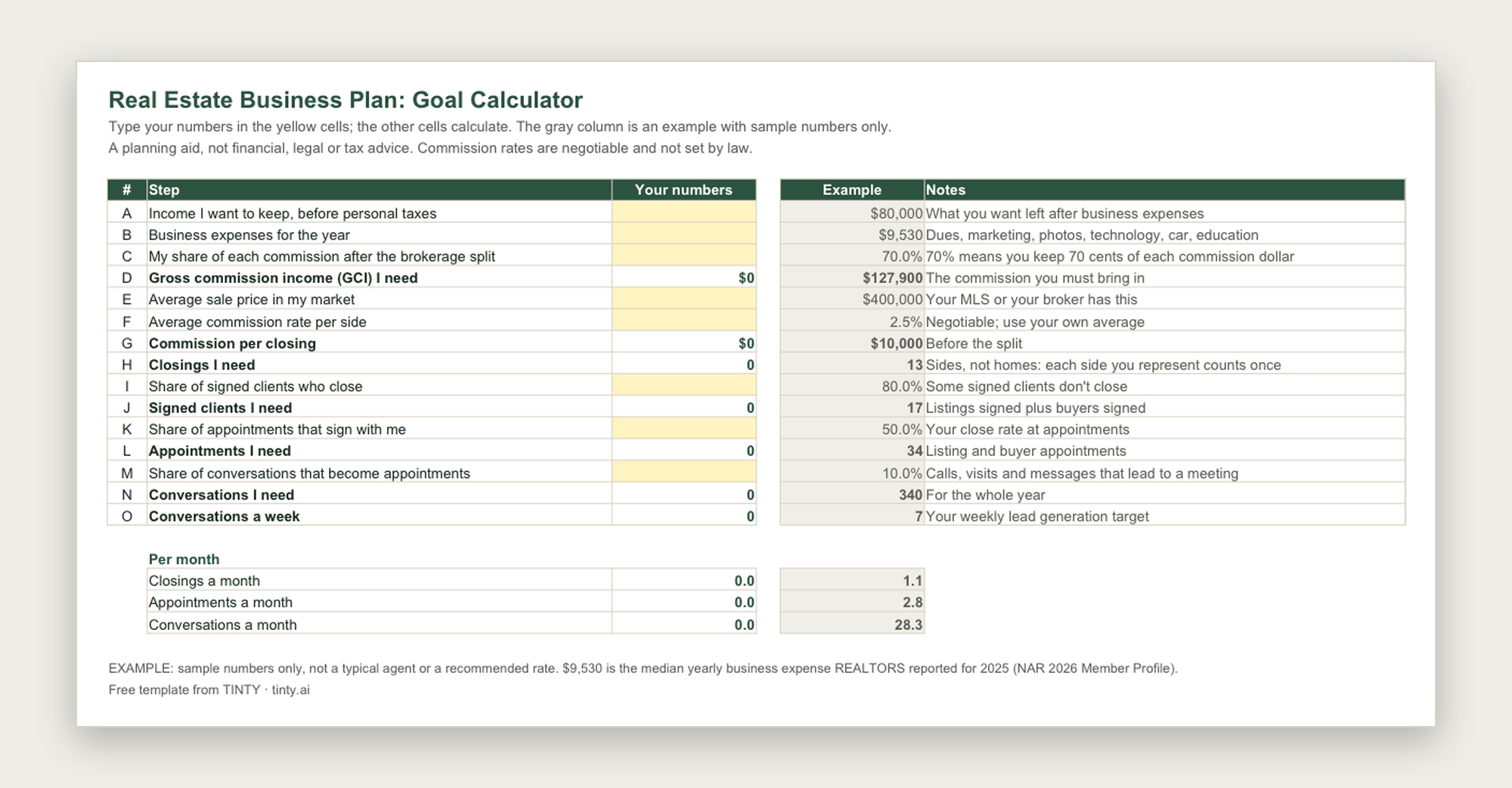
The Excel calculator does the worksheet math for you. Type eight numbers in the yellow cells, and it returns the closings, appointments and conversations you need. No rates are filled in for you, because splits, commission rates and conversion rates differ for every agent.
- Open the calculator and enter your income goal, expenses and split.
- Add your market numbers: average sale price and your average commission rate.
- Add your conversion rates, or your broker’s office averages if you’re new.
- Copy the results to page 1 of the plan.
- Fill in lead sources, budget and schedule, then set four review dates.
Step 1: turn your income goal into closings
Start with the income you want to keep, before personal taxes. Add your business expenses. Divide by your share of each commission after the brokerage split. The result is the gross commission income (GCI) you need to bring in.
Then divide GCI by your average commission per closing. That gives the closings you need. Count sides, not homes: each side you represent counts once.
Example: you want to keep $80,000 and expect $9,530 in expenses. At a 70% split you need $127,900 in GCI. With a $10,000 average commission, that is 13 closings.
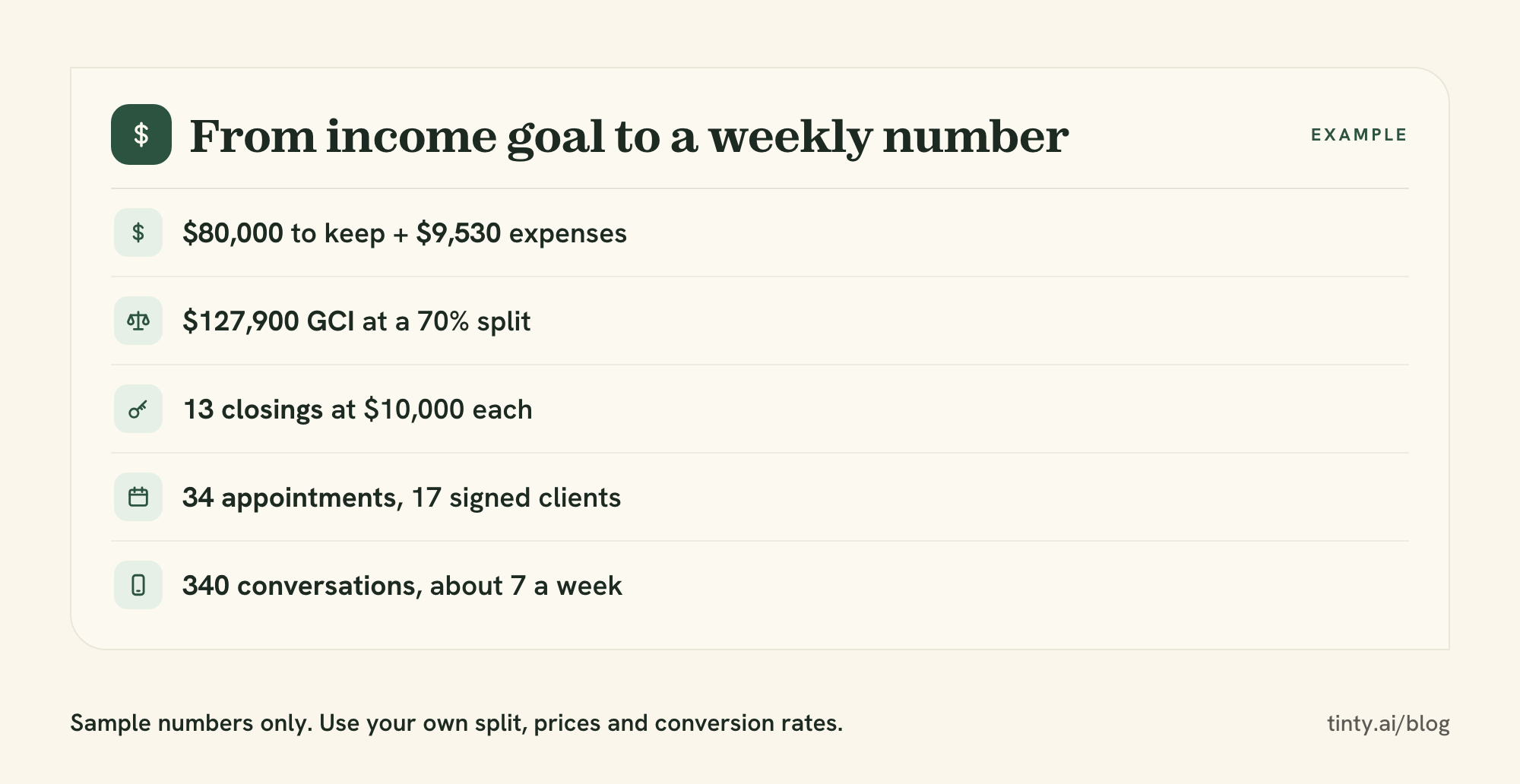
The example uses sample numbers, not typical ones. For scale, NAR’s 2026 Member Profile reports a median gross income of $59,200 for 2025. The typical agent reported nine transaction sides that year.
Conversion rates finish the math. If 80% of signed clients close, 13 closings take 17 signed clients. If half your appointments sign, that is 34 appointments. If one conversation in ten leads to an appointment, you need 340 conversations, or about 7 a week.
Step 2: pick your lead sources

A number without a source is a wish. Give each closing a place it will come from, and pick sources that fit your budget and your character.
- Sphere and past clients: calls, notes and events. See how to get listings.
- Open houses: yours or another agent’s. See our open house ideas.
- A farm area: monthly mail and door knocking. See real estate farming.
- Expired listings and FSBO sellers: see our expired listing scripts and FSBO scripts.
- Online leads and social media: see social media marketing for agents.
Write a weekly action next to each source, such as “call 10 past clients” or “host one open house.” Three sources you work every week beat seven you touch once.
Step 3: set a budget
List what you’ll spend before the year starts. NAR’s 2026 Member Profile puts the median business expense at $9,530 for 2025. Vehicle costs were the largest category, at $1,580.
The template has eight lines, from MLS and association fees to education, plus a total. Fill in a monthly and a yearly figure for each.
Then check one ratio: cost per closing. Divide a source’s yearly cost by the closings it brought. It shows which source to grow and which to drop.
Example: a farm mailing that costs $1,248 a year and brings two closings costs $624 per closing. Compare that with your average commission.
Listing costs belong here too. Photos and staging are paid per listing, so multiply by the listings you plan to take. Virtual staging keeps that line small: with TINTY you stage an empty room from a photo, and the first 6 staged photos are free.
Step 4: block your week

A plan becomes real on the calendar. Block lead generation first, because client work will fill any hour you leave open. Put it early in the day, before showings and email take over.
The template lists five activities: lead generation, follow-up, appointments and showings, listing and client service, and learning and admin. Write the hours and the days for each.
Use the calculator’s weekly number as the test. If you need 7 new conversations a week, the lead generation block must be long enough to have them.
Step 5: review the plan every quarter

Set four review dates now. At each one, fill in the monthly tracker and compare it with the plan:
- Closings against the goal for the quarter.
- Leads by source, to see where clients really come from.
- Conversion rates, which replace the estimates you started with.
- Cost per closing for each paid source.
Then pick three priorities for the next 90 days. The template has a table for them, with a first step and a date.
A business plan for a new real estate agent
New agents have no history, so the first plan runs on borrowed numbers. Ask your broker for the office’s average sale price and typical conversion rates. Replace them with your own after 90 days.
Plan for a slow start. Closings pay weeks after a client signs, so budget for several months of expenses before the first check. Keep the plan small: one or two lead sources, worked every week.
Your first appointments need two more files: a listing presentation and a seller net sheet. Both are free.
Real estate business plan FAQ
How do I write a business plan as a real estate agent?
Start with the income you want to keep. Work back to commission income, closings, appointments and weekly conversations. Then choose lead sources, set a budget, block your week and set quarterly review dates. Our free template follows these steps.
How many closings does an agent need a year?
It depends on your income goal, split and average commission. In our example, $127,900 in GCI at $10,000 a closing takes 13 closings. NAR reports that the typical agent closed nine transaction sides in 2025.
What is GCI in real estate?
GCI is gross commission income: the commission you bring in before your brokerage split and your business expenses. A plan starts from the income you want to keep and works up to GCI. For example, a $10,000 commission at a 70% split leaves you $7,000 before expenses.
How long should a real estate business plan be?
One to three pages is enough for a solo agent. A lender or an investor may ask for a longer plan with financial statements, which this template doesn’t cover.
Is the business plan template free?
Yes. The Word file, the PDF and the Excel calculator download directly, with no sign-up.
How we researched this
On November 25, 2026, we pulled US search data for “real estate business plan” in Ahrefs and read the pages that rank. Most are long guides or single PDFs, so we built an editable plan and a calculator. Income, expense and transaction figures come from NAR’s 2026 Member Profile release of June 25, 2026.
Sources
Show 6 sourcesHide sources
- NAR newsroom: 2026 Member Profile release (June 25, 2026: median gross income $59,200, median business expenses $9,530, nine transaction sides)
- NAR: Writing a Business Plan
- FTC: National Do Not Call Registry
- 47 CFR § 64.1200: prior express written consent
- tinty.ai · TINTY Studio · TINTY pricing
- How to get listings · Open house ideas · Real estate farming · Expired listings · FSBO scripts · Social media marketing · Listing presentation · Seller net sheet