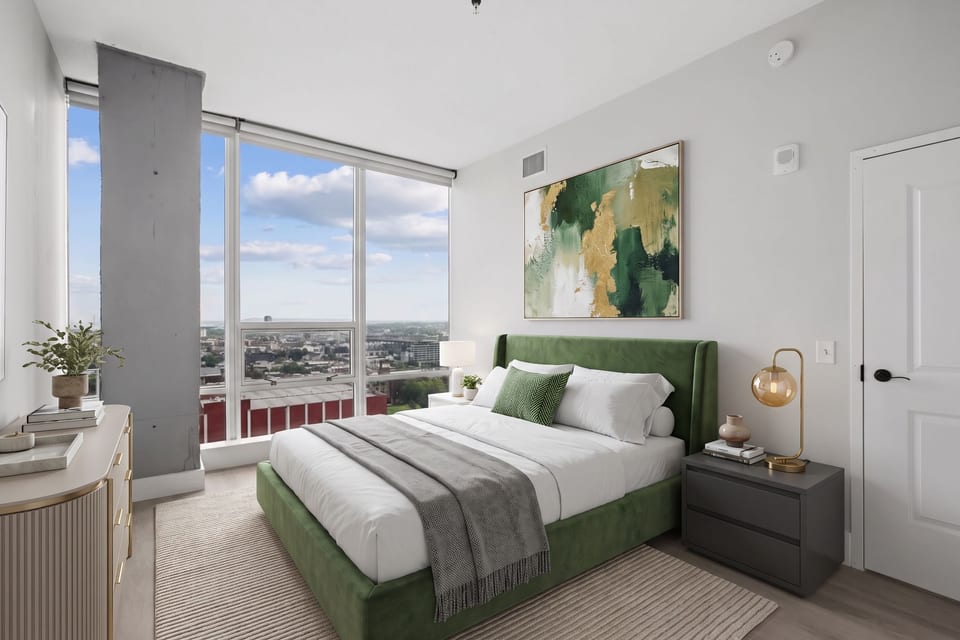
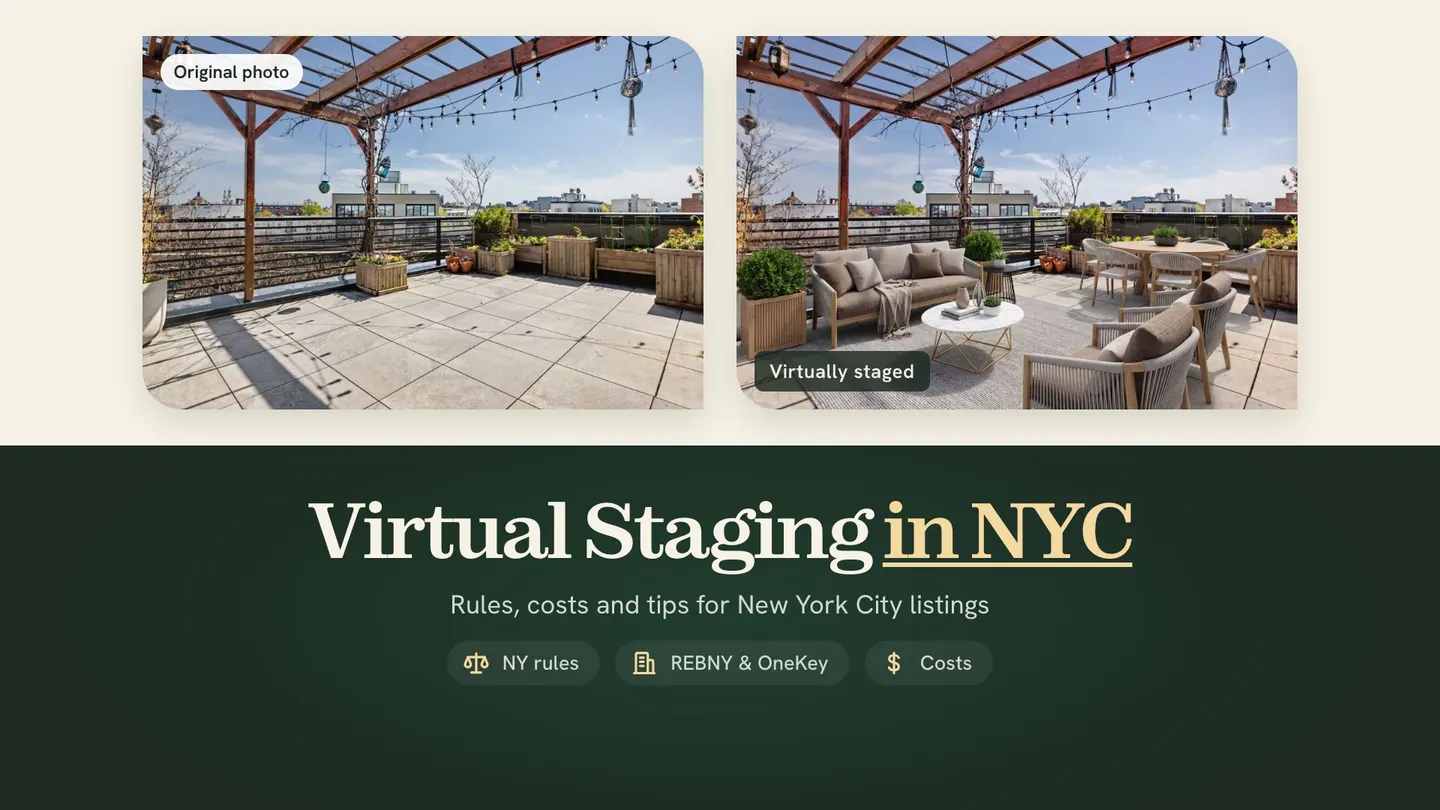
Is virtual staging common in NYC, and is it legal? It is legal and common. On November 25, 2026, 641 of 6,365 Manhattan sale listings on StreetEasy said they were virtually staged: one in ten. No New York law regulates it by name yet, but every listing photo must be an honest and accurate picture of the home.
We make TINTY, an AI virtual staging app for real estate agents. We have no New York office: we work online for listings anywhere in the US. The listing counts are ours, and the method is at the end. This is general information, not legal advice. Rules, prices and counts checked November 25, 2026.
Key takeaways
- One in ten: 641 of 6,365 Manhattan sale listings on StreetEasy said “virtually staged” on November 25, 2026.
- Six firms, two thirds: Compass, Corcoran, Douglas Elliman, Brown Harris Stevens, Sotheby’s and Christie’s hold 67% of those listings.
- Legal, with one rule: New York requires an honest and accurate depiction of the property. No law names virtual staging yet.
- Rules are coming: two state bills and a city plan would require labels on altered photos.
- The price gap is wide: physical staging starts near $5,000 for a studio. A virtually staged photo costs $1 to $10.
On this page: NYC in numbers · How common · Who uses it · Costs · Does it work · Problems · Laws · REBNY and OneKey · How to do it right · FAQ
NYC housing in numbers
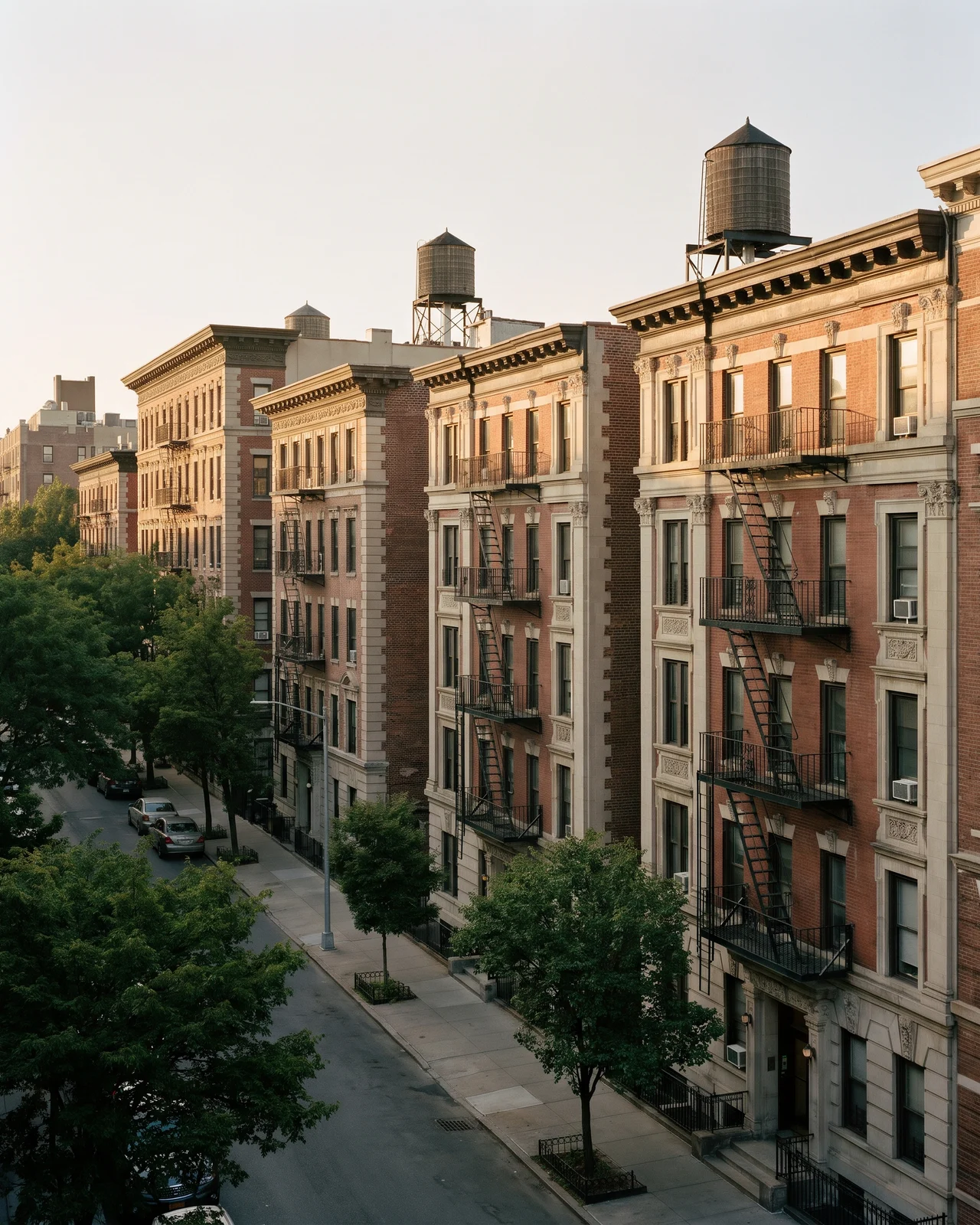
New York is a market of old, small homes that change hands fast. That is why empty rooms are a bigger problem here than in most cities.
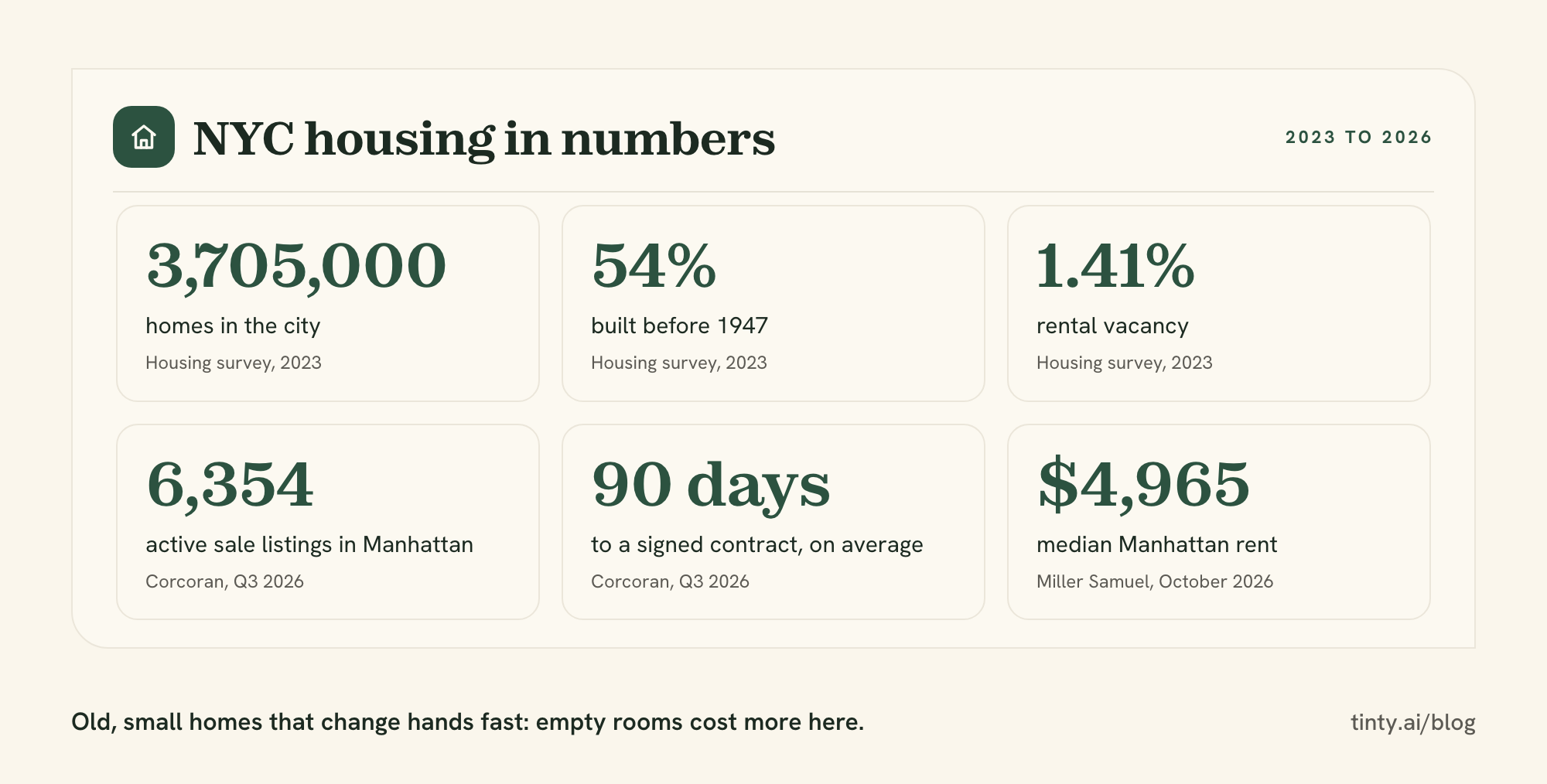
- 3,705,000 homes. That was the city’s housing stock in 2023, the largest since the city’s Housing and Vacancy Survey began in 1965.
- 54% built before 1947. More than two million units sit in prewar buildings.
- 54% studios and one-bedrooms in Manhattan, or about 504,600 units.
- Just under one in four units (861,200) is in a co-op or condo building.
- 1.41% rental vacancy in 2023. Only 33,210 units were available to rent.
The sales market is tight too. Corcoran counted 6,354 active listings in Manhattan in the third quarter of 2026, the thinnest third-quarter supply since 2017. Closed sales reached 3,625, and contracts were signed in 90 days on average. The median price was $1.25 million.
On November 25, 2026, StreetEasy listed 15,366 homes for sale and 14,655 for rent across the five boroughs. Manhattan alone had 6,365 for sale and 4,635 for rent.
Rentals move even faster. The median Manhattan rent for new leases was $4,965 in October 2026, the second highest on record, per appraiser Jonathan Miller’s report. At that rent, each vacant day costs a landlord about $165.
How common is virtual staging in NYC
StreetEasy, the city’s main listing site, has a page for sale listings “described as virtually staged.” On November 25, 2026, it showed 641 listings in Manhattan. The same minute, the site had 6,365 Manhattan sale listings in all.
That is 10%, or one listing in ten. The real share is higher, because the page counts only listings that say so in their text. Listings staged without a label don’t show up.
Local press agrees with the count. In September 2026, CityRealty wrote that virtually staging an empty apartment “has become common practice” in New York City listings.
Example: a search for a Manhattan one-bedroom under $1 million returns dozens of staged listings. Most show an empty room with digital furniture, and the better ones show the empty original next to it.
Which brokerages use virtual staging most
We read all 641 listings and counted the brokerage on each. Ninety firms had at least one, but six firms held 67% of them.
| Brokerage | Staged listings | Share |
|---|---|---|
| Compass | 154 | 24% |
| Corcoran | 96 | 15% |
| Douglas Elliman | 78 | 12% |
| Brown Harris Stevens | 39 | 6% |
| Sotheby’s International Realty | 38 | 6% |
| Christie’s International Real Estate | 26 | 4% |
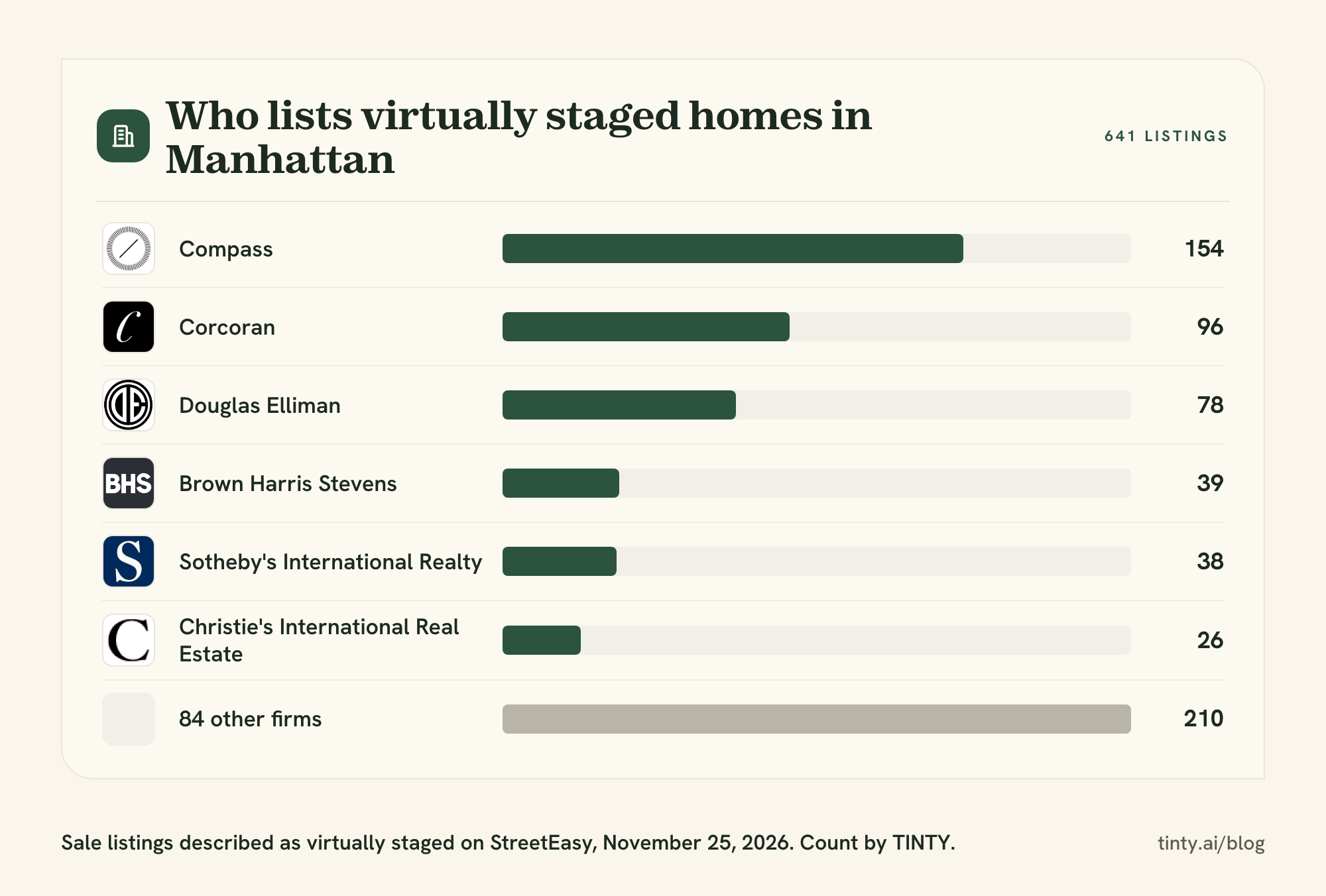
Next came SERHANT. with 15, Platinum Properties with 14, Keller Williams NYC and FIND Real Estate with 13 each. The other 84 firms shared 210 listings, most with one or two.
Read the table with care. It shows volume, not rate: big firms have more listings of every kind. It also covers one day and one borough.
Some brokerages help sellers pay for staging. Compass launched Compass Concierge in 2018: it covers staging and other prep costs, then bills the seller at closing with no added fee.
What staging costs in NYC
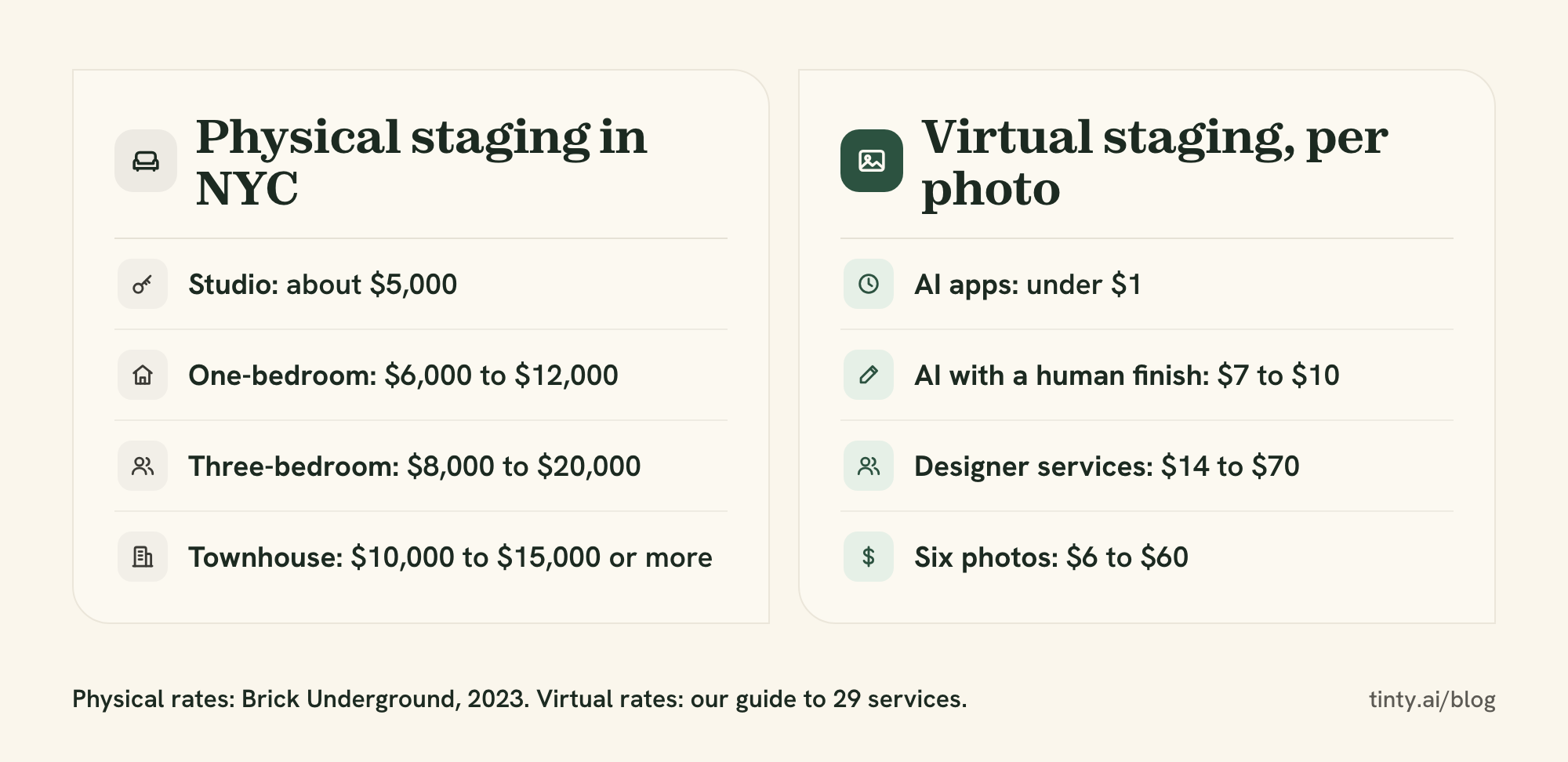
Physical staging in New York costs several times the national figure. Brick Underground asked local stagers for their rates in 2023:
- Studio: about $5,000.
- One-bedroom: $6,000 to $12,000.
- Three-bedroom: $8,000 to $20,000.
- Townhouse: $10,000 to $15,000 or more.
One Manhattan firm, Quadra, told the site it tries to cap fees at 1% of the asking price. In one example, the owners of a Tribeca apartment spent $18,000 on staging and sold for $2 million. Nationally, the median was $1,500 with a staging service, per NAR’s 2025 staging report.
The seller usually pays. Brick Underground found that some brokers lend furniture and some share the cost.
Virtual staging is priced per photo, not per city. Our virtual staging cost guide compared 29 services and found three bands:
- AI apps: under $1 a photo.
- AI with a human finish: $7 to $10 a photo.
- Designer services: $14 to $70 a photo.
On TINTY, the first 6 staged photos are free with a light watermark. A one-time pack is $29 for 30 photos, and TINTY Studio is $10 a photo, from 3 photos. See pricing.
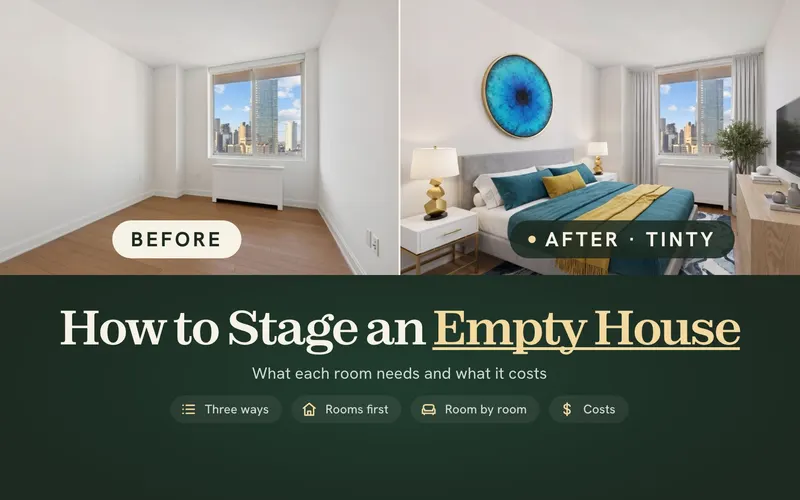
Example: a vacant one-bedroom needs about six staged photos. That is under $6 from a 30-photo pack, or $60 with TINTY Studio, against $6,000 or more for furniture.
Who does the staging in New York
Agents here choose among three kinds of providers:
- Local stagers bring real furniture. Quadra, Cathy Hobbs Design Recipes, UpStager and Staged to Sell Home are among the firms the local press quotes.
- Listing photographers and studios add virtual staging to a shoot, so one visit covers photos and staging.
- Online services and apps take your photos and return staged files, with no visit at all.
The first group suits listings above a few million dollars, where buyers expect to walk through furnished rooms. Corcoran broker Julia Boland told Brick Underground that for homes priced at $2 million or below, virtual staging is “a cost-effective means of achieving a similar result online.”
Does staging work? What the numbers say
Agents say it helps, though nobody has measured it cleanly. In NAR’s 2025 survey of Realtors:
- 83% of buyers’ agents said staging makes it easier for buyers to picture the home.
- 49% of sellers’ agents said it cut time on market.
- 29% of sellers’ agents saw offers 1% to 10% higher.
- 21% of sellers’ agents stage every home they list.
New York has its own stories. Stager Jason Saft of Staged to Sell Home told Forbes about a Manhattan home that sat unsold for 14 months. After staging it sold in 35 days, as CityRealty recounts. A Quadra founder told Brick Underground that a realistic price bump is 5% to 15%, and admitted it’s hard to prove.
No study has isolated the effect of virtual staging yet. Our home staging statistics page tracks what has been measured.

Where virtual staging goes wrong in New York
The tool isn’t the problem. The problems start when a photo shows a home that doesn’t exist.
- Edits beyond furniture. CityRealty lists what generative AI now adds to listings: views and natural light that aren’t there, stretched rooms, new windows and moved doors.
- Renters who never visit. Renters sometimes sign leases from photos alone, so a misleading image costs them more than it costs a buyer.
- Disappointed showings. A Compass agent told Brick Underground that virtual staging “disappears when the buyer walks into the home.”
- Labels nobody requires. No rule says where a staging label goes, so many listings carry none.
Renters notice. One thread on Reddit’s r/NYCapartments is titled “They should ban virtual staging and super wide angle photos in apt listings.”
The city heard about it directly. In 2026, the mayor’s office held Rental Ripoff Hearings in all five boroughs and took testimony from more than 2,400 New Yorkers. The report that followed lists 23 policy actions. One of them requires landlords to disclose when rental listings were altered with AI or other digital tools.
The state acted earlier. In a November 2025 trend alert, the Department of State warned that AI tools “may produce misleading or exaggerated representation of properties.”
New York laws on virtually staged photos
New York has no law written for virtual staging yet. The general advertising rule covers every listing photo.
Rule: state regulations require “an honest and accurate depiction of the property being sold or leased” in real estate ads (19 NYCRR §175.25(c)(9)).
The penalty sits in the license law. Under Real Property Law §441-c, the Department of State can revoke or suspend a license. It can also impose a fine of up to $2,000 instead.
Three proposals would add disclosure duties:
- Senate bill S9584: staged listings would disclose that “furnishings or finishes were digitally added.” It has sat in the Senate Judiciary Committee since April 28, 2026.
- Assembly bill A11635: a statement on or next to each altered image, plus access to the unaltered photos. It is in the Assembly Housing Committee.
- New York City: the Department of Consumer and Worker Protection plans a rule for rental listings with digitally altered photos. Nothing is adopted, and no date is set.
None of these is law today. California’s AB 723 already requires labels on altered sale photos, so New York’s bills follow a working model. Our guide to virtual staging laws tracks every state.
REBNY RLS and OneKey MLS: what the listing rules say
Two listing systems cover most New York agents. REBNY’s Residential Listing Service (RLS) shares listings among member brokerages in the five boroughs. OneKey MLS serves the wider New York region. We read the current rules of both.
- REBNY RLS: the 2026 RLS rules took effect January 20, 2026. We found no rule written for virtual staging. REBNY’s Code of Ethics bars advertising “in an inaccurate or misleading fashion.”
- OneKey MLS: the Rules and Procedures, version 2026C, have no staging rule either. Section 307.1 says images “must accurately reflect only information or descriptions of the listed Property.”
- Fines: Section 307 is on OneKey’s schedule of automatic fines, so an inaccurate image can cost money.
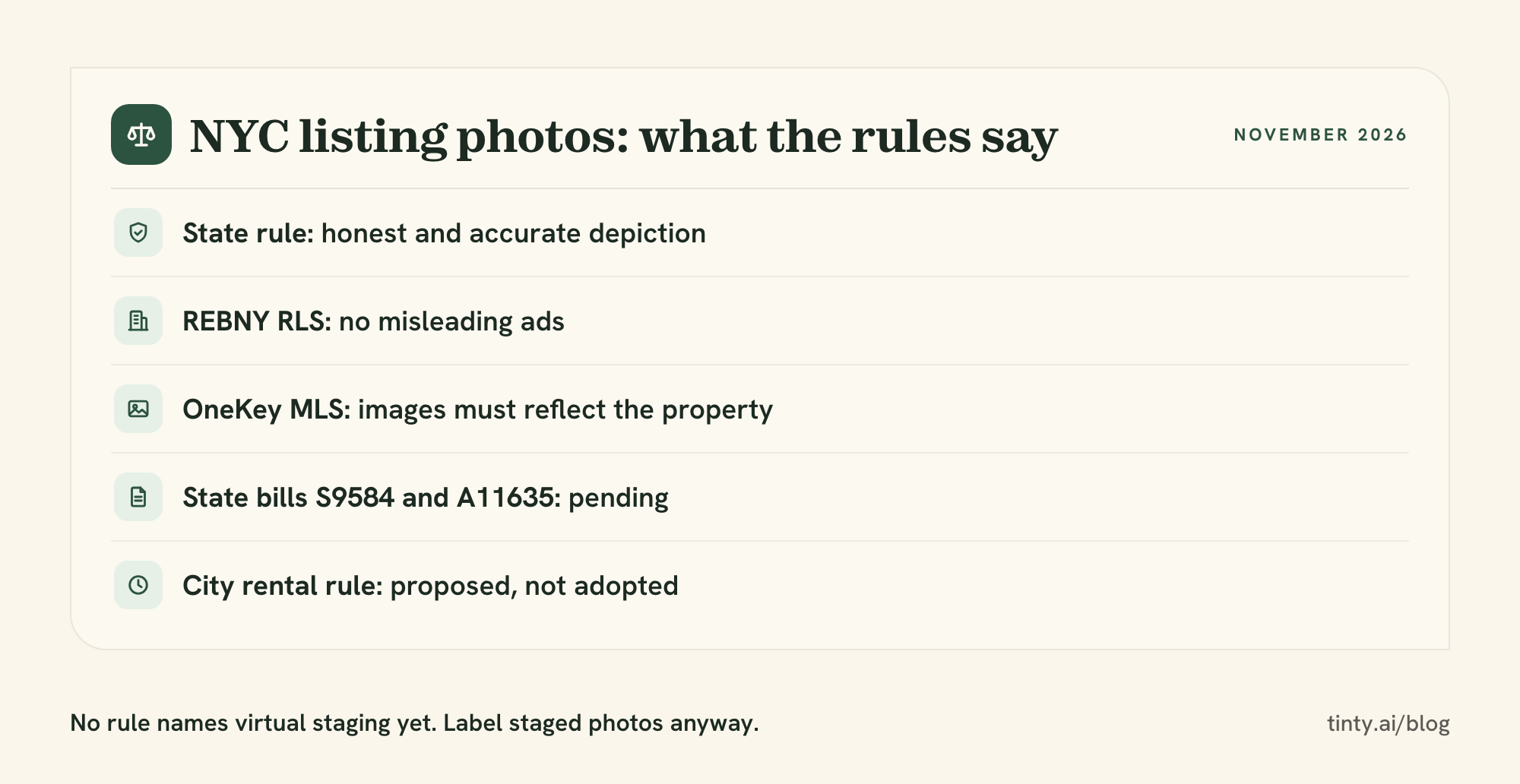
Neither system says where a staging label goes. Your broker may ask for more than the rules do.
How to stage and label an NYC listing
Start with the room types New York has most. In a studio, show a bed, seating and a small table in one frame, so buyers see that all three fit. In an L-shaped living room, put a sofa in one leg and a dining table in the other.
If a small second bedroom looks crowded with a bed, stage it as a home office. On a terrace, add outdoor furniture and leave the view exactly as shot.
Co-ops add a wait. Since July 28, 2026, Local Law 58 sets deadlines for co-op boards to act on purchase applications. Photos that match the apartment keep buyers confident during that time.
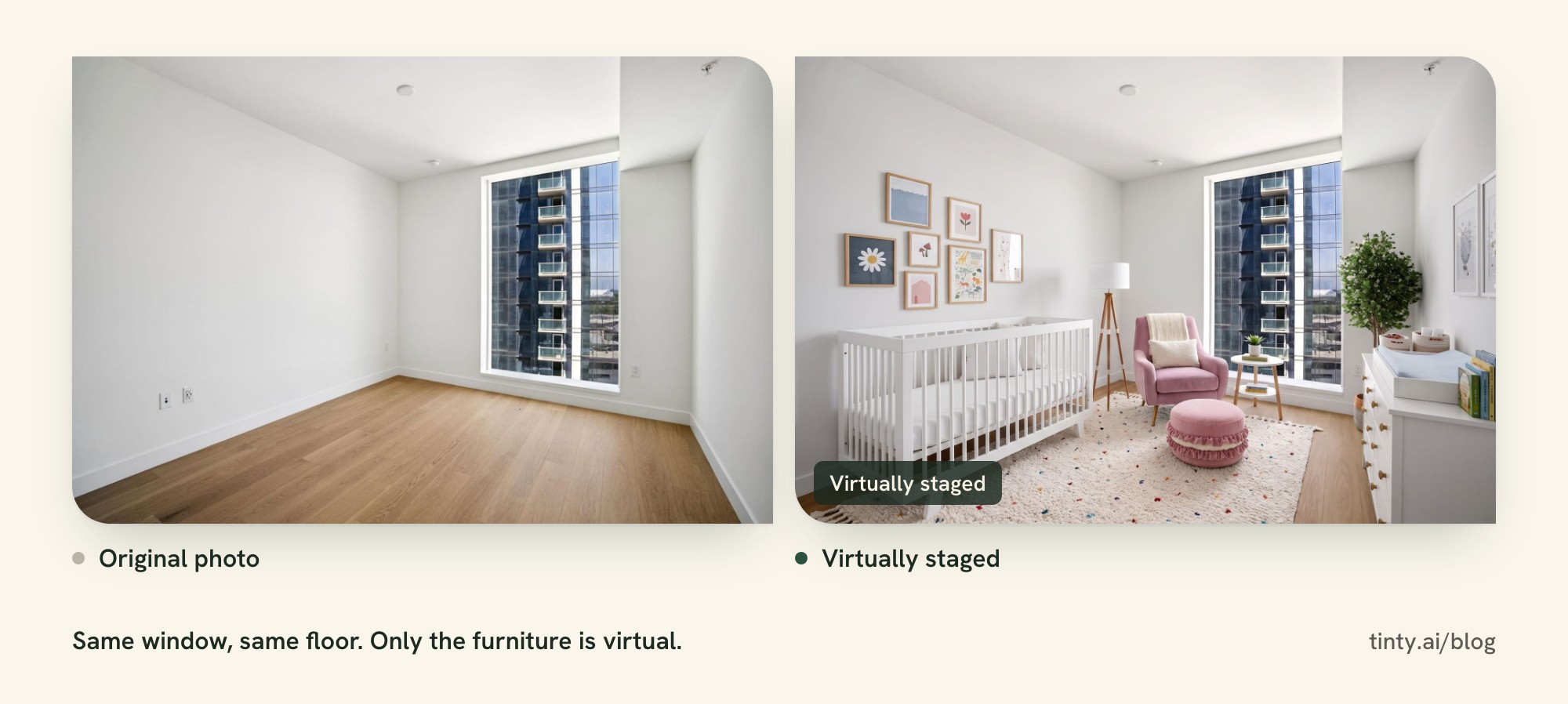
Label every staged photo
This is our cautious checklist, built from the rules above:
- Stage furniture only. Leave walls, floors, windows and views as shot.
- Label each staged photo. Write “Virtually staged” in the photo caption.
- Add one line to the remarks. For example: “Some photos are virtually staged. Furniture is not included.”
- Keep the empty original in the listing, next to the staged photo.
- Use the same photos everywhere you publish the listing.
- Ask your broker about house policy before you post.
With TINTY, you upload a photo, pick the room type and a style, and get the staged photo in about a minute. TINTY Studio does it for you by email within 24 hours, and you pay only if you’re happy. TINTY doesn’t stage kitchens, bathrooms or exteriors.
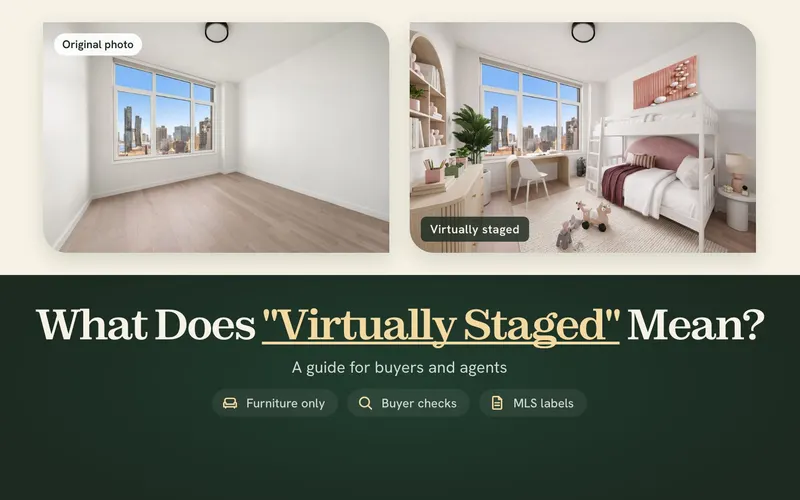
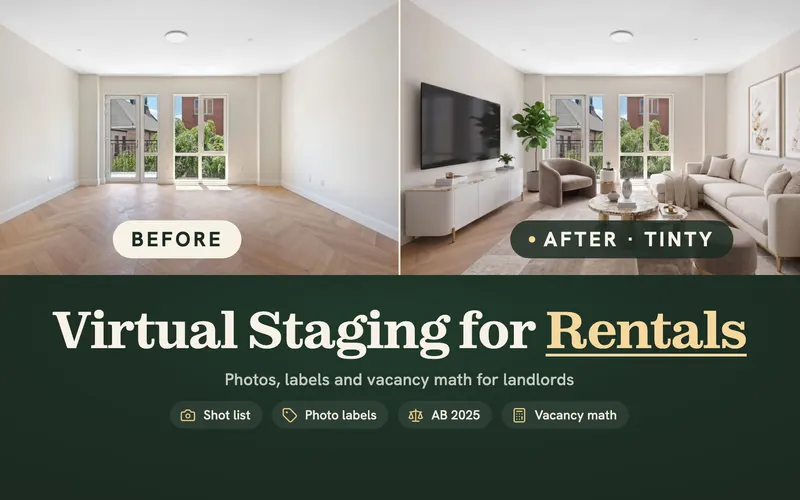
For rentals, follow the same steps now. At about $165 a vacant day, a staged photo set pays for itself if it fills the unit one day sooner. The city’s plan targets rental ads first, and our virtual staging for rentals guide covers what landlords should shoot. Our guide to what “virtually staged” means shows how buyers read the labels.
Virtual staging NYC FAQ
Is virtual staging legal in New York?
Yes. As of November 25, 2026, no New York law bans it or regulates it by name. Listing photos must still give an honest and accurate depiction under state rules. Bills S9584 and A11635 would add disclosure duties if they pass.
How many NYC listings are virtually staged?
At least one in ten in Manhattan. On November 25, 2026, StreetEasy showed 641 sale listings described as virtually staged, out of 6,365. Listings staged without a label aren’t counted.
Which NYC brokerages use virtual staging most?
By listing count, Compass, Corcoran and Douglas Elliman. In our November 2026 count they had 154, 96 and 78 of the 641 labeled listings. Larger firms have more listings overall, so this shows volume.
Does REBNY require a “virtually staged” watermark?
We found no such rule in REBNY’s 2026 RLS rules or its Code of Ethics. REBNY does bar inaccurate or misleading ads. Label staged photos in the caption and the remarks, and ask your broker about house policy.
How much does virtual staging cost in NYC?
The same as anywhere in the US, because the work is done online. AI apps cost under $1 a photo, and hand-finished photos cost about $10. Physical staging in New York starts near $5,000 for a studio.
What is the fine for a misleading listing photo in New York?
The Department of State can fine a licensee up to $2,000, or suspend or revoke the license, under Real Property Law §441-c. OneKey MLS also lists inaccurate images on its schedule of automatic fines.
How we researched this
We counted listings on StreetEasy on November 25, 2026. We read every page of sale listings “described as virtually staged” in Manhattan and noted the brokerage on each. Featured listings repeat across pages, so we removed duplicates and got 641 unique listings from 90 firms.
We read New York’s advertising regulation, the license law, both bills, REBNY’s 2026 RLS rules and Code of Ethics, and OneKey MLS’s Rules and Procedures. We first read them on October 3, 2026, and checked them again on November 25, 2026. Market numbers come from the city’s Housing and Vacancy Survey, Corcoran and Miller Samuel.
Sources
Show 15 sourcesHide sources
- NYC Housing and Vacancy Survey 2023: selected initial findings (PDF)
- Corcoran: Manhattan real estate market report, 3Q 2026 (October 2, 2026)
- Brick Underground: Manhattan and Brooklyn rental market report, October 2026 (Miller Samuel figures)
- StreetEasy: Manhattan sale listings described as virtually staged (count read November 25, 2026)
- CityRealty: Is that apartment real? AI-altered listing photos face growing scrutiny (September 22, 2026)
- Brick Underground: How much does it cost to stage your NYC apartment or brownstone? (May 18, 2023) · Who pays to stage an apartment in NYC?
- NYC Mayor’s Office: Rental Ripoff Report release (July 16, 2026)
- New York Department of State: trend alert on AI-generated home listings (November 2025; cites 19 NYCRR §175.25(c)(9))
- New York Real Property Law §441-c
- New York Senate bill S9584 · Assembly bill A11635
- REBNY: compliance and 2026 RLS rules · REBNY Code of Ethics (PDF)
- OneKey MLS Rules and Procedures, version 2026C
- NAR: 2025 home staging report release
- tinty.ai · TINTY Studio · TINTY pricing
- Is virtual staging legal? · Virtual staging cost · Home staging statistics · What does “virtually staged” mean? · Virtual staging for rentals