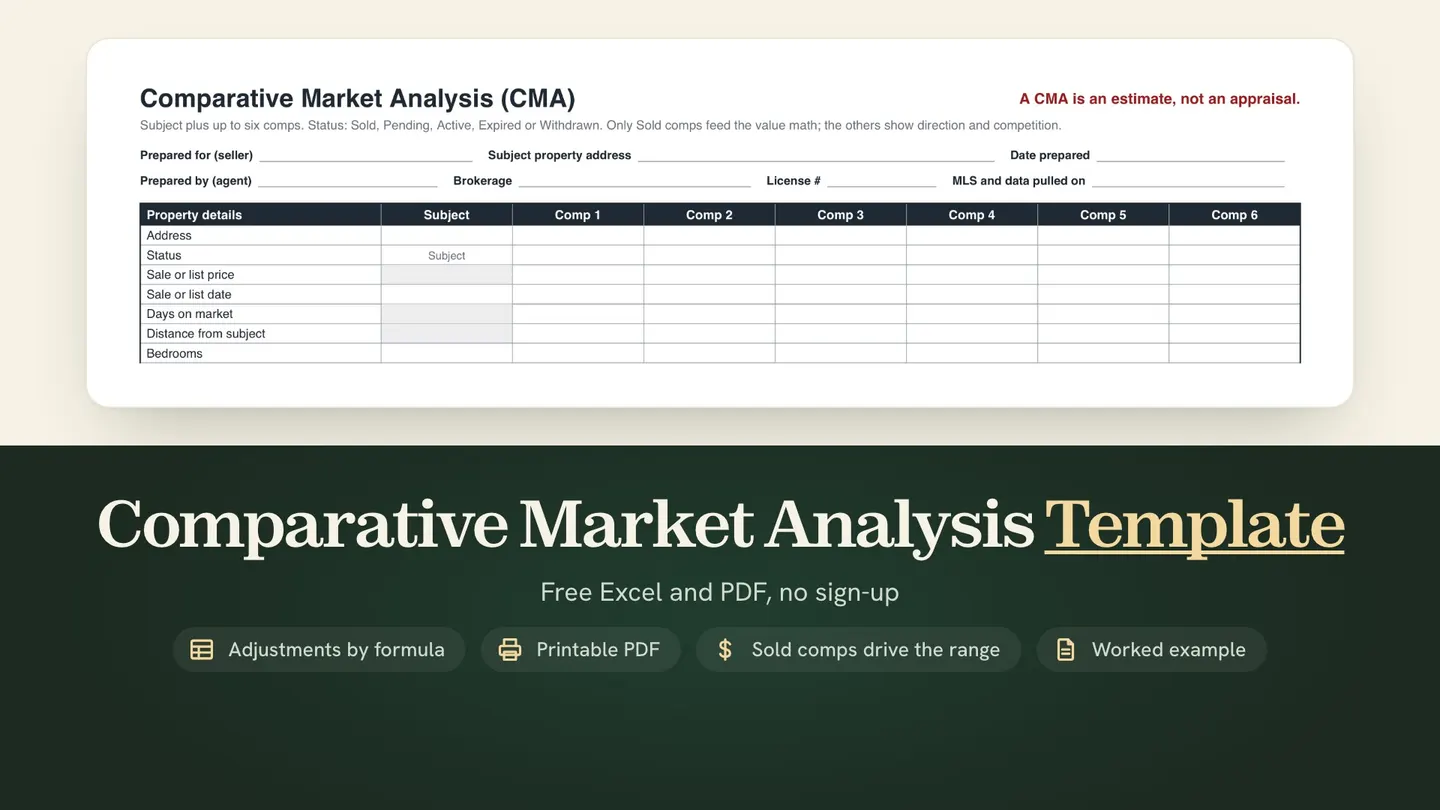
What is a comparative market analysis? A comparative market analysis (CMA) is a real estate agent’s estimate of a home’s likely sale price. It’s built from recent sales of similar nearby homes, adjusted for their differences. Agents use it to suggest a list price range. It isn’t an appraisal, the opinion of value a lender gets from a licensed or certified appraiser.
Download free, no sign-up:
The Excel file does the adjustment math. The PDF is a one-page grid to print and fill in by hand.
We make TINTY, an AI virtual staging app for real estate agents, and we built this template. It’s a pricing aid, not an appraisal or legal advice. State rules and multiple listing service (MLS) rules vary, so check yours.
Rules, market data and TINTY details checked November 6, 2026.
Key takeaways
- Sold homes set the value: pending, active and expired listings show direction and competition.
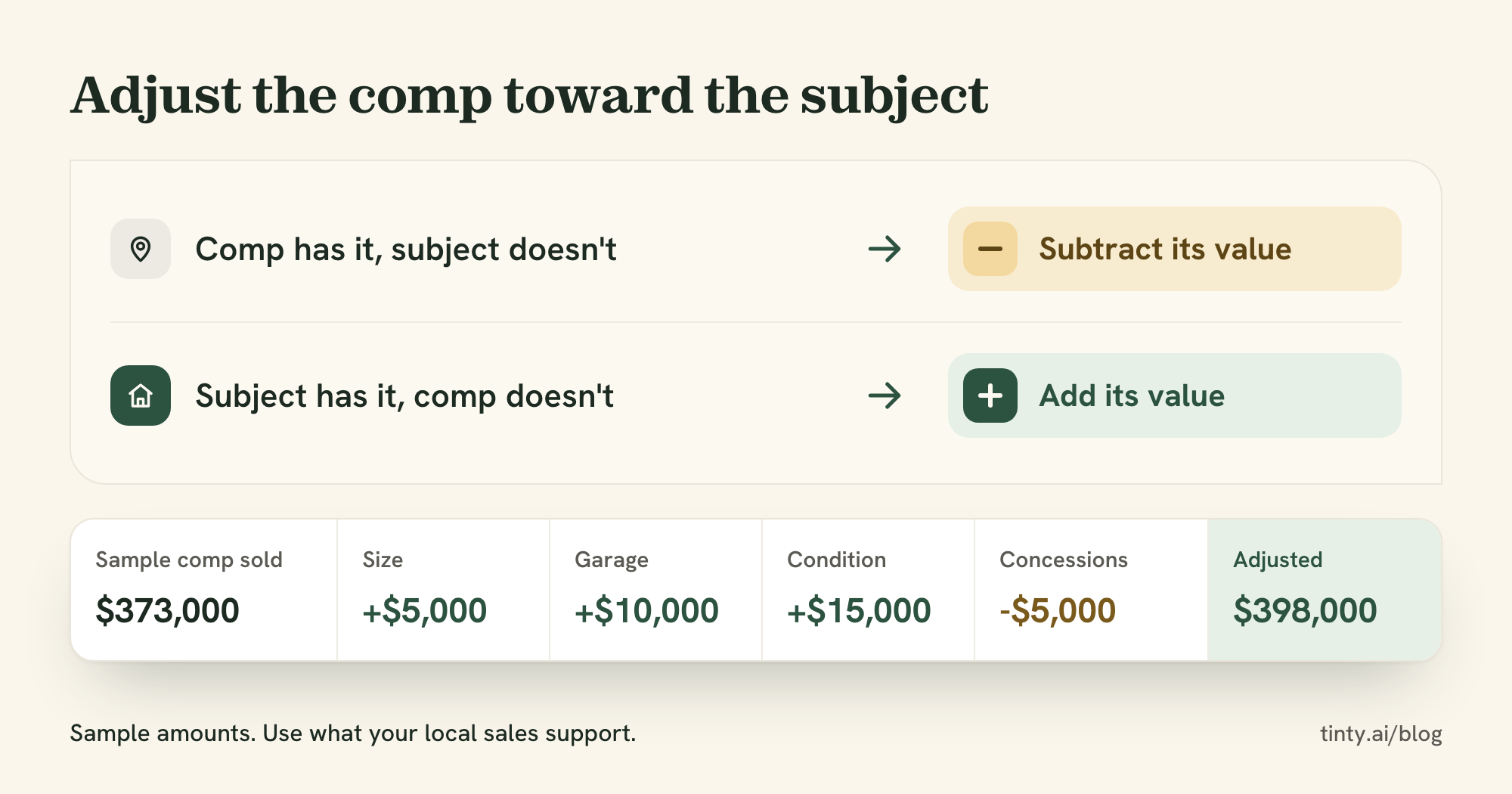
- Adjust the comp toward the subject: subtract for what the comp has and the subject lacks, add for the reverse. Use dollar amounts your local sales support.
- Not an appraisal, not a Zestimate: a CMA is an agent’s price opinion. Texas, for one, requires set wording saying so on every written CMA.
- Fair housing applies: adjust for the home, the lot, location features and market timing, never for who lives in the neighborhood.
On this page: CMA vs appraisal · Template · Steps · Choosing comps · Adjustments · Price range · Photos and condition · Fair housing · CMA report · FAQ
What a CMA is: CMA vs appraisal vs Zestimate
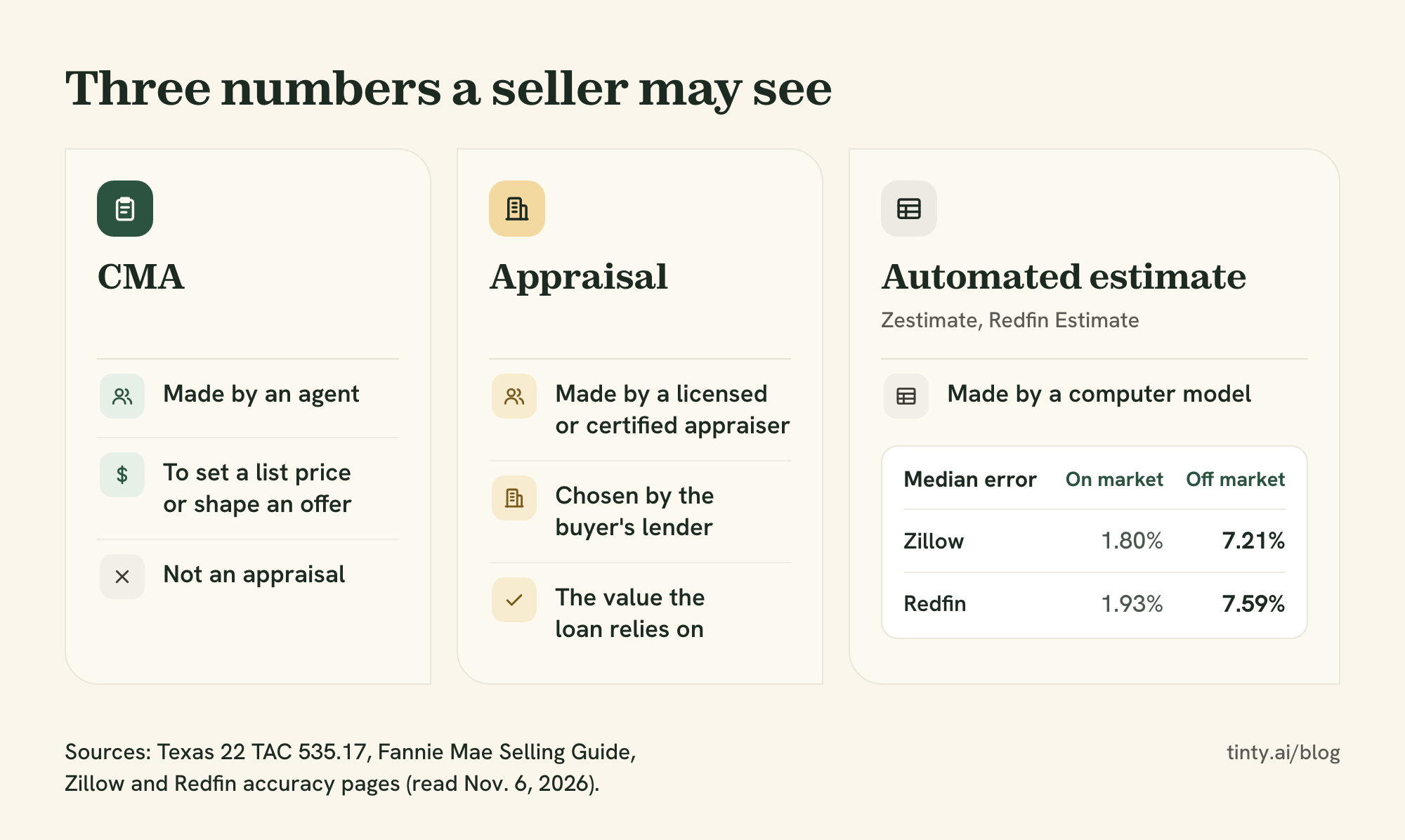
A CMA in real estate is an agent’s opinion of a home’s likely sale price, built from comparable sales. It isn’t an appraisal or an automated estimate, and the three numbers often differ.
Agents build one for a listing appointment or a buyer’s offer. It’s also a low-pressure opener with for sale by owner (FSBO) sellers, as our FSBO prospecting script shows.
Federal law calls an agent’s estimate of a home’s probable selling price a broker price opinion (BPO). A lender can’t use one as the main basis for valuing a buyer’s main home in a purchase mortgage (12 U.S.C. 3355).
Rule: Texas requires this statement on every written CMA, word for word, in at least 12-point type (22 Tex. Admin. Code § 535.17): “This represents an estimated sale price for this property. It is not the same as the opinion of value in an appraisal developed by a licensed appraiser under the Uniform Standards of Professional Appraisal Practice.”
Appraisal: the lender’s opinion of value
An appraisal is a licensed or certified appraiser’s opinion of value, and it’s the number the buyer’s lender relies on. Fannie Mae’s appraiser selection rules require the lender, or its authorized agent, to use state-licensed or state-certified appraisers.
Those appraisers also follow Fannie Mae’s rules for comps, adjustments and condition ratings, which this guide uses as a benchmark. If the appraisal comes in lower, see our low appraisal answer.
Zestimate and other automated valuations
Zillow’s Zestimate, the Redfin Estimate and other automated valuation models (AVMs) are computer estimates. Both companies’ own numbers show they miss most on homes that aren’t for sale:
- Redfin, homes for sale: median error 1.93%; 92.52% land within 10% of the sale price (Redfin’s accuracy page, data updated November 5, 2026).
- Redfin, off-market homes: median error 7.59%; only 59.76% land within 10%.
- Zillow: a nationwide median error of 1.80% on market and 7.21% off market (Zillow’s Zestimate page).
A home not yet listed is off market (our reading). On a $400,000 home, half of off-market Redfin estimates miss by more than about $30,000 (our arithmetic). Both companies say their estimate is not an appraisal.
The Houston Association of Realtors (HAR) MLS requires a disclaimer wherever members’ Internet Data Exchange (IDX) sites show or link to AVM results (HAR MLS Rules). It says the estimate “should not be considered a comparative market analysis (CMA) or appraisal.”
Free comparative market analysis template: Excel and PDF
Our comparative market analysis template comes as an Excel file and a one-page PDF grid, both free with no sign-up. In the Excel file:
- Comp grid: the subject plus six comps, with rows from status, price and date to size, age, garage and condition.
- Adjustment rows: dollar amounts you enter for size, rooms, garage, lot, condition, age, location, concessions and market change.
- Formulas: price per square foot, total adjustments and adjusted price for each comp.
- Summary: low, high, average and median adjusted price from sold comps only, a suggested range and a price per square foot check.
- Example sheet: a filled-in sample with made-up addresses.
Every sheet says “A CMA is an estimate, not an appraisal” and reminds you to use MLS data as your MLS rules allow. It’s a real estate CMA template you can reuse for every listing.
The PDF is one horizontal US Letter page with the same rows, plus lines for your name, brokerage, license number, dates and your state’s statement.
How to do a comparative market analysis in 6 steps
Build a CMA in six steps, from the subject’s facts to a written range:
- Collect the subject’s facts: size, rooms, lot, age, garage, updates and condition, from public records and your walk-through.
- Pull candidates from the MLS: recent sales in the same market area, plus pending, active and expired listings.
- Pick 3 to 6 comps that need the fewest adjustments, and mark each one’s status.
- Adjust each sold comp toward the subject, in dollars your local sales support.
- Reconcile to a range inside the adjusted sold prices, then check it against price per square foot and the competition.
- Write it up with your data source and date, and the statement your state requires.
Choosing comps: market area, recency and similarity

The best comps are recent sales from the same market area that a buyer would weigh against your listing, and they need the fewest adjustments. Fannie Mae’s comparable sales rules for appraisers make a useful benchmark:
- Similar homes: site, room count, finished area, style and condition.
- Same market area: where most of the subject’s buyers come from and where its competition sits.
- Three or more closed sales: pending contracts and current listings count only as supporting data.
- Recent sales: closed within the last 12 months. A slightly older sale with a time adjustment can beat a new one that needs many adjustments.
We found no national rule on radius or look-back for an agent’s CMA. One state’s course page, from the Massachusetts real estate board, says sold comps are “usually within the last six months” and arm’s-length (Mass.gov CMA course page). That leaves out short sales, foreclosures and sales between relatives. Fannie Mae lets appraisers use foreclosures and short sales when they’re the best sales available.
Start close and recent, and widen the search only as far as you need, noting why (our suggestion).
Sold, pending, active, expired: what each status tells you
Only sold comps prove value. The other statuses show where the market is heading and what your seller competes with:
How our template uses each comp status. Status names differ by MLS.
| Comp status | What it tells you | In the template |
|---|---|---|
| Sold (closed) | The price a buyer actually paid | Feeds the adjusted prices, the range and the median |
| Pending (under contract) | Where buyers are committing now | Shown for direction, left out of the value math |
| Active | The homes your seller will compete with | Shown for positioning, left out of the value math |
| Expired or withdrawn | Asking prices that didn’t sell | Shown as a ceiling check, labeled by status |
Pending isn’t sold: in October 2026, 7.8% of pending homes went back to active, Realtor.com reports.
The National Association of Realtors (NAR) model MLS policy wants expired and withdrawn listings in an association’s comparable reports clearly labeled (NAR MLS policy handbook). Our expired vs withdrawn vs canceled guide explains each status.
CMA adjustments: which way and how much
Adjust each sold comp toward the subject: subtract for what the comp has and the subject lacks, and add for the reverse. Fannie Mae’s adjustment rules for appraisers give three guardrails:
- Market-based amounts: adjustments must reflect how local buyers react. Fannie Mae’s own example calls a $20-a-square-foot rule of thumb wrong where the market shows $100.
- Concessions only go down: when a comp’s seller paid buyer costs, such as a rate buydown or closing costs, subtract what the concession added to its price. That isn’t automatically the full amount.
- Time needs proof: an adjustment for market change needs evidence, such as a home price index or paired sales.
Fannie Mae sets no cap on net or gross adjustments, but the best comp needs none. Take the amounts from pairs of local sales that differ in one feature, not from national averages (our suggestion). We found no source for a typical value of a bedroom, bath or garage.
Comparative market analysis example: one comp adjusted
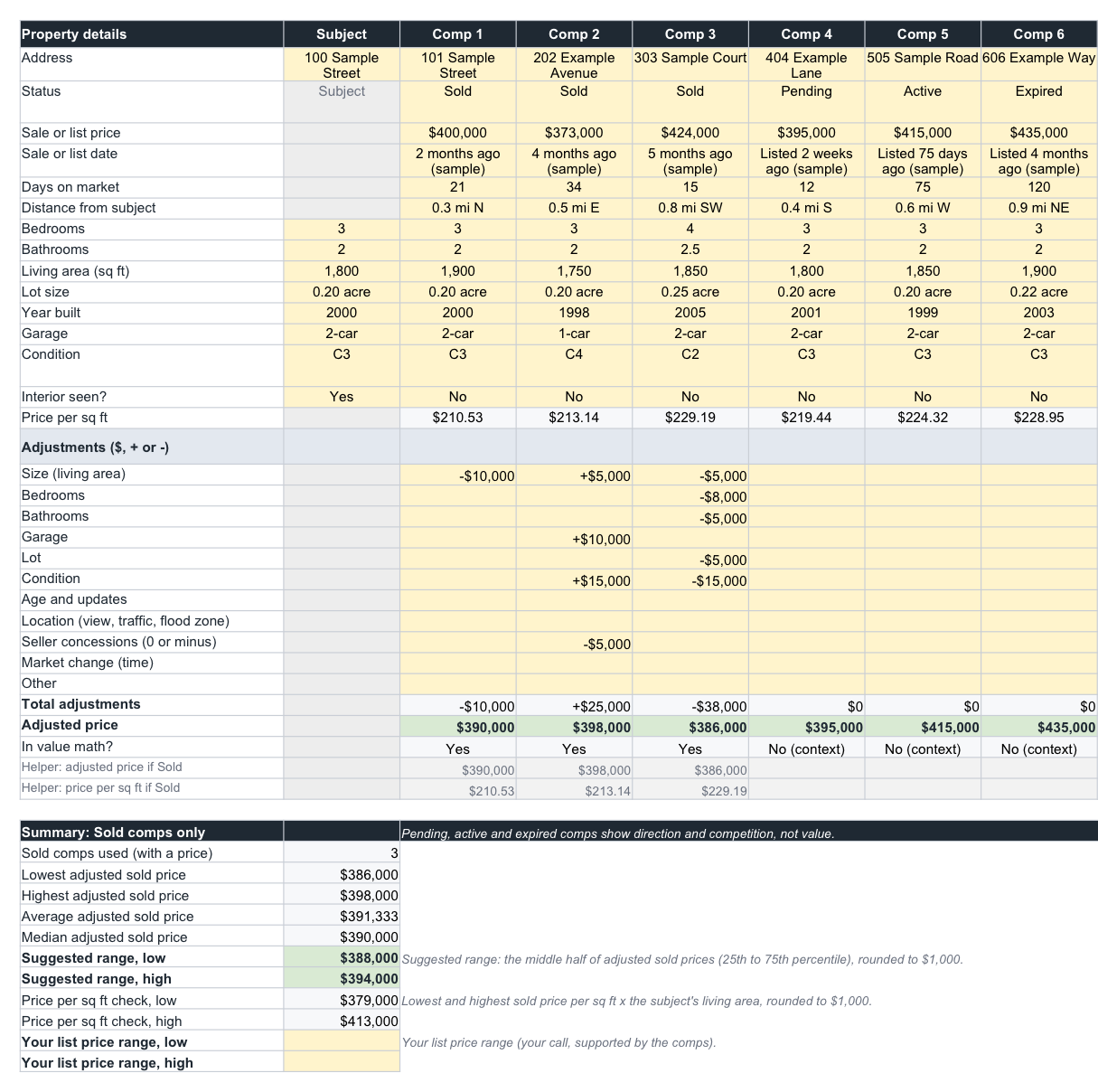
Here’s one comp from our example sheet, adjusted to a sample subject: 1,800 square feet, three bedrooms, two baths, a two-car garage and C3 (“well-maintained”) condition.
Example: a sample comp sold for $373,000. It’s 50 square feet smaller than the subject (+$5,000 at a sample $100 a square foot). It has a one-car garage to the subject’s two (+$10,000) and is in worse condition (+$15,000). Its seller paid $5,000 of the buyer’s costs, and here the market paid all of it (-$5,000). Adjusted price: $398,000.
The same math on the other two sold comps gives $390,000 and $386,000. Every amount is a sample, not a typical value.
From adjusted comps to a list price range
Your suggested price range should sit inside the span of your adjusted sold prices. Fannie Mae holds appraisers to the same rule: the value must fall “within the range of the adjusted sales price of the comparables.”
The template’s suggested range is the middle half of the adjusted sold prices, the 25th to 75th percentile, rounded to $1,000. On the example sheet that’s $388,000 to $394,000, inside the adjusted span of $386,000 to $398,000.
As a cross-check, it multiplies the lowest and highest sold price per square foot by the subject’s living area: $379,000 to $413,000 here. Then let the context comps place the list price.
Pair the range with a net sheet at two or three prices in it. Our free seller net sheet template shows the seller’s estimated proceeds at each.
Photos and condition: rating comps you haven’t walked
Rate each comp’s condition from what a buyer pays for, not from how the photos were furnished: floors, walls, windows, fixtures, updates and the agent remarks. For comps you haven’t been inside:
- One scale for every home: appraisers rate condition from C1 to C6. C3 is “well-maintained” with normal wear; C4 has “some minor deferred maintenance” (Fannie Mae condition ratings).
- Interior seen or not: note it on each comp, so the seller knows which ratings rest on photos.
- Furniture doesn’t count: real or virtual, it usually doesn’t convey with the house, so it gets no adjustment (our reading).
- Staged comp photos: judge the room from what staging shouldn’t change, and expect a label. Our virtual staging laws by state cover the rules.
Where staging fits: after the price, in the marketing plan
Staging belongs in the marketing plan you show after the price, not in the CMA math.
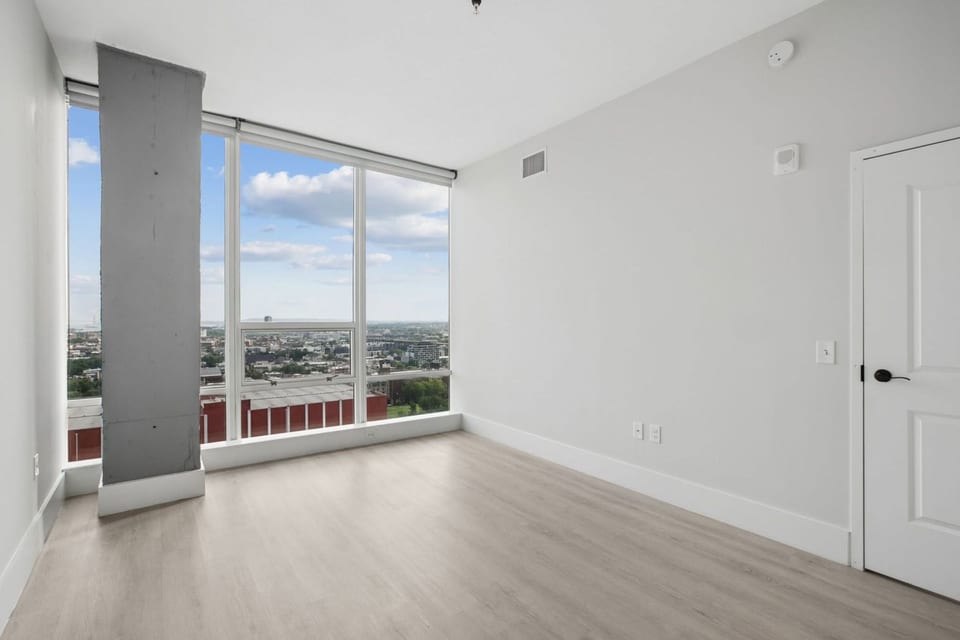
If the seller has an empty room, stage one of their photos free with TINTY and show it with your plan. The 6 free staged photos carry a light watermark and need no card, so use them in the meeting, not on the MLS.
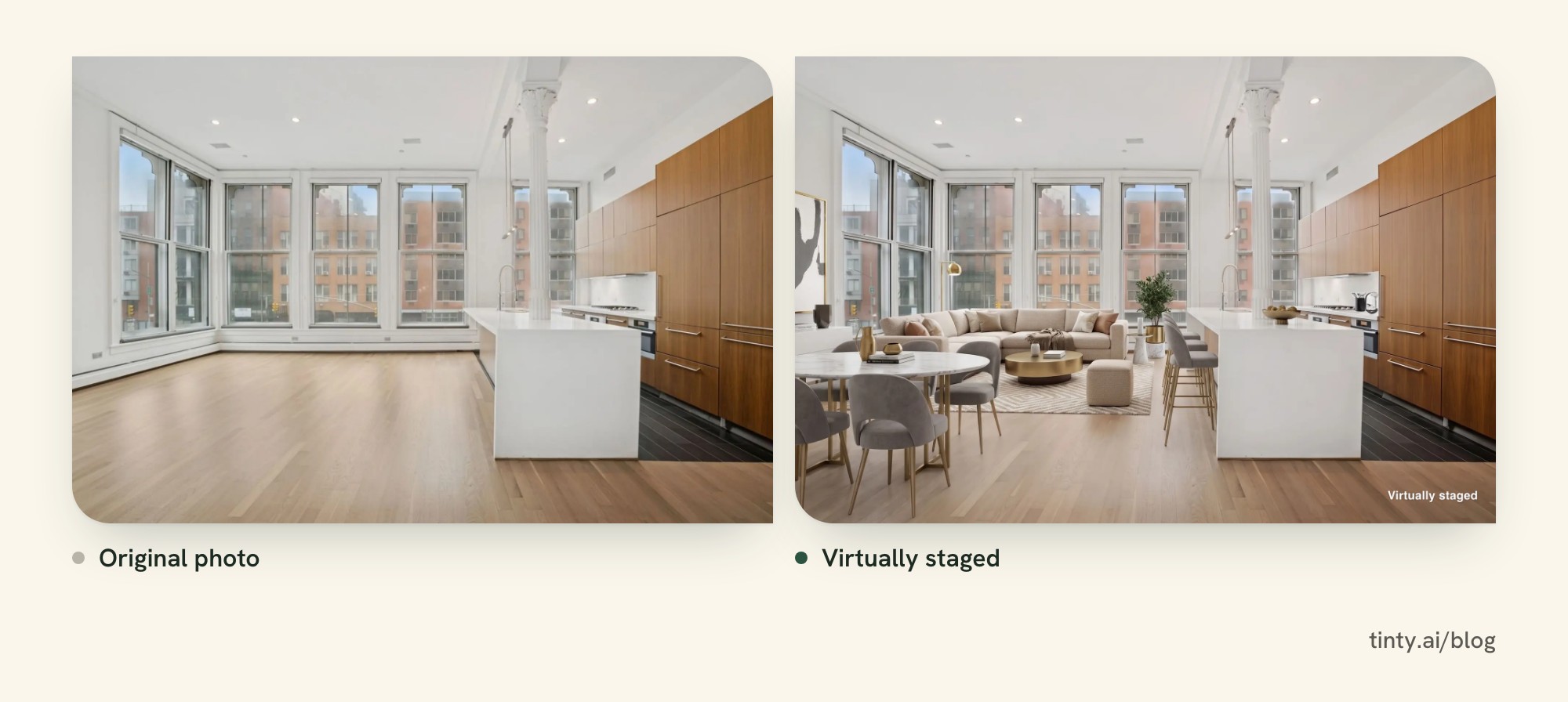
Lived-in rooms work too: TINTY can remove the furniture and decor first, then stage the room. Each removal uses one photo. A staged photo takes about a minute, with an optional “Virtually staged” label. TINTY doesn’t stage kitchens, bathrooms, yards or building exteriors.
Booked solid with listing appointments? Email the room photos to hello@tinty.ai, empty or lived in, with a room type and style for each. TINTY Studio, our done-for-you service, stages them with our AI tools and finishes every photo by hand. A private link comes back in 2 to 24 hours, at $10 a photo from 3 photos, and you pay only if you’re happy.
Fair housing, state and MLS rules for a CMA
Fair housing law limits what you may adjust for; state and MLS rules set what the report says.
Fair housing: adjust for the home, not for who lives nearby
Adjust for the home and the market, never for the protected traits of the people who live nearby. Fair to adjust for, and off limits:
- The home: size, rooms, condition, updates and garage.
- The lot and location features: lot size, view, a busy road or a flood zone.
- Timing: market change backed by data.
- Off limits: the race, color, religion, sex, disability, familial status or national origin of the people who live nearby, and wording that hints at them.
Realtors also may not volunteer the racial, religious or ethnic makeup of a neighborhood (Standard of Practice 10-1). Our template has no rows for neighborhood demographics.
Rule: the Fair Housing Act covers “the selling, brokering, or appraising of residential real property” (42 U.S.C. 3605). A Department of Housing and Urban Development rule defines appraisal as a business opinion of a home’s value tied to a sale, rental or loan (24 CFR 100.135). Our reading: a CMA fits that definition.
For listing remarks, see our list of fair housing words to avoid.
State and MLS rules that shape a CMA
Check your state’s and your MLS’s rules before you hand over a CMA. Four examples:
- Texas: the statement quoted above goes on every written CMA. A sales agent prepares it in the sponsoring broker’s name, and the broker is responsible.
- Maryland: a set disclosure printed on the first page, plus disclosure of any interest you have in a home used as a comp (Maryland Real Estate Commission).
- Massachusetts: the real estate board’s course outline says licensees “must never imply” they’re licensed or certified appraisers.
- Your MLS: NAR’s model policy lets you use MLS sold data to support valuations for clients. Where sale prices aren’t public, an MLS may keep them confidential to its users.
These are examples, not a full list. Ask your broker which wording your state requires, and type it into the template’s statement field on page one.
What goes in a CMA report and how to present it

A CMA report should let the seller follow your math from the comps to the range, with your state’s not-an-appraisal statement up front. What to put in it:
- The subject: facts, updates, condition and whether you saw the inside.
- The comps grid: status, price, date, distance and dollar adjustments for each comp.
- The range: low, high and median adjusted price, and your suggested list price range.
- Market context: the active listings the seller will compete with and the expired ones.
- The fine print: MLS name and data date, your name, brokerage, license number and your state’s statement.
Show the range and let the seller choose the price. Our free listing presentation templates put the comps and the range on slides 6 and 7. If another agent quoted a higher number, ask which sales it rests on; our seller objection scripts include an answer.
Comparative market analysis FAQ
How do I get a comparative market analysis for my home?
Ask a local listing agent, and invite them inside first so the condition rating is real. Massachusetts’ real estate board notes a licensee “may or may not charge a fee” for a CMA. Ask which sold comps the range rests on and how each was adjusted.
How many comps should a CMA have?
At least three sold comps where the market has them, the minimum Fannie Mae requires in an appraisal. Our free CMA template has six comp columns, so there’s room for context comps too.
What does CMA stand for in real estate?
Comparative market analysis. You’ll also see “competitive market analysis,” the name Maryland’s rule uses, and “comparable market analysis.” Whatever the name, it’s an agent’s price estimate, not an appraisal.
Can a seller do their own CMA?
Roughly, yes, where sale prices are public; elsewhere an MLS may keep them for its users. A seller also can’t easily rate condition inside other homes. An agent adds MLS status history, local adjustments and a walk-through.
How long is a CMA good for?
We found no rule that sets an expiry; a CMA ages as fast as the market moves. Rerun it before every price talk and when showings slow: in October 2026, 20.5% of listings on Realtor.com had a price cut. Our stale listing guide covers the refresh.
What if the appraisal comes in lower than the CMA?
You may ask that the appraiser consider other comparable sales, but you may not pressure the appraiser toward a number. Federal valuation rules for loans on a buyer’s main home (12 CFR 1026.42) allow the first and ban the second, and they reach real estate agents.
How we researched this
We read every source on November 6, 2026 (list below). They range from Fannie Mae’s Selling Guide and federal and state law to MLS rules, NAR policy and the portals’ accuracy pages. We also compared the pages that rank for “comparative market analysis.”
We couldn’t confirm a standard comp radius or look-back, or any effect of listing photos on appraised value. If something here is wrong, email hello@tinty.ai and we’ll fix it.
Sources
Show 21 sourcesHide sources
All pages read November 6, 2026. Dates in parentheses are publication or update dates.
What a CMA is, appraisals and automated estimates:
- 12 U.S.C. 3355, Broker price opinions (Cornell LII)
- 22 Tex. Admin. Code § 535.17, Broker Price Opinion, Comparative Market Analysis, or Sales Price Estimate (Cornell LII) (last amended effective December 6, 2017)
- Fannie Mae Selling Guide B4-1.1-03: Appraiser Selection Criteria (section dated June 4, 2025)
- Redfin: Redfin Estimate accuracy (data updated November 5, 2026)
- Zillow: What is a Zestimate? (nationwide accuracy figures as shown November 6, 2026)
- HAR: MLS Rules and Regulations, rule 18.3.13 (PDF) (dated June 8, 2026)
Comps, statuses and adjustments:
- Fannie Mae Selling Guide B4-1.3-08: Comparable Sales (June 4, 2025)
- Mass.gov, Board of Registration of Real Estate Brokers and Salespersons: RE62RC25, Comparative Market Analysis (CMA)
- Fannie Mae Selling Guide B4-1.3-05: Improvements Section of the Appraisal Report (June 4, 2025)
- Realtor.com: October 2026 Monthly Housing Trends (published November 4, 2026)
- NAR: Handbook on Multiple Listing Policy, 2025 edition (PDF): Policy Statements 7.36, 7.75 and 7.79
- Fannie Mae Selling Guide B4-1.3-09: Adjustments to Comparable Sales (June 4, 2025)
Ethics, photos and condition:
- NAR: 2026 Code of Ethics and Standards of Practice: Standards of Practice 1-3 and 10-1
- Fannie Mae Selling Guide B4-1.3-06: Property Condition and Quality of Construction (June 4, 2025)
TINTY (ours):
- tinty.ai · Done-for-you virtual staging (checked November 6, 2026)
Fair housing and state rules:
- 42 U.S.C. 3605, Discrimination in residential real estate-related transactions (Cornell LII)
- 24 CFR 100.135, Unlawful practices in the selling, brokering, or appraising of residential real property (eCFR)
- Maryland Real Estate Commission: Competitive Market Analysis (regulation effective July 19, 2004)
Appraisals:
- 12 CFR 1026.42, Valuation independence (eCFR)
- 12 U.S.C. 2602, RESPA definitions (Cornell LII): “settlement services” include a real estate agent’s services
Related guides on our blog: