How do you get your house ready to sell? On our suggested schedule, start four to six weeks before listing photos: declutter, depersonalize and book repairs. Two weeks out, deep clean, touch up paint, fix the lights and tidy the yard while you gather documents. Prep each room on the morning of the shoot, then reset the house before every showing.
Download free, no sign-up:
Agents: add your logo and contact details in the Word file, then send it to the seller once the listing agreement is signed.
We make TINTY, an AI virtual staging app for real estate agents, and we built this checklist. It’s general information, not legal advice. Disclosure rules vary by state, so check them with your agent or attorney.
Sources and TINTY details checked November 6, 2026.
Key takeaways
- Start early: four to six weeks before photos is our suggested lead time. Allow longer for big repairs, a move or a pre-listing inspection.
- Do what agents ask most: in a 2025 National Association of Realtors (NAR) survey, agents most often told sellers to declutter, deep clean and improve curb appeal.
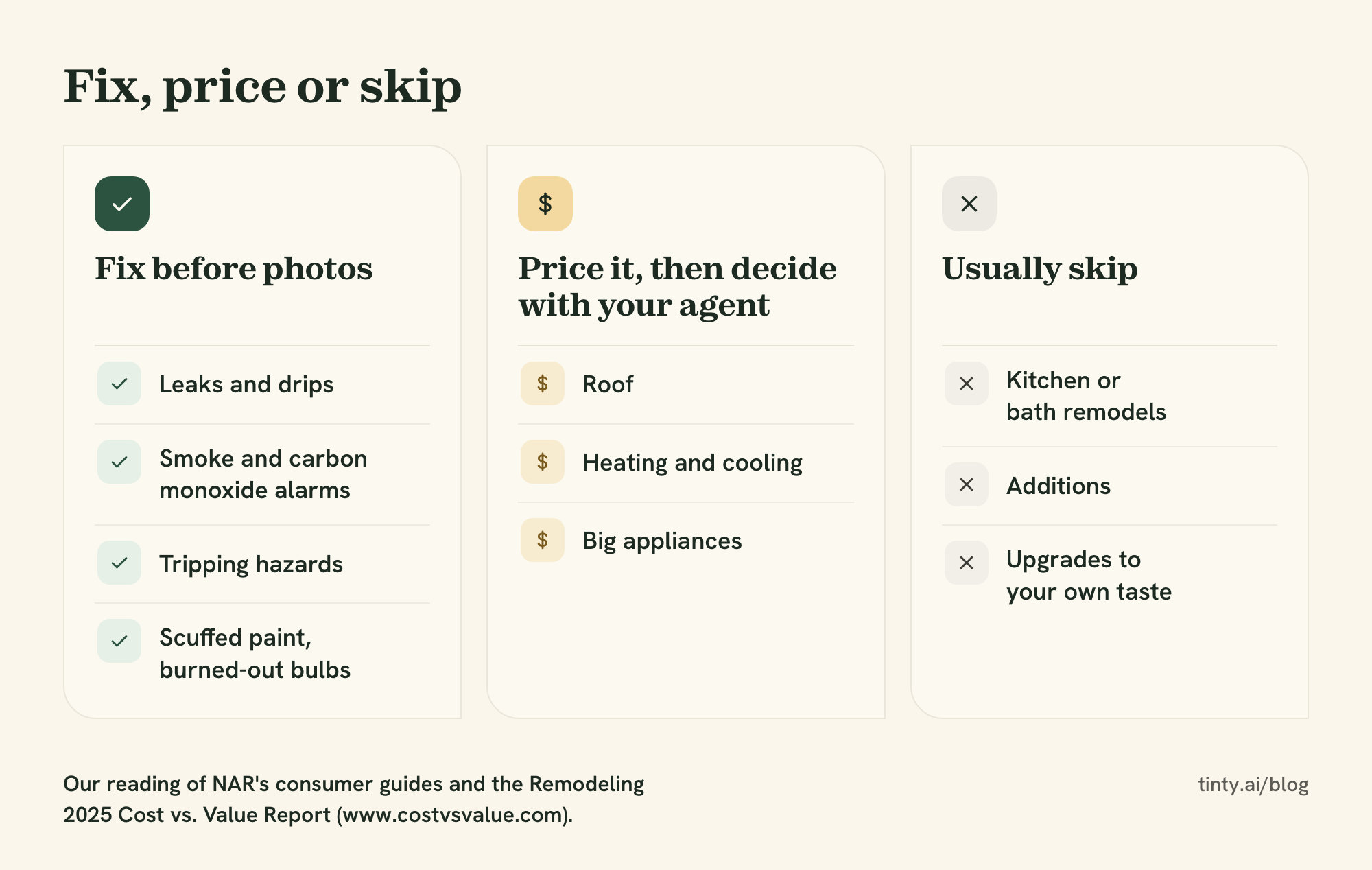
- Fix, price or skip: fix what’s broken or unsafe, get estimates for big items like the roof, and skip remodels. Ask your agent before any large project.
- Photos last: shoot once the house is ready. Empty or crowded rooms can be virtually staged, labeled “Virtually staged”, with the original photo kept.
On this page: Free checklist · Timeline · 4 to 6 weeks out · What not to fix · Inspection · 2 weeks out · Documents · Staging plan · Photo day · Showings · FAQ
Getting house ready to sell checklist: free PDF and Word
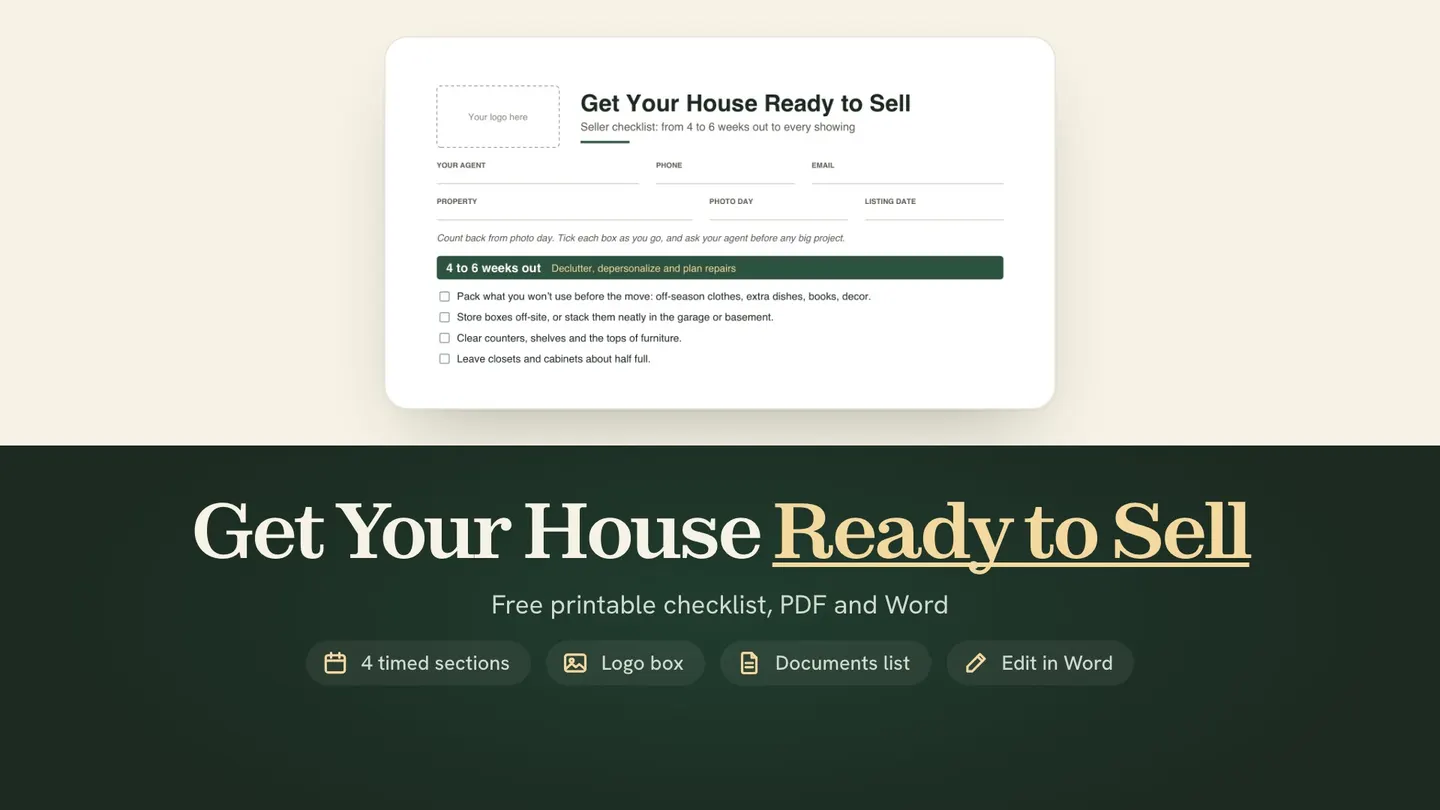
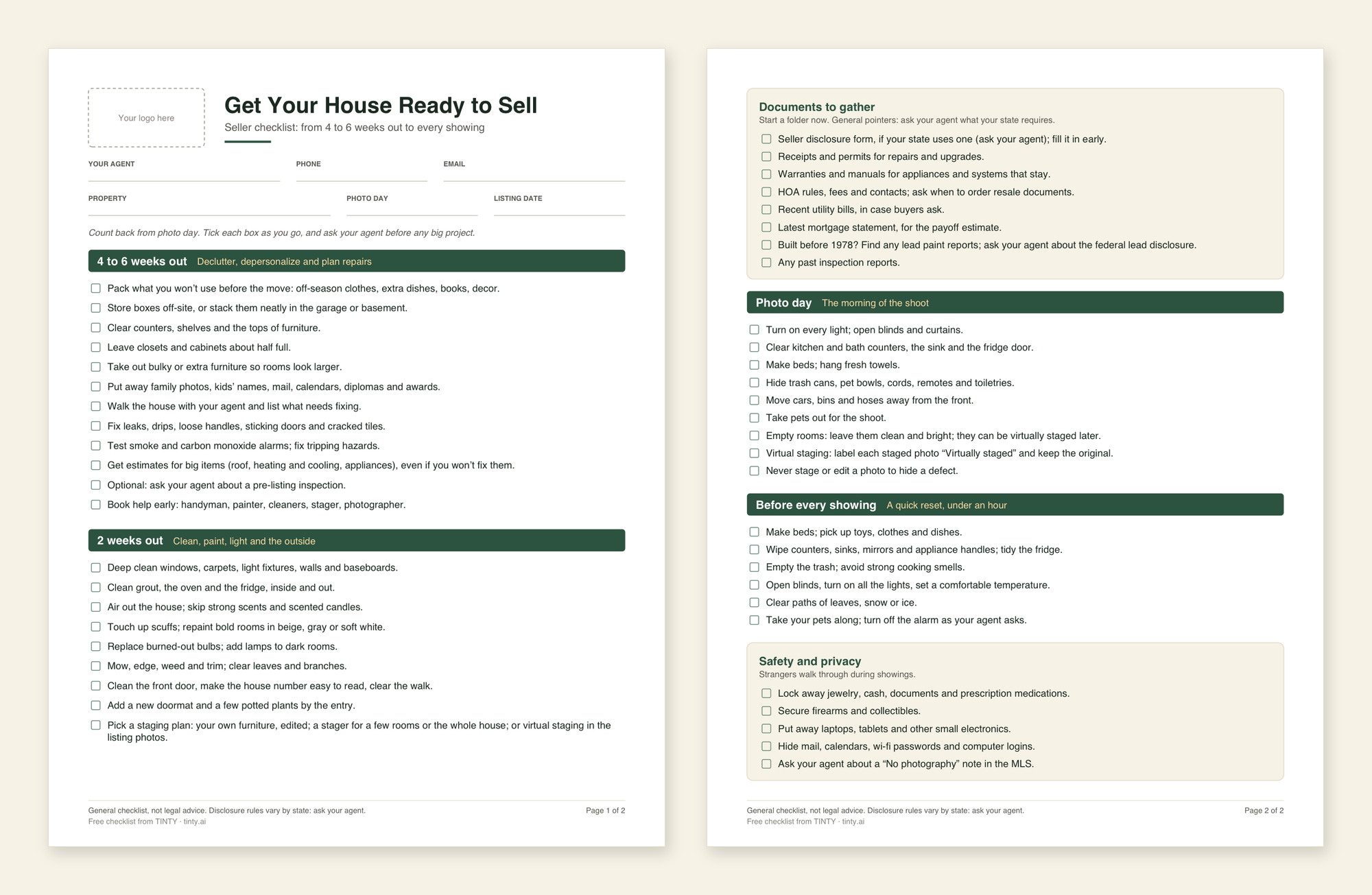
Our free checklist puts every job in this guide on two printable pages, sorted by timing. What’s on it:
- Header: a “Your logo here” box and lines for the agent’s name, phone and email, the property, photo day and listing date.
- Four timed sections: 4 to 6 weeks out, 2 weeks out, photo day, and before every showing.
- Documents box: the papers to start gathering now, as general pointers.
- Safety and privacy box: what to lock away before strangers walk through.
- 49 checkboxes, and a footer that says it’s general information, not legal advice.
It shows how to prepare your house for sale, in the order the jobs come up. The PDF prints on US Letter paper; in the Word file you can edit any line or add your logo.
For listing agents: add your logo and hand it over
Use it as your pre-listing checklist for sellers: brand it and write in the photo date. Slide 10 of our free listing presentation templates is “Getting the home ready,” so the list can start there.
How to get your house ready to sell: the timeline at a glance
The things to do before selling your house fall into four stages, from 4 to 6 weeks out to every showing. The schedule is ours, not a rule: no primary source we read sets one.
Starting early helps because there’s usually a lot to sort. In NAR’s 2026 Profile of Home Buyers and Sellers, sellers had owned their homes a median of 12 years, an all-time high.
Our suggested schedule.
| When | What to do | Who can help |
|---|---|---|
| 4 to 6 weeks out | Declutter, depersonalize, list and book repairs, decide on an inspection | Your agent, a handyman, movers or storage |
| 2 weeks out | Deep clean, touch up paint, fix the lights, tidy the front, gather documents, pick a staging plan | Cleaners, a painter, a stager |
| Photo day | Lights on, counters clear, beds made, cars and pets out | Your agent and the photographer |
| Before every showing | Reset in under an hour and lock away valuables, then leave with the pets | You |
4 to 6 weeks out: declutter, depersonalize and plan repairs
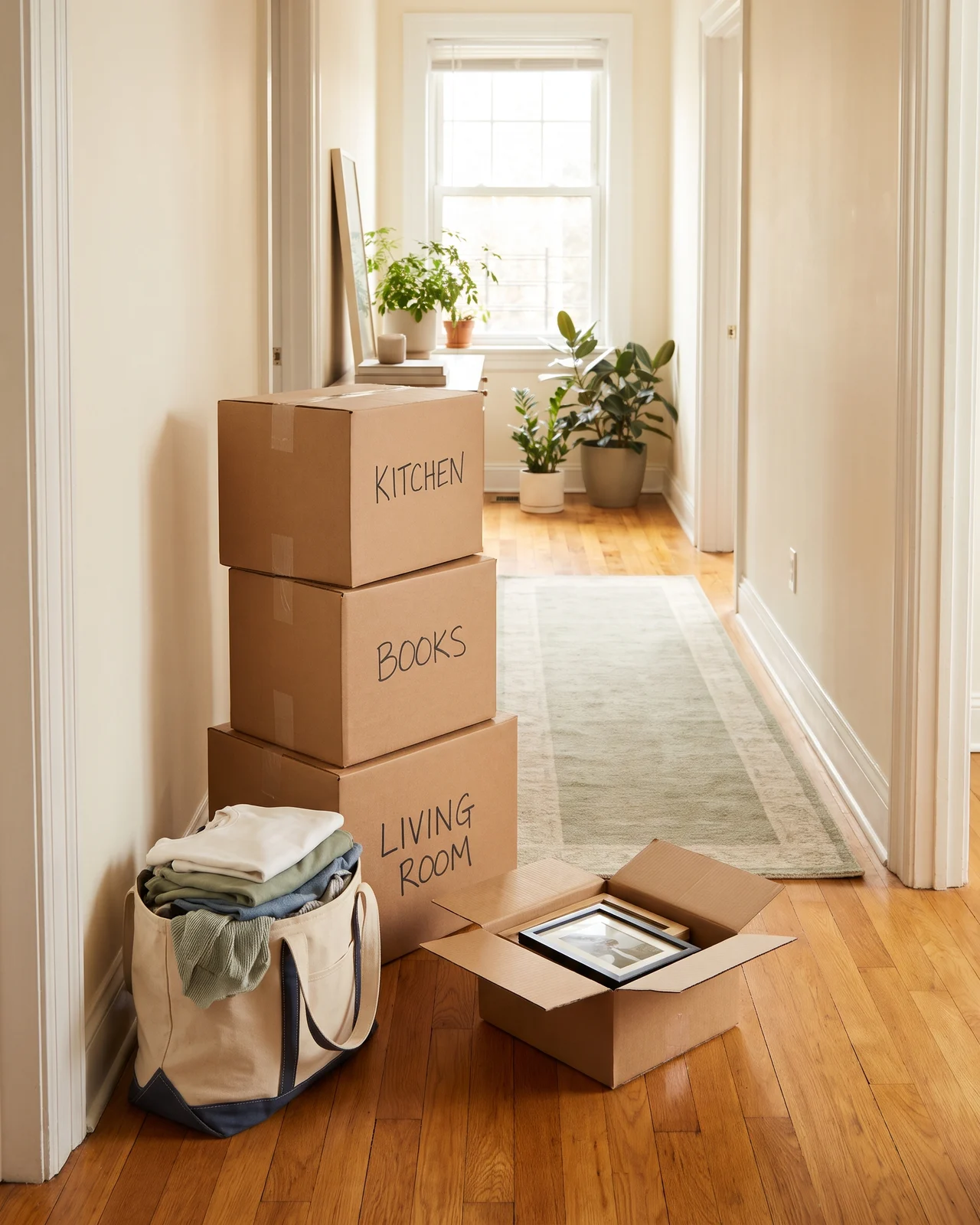
Spend the first weeks on the slow jobs: sorting and packing, and getting repairs booked before the trades fill up. In NAR’s 2025 Profile of Home Staging, a survey of 1,266 Realtors in February 2025, sellers’ agents recommended decluttering (91%), minor repairs (75%) and depersonalizing (72%) before listing.
Declutter room by room, starting with what you won’t miss
Pack first what you won’t use before the move, so the rooms look bigger in photos and at showings. Start with:
- Off-season clothes, extra dishes, books and spare decor.
- Counters, shelves and the tops of furniture, cleared.
- Closets about half full: NAR’s staging guide says “Closets should be half full, not filled to the max.”
- Bulky or extra furniture, moved out so rooms read larger.
- Boxes stored off-site, or stacked neatly in the garage or basement.
Depersonalize for privacy as well as looks
Put away what tells strangers who you are. It keeps the focus on the house, and it keeps your family’s details off the internet.
NAR’s privacy and safety guide lists family photos, calendars, mail, computer logins, wi-fi passwords and sensitive documents. It adds: “Even diplomas, awards or books can give away more than you realize.”
Listing photos go to the multiple listing service (MLS) with your permission, and from there to brokerage sites and portals.
Repairs worth making before you list
Fix what’s broken or unsafe now, because a buyer’s inspector will look for exactly that. Put these on the list:
- Leaks, drips, loose handles, sticking doors and cracked tiles.
- Safety items: test smoke and carbon monoxide alarms and fix tripping hazards. NAR’s home inspection guide names both among common findings.
- Big-ticket items: get a price for the roof, heating and cooling or an appliance. NAR’s guide to preparing to sell says to do it “even if you do not plan to fix it before selling.”
- Trades booked early: a handyman, a painter, cleaners and a photographer.
Before you commit, ask your agent to add each repair you’ll pay for to a free seller net sheet, so you see what it does to your proceeds.
What not to fix when selling a house
Skip big remodels and upgrades to your own taste before you sell. NAR’s guide to preparing to sell says cosmetic updates aren’t required.
Some agents do recommend big jobs: 37% of Realtors recommended new roofing before listing in the 2025 Remodeling Impact Report. So treat a big job as a decision with your agent, not a default.
The Remodeling 2025 Cost vs. Value Report (www.costvsvalue.com) found that “the more complex the project, the lower the return on investment at the time of house sale.” Eight of its 10 best-returning projects were exterior replacements, led by a new garage door.
Pre-listing inspection: optional, with a trade-off
A pre-listing inspection is optional: it finds problems before a buyer does, but anything it turns up may have to be disclosed.
Rule: “No, a pre-sale inspection is not required,” says NAR’s guide to preparing to sell. If one turns up a problem, NAR’s advice is to talk to your agent about your state’s disclosure requirements.
NAR’s guide says an inspection covers the structure, exterior, roof, plumbing, electrical, heating and cooling and more. A typical one costs about $300 to $500, according to Fixr, a figure NAR’s consumer site cites too. Buyers typically pay for their own inspection and may still order one.
In July 2026, 14% of home-sale agreements fell through nationwide, the highest share since November 2023, Redfin reports. Redfin names an inspection before listing as one way sellers can lower that risk. It tends to pay off when:
- The home is older: a broker quoted on NAR’s consumer site recommends one for older homes.
- You want to know the home’s condition before you set the price.
- You want more negotiating power and an early start on repairs, as the American Society of Home Inspectors (ASHI) notes.
ASHI’s advice for a fixer-upper is the opposite: skip the inspection and list the home low enough that buyers can do the work themselves.
2 weeks out: deep clean, paint, light and curb appeal
Two weeks out, switch from fixing to finishing: a deep clean, fresh paint where it’s needed, every bulb working and a tidy front. Agents in NAR’s survey recommended cleaning the whole home (88%), curb appeal (77%), carpet cleaning (74%), paint touch-ups (67%) and landscaping (53%).
Deep clean the whole house once
Clean once, top to bottom, then keep it that way until the sale closes. Don’t skip:
- Windows, carpets, light fixtures, walls and baseboards.
- Grout in the kitchen and bathrooms.
- Appliance doors and handles, and the inside of the fridge: “Buyers will open it,” NAR’s showing checklist warns.
- Smells: buyers may be sensitive to strong perfumes and scented candles, per NAR’s winter selling tips.
- Stained carpets, cleaned by a professional.
Paint and lighting: neutral walls, every bulb working
Paint is the project Realtors recommend most before listing: 50% suggested painting the entire home and 41% a single room in the Remodeling Impact Report. NAR’s staging guide suggests neutral colors “like beige, gray or soft white.”
For light, NAR’s winter tips say to “Replace burned out lightbulbs, add standing lamps to darker spaces, and turn on all the lights for showings.”
Curb appeal: the first photo and the first impression
The front of the house is in the listing photos and is the first thing buyers see, so give it a weekend. NAR’s guide to preparing to sell points to landscaping, the front entrance and paint: “These steps may help improve the home’s appearance in photos.”
Its staging guide adds a doormat, a well-kept yard and small potted plants at the entry. In fall and winter, clear leaves and branches, and keep the driveway and paths clear with rock salt or sand.
Documents to gather before you list
Start a folder now: your agent needs some of these papers for the listing, and NAR’s seller handoff checklist asks for several again at closing. Put these in it:
- Seller disclosure form: most states have a standard form, often due before the buyer signs a binding contract, per NAR’s seller disclosures guide. Ask your agent for yours and fill it in early.
- Repair records: receipts and permits for work you’ve done, since sellers typically list completed repairs.
- Manuals and warranties for appliances and systems that stay, noting which warranties transfer.
- Homeowners association (HOA) papers: rules and fees, as NAR’s HOA guide explains them, plus board contacts. Ask your agent when to order resale or estoppel documents.
- Utility bills from the last year, in case buyers ask.
- Mortgage statement, so your agent can estimate the payoff.
Not sure whether something must be disclosed? NAR calls disclosing it “best practice to avoid potential legal liabilities in the future.”
Rule: for most homes built before 1978, sellers must give buyers the federal pamphlet “Protect Your Family From Lead in Your Home.” They also disclose known lead paint and hazards, plus any reports. Buyers get 10 days to test unless they waive it, or both sides agree otherwise, in writing (Code of Federal Regulations, 40 CFR 745, subpart F).
Choose a staging plan: your furniture, a stager or virtual
Decide how each room will look before photo day. Staging “is not required,” NAR’s guide to preparing to sell says.
What agents in NAR’s survey do:
- Your own furniture: 51% of sellers’ agents don’t stage, but ask sellers to declutter and fix faults.
- Staging: 21% stage every listing, 10% only hard-to-sell homes and 5% only high-priced ones.
- Virtual only: 8% of sellers’ agents only virtually stage their listings.
For what to do in each room, see our room-by-room guide to staging a house. Our home staging cost guide prices each option, from a single consultation to a fully furnished vacant house.
Virtual staging and furniture removal in the photos
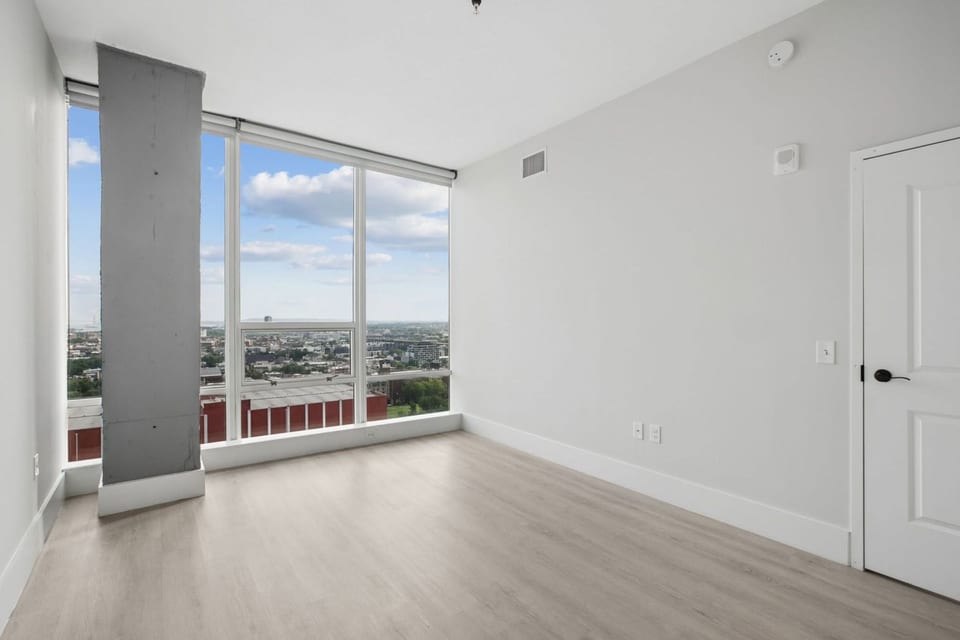
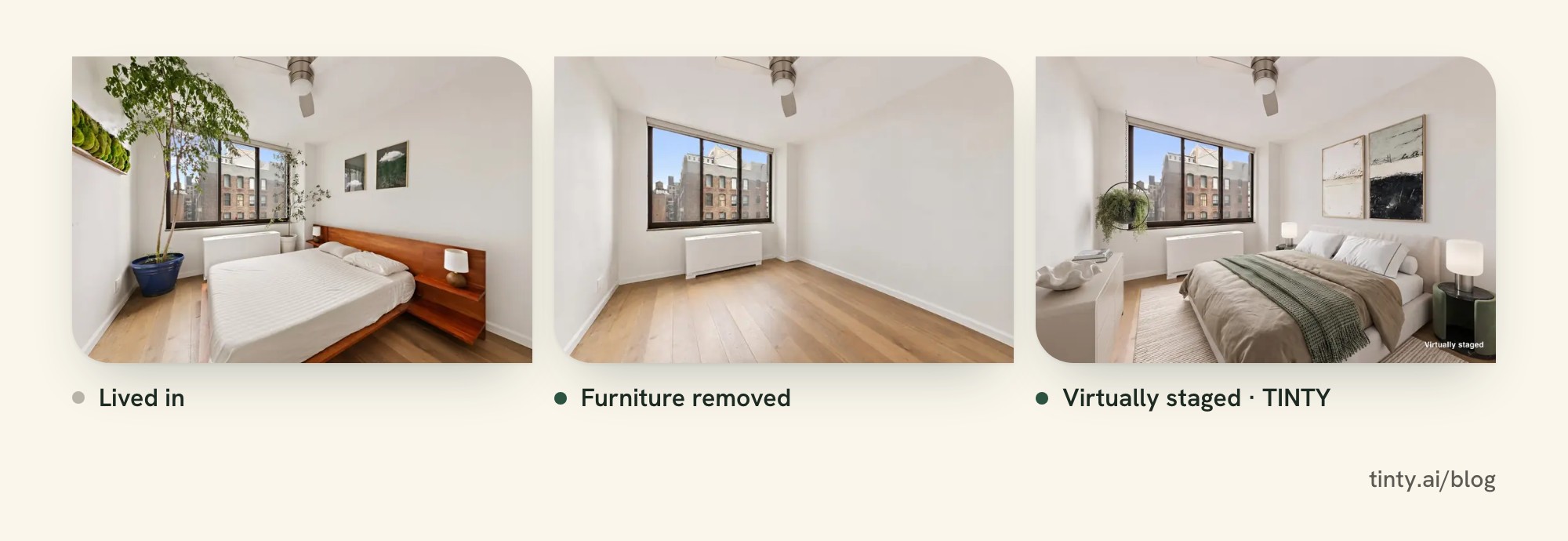
Buyers still walk the real rooms, so virtual staging doesn’t replace decluttering. It fixes photos of rooms that are empty, or still crowded after you’ve packed.
Lived-in rooms: TINTY can first remove the furniture and decor, keep built-ins like cabinets and radiators, and then stage the empty room. Each removal uses one photo. Empty rooms go straight to staging, and a staged photo takes about a minute.
TINTY stages living spaces such as living rooms, bedrooms, dining rooms and home offices, but not kitchens, bathrooms, building exteriors or yards. Those rooms get the real prep from the checklist.
Plans start at $9 a month for 10 staged photos, or $29 once for 30, on TINTY’s pricing page. These are launch prices, so they may change. Stage a room photo free with TINTY. The 6 free staged photos carry a light watermark and need no card, so use them to test the look, not on the MLS.
Photo day: get each room ready for the camera
Book the photos only after the cleaning and repairs are done, because buyers see the photos long before they see the house. In NAR’s staging survey, 88% of sellers’ agents said photos were much more or more important to their clients.
The morning of the shoot:
- Every light on, and blinds and curtains open.
- Kitchen and bath counters, the sink and the fridge door cleared.
- Beds made and fresh towels out.
- Trash cans, pet bowls, cords, remotes and toiletries out of sight.
- Cars, bins and hoses away from the front of the house.
- Pets out of the house for the shoot.
Shooting the listing on a phone? Our iPhone listing photo guide covers camera height, the corner shot, light and a room-by-room shot list. TINTY’s tip for empty rooms: “A bright, level shot taken from a corner gives the AI the most to work with.”
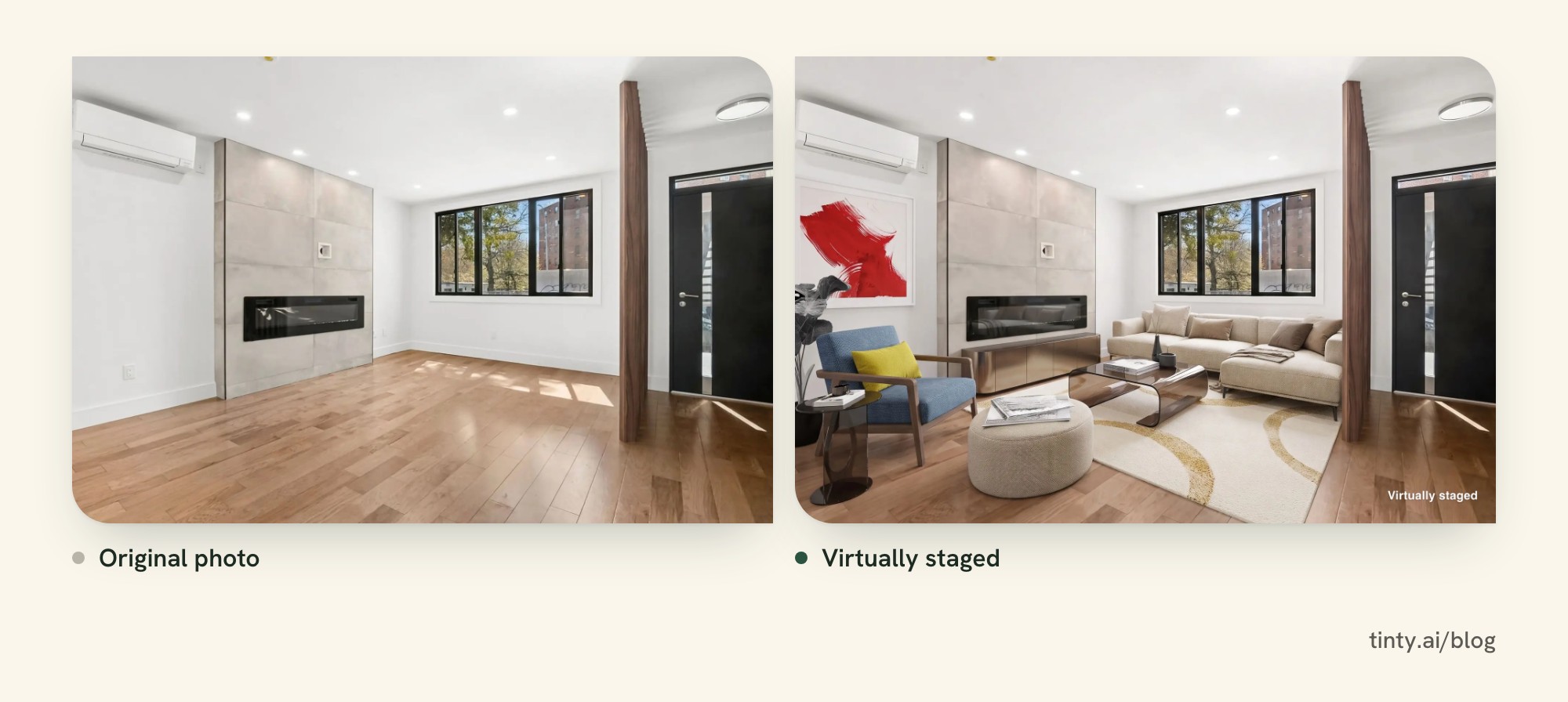
Listing agents with no time to stage photos can email them to hello@tinty.ai, empty or furnished, with the room and style for each. Our team at TINTY Studio removes the furniture where needed, stages each photo with TINTY’s AI tools and finishes it by hand. The private link arrives in 2 to 24 hours, it’s $10 a photo with a 3-photo minimum, and you pay only if you’re happy.
Showings: a quick reset and your valuables locked away
Before each showing, reset the house and lock away anything valuable or private. NAR’s showing checklist says you’ll soon get it done in under an hour. The quick reset:
- Beds made; toys, clothes and dishes picked up.
- Counters, sinks, mirrors and appliance handles wiped.
- Trash out, and no strong cooking smells before a showing.
- Blinds open, every light on and a comfortable temperature.
- Paths clear of debris, snow or ice.
- Pets taken along and the alarm off, as your agent asks.
Lock up jewelry, sensitive documents, firearms and prescription medications in a small lockbox or safe, and put away small electronics. NAR’s privacy guide also suggests asking your agent for a “No Photography” note in the MLS.
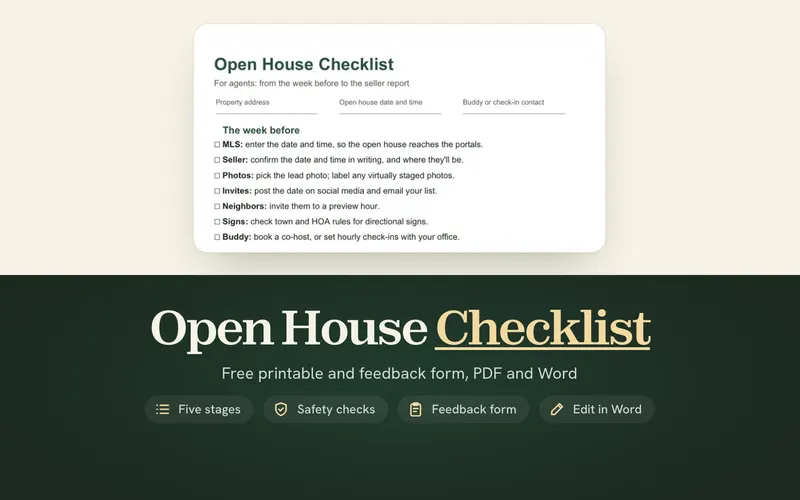
Hosting an open house too? Our open house safety steps add a buddy, check-in calls and a careful lock-up at the end.
Getting your house ready to sell: FAQ
How far ahead should I start getting my house ready to sell?
Four to six weeks before listing photos works if the house needs sorting, small repairs and cleaning. That’s our suggested schedule, not a rule. Start earlier for bigger repairs, a pre-listing inspection or a move, and count back from the photo date your agent books.
How do I get my house ready to sell in 30 days?
Squeeze the checklist into four weeks. In week 1, declutter and book repairs; in week 2, finish repairs and touch up paint. In week 3, deep clean, tidy the front and gather documents; in week 4, prep for photo day and list. Drop any project that can’t be finished before the photos.
What’s the cheapest way to get a house ready to sell?
Do the jobs that cost time more than money: declutter, clean, touch up paint, replace burned-out bulbs and tidy the front. They are also among the top items agents in NAR’s 2025 survey recommend. Hire help only for what you can’t do yourself.
What mistakes should I avoid when preparing a house for sale?
NAR’s staging guide names overcrowded rooms, a house that isn’t clean, political or religious decor and personal information, a neglected entry, and overly bold paint or decor. Two more from this guide: starting a remodel you can’t finish before the photos, and editing a listing photo to hide a defect.
Can I sell my house as-is instead of fixing it?
Yes. Selling as-is means you make no guarantees about the home’s condition and won’t make repairs, as NAR’s inspection guide puts it. It doesn’t change your state’s disclosure rules, and buyers can still inspect.
What if my house doesn’t sell after all this prep?
Ask your agent what buyers are saying, and fix that before cutting the price. In October 2026 the median US listing spent 63 days on the market, and 20.5% of active listings had a price cut, per Realtor.com’s October report. Our stale listing guide walks through 15 fixes to try before a price cut.
How we researched this
We read every source on November 6, 2026: NAR’s research and consumer guides, the Cost vs. Value report, the federal lead rule, Redfin, Realtor.com, Fixr and ASHI. Then we compared about 15 ranking pages on getting your house ready to sell.
No primary source we read gives a prep timeline, so ours is a suggestion, and disclosure forms vary by state. If something here is wrong, email hello@tinty.ai and we’ll fix it.
Sources
Show 22 sourcesHide sources
All pages read November 6, 2026. Dates in parentheses are publication or update dates.
NAR research and consumer guides:
- NAR: 2025 Profile of Home Staging (PDF) (May 2025; survey of February 2025, 1,266 responses), pages 13, 19, 20 and 37
- NAR: Consumer Guide: Preparing to Sell Your Home (January 28, 2025)
- NAR: Top 10 Takeaways from NAR’s 2026 Profile of Home Buyers and Sellers (November 5, 2026)
- NAR: Consumer Guide: Staging Your House for a Sale (March 18, 2026)
- NAR: Consumer Guide: Home Selling Tips for Privacy and Safety (September 17, 2025)
- NAR: Consumer Guide: Home Inspections (December 17, 2024)
- NAR: Top remodeling projects for homeowner satisfaction and cost recovery (2025 Remodeling Impact Report, with the National Association of the Remodeling Industry) (April 9, 2025)
- NAR’s consumer site: Seller Prelisting Home Inspections: Are They Worth It? (updated December 15, 2025)
- NAR: Seller Checklist: 15 Things to Do Before Every Showing (February 18, 2026)
- NAR: Consumer Guide: 8 Tips for Selling Your Home in Winter (November 25, 2025)
- NAR: Consumer Guide: Seller Handoff Checklist (July 15, 2026)
- NAR: Consumer Guide: Seller Disclosures (March 5, 2025)
- NAR: Consumer Guide: Homeowners Associations (March 18, 2025)
Repairs and inspections:
- Remodeling 2025 Cost vs. Value Report (Zonda; key trends read on jlconline.com). © 2025 Zonda Media, a Delaware Corporation. Complete data from the Remodeling 2025 Cost vs. Value Report can be downloaded free at www.costvsvalue.com.
- Fixr: Home Inspection Cost (cost guide, January 31, 2025)
- Redfin: Home-purchase cancellations hit highest level in nearly 3 years (August 21, 2026; updated August 27, 2026)
- American Society of Home Inspectors: How to Decide if You Should Get a Pre-Listing Inspection (March 10, 2021)
Federal lead paint rule:
- 40 CFR part 745, subpart F (eCFR) (current version, read November 6, 2026)
- EPA: Real Estate Disclosures about Potential Lead Hazards (updated May 27, 2026)
Market data:
- Realtor.com: October 2026 Monthly Housing Trends (November 4, 2026)
TINTY (ours):
- tinty.ai · TINTY pricing (launch pricing, furniture removal) · Done-for-you virtual staging
Related guides on our blog: