What is a pocket listing? It’s a home for sale that the listing agent markets privately, to their own contacts, instead of entering it in the multiple listing service (MLS) or advertising it. In most states, a pocket listing isn’t illegal in itself. But the National Association of Realtors (NAR), local MLSs and some states now limit how it’s done.
We make TINTY, an AI virtual staging app, which appears in one photo tip near the end. Every rule here was checked on its primary source on October 19, 2026. This is general information, not legal advice, so check your MLS and broker before you act.
Key takeaways
- Informal term: a pocket listing is a private, off-MLS sale. An office exclusive is the formal version; delayed marketing and coming soon listings sit in the MLS.
- One business day: under NAR’s Clear Cooperation Policy, once you market a listing to the public, it must be in the MLS within one business day.
- Seller signs: since NAR’s 2025 policy, office exclusive and delayed marketing listings need a signed seller disclosure.
- Local rules vary: each MLS sets its own delayed marketing and coming soon rules, and Washington, Connecticut and Wisconsin have their own laws.
- Prepare early, publish later: get photos, staging and the description ready privately, so the MLS launch is strong.
On this page: Definition · Compared · Clear Cooperation · NAR’s 2025 policy · Zillow and states · Pros and cons · Marketing · FAQ
What is a pocket listing in real estate?
A pocket listing is a home sold through private contacts, without entering it in the MLS or advertising it to the public. The name comes from the idea that the agent keeps the listing “in their pocket.” You’ll also hear off-market, private, quiet or whisper listing.
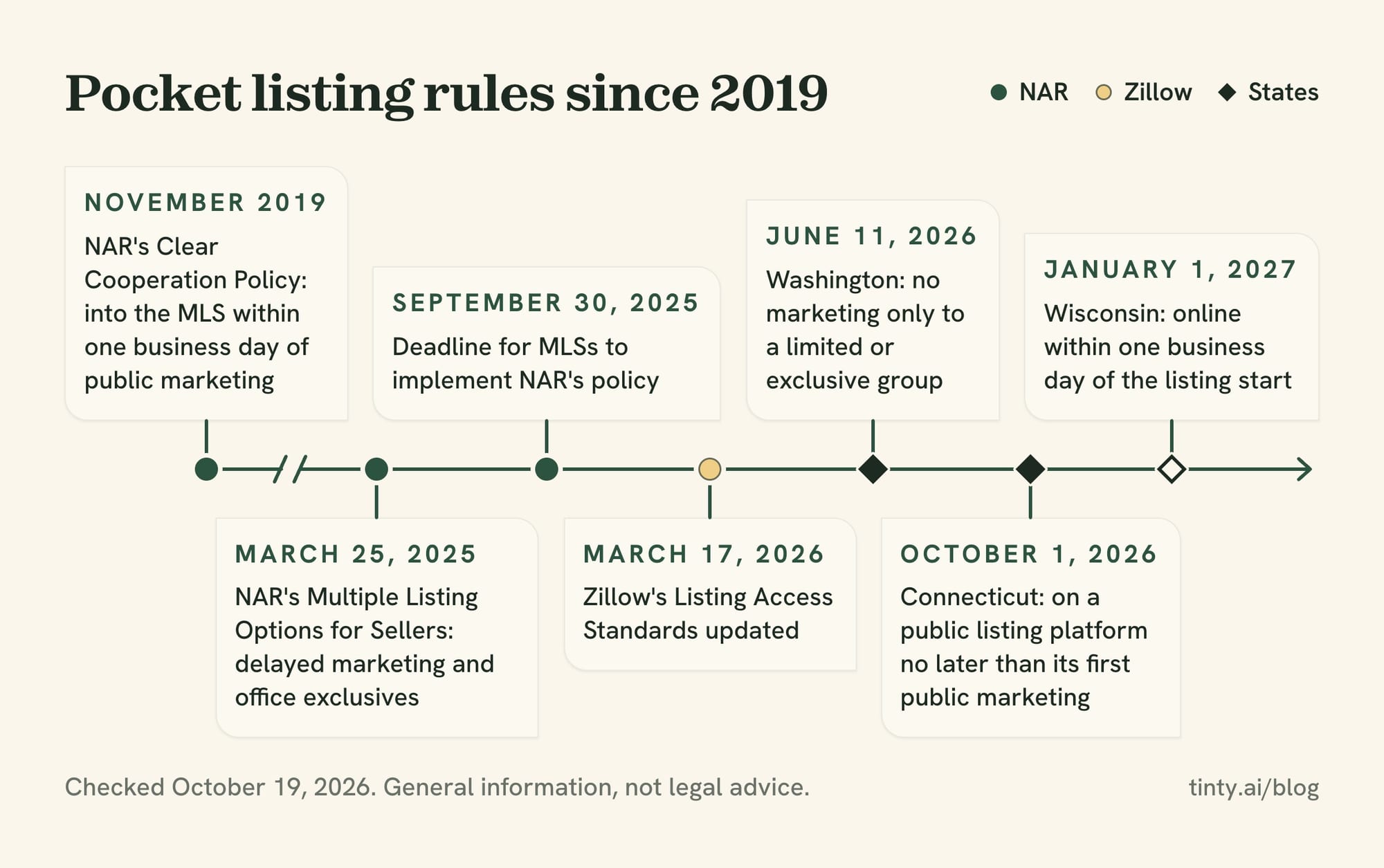
NAR’s Clear Cooperation Policy, adopted in November 2019, requires a listing to go into the MLS within one business day of public marketing. In 2025, NAR added a delayed marketing option. At MLSs that follow NAR’s policy, a quiet sale now has to fit an official option: an office exclusive or, where offered, delayed marketing or coming soon.
Pocket listing vs office exclusive vs coming soon
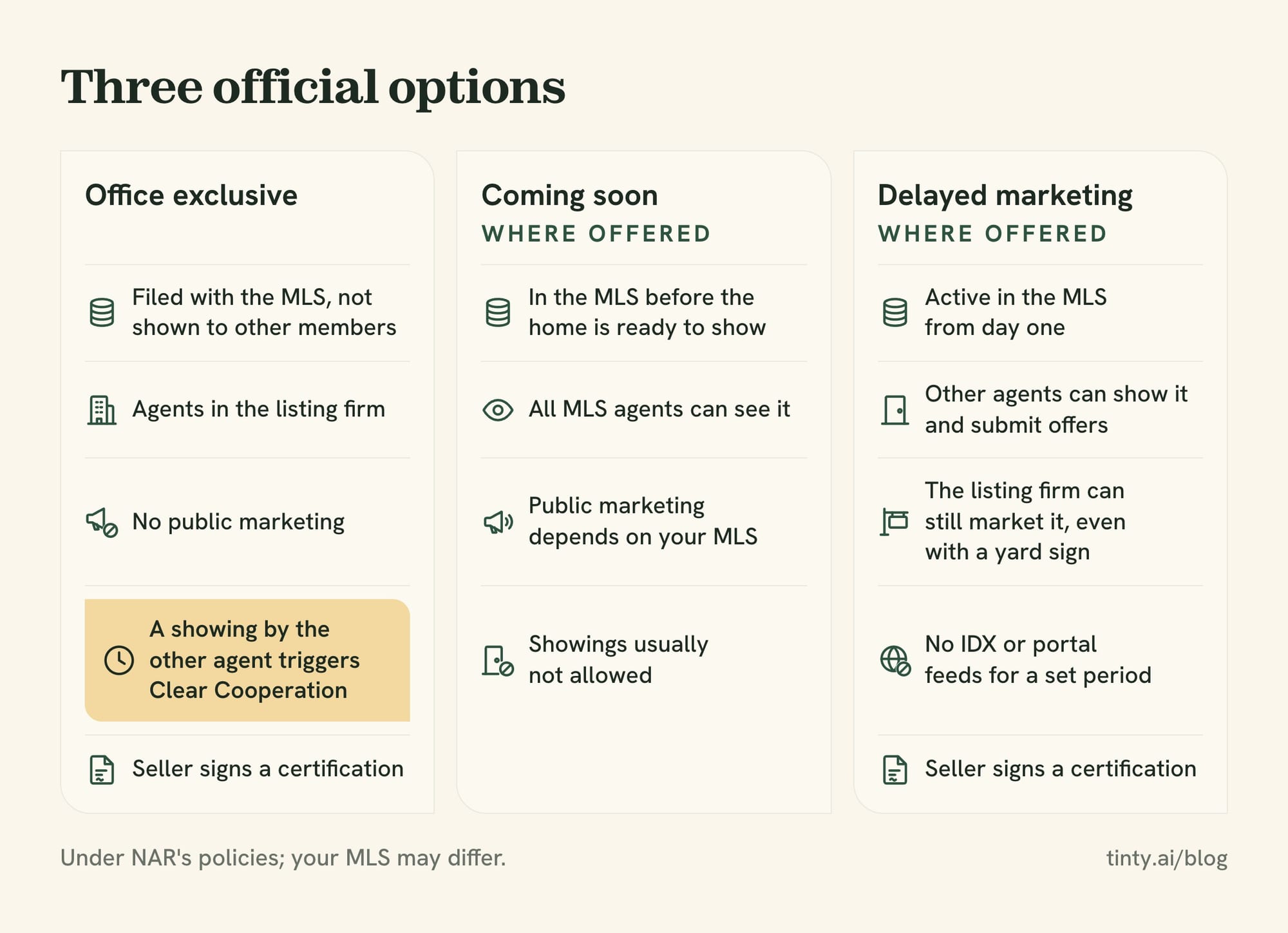
Two questions separate them: is the listing in the MLS, and can anyone market it publicly? Here’s how they compare under NAR’s policies; your MLS may differ. Internet Data Exchange (IDX) is the feed that shows MLS listings on other brokers’ websites.
Pocket listing options compared under NAR’s policies, checked October 19, 2026.
| Option | In the MLS? | Public marketing? | Who can see it |
|---|---|---|---|
| Pocket listing (informal) | No | No | The agent’s private contacts |
| Office exclusive | Filed, not shared | No | Agents in the listing firm |
| Delayed marketing (where offered) | Yes | By the listing firm only | All MLS agents; no IDX or portal feeds for a set period |
| Coming soon (where offered) | Yes | Depends on your MLS | All MLS agents; showings usually not allowed |
| Active listing | Yes | Yes | Everyone, through the MLS and portals |
Office exclusive listings
An office exclusive is the formal version of a pocket listing. The seller directs that the home not be shared through the MLS or marketed publicly. Under NAR’s policy, the listing is filed with the MLS but not shown to other members. If anyone markets it to the public, it must go to all MLS members within one business day.
Coming soon real estate listings
Coming soon real estate listings sit in the MLS before the home is ready to show. NAR’s Clear Cooperation FAQ says a coming soon status that shares listing data with all MLS members complies with the policy. It adds that the most common versions allow no showings until the listing goes active. Not every MLS offers the status, and each sets its own limits.
Delayed marketing listings
A delayed marketing listing is active in the MLS from day one. Other agents can see it, tell their buyers, arrange showings and submit offers, per NAR’s FAQ on the 2025 policy. What’s delayed is IDX and syndication to portals, for the period your MLS allows. The listing firm can still market the home itself, even with a yard sign.
Clear Cooperation: the one-business-day rule
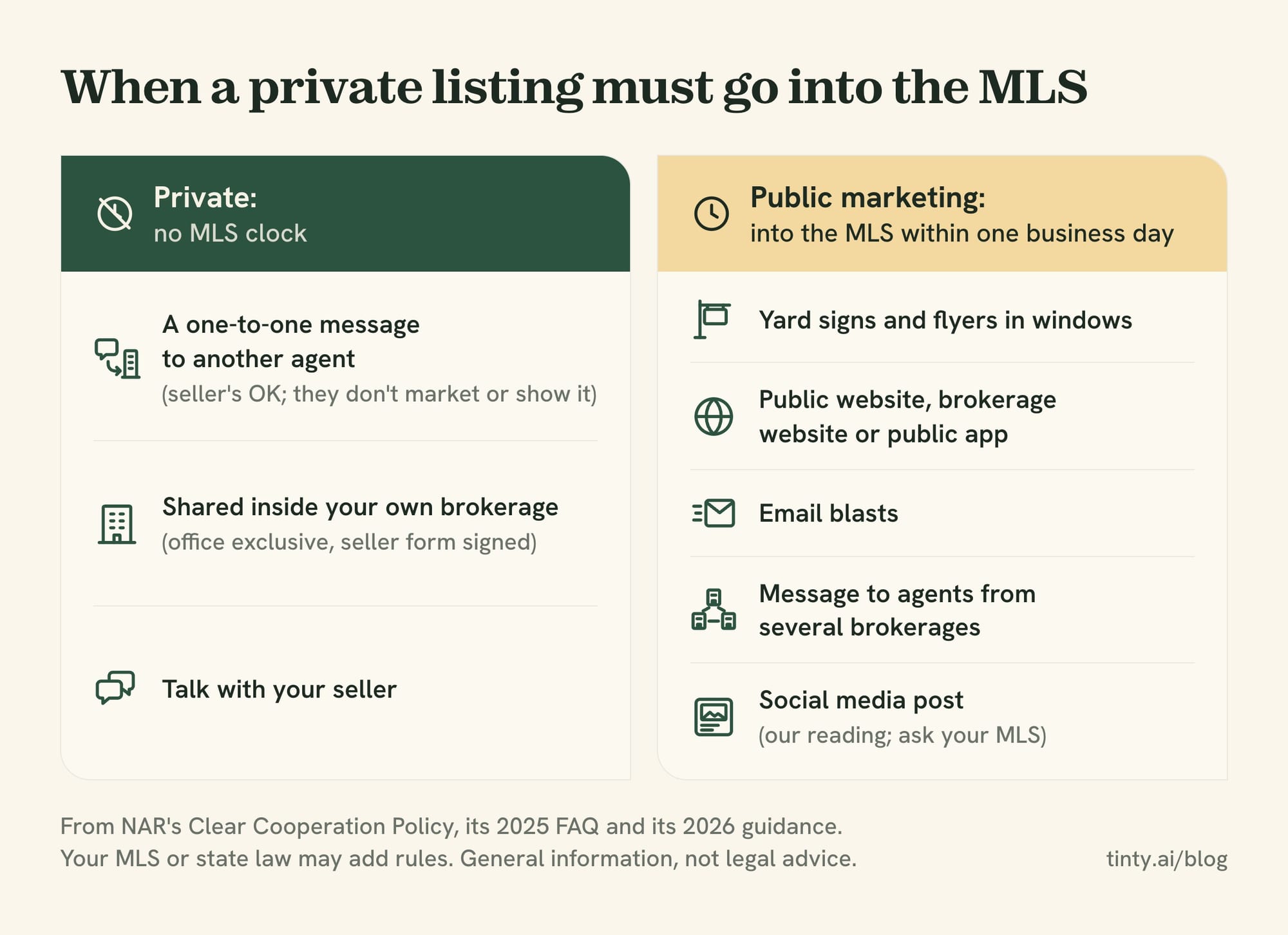
Under NAR’s Clear Cooperation Policy, “within one (1) business day of marketing a property to the public, the listing broker must submit the listing to the MLS.” It covers members of Realtor association-owned MLSs, and there’s no opt-out.
NAR’s examples of public marketing include:
- Signs and flyers: yard signs and flyers displayed in windows.
- Websites and apps: public-facing websites, brokerage website displays and apps open to the general public.
- Email blasts: digital marketing sent to a list.
- Listing networks: listing-sharing networks that span several brokerages.
The clock starts at public marketing, not at signing. Your MLS’s own deadline for entering a signed listing still applies.
NAR’s examples don’t name social media. A public post sits on a public-facing website or app, so expect it to count (our reading), and ask your MLS how it treats a teaser. Florida’s Stellar MLS says any social media marketing of an office exclusive listing violates the policy.
Rule: one-to-one, broker-to-broker messages about a listing don’t trigger Clear Cooperation. But “multi-brokerage communications about a listing will constitute public marketing,” per NAR’s 2025 FAQ. NAR’s 2026 guidance adds that a showing by the other agent triggers Clear Cooperation too.
NAR’s 2025 policy: delayed marketing and office exclusives
NAR’s Multiple Listing Options for Sellers policy took effect March 25, 2025, and MLSs had to implement it by September 30, 2025. It left Clear Cooperation unchanged and added a formal way to delay public exposure.
For an office exclusive or a delayed marketing listing, the listing broker must get a seller certification that covers three things:
- The relationship: a disclosure about the professional relationship between the broker and the seller.
- What’s given up: the seller’s acknowledgment of the MLS benefits they waive or delay, such as broad and immediate exposure.
- The decision: the seller’s confirmation of the chosen option, office exclusive or delayed marketing.
Each MLS decides whether to offer delayed marketing, and for how long. Two examples:
In Stellar MLS (Florida), a “Delayed Distribution” listing stays out of IDX and syndication for five calendar days. The seller signs a form, and the listing office may market the home in any manner, per Stellar MLS.
California Regional MLS (CRMLS) has no delayed marketing status. Its Coming Soon status lasts up to 21 days, with no showings and a seller-signed form. Since June 2026, a second CRMLS form lets a seller keep a coming soon listing out of IDX feeds.
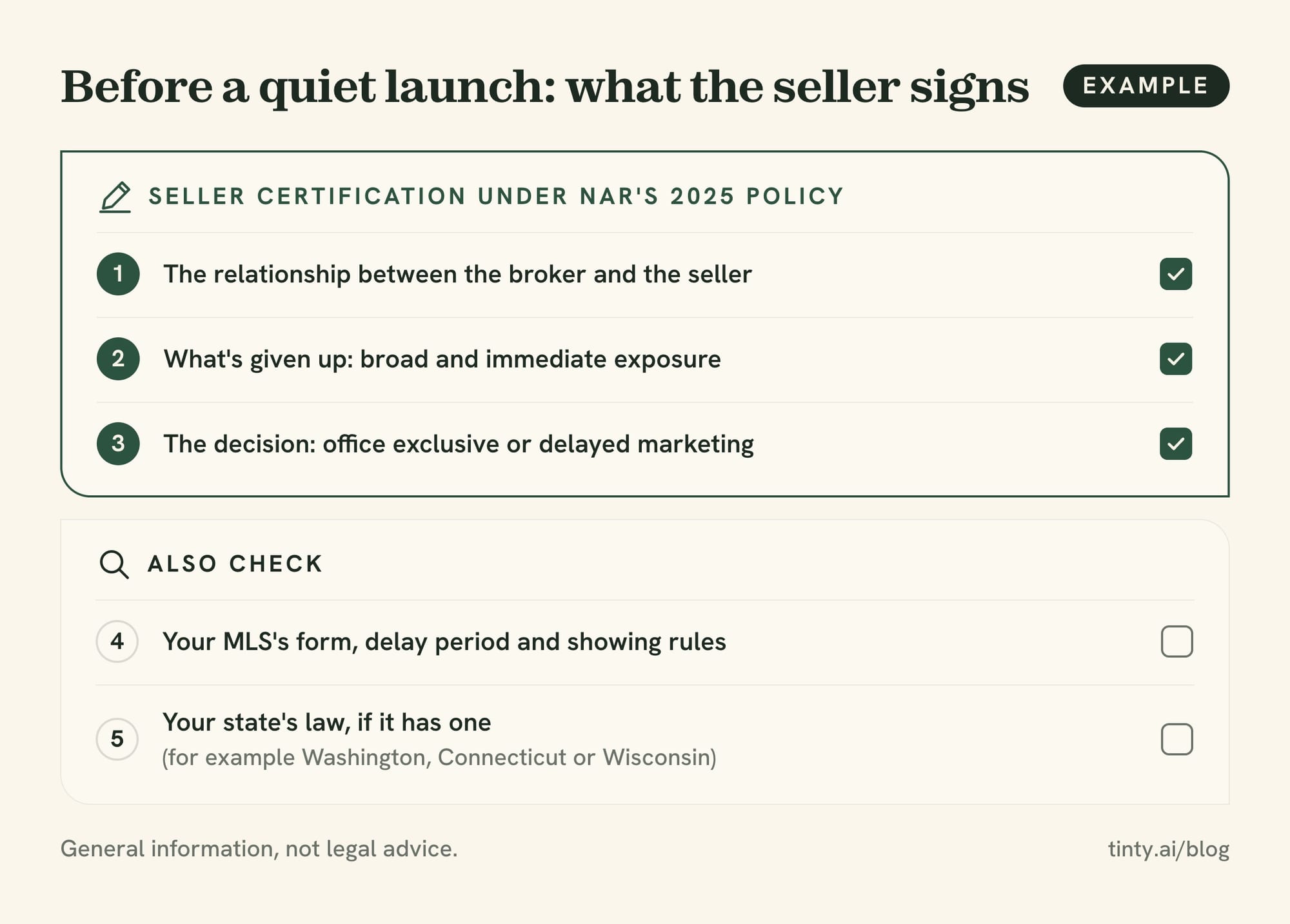
Tip: before you promise a seller a quiet launch, read your MLS’s delayed marketing and coming soon pages. The forms, the delay period and the showing rules all come from there.
Zillow and state laws add their own rules
Even when your MLS allows a quiet launch, Zillow and some states draw their own lines.
Zillow’s Listing Access Standards
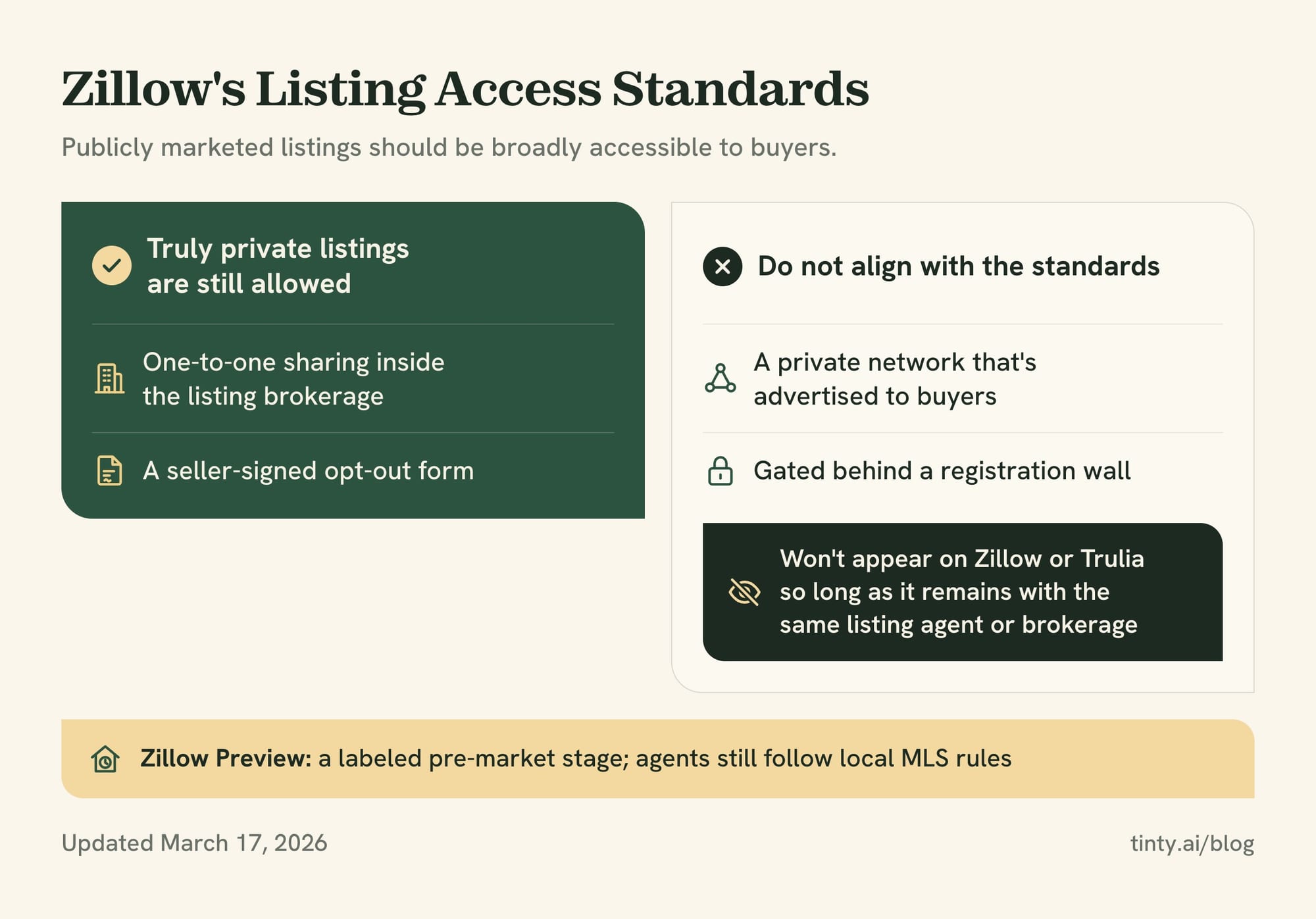
Zillow introduced its Listing Access Standards in April 2025 and updated them on March 17, 2026. Publicly marketed listings “should be broadly accessible to buyers.” Truly private listings are still allowed, but the current standards require one-to-one sharing inside the listing brokerage and a seller-signed opt-out form.
Listings in a private network that’s advertised to buyers, or gated behind a registration wall, “do not align with the standards.” A listing that doesn’t comply won’t appear on Zillow or Trulia “so long as it remains with the same listing agent or brokerage.” Zillow also launched Zillow Preview, a labeled pre-market stage where agents still follow local MLS rules.
State laws on private listings
Some states now regulate private marketing directly:
- Washington: since June 11, 2026, brokers can’t market a home only to “a limited or exclusive group” (Substitute Senate Bill 6091). It must reach the public and all other brokers at the same time, barring health or safety reasons.
- Connecticut: since October 1, 2026, a home of one to four units must be on a public listing platform no later than its first public marketing. Sellers can opt out of public marketing on a signed form (Public Act 26-23).
- Wisconsin: from January 1, 2027, listing firms must market homes of one to four units online within one business day of the listing start (Act 69 memo). Owners can opt out on a signed form.
- Your state: others may follow, so check your state’s license law and ask your broker.
Act 69 also sets photo disclosure rules, covered in our Wisconsin Act 69 guide.
Pros and cons of a pocket listing for sellers
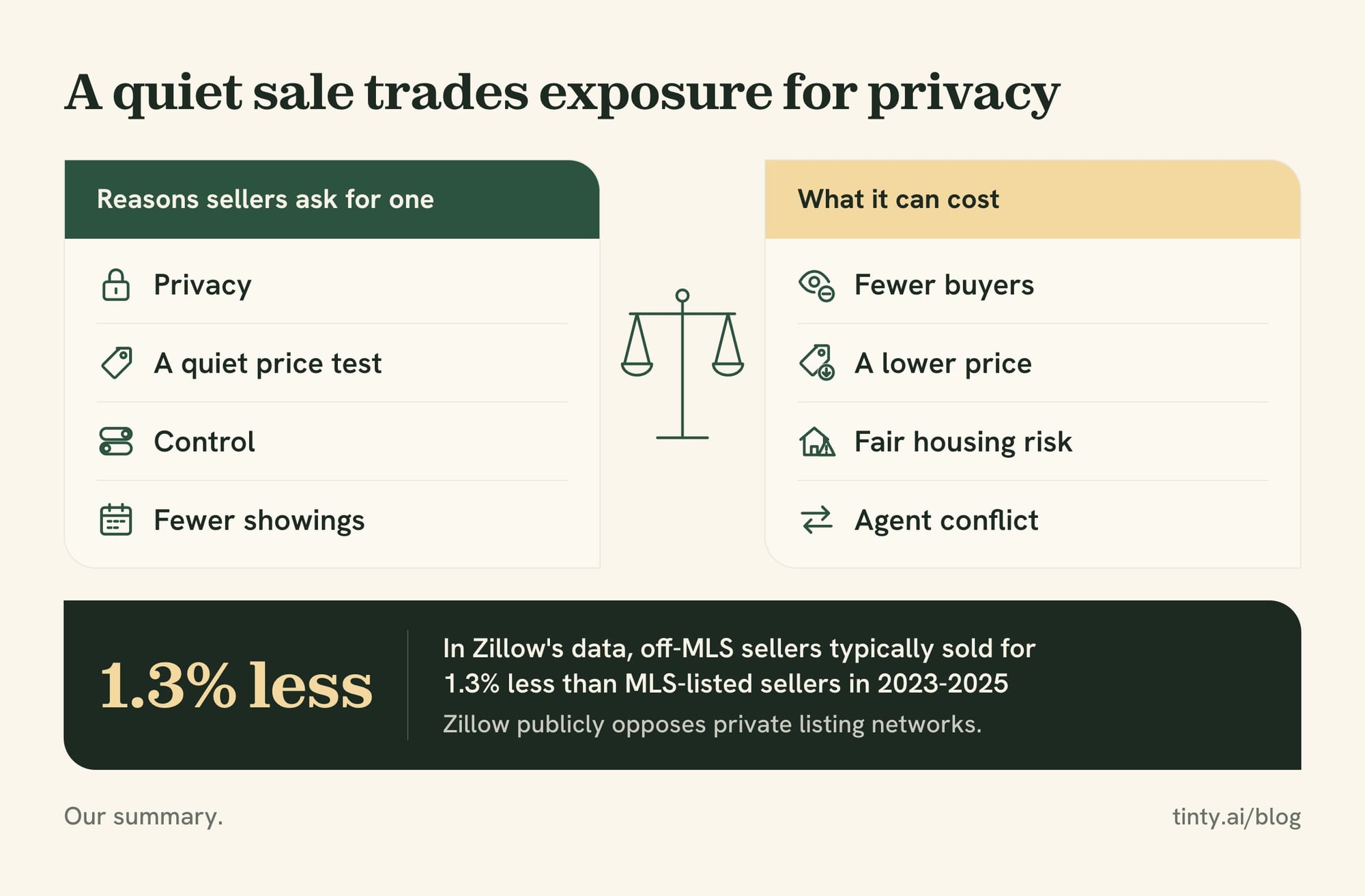
A quiet sale trades exposure for privacy. NAR’s FAQ names privacy and “other personal reasons” as why a seller might delay marketing.
Reasons sellers ask for one (our summary):
- Privacy: no public photos, no sign and fewer strangers in the house.
- A quiet price test: feedback from a few agents before the price is public.
- Control: the seller decides who sees the home and when.
- Fewer showings: easier for occupied homes, tenants or a sensitive move.
What it can cost:
- Fewer buyers: Wisconsin’s opt-out form must include the owner’s acknowledgment that reduced exposure “may reduce the number of offers” and the price.
- A lower price: Zillow, which publicly opposes private listing networks, found off-MLS sellers typically sold for 1.3% less than MLS-listed sellers in 2023-2025.
- Fair housing risk: NAR says its policy supports fair housing by giving buyers and their agents “equal access” to MLS information. A private circle can leave qualified buyers out.
- Agent conflict: a private sale makes it easier for one agent to end up on both sides (our view).
For agents, a private sale also skips the sign calls and open house sign-ins a public listing brings (our view). Our guide on how to get listings covers other lead sources.
Example: what you might say when a seller asks to sell quietly: “We can keep it private, and here’s the trade. Fewer buyers will hear about it, which can mean fewer offers. If privacy matters most, I’ll show you the options our MLS allows and the form you’d sign.” Adapt it; it’s not a tested script.
Lay these options out at the listing appointment with our listing presentation templates. If the seller pushes back, our objection handling scripts show how to find the real worry first.
How to market a delayed or office-exclusive listing
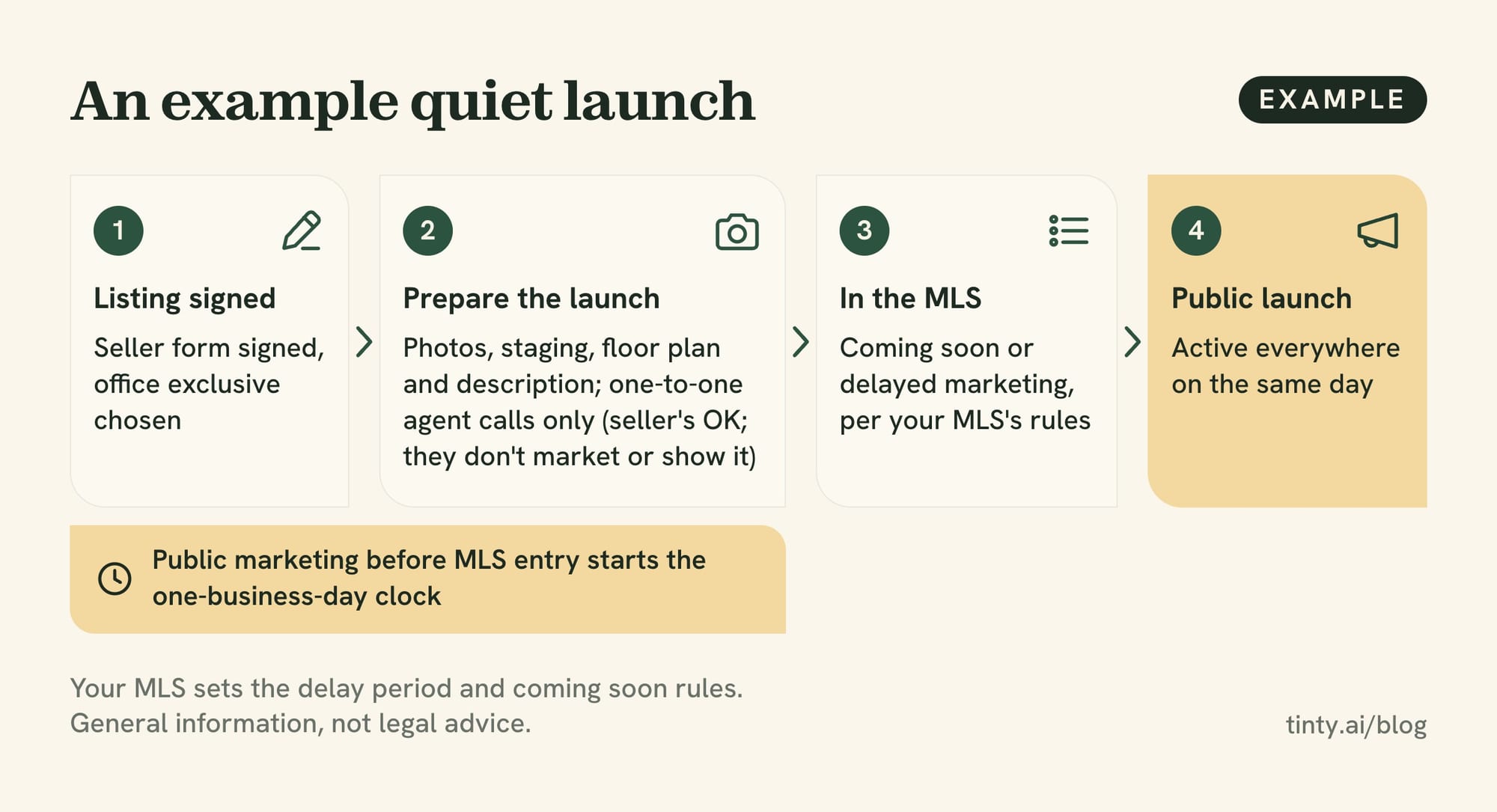
Market it only in the channels the seller signed for. Then use the quiet weeks to get the public launch ready.
A simple order to follow:
- Get the seller’s signed form before any marketing. Your MLS may require its own.
- Confirm the clock: your MLS’s entry deadline, delay period and coming soon limits, plus your state’s law.
- Keep private channels private: for an office exclusive, share inside your firm. Tell an outside agent one to one, with the seller’s OK, and only if they won’t market or show it. Zillow treats only in-firm sharing as private.
- Log what you share: who you told and when, in case of a compliance question (our suggestion).
- Prepare the launch: photos, a floor plan and the listing description, finished before the home goes public.
- Plan launch day: move to active and publish everywhere on the same day.
Example: a one-to-one message to another agent: “I have a listing coming to [neighborhood], [beds] beds, around $[price]. Do you have a buyer for it? Happy to talk by phone.” It’s an example; get the seller’s OK and check your MLS and state law first. For an office exclusive, a showing by that agent triggers Clear Cooperation.
Get the photos ready before launch
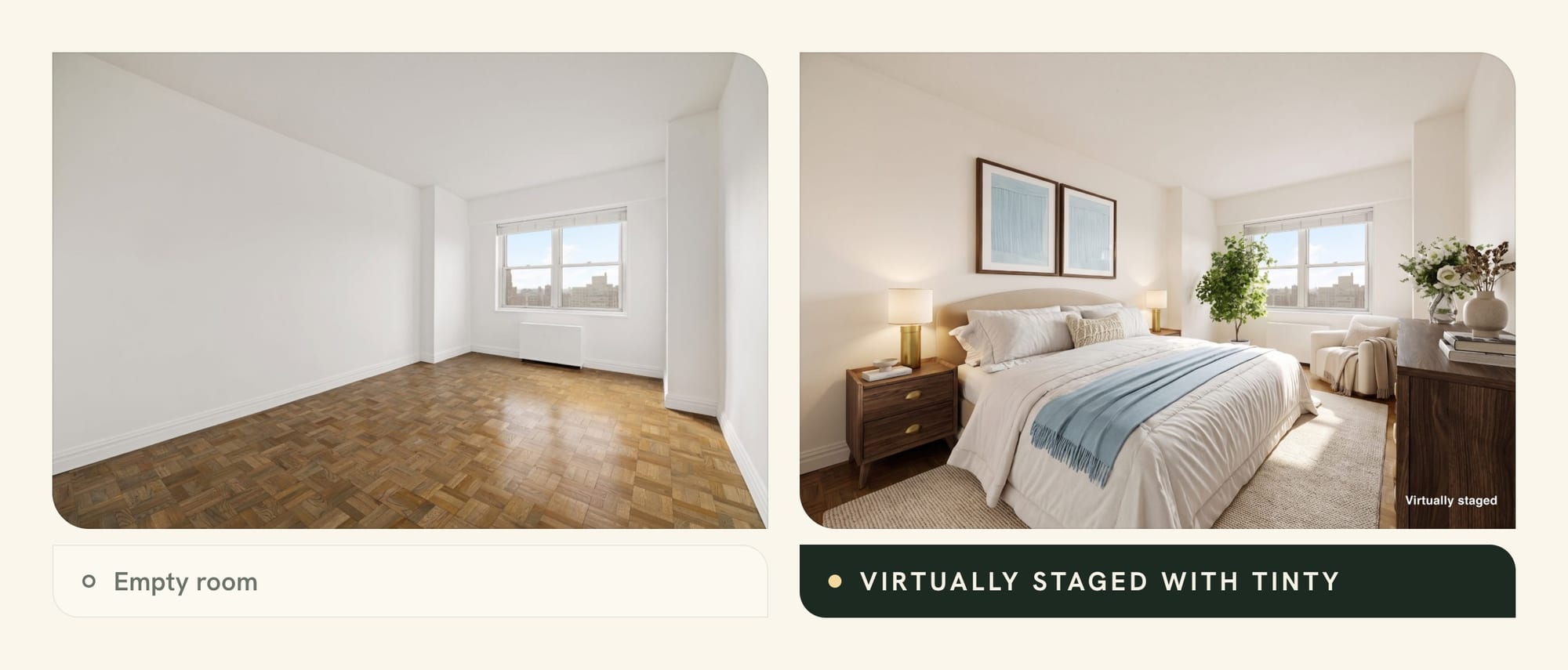
Photos carry the first impression on launch day, so finish them during the quiet period. For an empty home, plan how buyers will read the rooms; our guide to selling a vacant house covers the options.
We make TINTY, an AI virtual staging app. Shoot the empty living room or bedroom early and stage 6 photos free with TINTY, about a minute each, with a free account and no card. They carry a light TINTY watermark, so they’re for testing, not for the listing. TINTY doesn’t stage kitchens, bathrooms or exteriors.
Watch out: prepare staged photos early, but don’t post them until the listing goes public, because a public post can start the Clear Cooperation clock. Label each one “Virtually staged” (TINTY can add the label when you download), keep the original (California requires a link to it) and follow your MLS’s rules. Our virtual staging disclosure guide compares them.
Once your MLS allows public marketing, our coming soon post ideas help you announce the home.
Pocket listing FAQ
Is a pocket listing legal?
Usually yes, as the seller’s choice, but rules limit how it’s done. At MLSs that follow NAR’s policy, any public marketing means the listing goes into the MLS within one business day. Washington has barred marketing a home only to an exclusive group since June 11, 2026. In Connecticut (since October 1, 2026) and Wisconsin (from January 1, 2027), a seller who skips public marketing signs an opt-out form.
Why would a seller want a pocket listing?
Mostly for privacy: no public photos, fewer showings and a quieter move. Some sellers want to test a price with a few agents first. The trade-off is fewer buyers, which can mean fewer offers and a lower price.
Show 3 more questionsShow fewer questions
How do buyers find pocket listings?
Through agents. Ask your agent to watch for delayed marketing and coming soon listings in the MLS, and to ask other brokerages about office exclusives. Some pre-market homes also appear publicly as labeled Zillow Preview listings. A truly private listing has no public list by definition.
What’s the difference between coming soon and a pocket listing?
A coming soon listing is in the MLS, where all member agents can see it before showings start. A pocket listing stays off the MLS and is shared only with the agent’s contacts. How long a coming soon listing can last, and whether you can advertise it, depends on your MLS.
Do pocket listings sell for less?
In Zillow’s data, yes. Zillow, which opposes private listing networks, found off-MLS sellers typically sold for 1.3% less than MLS sellers in 2023-2025. Results for one home depend on its market and its buyers.
How we researched this
On October 14, 2026, we searched for “pocket listing,” “what is a pocket listing” and “pocket listing real estate.” We read the top results we could open: The Close, HousingWire, Wikipedia, Veterans United and iBuyer.com. One describes Clear Cooperation as a 24-hour rule from signing, which isn’t what NAR’s text says.
We checked each rule on its primary source: NAR’s pages and FAQs, two MLSs, Zillow’s own pages and the official state records for Washington, Connecticut and Wisconsin. We left out the lawsuits over private listings. If something here is out of date, email hello@tinty.ai and we’ll fix it.
Sources
All pages read October 19, 2026. Dates in parentheses are publication or update dates.
NAR policies:
- NAR: Multiple Listing Options for Sellers (policy effective March 25, 2025; MLSs to implement by September 30, 2025)
- NAR: Multiple Listing Options for Sellers FAQs (PDF) (last updated May 27, 2025; questions 1, 4, 13, 19, 20, 29, 32, 43, 48-51)
Show 19 more sourcesShow fewer sources
- NAR: MLS Clear Cooperation Policy (Section 1.01 adopted November 2019; Section 1.3 exempt listings; FAQ)
- NAR: Office Exclusive Listings / Pre-Marketing Guidance (PDF) (July 9, 2026)
MLS rules (examples):
- Stellar MLS: Clear Cooperation and Delayed Distribution (last updated October 2025)
- CRMLS: Clear Cooperation Policy, Registered, Coming Soon and Active
- CRMLS: response to NAR’s Multiple Listing Options for Sellers (PDF) (April 18, 2025)
- CRMLS Blog: June 2026 Broker Report (June 30, 2026; announces the Limited Exposure form)
- CRMLS Knowledgebase: Limited Exposure for Coming Soon FAQs (July 8, 2026; updated July 30, 2026)
Zillow:
- Zillow: Updating Zillow’s Listing Access Standards for today’s market (March 17, 2026)
- Zillow Listing Access Standards (updated March 17, 2026)
- Zillow: Selling with one agent on both sides cost home sellers $1.49 billion over three years (May 14, 2026; off-MLS figures for 2023-2025)
State laws:
- Washington SSB 6091, Chapter 57, Laws of 2026 (PDF) (effective June 11, 2026)
- Connecticut Public Act 26-23, Section 32 (PDF) (signed May 27, 2026; effective October 1, 2026)
- Connecticut General Assembly: SB 340 bill record
- Connecticut Office of Legislative Research: bill analysis of SB 340 as amended by Senate “A” (PDF) (May 5, 2026; the version both chambers passed)
- Wisconsin Legislative Council: Act memo, 2025 Wisconsin Act 69 (December 19, 2025; effective January 1, 2027)
Guides that rank for this topic:
- The Close: What Is a Pocket Listing? (July 28, 2026)
- HousingWire: A complete guide to understanding pocket listings (January 9, 2025; updated February 24, 2025)
TINTY and related guides: