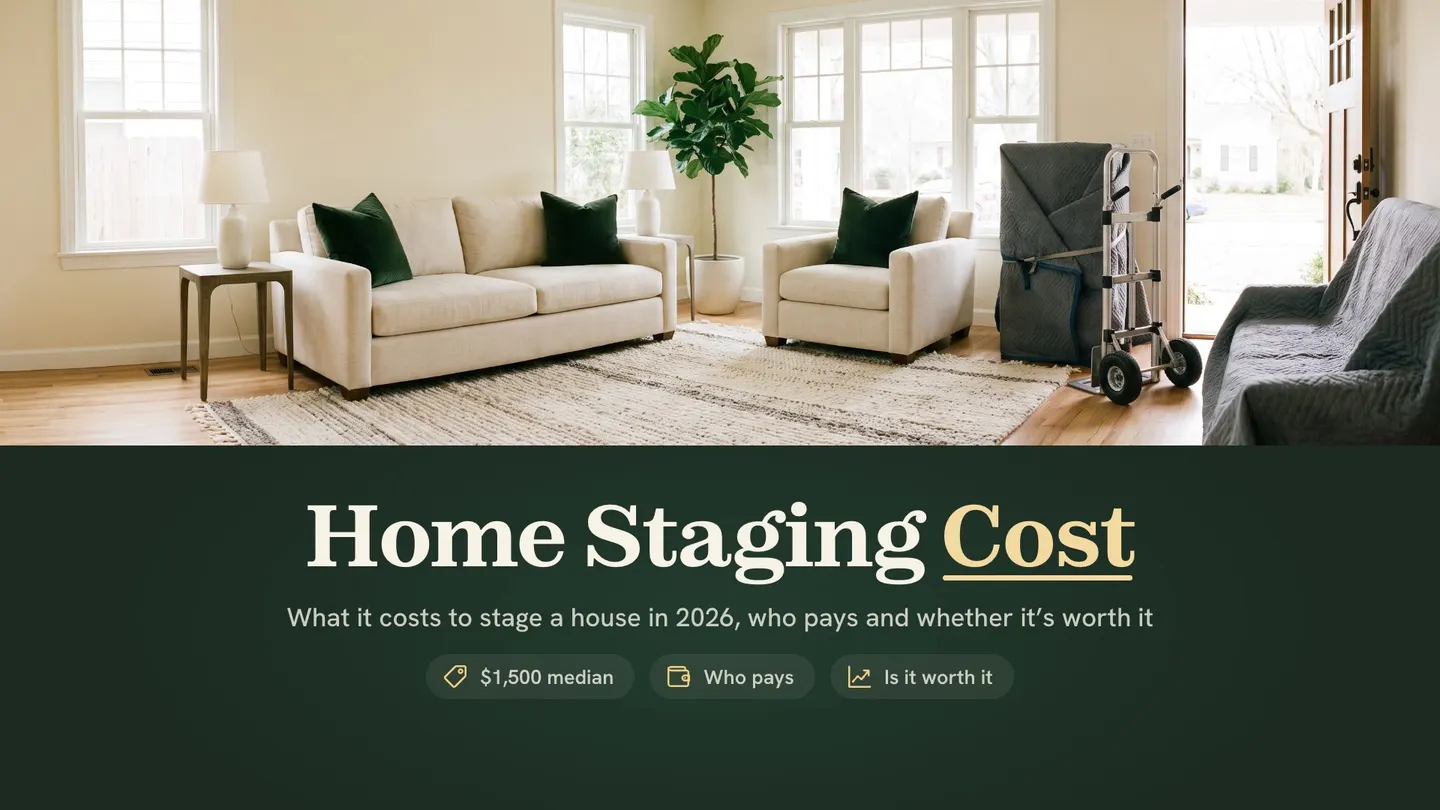
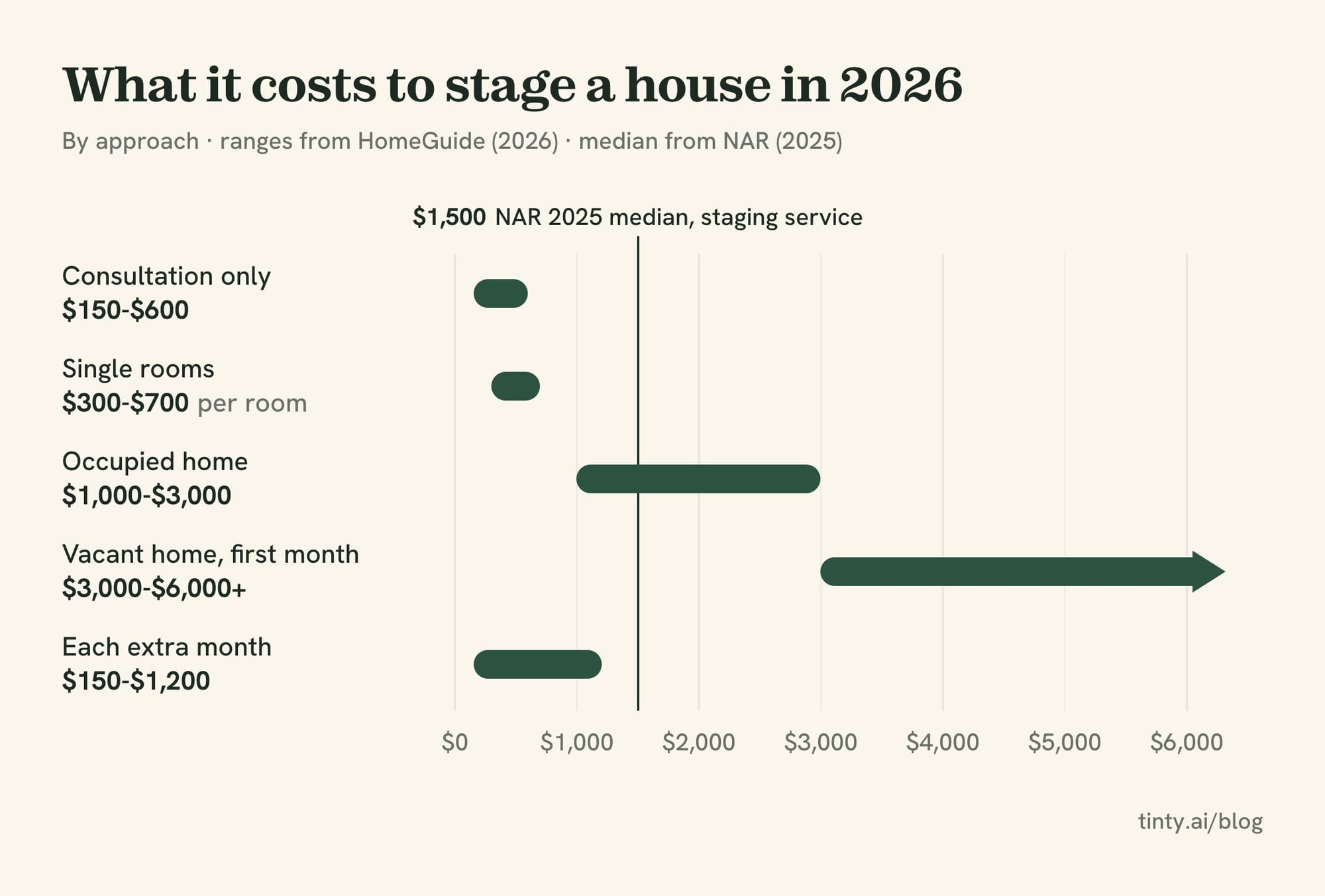
How much does it cost to stage a house? Staging an occupied home with the seller’s own furniture costs $1,000 to $3,000 on average, per HomeGuide’s 2026 guide. Furnishing a vacant home costs $3,000 to $6,000 or more for the first month. In NAR’s 2025 survey, the median was $1,500 with a staging service and $500 when the agent staged.
Prices checked October 3, 2026.
We make TINTY, an AI virtual staging app, so we sell a cheaper alternative to real furniture. To keep this guide fair, every physical staging price comes from a named cost guide, the National Association of Realtors (NAR) or the Real Estate Staging Association (RESA). Our own prices sit in a separate section.
Key takeaways
- Cost guide ranges: $1,000 to $3,000 for an occupied home, $3,000 to $6,000 or more for a vacant one, plus $150 to $1,200 for each extra month.
- Median: $1,500 with a staging service in NAR’s 2025 survey, and $500 when the agent stages.
- Who pays: no rule decides it. The listing agreement does, and 26% of agents told NAR it depends on the situation.
- Worth it: 49% of sellers’ agents saw less time on market, but 30% saw no effect on offers.
- Cheaper route: virtual staging costs under $1 to $70 a photo, but buyers still tour empty rooms.
On this page: 2026 prices · Cost by approach · Cost drivers · Who pays · Is it worth it? · Taxes · Spend less · Photos only · TINTY · Disclosure · FAQ
How much does it cost to stage a house in 2026?
In HomeGuide’s and Zillow’s guides, home staging costs about $1,000 to $6,000 for the first month. NAR’s 2025 median sits at $1,500. The spread is wide because each source measures something different.
Here’s what each source says, newest first:
- HomeGuide (February 2026): $1,500 to $4,000 for the first month of whole-home staging, then $150 to $1,200 a month, per its home staging cost guide.
- RESA (first half of 2026): an average investment of $4,934 across 233 homes staged by members, in RESA’s staging statistics.
- NAR (2025 survey): a median of $1,500 with a staging service, and $500 when the agent staged, in the 2025 Profile of Home Staging.
- HomeAdvisor (2025): an average of $1,844, with most projects between $837 and $2,924, as cited by Bankrate.
- Thumbtack: an average of $995, usually between $598 and $1,201, as cited by Zillow in May 2025.
Why house staging cost averages disagree
Averages run low when they mix in consultations and partial jobs, in our reading. The high ones lean on full vacant installs with rented furniture. NAR’s $1,500 is what agents reported spending, so it’s agent-reported, not invoiced.
RESA’s figure of $4,934 comes from stagers who chose to submit their projects. RESA itself says the results “do not isolate staging’s effect.” Self-selected data like this probably tilts toward bigger jobs.
Tip: ask every stager to quote in the same format: the install fee, the days it covers and the monthly rate after that. Without those three numbers, two quotes can’t be compared.
Staging fees as a share of the list price
Some stagers price by the home’s value. HomeGuide says two to three months of staging typically costs 0.5% to 1.0% of the list price. For a luxury home, it can reach 2%.
A stager quoted by Bankrate in 2025 put it at about 1% for two to three months, and around 1% to 1.25% for luxury homes. Some companies also set a minimum fee. HomeGuide says minimums in New York and Los Angeles can reach $5,000.
Example: Realtor.com’s September 2026 data put the median list price at $419,250. At 0.5% to 1.0%, two to three months of staging comes to about $2,100 to $4,200 (our math).
Home staging cost by approach
The approach you pick moves the bill more than the stager you hire. A consultation costs a few hundred dollars, while a vacant house can cost thousands before the first showing.
Home staging cost by approach, checked October 3, 2026.
| Approach | Typical cost | What you get | Source |
|---|---|---|---|
| Consultation only | $150-$600 | A walk-through and a to-do list | HomeGuide, Zillow |
| Single rooms | $300-$700 per room | Key rooms staged, the rest left as is | HomeGuide |
| Occupied home | $1,000-$3,000 | Your furniture rearranged, plus décor | HomeGuide, Zillow |
| Vacant home | $3,000-$6,000+ first month | Rented furniture for the whole house | HomeGuide (Zillow: from $4,000) |
| Each extra month | $150-$1,200 | The rental kept in place | HomeGuide |
| Virtual staging | Under $1-$70 per photo | Furniture added to the photos only | Our cost guide |
Consultation only: $150 to $600
A consultation is the cheapest way to get a stager’s eye on the house. The stager walks through with the seller and the agent, then sends a list of changes the seller can make alone.
Zillow says the visit usually takes one to two hours, and some companies waive the fee if you book full staging. It fits an occupied home in good shape that needs editing more than furniture. A stager serving Chicago and southeastern Wisconsin told Realtor.com her walk-through costs $125 for 90 minutes.
Occupied staging: $1,000 to $3,000
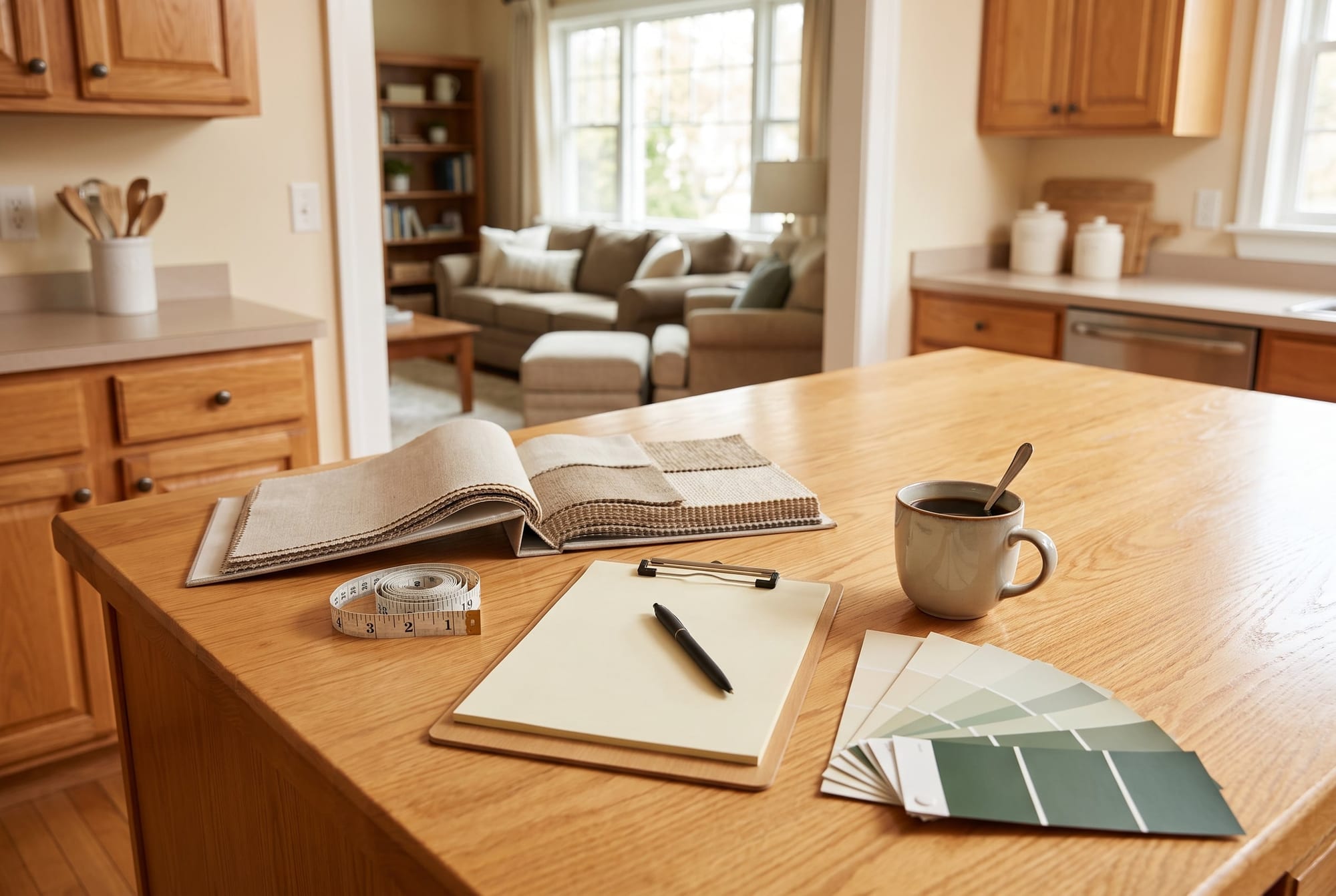
In an occupied home, the stager works with the seller’s own furniture. They remove some pieces, rearrange the rest and bring in art, rugs, pillows and accessories.
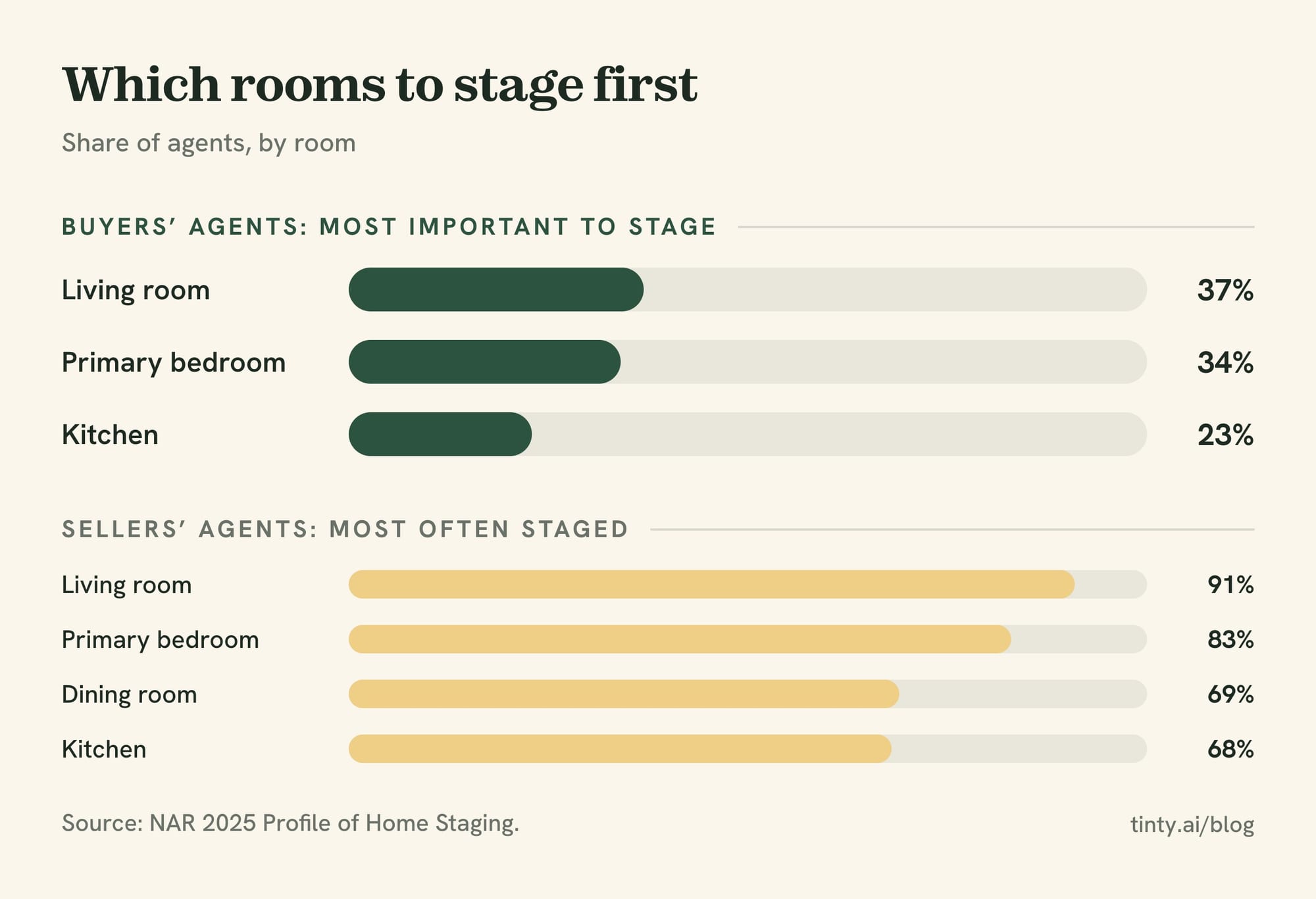
Partial staging covers only the rooms that sell the house. HomeGuide puts single rooms at $300 to $700 each, and living rooms and bedrooms cost more than kitchens. In NAR’s survey, the rooms agents staged most were the living room (91%), primary bedroom (83%) and dining room (69%).
Full vacant staging: $3,000 to $6,000 or more
Vacant staging costs the most because every piece is rented, delivered, installed and later removed. HomeGuide puts it at $3,000 to $6,000 or more, and Zillow says it “usually starts around $4,000.”
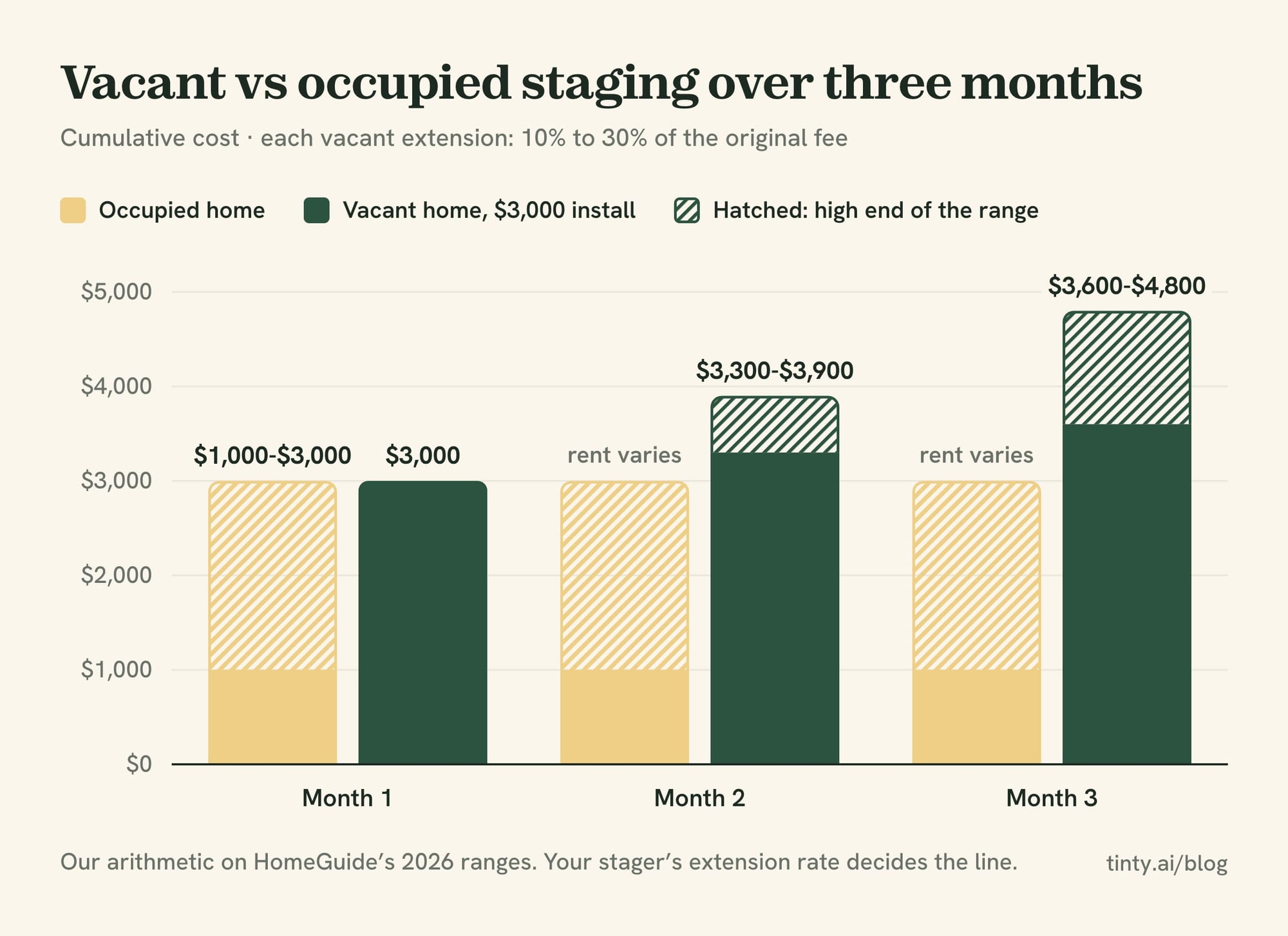
Rental is the line that keeps growing. HomeGuide says furniture rental alone can reach $2,000 a month for large homes. Contracts typically run 30 days, and each extension costs 10% to 30% of the original fee.
Watch out: a vacant-home quote usually covers 30 days. If the house sits 90 days, a $3,000 install with 30% extensions becomes $4,800 (our math on HomeGuide’s ranges). Get the extension rate in writing before the truck arrives.
Virtual staging: per photo, not per month
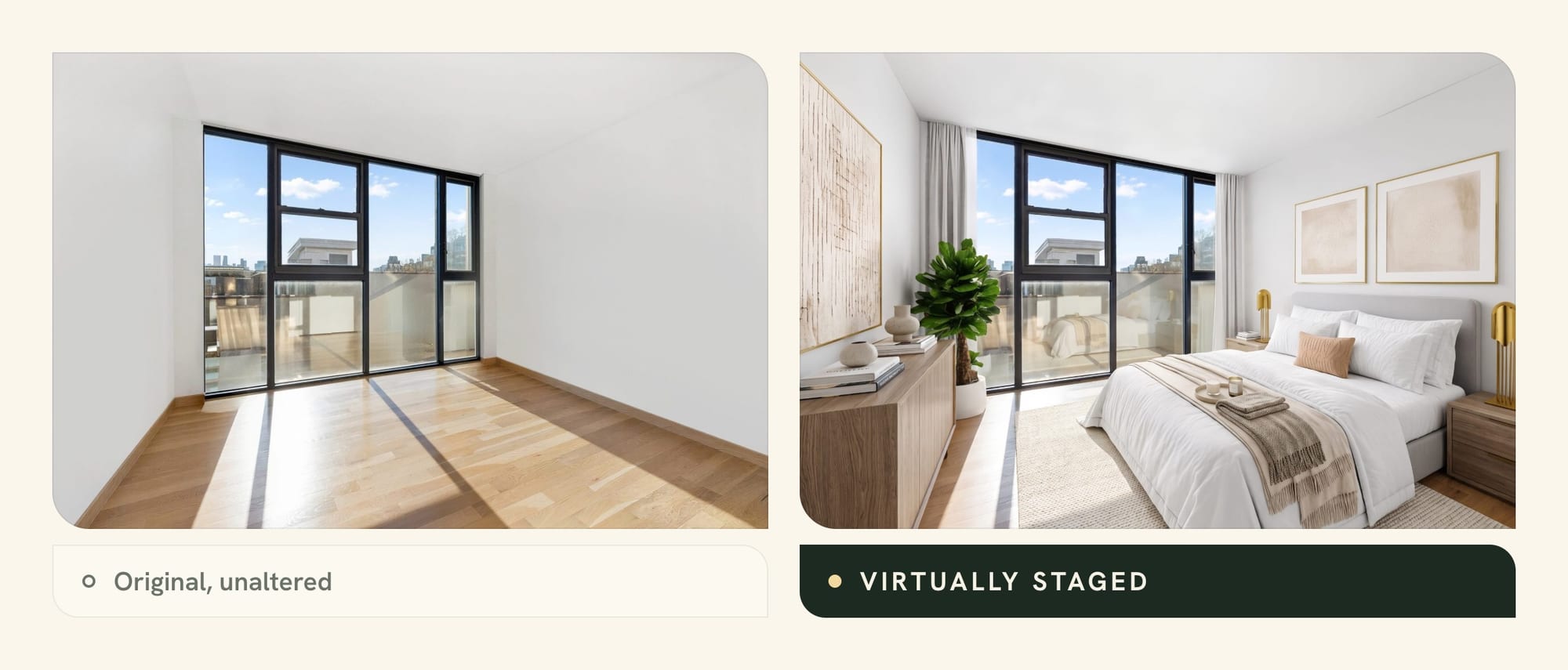
Virtual staging adds furniture to listing photos instead of the house. It’s billed once, per photo or per plan, with no monthly rent. Our guide explains what virtual staging is and how it works.
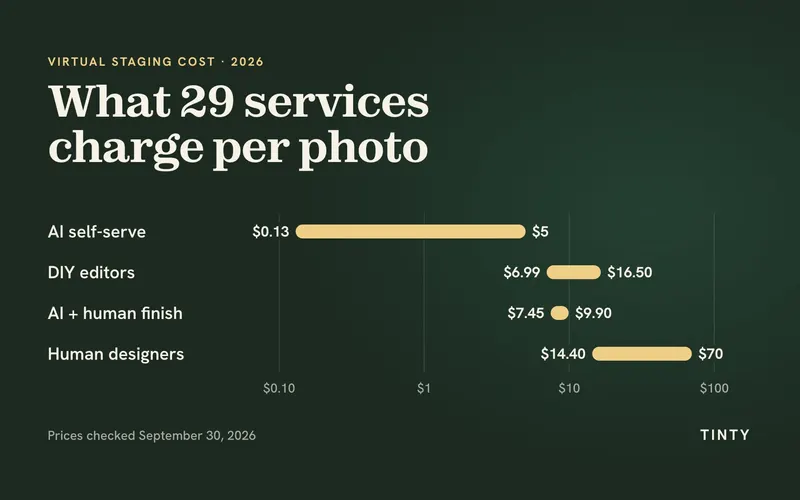
From our check of 29 services in September 2026, AI tools cost under $1 to about $5 a photo. AI with a human finish runs $7.45 to $9.90, and human design services charge $14.40 to $70.
Example staging budgets for three listings
What staging might cost on three typical listings, using HomeGuide’s 2026 ranges (our math):
- Occupied condo, consultation only: $150 to $600, and the seller does the decluttering and rearranging.
- Occupied 3-bedroom, partial staging: $900 to $2,100 for the living room, primary bedroom and dining room, at $300 to $700 a room.
- Vacant 4-bedroom, sold in 60 days: a $3,000 to $6,000 install plus one extension. On a $3,000 install, that’s $3,300 to $3,900 in total.
- Same vacant house, photos only: about $12 to $50 for five virtually staged photos on an AI plan, or $96 to $328 from a design service.
None of these include paint, cleaning or repairs, which are billed separately. The vacant budget also assumes the house sells inside 60 days.
How much does staging a house cost? What sets the price
HomeGuide’s and Zillow’s ranges run from $1,000 to $6,000, and six things decide where your quote falls:
- Consultation: $150 to $600 on its own, though some stagers fold it into the staging fee.
- Vacant or occupied: vacant costs most, because every piece of furniture is rented, delivered and installed.
- Number of rooms: each room runs $300 to $700, so staging two key rooms costs less than the whole house.
- Contract length: contracts usually run 30 days, and each extra month adds 10% to 30% of the original fee.
- Home size and layout: larger homes need more furniture, and some companies charge extra to carry it upstairs.
- Market and tier: big-city minimums can reach $5,000, and luxury furniture packages cost more than standard ones.
Per-room monthly pricing and home size
Some stagers price by the room and the month instead of a flat install fee. Realtor.com’s staging guide puts it at $500 to $600 per staged room a month, after a $300 to $600 consultation.
A real estate professional quoted there puts a 2,000-square-foot home at about $2,000 to $2,400 a month. HomeGuide describes 30-day contracts, but Realtor.com says most stagers want a three-month minimum. That can push the bill to $7,200 even if the house sells fast.
Questions to ask a stager before you sign
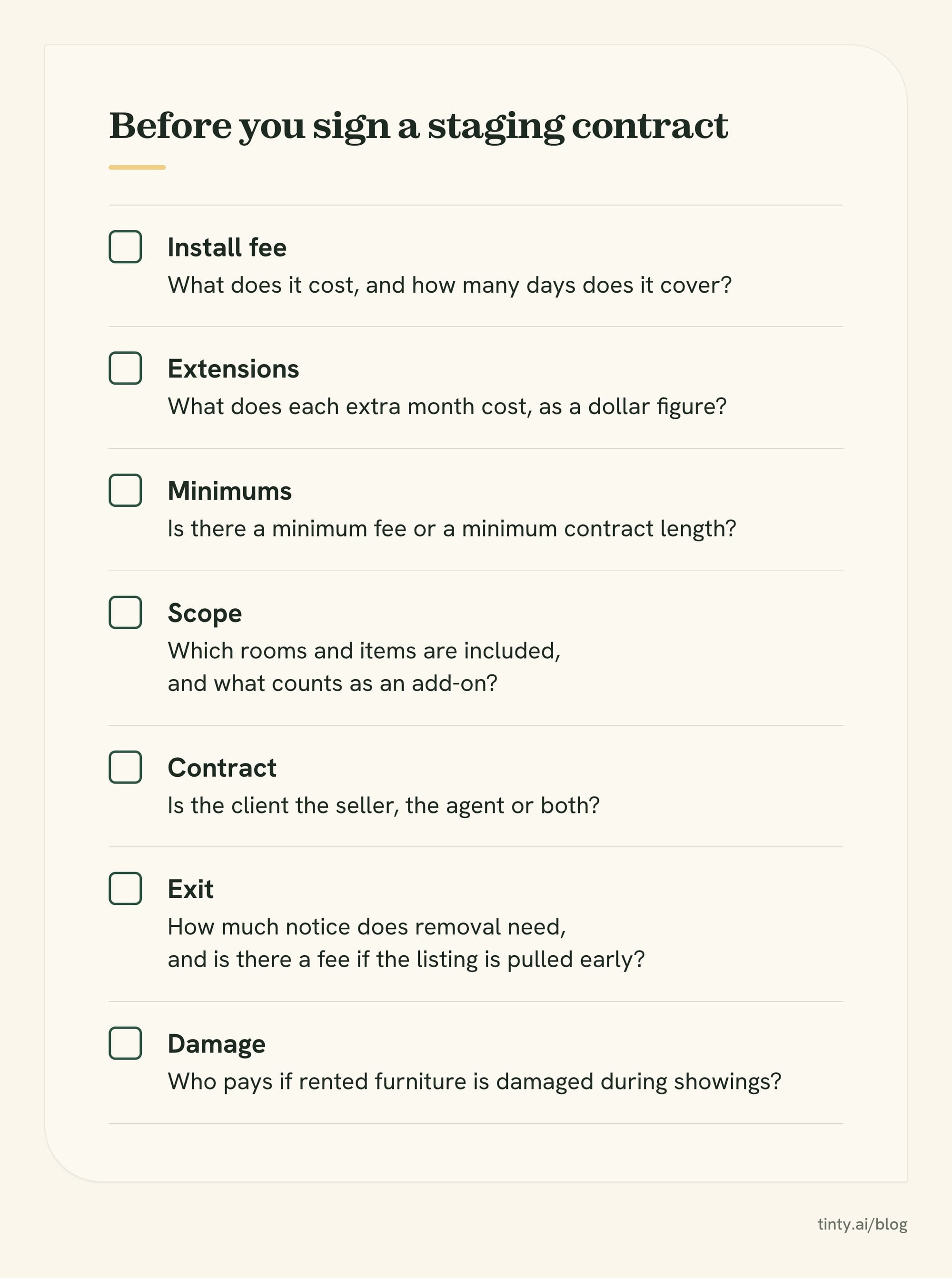
A staging quote is only as clear as its fine print. Ask these before anyone signs (our checklist):
- Install fee: what does it cost, and how many days does it cover?
- Extensions: what does each extra month cost, as a dollar figure?
- Minimums: is there a minimum fee or a minimum contract length?
- Scope: which rooms and items are included, and what counts as an add-on?
- Contract: is the client the seller, the agent or both?
- Exit: how much notice does removal need, and is there a fee if the listing is pulled early?
- Damage: who pays if rented furniture is damaged during showings?
Local market: why quotes differ so much
Local prices swing more than any national range shows. HomeGuide says minimum charges in New York and Los Angeles can reach $5,000, above its whole range for an occupied home.
In a 2022 r/realtors thread, agents compared what staging cost where they work. Some covered a modest fee out of their commission, while agents in pricey coastal markets described much bigger bills.
The thread’s stories are anecdotes, not data. They show why a national average is only a starting point, and why local quotes matter more.
Add-ons that sit outside the staging fee
Stagers often recommend work their fee doesn’t cover. HomeGuide’s 2026 ranges for the usual extras:
- Decluttering: $650 to $1,000 or more, including packing and storage.
- Interior paint: $1 to $3 per square foot of surface, usually to tone down bold walls.
- Light fixtures: $80 to $350 each to replace dated ones.
- Cleaning: $25 to $75 an hour per cleaner or $30 to $50 a room, and carpets $35 to $55 a room.
Who pays for staging a house?
No rule decides who pays for staging. The listing agreement settles it, or the agent and the seller negotiate it.
In NAR’s 2025 survey, sellers’ agents described how staging gets paid for:
- It depends on the scenario: 26%.
- The agent personally stages the home: 23%.
- The seller pays before listing: 17%.
- The agent offers a professional staging service: 15%.
- The agent hires a staging service: 6%.
- The agent’s firm pays: 4%.
- The seller pays after the home sells: 3%.
Read broadly, agents carry some or all of the cost in many of these answers. The seller paying upfront is a minority arrangement in NAR’s data, though cost guides written for sellers often assume it.
Who pays for staging a house for sale: four common setups
Most deals land on one of these, going by NAR’s categories and Zillow’s guide:
- Seller pays upfront: the seller signs with the stager and pays the install fee before the listing goes live.
- Seller pays at closing: Zillow says some agents cover staging upfront and deduct it from the sale proceeds later.
- Agent pays: the agent treats staging as marketing and pays it from the commission.
- Split: for example, the agent pays the install and the seller pays any extensions.
Agents who pay often see it as marketing for themselves too. One agent in a 2022 r/realtors thread put it this way: their name is attached to the business, so they want the listing to look good.
Tip: write staging into the listing agreement: who pays, the cap, who pays extensions, and what happens if the listing is withdrawn or expires. Settling that last point upfront avoids a hard conversation later (our view).
When the seller won’t pay for staging
A seller who won’t pay for staging still has options. Start with the cheapest: a $150 to $600 consultation and a weekend of decluttering.
If the house is vacant, the agent can cover the install and recover it from the proceeds at closing, the setup Zillow describes. Put the repayment terms in writing, including what happens if the home doesn’t sell.
Or stage the photos only. Virtual staging costs about $9 to $500 per listing, so the online listing shows furnished rooms while the seller decides on the rest.
Is home staging worth it? What NAR’s 2025 data shows
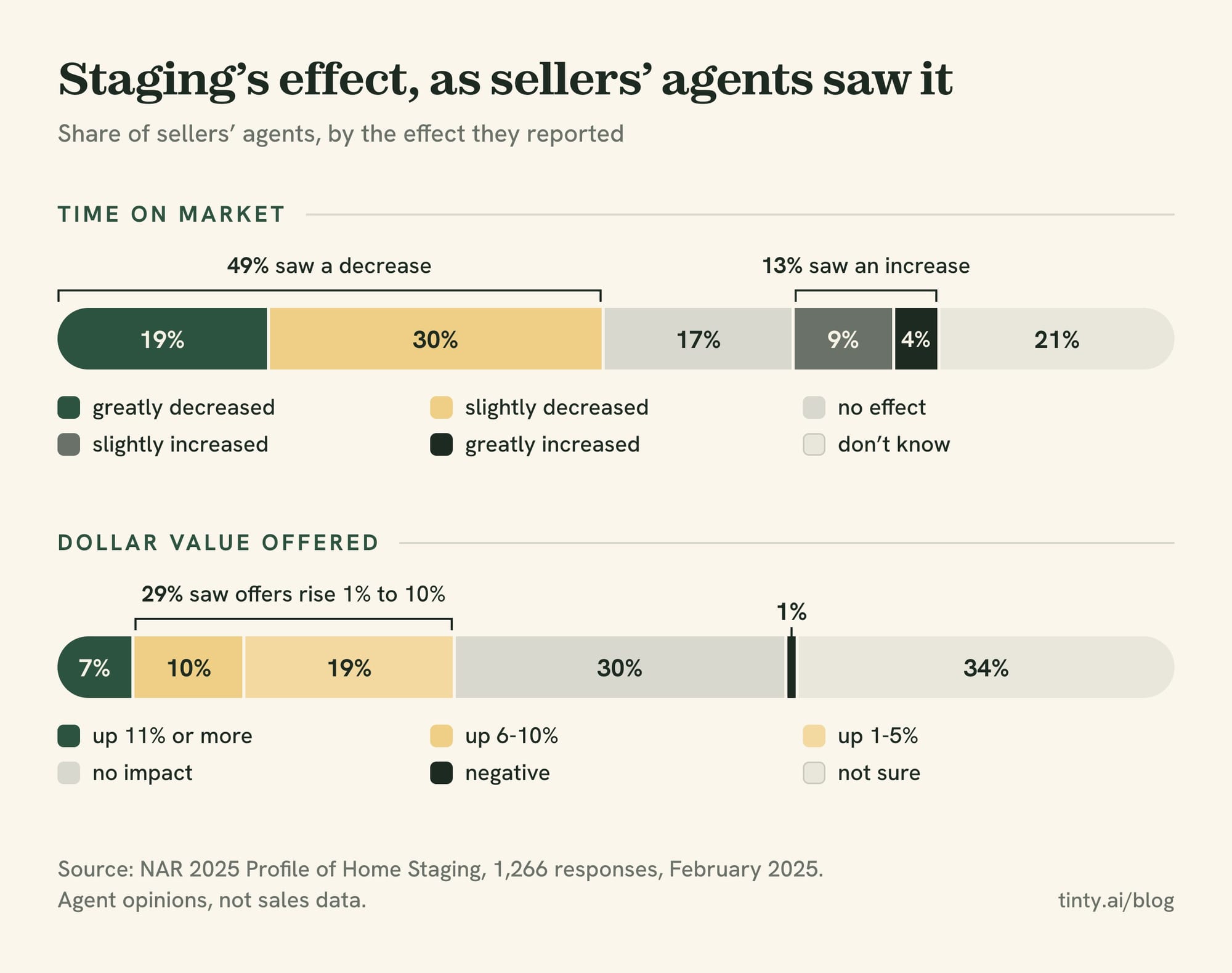
In NAR’s 2025 staging survey, about half of sellers’ agents saw staging shorten time on market. Fewer saw it raise offers, and about a third weren’t sure.
What sellers’ agents reported:
- Time on market: 49% saw a decrease (19% a great one, 30% a slight one), 17% saw no effect, and 13% saw an increase.
- Offers: 29% saw the dollar value offered rise by 1% to 10% (19% saw 1% to 5%, and 10% saw 6% to 10%).
- No effect on offers: 30% saw none, and 34% weren’t sure.
- Buyers’ view: 83% of buyers’ agents said staging made it easier for buyers to picture the home as theirs.
Buyers’ agents were cooler on price. 41% said staging had no impact on the dollar value offered, and 17% saw offers 1% to 5% higher than for similar unstaged homes.
Watch out: these are agents’ opinions, not sales records. NAR got 1,266 usable responses, a 2.5% response rate. Be careful with claims like “staged homes sell 73% faster” when no current source is linked.
Does staging help sell a house faster?
Probably, in many markets, but the evidence is soft. The best national figure is NAR’s: 49% of sellers’ agents saw staging cut time on market.
RESA’s members report that their staged homes sold in an average of 10 days in the first half of 2026. That figure covers only homes stagers chose to submit. We didn’t find a recent controlled study comparing staged and unstaged sales, so we treat staging as a likely help, not a sure one.
Is staging a house worth the cost? A quick break-even check
Staging pays for itself if it adds more to the sale than it costs, or saves enough in holding costs. A rough check helps before you sign:
Example: on a $419,250 home, NAR’s $1,500 median is about 0.36% of the price. If staging lifts the best offer by 1%, that’s about $4,193, nearly three times the cost (our math).
If staging doesn’t move the offer, the seller is betting on fewer days on market. Each extra month of mortgage, taxes, insurance and utilities counts toward that bet. Our guide to selling a vacant house puts carrying costs at about $3,000 a month in a worked example.
Staging tends to earn its fee where buyers struggle to picture the space: vacant homes, odd layouts and higher price points, in our view. In NAR’s survey, 21% of sellers’ agents staged every listing, and 10% staged only hard-to-sell homes.
When staging is less likely to pay off
Staging is a weaker bet in some cases, in our view. Where homes sell in days, buyers may compete for any clean, well-lit listing. One agent in a 2022 r/realtors thread asked why anyone would stage “in this market” at all.
Staging also won’t fix a house that needs work, or a price well above the comps. That may be why 51% of sellers’ agents in NAR’s survey didn’t stage before listing. They asked sellers to declutter or fix faults instead.
Are home staging costs tax deductible?
It depends on your situation, so ask a tax professional before you count on it. This section is general information, not tax advice.
IRS Publication 523 (for 2025 returns) lists examples of selling expenses, such as sales commissions, advertising fees and legal fees. Selling expenses reduce the amount realized, which is the sale price minus those expenses. Whether your staging costs qualify is a question for a tax professional.
For many sellers the tax bill won’t change either way. You can exclude up to $250,000 of gain, or $500,000 for a married couple filing jointly, if you meet the IRS tests.
Rule: IRS Publication 523 says selling expenses reduce the amount realized on a home sale. Ask a tax professional whether your staging costs qualify.
Agents who pay for staging face a different question, since for them it may be a business expense. We didn’t research that, so check with your accountant.
How to spend less on home staging
You can cut the staging bill without skipping staging altogether. Seven ways, roughly from cheapest to most effort:
- Start with a consultation. For $150 to $600, you get a plan the seller can carry out alone.
- Stage the rooms buyers care about. Buyers’ agents ranked the living room (37%), primary bedroom (34%) and kitchen (23%) highest.
- Use the seller’s furniture. Occupied staging runs $1,000 to $3,000, against $3,000 to $6,000 or more for a vacant install.
- Get at least two bids. Agents in NAR’s survey got a median of two. Compare the install fee, the days included and the extension rate.
- Negotiate the extension rate. At 10% to 30% of the fee per month, it decides the bill if the house sits.
- Declutter and clean first. A stager’s decluttering service adds $650 to $1,000 or more.
- Stage secondary rooms virtually. Furnish spare bedrooms in the photos for a few dollars each, and keep real furniture for the main rooms.
Price wasn’t the top factor for agents choosing a stager. In NAR’s survey, 63% named the quality of the design and 51% named price. A cheap stager who misses the buyer isn’t a saving.
Staging only the photos: cost and trade-offs
Virtual staging costs a small fraction of physical staging, but it only changes the photos. Buyers who visit still walk into empty rooms.
The numbers side by side: NAR’s median for a staging service is $1,500. Five AI-staged photos usually cost $12 to $50, because you buy a plan or pack. Five photos from a human design service cost $96 to $328. Our 29-service virtual staging price comparison has the full list.
How the two compare beyond price:
- What changes: physical staging changes the house, while virtual staging changes the listing photos only.
- How you pay: physical staging bills an install fee plus monthly rent; virtual staging bills once per photo or plan.
- Showings: buyers tour real furniture in a staged home and empty rooms in a virtually staged one.
- Speed: installs need scheduling, while AI previews take seconds to minutes and human services a few hours to two business days.
- Rules: virtually staged photos need a label under many multiple listing service (MLS) rules and under California law.
Agents rate the two differently. In NAR’s survey, 34% of sellers’ agents called virtual staging less important to their clients and 24% called it equally important. Still, 8% of sellers’ agents said they only stage homes virtually.
What a mixed staging plan costs
A mixed plan often makes sense for a vacant listing, in our view. Stage the living room for real, since buyers rank it first, and stage the bedrooms in the photos.
Take a vacant 3-bedroom. Staging the living room for real costs $300 to $700 at HomeGuide’s per-room rates. Three bedrooms staged in the photos add $9 to $50 on an AI plan, or $57.60 to $210 from a human design service.
That’s well below a $3,000 vacant install, though buyers will see empty bedrooms at showings. Our vacant listing guide covers the rest of that job.
What TINTY costs, and what it can’t do
We make TINTY, so here’s our own price with the limits right next to it. It’s an AI virtual staging app: you upload a photo of an empty room and get furnished previews in about 30 seconds.
What it costs, from our pricing page:
- Free: 3 watermarked finished photos once, plus 6 previews per photo (up to 20 a month). No card.
- Plans: Base $9 a month for 4 photos, Standard $39 for 20, Professional $79 for 50. Yearly billing gives two months free.
- Listing pack: $29 once for 10 finished photos, valid 12 months.
- Per finished photo: $1.32 to $2.90, depending on the plan and billing.
See every plan on our virtual staging pricing page.
Our pricing panel labels these “Launch pricing · locked in for early users,” so they may change. Your first plan payment or pack has a 30-day money-back guarantee.
Now the limits:
- Resolution: output is 2K, about 2,500 px on the long side, while some tools sell 4K.
- Rooms: no kitchens, bathrooms or exteriors.
- Furniture removal: not available yet, and TINTY doesn’t declutter either.
- Angles: it doesn’t match furniture across several angles of one room.
See before and after examples of rooms staged with TINTY.
Busy realtor with no time to stage photos? TINTY Studio, our done-for-you service, does it for you. Email the empty-room photos to hello@tinty.ai with the style you want and what each room is for (a floor plan helps).
Our team stages them with TINTY’s AI tools and finishes every photo by hand. They arrive on a private link in 2 to 24 hours. It costs $10 a photo, from 3 photos, with no account and no prepayment: you pay only if you’re happy with the result.
Stage three photos free with TINTY. They’re watermarked, so they’re for testing, not your listing. For other free options, see our list of the best free virtual staging apps.
Disclose virtual staging in the listing
If you stage photos virtually, label them and keep the originals. Physical staging needs no label, because the furniture is really there.
Rule: California’s AB 723 has applied since January 1, 2026. A listing must disclose that an image was altered and give access to the unaltered original.
Outside California, Article 12 of NAR’s Code of Ethics asks Realtors to present a true picture in their advertising. Your MLS decides where the label goes, and the rules differ. TINTY lets you add a “Virtually staged” label when you download.
Stage furniture and décor only. Never hide damage or add features the house doesn’t have. Our guide on whether virtual staging is legal covers state laws and MLS rules.
If the house still sits after staging, the problem may be price or access, not looks. Our guide to selling a stale listing covers what to try next.
Home staging cost FAQ
How much does home staging cost per month?
After the first month, HomeGuide puts each extra month at $150 to $1,200, or 10% to 30% of the original fee. Realtor.com’s guide prices it by the room instead, at $500 to $600 per staged room a month. Ask whether the quote has a minimum term.
How much does it cost to stage one room?
About $300 to $700 per room, per HomeGuide’s 2026 guide. Living rooms and bedrooms cost more than kitchens, where cabinets and appliances fill most of the space. Staging one room in a photo costs under $1 to $70 with virtual staging.
Show 6 more questionsShow fewer questions
How much does it cost to stage a 3-bedroom house?
No source we found prices staging by bedroom count. A real estate professional quoted by Realtor.com puts a 2,000-square-foot home at about $2,000 to $2,400 a month. Room by room, four or five main rooms at $300 to $700 each come to $1,200 to $3,500 (our math).
What do staging fees include?
In our reading, it usually covers design, delivery, installation and removal, plus furniture and décor for the first 30 days. HomeGuide says each 30-day extension costs 10% to 30% of the original fee. Consultations, decluttering, painting and cleaning are often billed separately, so ask what’s in the quote.
Can you stage a house yourself to save money?
Yes. In NAR’s 2025 survey, staging cost a median of $500 when the listing agent did it, against $1,500 with a staging service. A seller can declutter, rearrange and add lamps, art and plants. A paid consultation for $150 to $600 gives you a plan to follow.
Is staging cheaper than a price reduction?
Often, in dollars. A 1% cut on Realtor.com’s September 2026 median list price of $419,250 is about $4,193, well above NAR’s $1,500 staging median (our math). Staging can’t fix a price that’s far above the market, though.
Do you need to stage every room?
No. Buyers’ agents in NAR’s 2025 survey ranked the living room (37%), primary bedroom (34%) and kitchen (23%) as the rooms that matter most. Guest bedrooms and children’s bedrooms were the least commonly staged, at 22% each.
What happens to the staging if the house doesn’t sell?
The rental continues month to month at the extension rate, or the stager removes the furniture. In HomeGuide’s example, a $3,000 install costs $300 to $900 for each extra 30 days. Agree in writing who pays extensions before the install.
How we researched this
On October 3, 2026, we read NAR’s full 2025 Profile of Home Staging and its press release. We also read HomeGuide’s 2026 cost guide, the Zillow, Bankrate and Realtor.com guides, RESA’s statistics page and IRS Publication 523. Then we read the pages that rank for “how much does home staging cost” to see what they leave out.
Angi, HomeAdvisor, Thumbtack and Reddit blocked our tools that day. HomeAdvisor and Thumbtack figures appear only as cited by Bankrate and Zillow, and we left out Angi’s. The Realtor.com list price comes from its September 2026 report.
Virtual staging prices come from our check of 29 services on September 30, 2026. We didn’t request quotes from stagers or test any service. If a figure here is out of date, email hello@tinty.ai and we’ll correct it.
Sources
All pages read October 3, 2026, unless a date is given.
Survey data and tax rules:
- NAR 2025 Profile of Home Staging (full report, PDF) (May 2025; 1,266 responses, February 2025)
- NAR press release on the 2025 Profile of Home Staging (May 6, 2025)
Show 12 more sourcesShow fewer sources
- IRS Publication 523, Selling Your Home (for 2025 returns)
- RESA home staging statistics (Q1 and Q2 2026 highlights)
Cost guides:
- HomeGuide: How much does it cost to stage a house? (2026) (Kristen Cramer, February 4, 2026)
- Zillow: How much does it cost to stage a house? (Jennifer Lyons, May 1, 2025; cites Thumbtack)
- Realtor.com: The cost of staging your home (Margaret Heidenry, April 23, 2025; updated April 1, 2026)
- Bankrate: How much does it cost to stage a house? (February 24, 2025; cites HomeAdvisor’s 2025 data)
Market and community:
- Realtor.com, September 2026 Monthly Housing Trends (Jake Krimmel, September 30, 2026)
- r/realtors thread on who pays for staging (April 25, 2022; anecdotes only, read through an API copy)
Virtual staging and disclosure: