

Will AI replace real estate agents? Not on current evidence. AI is taking over tasks such as listing drafts, photo edits and first replies to leads. But state laws license people and their firms, not software, to broker a sale. In a 2025 survey by the National Association of Realtors (NAR), 88% of buyers used an agent.
We make TINTY, an AI virtual staging app, so we have a stake in this topic. Every number below comes from a dated source listed at the end, and forecasts and our own views are marked as such. Notes on laws are general information, not legal advice.
Key takeaways
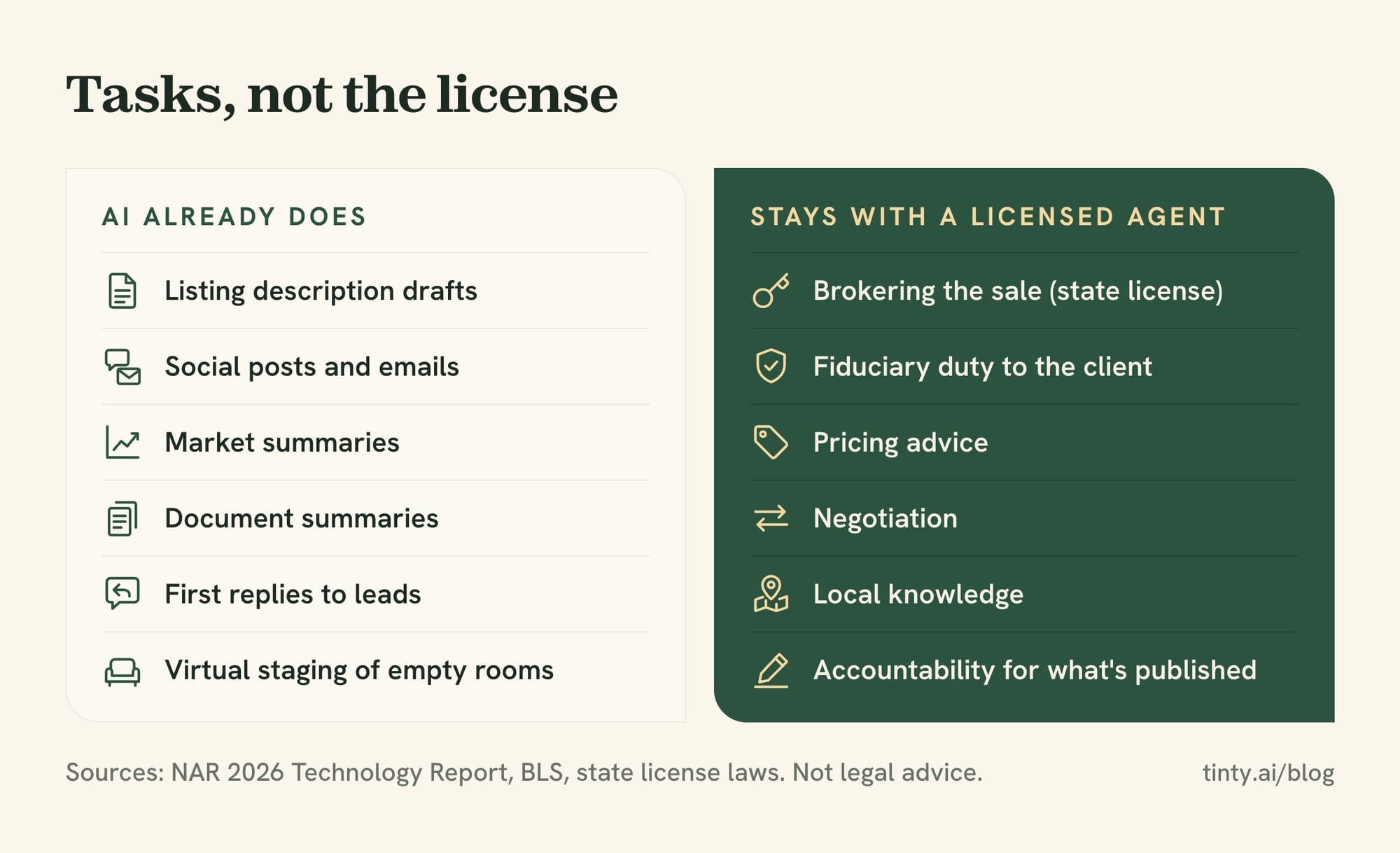
- Tasks, not the license: AI drafts copy, edits photos and answers leads. Brokering a sale for pay still takes a state license.
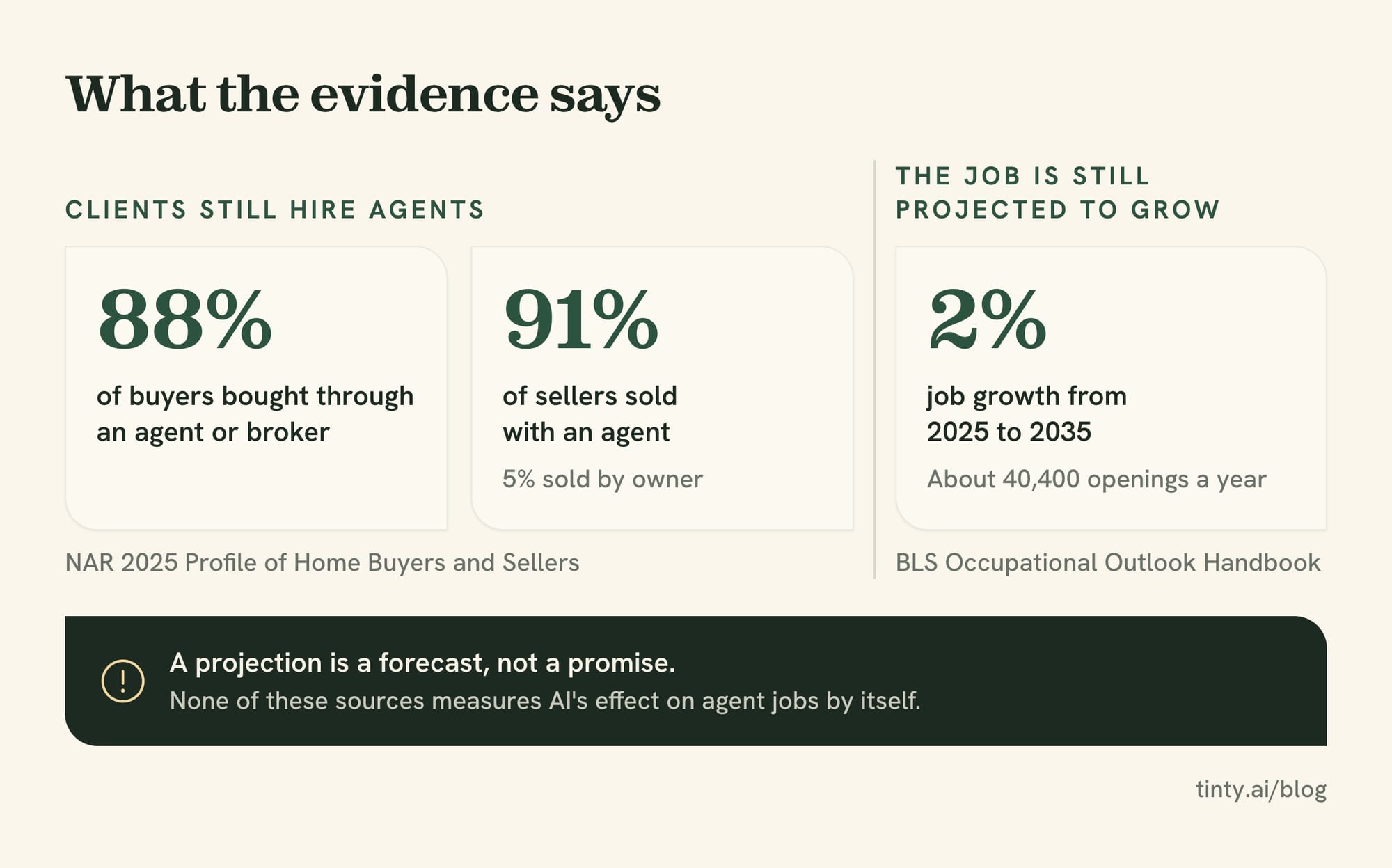
- Clients still hire agents: in NAR’s 2025 survey, 88% of buyers and 91% of sellers worked with one.
- Slow growth, not collapse: the Bureau of Labor Statistics (BLS) projects 2% job growth from 2025 to 2035.
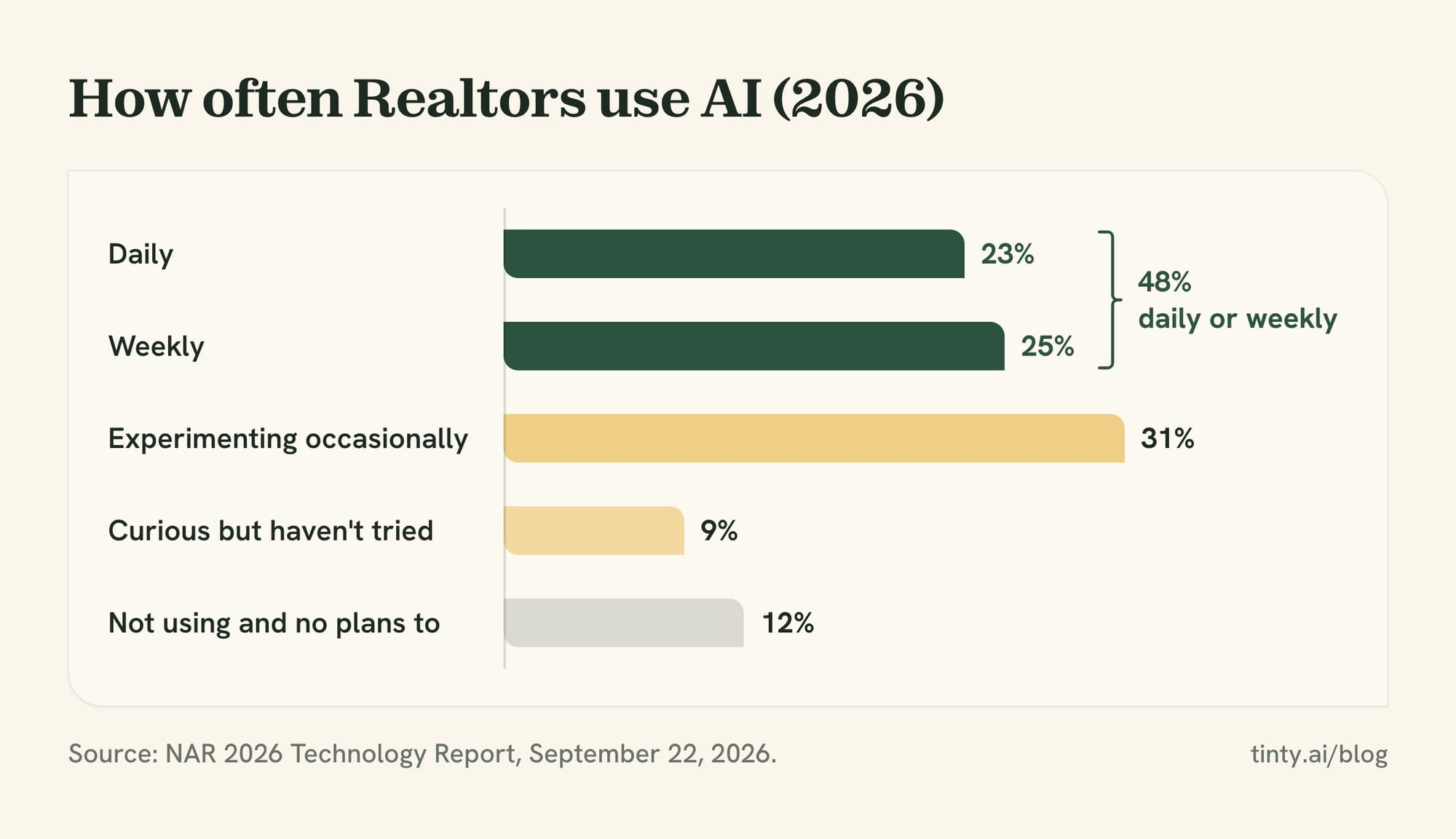
- Agents already use AI: 48% of Realtors use it daily or weekly, per NAR’s 2026 Technology Report.
- You own the output: check every AI draft for facts and fair housing, and label altered photos.
On this page: The evidence · What AI does · What it can’t do · How the job changes · Risks · Using AI safely · Career · FAQ
Will AI replace real estate agents? What the evidence says
The evidence points to AI changing the job, not removing it. Clients still hire agents, the occupation is still projected to grow, and agents are the ones adopting AI.
Five data points, each from its primary source:
| Question | What the data says | Source |
|---|---|---|
| Do buyers still use agents? | 88% bought through an agent or broker | NAR 2025 Profile of Home Buyers and Sellers |
| Do sellers? | 91% sold with an agent; 5% sold by owner | Same report |
| Is the job shrinking? | 2% growth from 2025 to 2035, about 40,400 openings a year | BLS Occupational Outlook Handbook |
| Do agents use AI? | 23% daily and 25% weekly | NAR 2026 Technology Report |
| For what? | Listing descriptions, cited by 75% of AI users | Same report |
The NAR buyer and seller figures come from people who bought homes between July 2024 and June 2025, per the 2025 Profile highlights. The BLS outlook was last updated on August 27, 2026. The AI figures come from NAR’s 2026 Technology Report release of September 22, 2026.
None of these sources measures AI’s effect on agent jobs by itself. The BLS job outlook doesn’t mention AI. It ties demand for agents to the housing market and the wider economy.
Watch out: a projection is a forecast, not a promise. BLS itself notes that agent employment may decline when the economy slows or interest rates rise.
What AI already does well in real estate
AI is good at first drafts and repeat work: text, images and summaries built from facts you give it. Each task still has a limit that a person has to cover.
Top uses among Realtors who use AI, per NAR’s 2026 report, plus photo work, each with its limit:
- Listing descriptions: the top use, cited by 75%. Limit: a draft can invent features, so check every claim against the listing data.
- Social posts: 56% use AI for them. Limit: the copy comes out generic, and you’re still the one who posts it.
- Emails and lead follow-up: 52% use AI for emails and follow-up. Limit: a lead who wants a person should reach one fast (our view).
- Market summaries and comparative market analysis (CMA) drafts: 30% use AI for market summaries. Limit: a model only knows the data and photos you give it, so pricing advice stays yours.
- Document summaries and deadline reminders: 27% use AI to review or summarize documents. Limit: a summary isn’t legal review, so read the contract dates yourself.
- Photo edits and virtual staging: AI can furnish an empty room in a photo. Limit: the photo must stay true to the home, and many rules require a label.
Our guide to writing a listing description has a checklist for every AI draft.
Virtual staging: a task AI already does
Virtual staging is a clear case. For years a designer furnished each photo by hand, and AI tools now do it from one upload. Our short history of virtual staging covers how it got there.
TINTY, our AI web app, stages a photo of an empty room in about a minute. You can stage 6 photos free with TINTY: sign in with Google or an email code, no card needed. The free photos carry a light TINTY watermark, so they’re for testing and sharing, not for the listing.
TINTY doesn’t stage kitchens, bathrooms or exteriors. When you download a staged photo, you can add a “Virtually staged” label to it. Our comparison of virtual staging software covers other tools and what each one handles.
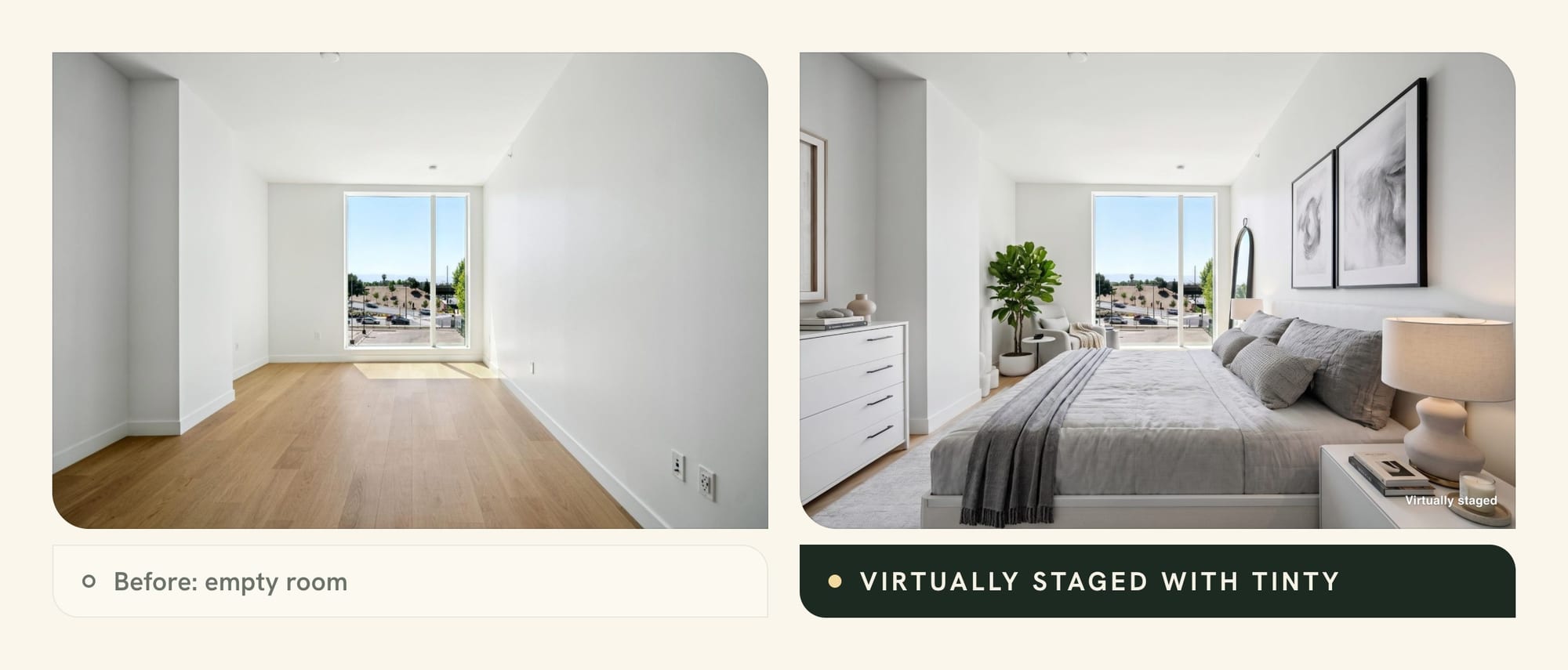
Watch out: a staged photo shows furniture that isn’t there. Label it, keep the original and check your multiple listing service (MLS) rules before it goes live.
What AI can’t do, or isn’t allowed to do
The work that carries legal duty and personal trust stays with a licensed person. That’s partly about skill and partly about law.
Only licensed people can broker a sale for pay
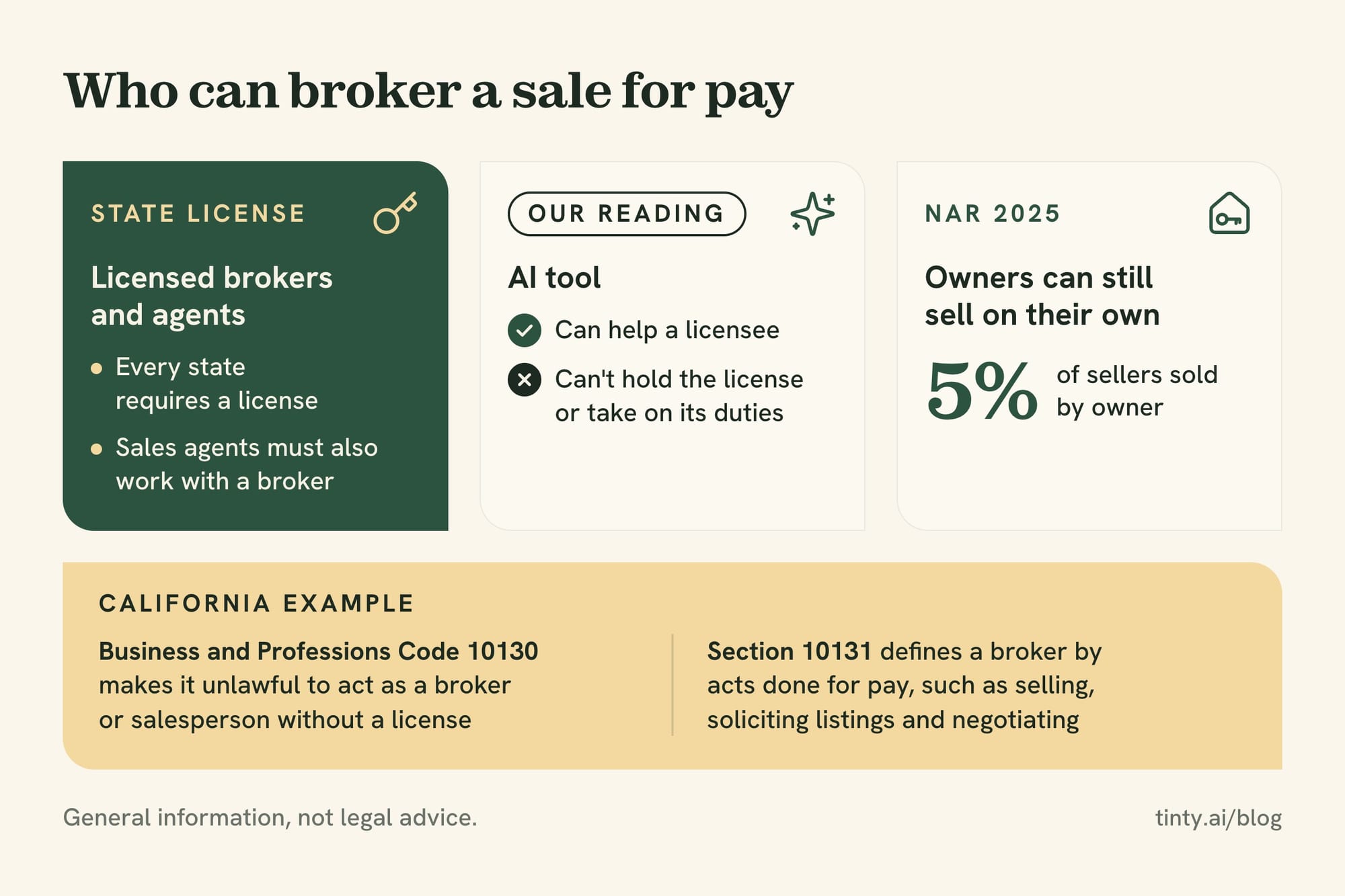
Every state requires real estate brokers and agents to be licensed, per the BLS Occupational Outlook Handbook. Sales agents must also work with a broker.
California shows how such laws are written. Business and Professions Code 10130 makes it unlawful to act as a broker or salesperson without a license. Section 10131 defines a broker by acts done for pay, such as selling, soliciting listings and negotiating.
So an AI tool can help a licensee, but it can’t hold the license or take on its duties (our reading). Owners can still sell on their own, and 5% of sellers did in NAR’s 2025 survey.
Fiduciary duty and accountability
An agent owes the client duties that software doesn’t. California’s agency disclosure form, set out in Civil Code 2079.16, lists “a fiduciary duty of utmost care, integrity, honesty, and loyalty.” The agent must also disclose known facts that materially affect the property’s value or desirability.
Under NAR’s 2026 Code of Ethics, Realtors pledge to “protect and promote the interests of their client.” When an AI draft gets something wrong, the licensee who published it answers for it (our reading).
Negotiation, local knowledge and trust
Most of what clients want from an agent takes judgment (our reading). In NAR’s 2025 survey, buyers mainly wanted help finding the right home, then negotiating terms and price. Sellers ranked marketing the home, pricing it competitively and selling on time highest.
AI can help an agent prepare for those moments, but it can’t (our view):
- Read the room: notice that a seller is ready to accept or a buyer is about to walk away.
- Know the street: a busy cut-through road or a building quirk that never made it into the data.
- Earn trust: clients trust an agent with one of their largest purchases, often on a friend’s referral.
- Take responsibility: advise, sign and answer to a licensing board.
That relationship work is also how agents win business, as our guide on how to get listings shows.
How the agent’s job is changing
Agents take up new technology mainly to get time back. In NAR’s 2026 Technology Report, 81% of Realtors said saving time is their main reason for adopting new technology.
For about half of agents, AI is now routine:
- Daily: 23% of Realtors.
- Weekly: 25%.
- Experimenting occasionally: 31%.
- Curious but haven’t tried: 9%.
- Not using it and no plans to: 12%.
The other change is about pay. Since August 17, 2024, MLS participants working with buyers need a written agreement before touring a home, per NAR’s settlement FAQ. The agent’s pay is agreed in writing up front, so agents have to explain their value early (our view).
Our forecast, not a fact: listing production (copy, photos and first replies) moves to AI first, and agents who use it get more hours for clients. We don’t predict how many agents there will be. Our look at AI adoption in real estate covers how brokerages roll AI out. Its AI-use figures run higher because Delta Media asked brokerage leaders about their agents, not Realtors about themselves.
Who is most exposed (our view): agents whose main offer is production work, such as listing copy and photo posts, compete most directly with AI. Agents hired for pricing advice, negotiation and local knowledge compete least.
Risks of using AI as a real estate agent
AI shifts the work, but not the liability. Whatever goes out under your name is yours, so each of these risks needs a person’s check.
Accuracy: you answer for what you publish
NAR’s Code tells Realtors to avoid “exaggeration, misrepresentation, or concealment of pertinent facts” (Article 2). It also asks them to “present a true picture” in their advertising (Article 12).
Watch out: an AI draft can call a laminate floor “hardwood” because an old listing did. If nobody checks, the buyer notices at the walk-through. The case is made up, but the mistake is easy to make.
Fair housing in ad copy and targeting
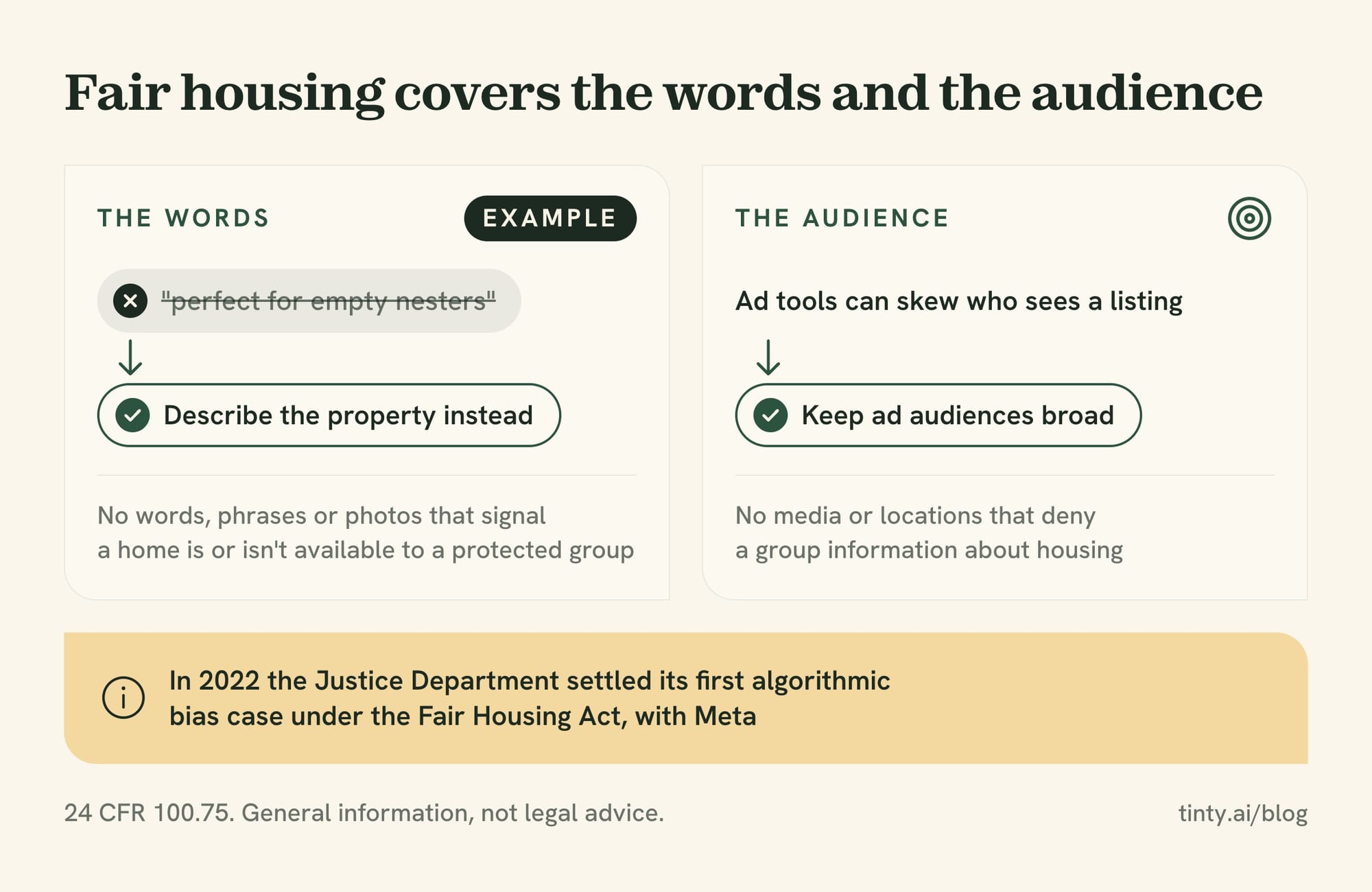
Fair housing law covers the words and the audience. One federal rule, 24 CFR 100.75 in the Code of Federal Regulations, covers housing ads. It bans words, phrases or photos that signal a home is or isn’t available to a protected group. It also bans choosing media or locations that deny a group information about housing.
An AI draft can describe the buyer instead of the home, such as “perfect for empty nesters” (our example). Describe the property instead.
Ad tools can skew who sees a listing, too. In 2022 the Justice Department settled its first algorithmic bias case under the Fair Housing Act with Meta, over how housing ads were targeted and delivered.
Altered photos need a label
Edits that add, remove or change what’s in a photo count as altered. California’s law exempts simple fixes such as lighting and cropping.
Rule: in California, an agent’s sale ad with a digitally altered image must say so and link to the original. Business and Professions Code 10140.8 (AB 723) names edits made with artificial intelligence, including added furniture. It took effect January 1, 2026.
Wisconsin’s narrower rule starts January 1, 2027: agents must disclose edits that create a false or misleading impression, as our Wisconsin Act 69 guide explains. Many MLSs have their own label rules. Our guide to whether virtual staging is legal compares them.
Client data in public chatbots
Keep personal client details out of public AI tools unless your brokerage approves them (our suggestion). Check your brokerage’s AI policy before you paste in an offer, a contract or a client’s finances.
How to use AI without the risk
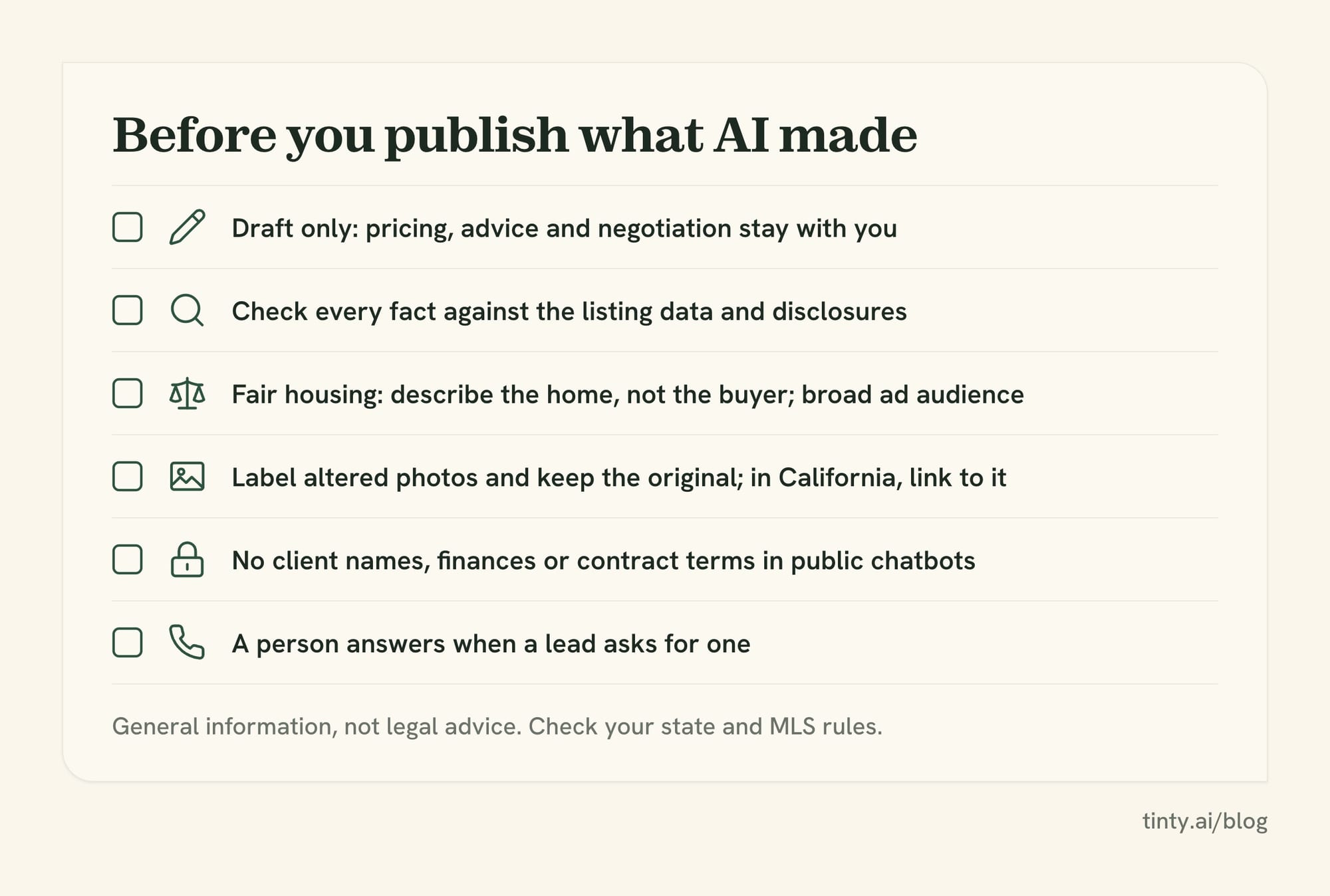
Use AI for drafts and keep decisions for yourself. Six habits cover most of the risk (our suggestions):
- Start with drafts: let AI write first versions, and keep pricing, advice and negotiation yours.
- Check every fact: compare each claim with the listing data, the seller’s disclosures and your notes.
- Read for fair housing: describe the home, never the ideal buyer, and keep ad audiences broad.
- Label altered photos: add “Virtually staged” and keep the original, as your MLS and state require. In California, the ad must also link to the original.
- Protect client data: use tools your brokerage approves, and leave out names, finances and contract terms.
- Keep a person on the line: when a lead asks for a human, answer yourself, and answer fast.
Tip: keep a one-page fact sheet for each listing, with rooms, sizes, upgrades and known issues. Paste it into the AI tool, then check the draft against it line by line.
Should you still become a real estate agent?
If you like working with people, AI alone isn’t a reason to skip the career (our view). BLS projects about 40,400 openings a year from 2025 to 2035, mostly to replace agents who retire or leave. Median pay for brokers and sales agents was $57,400 in 2025.
Licensing is the entry ticket. Requirements vary by state, but per BLS they typically include:
- Age: at least 18.
- Education: a high school diploma or equivalent, plus prelicensing courses.
- Exam: a state licensing exam.
- Renewal: usually every 2 to 4 years, with continuing education in most states.
Most agents are self-employed, so income depends on closed deals. Our forecast: AI becomes a basic skill, the way e-signature already is (79% of Realtors use it, per NAR’s 2026 report).
AI and real estate agents: FAQ
Will AI replace realtors?
Not on today’s evidence. AI handles tasks such as drafting listings, posts and emails, but state license laws require a licensed person to broker a sale for pay. In NAR’s 2025 survey, 88% of buyers and 91% of sellers used an agent.
How do real estate agents use AI today?
Mostly for writing. Among Realtors who use AI, 75% use it for listing descriptions, 56% for social posts and 52% for emails and follow-up, per NAR’s 2026 Technology Report. Fewer use it for market summaries (30%) or document review (27%).
Show 3 more questionsShow fewer questions
Will real estate agents be replaced by AI in the next 10 years?
Nobody knows for sure, and any answer is a forecast. BLS projects 2% employment growth for brokers and sales agents from 2025 to 2035. That projection doesn’t isolate AI’s effect, and it can change with the housing market.
Can AI legally act as a real estate agent?
No. Brokering a sale for pay takes a state license, and software can’t hold one or owe a client fiduciary duties (our reading). An AI tool can help a licensed agent, or an owner who sells without one.
Do you have to disclose AI-edited listing photos?
Often, yes. California’s AB 723 requires a disclosure and a link to the original for digitally altered images in sale ads. That covers AI edits that add, remove or change what’s in the photo. Many MLSs require a label too, so check your local rules before you publish.
How we researched this
On October 14, 2026, we searched for “will ai replace real estate agents” and two close variants. We read the ranking articles we could open: HeyGen, Callin (page since removed), Impact, Brokermint, Jeff Lenney, Move Ahead Homes and Nekst. HAR.com, Inman and Washingtonian blocked our browser, and Adaface was down. We skipped the Reddit, Medium, Facebook and YouTube results.
Only HeyGen cites the BLS projection, and none of the articles we read mentions fair housing or AB 723. Our data comes from NAR, BLS, California’s codes, federal housing rules and the Justice Department, read on official sites. If something here is wrong, email hello@tinty.ai and we’ll fix it.
Sources
All pages read October 14, 2026. Dates in parentheses are publication or update dates.
Data:
- NAR: 2025 Profile of Home Buyers and Sellers, highlights (PDF) (November 4, 2025; buyers from July 2024 to June 2025)
- BLS Occupational Outlook Handbook: Real Estate Brokers and Sales Agents (last modified August 27, 2026; projections 2025 to 2035)
Show 17 more sourcesShow fewer sources
- NAR: Realtors adopt technology to save time and improve the client experience (September 22, 2026; 2026 Technology Report)
- NAR: REALTORS Technology Report, key findings
Laws and rules:
- California Business and Professions Code 10130 and 10131 (license requirement and broker definition)
- California Civil Code 2079.16 (agency disclosure form; amended effective January 1, 2025)
- NAR 2026 Code of Ethics and Standards of Practice (effective January 1, 2026; Articles 1, 2 and 12)
- NAR Settlement FAQs (PDF) (last updated September 5, 2024)
- eCFR: 24 CFR 100.75, Discriminatory advertisements
- Justice Department: settlement with Meta over discriminatory housing ads (June 21, 2022; archived page)
- California Business and Professions Code 10140.8 (AB 723) (effective January 1, 2026)
Articles that rank for this topic:
- HeyGen: Will AI replace real estate agents? (updated October 11, 2026)
- Impact: Will AI replace real estate agents? (September 22, 2020)
- Brokermint: Will real estate artificial intelligence (AI) replace agents? (June 16, 2021)
- Jeff Lenney: Will AI replace real estate agents? Only if you let it (February 12, 2026)
- Move Ahead Homes: Will AI replace real estate agents? (October 15, 2025)
- Nekst: Agents, think AI can never fully replace you? (March 7, 2025)
TINTY and related guides: